
12V Outlet Not Working: Cigarette Lighter Causes to Check
Updated Nov 22, 2026
In This Guide
- Quick Symptom Match
- Step Zero: Is It the Charger or the Car?
- Blown Fuse: The Cheapest Fix First
- Faulty Charger, Cable, or Adapter
- Debris, Corrosion, and Worn Socket Contacts
- Ignition, Relay, and “Only Works Sometimes” Behaviour
- Wiring and Connector Problems
- Charging Works, but CarPlay or Bluetooth Does Not
- Quick Checks for a 12V Outlet Not Working
- When to Go to a Shop
- Cost Guidance
- FAQ
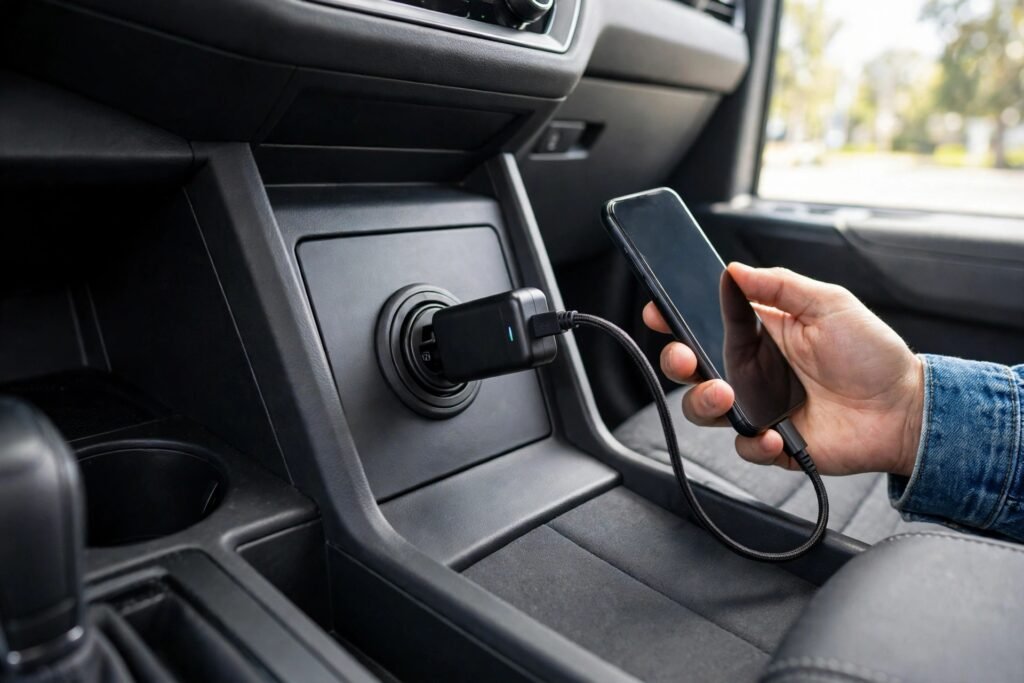
12V outlet not working: you plug in your phone, the charger light stays dark, and the battery percentage keeps falling. The 12V outlet — the socket most drivers still call the cigarette lighter — looks simple, but it sits at the end of a fuse, a relay, a length of wiring, and a spring-loaded socket that takes a beating from every charger ever jammed into it. The good news is that the fix is usually cheap and the diagnosis is quick, provided you test in the right order: charger first, fuse second, socket third, wiring last.
In this guide, you’ll learn:
- How to tell in two minutes whether the fault is your charger or your car
- Why a blown fuse is the most common cause — and how to replace it safely
- What debris, corrosion, and worn socket contacts look like
- Why some outlets only work with the ignition on
- When a dead outlet points to wiring, a relay, or a shop visit
- Honest cost guidance for each likely repair
Safety first: Work on the socket only with the ignition off. Never poke a metal object into a live 12V socket to fish out debris — a short there can blow the fuse, damage the socket, or burn you. Never replace a blown fuse with a higher-rated one; the fuse rating protects the wiring, and a bigger fuse lets a fault overheat the circuit instead. If the socket smells burnt, feels hot, or shows melted plastic, stop using it and book a shop visit. Do not diagnose electrics while driving — pull over, park, and test with the car stationary.
Quick Symptom Match
| Symptom | Likely cause | What to check |
|---|---|---|
| No outlet works, charger light dark | Blown fuse or no power to the circuit | Fuse labelled CIG, AUX, or PWR OUTLET. |
| One outlet dead, the others work | That socket, its fuse, or its wiring | Whether other outlets on the same car work. |
| Charger works in another car but not yours | Car-side fault: fuse, socket, or wiring | The fuse, then the socket contacts. |
| Charger works nowhere | Faulty charger or cable | A different charger and a different cable. |
| Phone charges slowly or keeps disconnecting | Weak charger, worn socket, or loose fit | Charger rating and how firmly the plug sits. |
| Outlet works only sometimes | Loose wiring, corroded connector, or worn contacts | Whether wiggling the plug changes anything. |
| Outlet works only with the ignition on | Normal design on many cars, or a relay fault | Your owner’s manual for that outlet’s behaviour. |
| New fuse blows straight away | Short in the socket or wiring | Stop replacing fuses and get a diagnosis. |
| Socket is hot, smells burnt, or looks melted | Overload or short | Stop using it immediately; shop repair. |
Step Zero: Is It the Charger or the Car?
Half of all “dead outlet” complaints end at the charger, so rule it out before touching the car. Try a different phone or device with the same charger, then try the same charger and cable in another car’s 12V socket. If the charger works elsewhere, the fault is in your car. If it works nowhere, replace the charger or cable and retest — cheap unbranded adapters are a common culprit, and a frayed cable can fail even when the charger itself is fine. Also check the obvious: is the charger pushed fully into the socket? 12V plugs need a firm push and a slight twist to seat, and a plug that sits half-out will not make contact. Try a second, known-good charger in your car’s socket as well — if that one works, your first charger was the problem, not the car.
Blown Fuse: The Cheapest Fix First
The fuse is the most common cause of a dead 12V outlet, and it is designed to fail: when the circuit draws more current than it is rated for — a short from a coin in the socket, a faulty adapter, or a high-draw device such as an inverter — the fuse’s metal strip melts and cuts power before the wiring overheats. Find the interior fuse box first. On most cars it sits under the dashboard on the driver’s side, behind the glove box, or in a kick panel; your owner’s manual gives the exact location and a diagram. Look for a fuse labelled CIG, CIGAR, AUX, ACC, or PWR OUTLET — the label varies by make, and on some cars the outlet shares a circuit with other accessories. Pull that fuse with the fuse puller (often clipped inside the fuse-box lid) or needle-nose pliers, and hold it to the light: a good fuse has an unbroken metal strip, while a blown fuse shows a broken strip or a dark smudge where it melted. Replace a blown fuse only with one of the exact same amperage rating — the number printed on the fuse body, commonly 15 amps on this circuit but different on some vehicles, so always read the fuse you removed rather than guessing. Push the new fuse firmly until it sits level with its neighbours, switch the ignition to accessory or on, and test the outlet. If the new fuse blows immediately, stop: the circuit has a short, and repeatedly fitting new fuses will not fix it. That pattern anywhere in the car calls for the same discipline — see our guide to a car fuse that keeps blowing for how a short is traced rather than guessed at.
Faulty Charger, Cable, or Adapter
Not every charger is equal. A charger that delivers too little power will charge a phone very slowly or not at all while the screen is on, which feels exactly like a dead outlet. A charger with a loose or worn tip will lose contact over bumps. And a multi-device splitter or a high-draw inverter can overload the circuit and blow the fuse it was supposed to protect. Test methodically: one known-good charger, one known-good cable, one device. If that combination works, add back your original parts one at a time until the fault returns — the part that brings it back is the faulty one. Avoid leaving cheap splitters and inverters plugged in permanently, and never run a high-wattage inverter from a 12V socket unless the device and the circuit are rated for it; heavy loads belong on a properly fused direct battery connection fitted by a shop.
Debris, Corrosion, and Worn Socket Contacts
The socket lives in a cup holder zone: coins, crumbs, spilled drinks, and the broken tip of an old charger all end up in it. Debris can block the plug from seating or bridge the contacts and cause a short. Corrosion from a spill or damp coats the contacts in a dull film that stops current flowing even though the fuse is fine. And after years of chargers being pushed in and pulled out, the spring contacts inside the socket lose tension, so the plug sits loose and loses contact on every bump. With the ignition off, shine a torch into the socket and look before touching anything. Remove loose debris with a plastic or wooden tool — never metal — or a short burst of compressed air. If the centre contact looks pushed down, bent, or blackened, or the socket walls are corroded, the socket itself usually needs replacing rather than cleaning. A plug that wobbles or falls out on its own is telling you the same thing: the socket has worn out and no charger will sit reliably in it again.
Ignition, Relay, and “Only Works Sometimes” Behaviour
Before condemning the socket, check how your car is supposed to behave. On many cars the front 12V outlet is live only with the ignition on or in accessory mode, while a rear or cargo outlet may be live all the time — or the reverse. That is design, not a fault. Your owner’s manual states which outlets are ignition-switched and which are always live; test with the ignition in the position the manual specifies before assuming the outlet is dead. If an outlet that should be live with the ignition on stays dead with a good fuse, a relay or the ignition switch feed can be at fault. Relays fail silently: no click, no power, no visible damage. Swapping a relay is only a driveway job if your manual identifies an identical spare relay you can swap for testing — otherwise leave relay and ignition-switch diagnosis to a shop, since the wrong swap can disable something else. The same “sometimes” pattern also points to wiring. An outlet that works when the car is parked but cuts out over bumps, or works only when the plug is held at an angle, usually has a loose connector behind the socket, a chafed wire, or worn contacts. Note exactly when it fails — that pattern is what a technician needs, and it separates a socket fault from a wiring fault.
Wiring and Connector Problems
Behind the socket, a short wiring harness runs to the fuse box, often through the centre console. Console work, spilled drinks, aftermarket stereo or dash-cam fitting, and years of vibration can loosen that connector, chafe the insulation, or corrode a joint. A wiring fault usually announces itself: the fuse is good, the socket looks clean, the charger is proven good, and still nothing works — or the fuse blows the moment anything is plugged in. The giveaway: the fault started after console or stereo work, after a spill, or after a dash-cam install, or the fuse blows instantly on every attempt. Do not strip console trim and chase wiring yourself unless you have done it on that exact model: airbag wiring, fragile clips, and hidden fasteners live in the same area. A shop can test for power at the socket with a multimeter in minutes and tell you whether the break is in the socket, the connector, or the harness.
Charging Works, but CarPlay or Bluetooth Does Not
A useful split: a 12V socket only supplies power. If your phone charges from the socket but CarPlay or Android Auto will not start, or Bluetooth will not connect, the fault is in the data connection — the USB port, the cable’s data lines, or the infotainment system — not the 12V outlet. A charge-only cable, for example, will power a phone perfectly while CarPlay stays silent. Test with a known-good data cable in the car’s USB port, and keep the two systems separate in your diagnosis — see our guide to CarPlay or Android Auto not working and our guide to Bluetooth not connecting in your car for those faults specifically.
Quick Checks for a 12V Outlet Not Working
- Test the charger elsewhere: Try your charger and cable in another car. If they work there, the fault is in your car, not the charger.
- Try a known-good charger in your car: One proven charger, one proven cable, one device. If that works, your original charger or cable was the fault.
- Check the fuse: With the ignition off, find the CIG, AUX, or PWR OUTLET fuse from the owner’s manual, inspect the strip, and replace only with the same amperage if it is blown. If it blows again immediately, stop.
- Inspect the socket with a torch: Ignition off, look for coins, crumbs, a broken charger tip, corrosion, or a bent centre contact. Remove debris only with a plastic or wooden tool.
- Test every outlet: Front, rear, and cargo outlets may sit on separate fuses. Note which ones work — one dead outlet and the rest alive points at that socket, not the whole circuit.
- Test with the ignition on: Many outlets are ignition-switched. Test in accessory and on positions, as your manual specifies, before calling the outlet dead.
- Stop at the trim: If the fuse and socket are fine and the charger is proven good, the fault is wiring, a relay, or the socket’s rear connector. That is a shop diagnosis, not a trim-removal project.
When to Go to a Shop
- The new fuse blows immediately, or blows again after a short drive — a short needs tracing, not another fuse.
- The socket is hot, smells burnt, or shows melted plastic or blackened contacts — stop using it; the circuit may be damaged.
- The fuse and socket are good and the charger is proven, but there is still no power — the wiring, connector, or relay needs testing.
- The fault started after stereo, dash-cam, or console work, or after a drink spilled into the console — the harness behind the socket may be damaged.
- You need a socket replaced and the console trim has to come off — clips break easily and airbag wiring runs nearby on many cars.
- The battery is also dying overnight and a device is left plugged into an always-live outlet — that combination deserves a proper parasitic-draw check rather than guesswork; see our guide to a car battery that keeps dying overnight for how that drain is separated from a failing battery.
Cost Guidance
No fixed numbers here because the range is wide and vehicle-specific: a fuse costs almost nothing, and a fuse multi-pack covers most cars for very little. A replacement charger or cable is the next cheapest fix and solves a large share of complaints outright. A replacement socket is a moderate part-plus-labour job, with the labour depending on how much console trim has to come off to reach it. Wiring or relay diagnosis costs more because it is time, not parts — but it is still cheaper than replacing the socket, the charger, and the fuse one after another on guesses. Get the diagnosis first: a shop that tests for power at the socket before quoting a socket replacement saves you from paying for parts you did not need.
FAQ
Why did my 12V outlet suddenly stop working?
Usually a blown fuse. A faulty adapter, a coin or debris shorting the socket, or a high-draw device can blow the fuse without warning. Check the fuse first, then test the charger in another car.
Which fuse is for the cigarette lighter?
Look in your owner’s manual or on the fuse-box diagram for CIG, CIGAR, AUX, ACC, or PWR OUTLET. The label and the fuse position vary by make and model, so do not guess from another car’s diagram.
What amp fuse does a 12V outlet use?
It varies by vehicle — commonly 15 amps, but some cars use 10 or 20 amps. Always read the amperage printed on the fuse you removed and fit exactly the same rating. Never fit a higher-rated fuse.
Can I replace the cigarette lighter fuse myself?
Yes — it is one of the simplest car jobs. With the ignition off, pull the fuse with the fuse puller, check the strip, and push in a matching fuse. If the new fuse blows straight away, stop and book a diagnosis.
Why does my phone charge slowly from the car outlet?
Usually the charger, not the outlet: a low-output charger, a worn cable, or a loose plug all slow charging. Test with a known-good charger and cable before suspecting the car.
Why does my outlet only work when the car is on?
On many cars that is normal — the outlet is ignition-switched by design. Check your owner’s manual for which outlets are switched and which are always live.
Is it safe to leave a charger plugged in overnight?
On an ignition-switched outlet, no power flows with the car off, so nothing drains. On an always-live outlet, a device left plugged in can draw power continuously, so unplug it if you are not driving the car daily.
My socket looks melted. Can I still use it?
No. Stop using it and have it inspected. Melted plastic or blackened contacts mean the socket or its wiring has overheated, and continued use risks a short or a fire.

lily John
The Fixtorial team writes hands-on car troubleshooting guides for everyday drivers — symptom first, honest costs, and fixes you can verify yourself.



One Comment