
Why Is My Car Shaking? Causes by Speed & When to Stop
Updated Nov 21, 2026

In This Guide
- Why Is My Car Shaking? The Quick Answer
- First, Rule Out the Three Shakes This Guide Does Not Cover
- Read the Shake: Speed and Where You Feel It
- Cause 1: Unbalanced Tires or Wheels
- Cause 2: Bent Rim or Damaged Tire
- Cause 3: Worn Wheel Bearing
- Cause 4: Worn CV Joint or Axle
- Cause 5: Driveshaft or U-Joint Trouble
- Cause 6: Worn Suspension Parts
- Cause 7: Engine Misfire or Broken Motor Mount
- Cause 8: Loose Lug Nuts
- When to Stop Driving
- What to Tell Your Mechanic
- What the Fix Costs in 2026
- FAQ
Why Is My Car Shaking? The Quick Answer
Why is my car shaking? A car that shakes while driving is almost always telling you something is out of balance or worn out in a part that spins. The most common cause is a wheel and tire that lost its balance, which usually shows up as a rhythmic shake between 50 and 70 mph. But the speed where the shake appears, and where in the car you feel it, narrows the suspect list fast.
Two details matter more than anything else. First, the speed: a shake that starts at one speed and fades above or below it points to a rotating part hitting its resonant frequency. Second, where you feel it: shaking in the steering wheel usually starts at the front wheels, while shaking in the seat or floor usually starts further back, in the rear wheels or the drivetrain.
This guide covers shaking that happens while you are driving. It does not repeat the three shake patterns that already have their own guides, and it links them where they apply.
In this guide, you’ll learn:
- How to read your shake by speed and where you feel it
- The 8 most common causes, from cheap to serious
- Simple checks you can do before calling a shop
- When a shake means stop driving now
- What each fix costs in 2026
Safety first: Steering, suspension and wheel-end problems are diagnosis-only territory for most drivers. This guide helps you describe the problem accurately so a shop can find it fast. If the shake is violent, getting worse quickly, or paired with grinding, pulling or a loose feeling in the steering, slow down, pull over somewhere safe and get the car towed. Do not keep driving at highway speed hoping it goes away.
First, Rule Out the Three Shakes This Guide Does Not Cover
Not every shake while driving is the same problem. Three common patterns have their own causes and their own guides, so check these first.
Your car shakes when you press the brake pedal. That is usually a brake rotor problem, not a driving vibration. Warped or unevenly worn rotors shake the car only while braking. See our guide on why a car shakes when braking at speed.
Your car shakes at idle, in park or in drive with your foot on the brake. That points to the engine: a misfire, a vacuum leak or a broken motor mount. It is a different diagnostic path from a shake that only appears once you are moving. See our guide on why a car vibrates at idle in drive.
Your car shakes only at low speeds, under about 25 mph. Low-speed shaking has its own short list, including a tire with a flat spot from sitting and a bent wheel. See our guide on why a car shakes at low speeds.
If none of those match, and the shake appears while you are actually driving, keep reading.
Read the Shake: Speed and Where You Feel It
Before you look at any part, note two things on your next drive: the exact speed where the shake starts, and where you feel it most. That pair of facts is what a mechanic will ask for first, and it points to the cause more reliably than any guess.
| When the shake appears | Where you feel it | Most likely cause |
|---|---|---|
| 50–70 mph, steady cruise | Steering wheel | Front tire or wheel imbalance |
| 50–70 mph, steady cruise | Seat or floor | Rear tire or wheel imbalance |
| Only while accelerating, 40–60 mph | Whole car, through the floor | Worn CV joint or axle |
| 60–75 mph, steady cruise | Whole car, low-frequency shake | Driveshaft or U-joint (RWD/AWD) |
| At one exact speed, then gone | Steering wheel or seat | Bent rim, damaged tire or driveshaft balance |
| Gets worse the faster you go | Anywhere, plus a humming or grinding noise | Worn wheel bearing |
| Only under load, uphill or accelerating | Whole car shudder | Engine misfire or broken motor mount |
| Right after a tire or brake job | Steering wheel wobble | Loose lug nuts, stop driving |
A shake that appears at one speed and smooths out above it is the classic signature of a balance problem. The part is spinning at a frequency that matches the car’s natural resonance at that speed, so the shake amplifies, then fades as the speed changes. A shake that keeps getting worse with speed, especially with a humming or grinding noise, is more likely a bearing.
One more quick test helps. If the shake disappears the moment you shift into neutral and coast, the cause is probably related to torque, such as a CV joint, driveshaft or motor mount, rather than a wheel. If it stays exactly the same while coasting, the cause is probably a wheel or tire.
Cause 1: Unbalanced Tires or Wheels
This is the most common cause of a shake while driving, and the cheapest to fix. A wheel and tire assembly needs small weights attached to the rim to rotate in perfect balance. When a weight falls off after hitting a pothole or curb, or when tires wear unevenly, the assembly spins unevenly and shakes the car, usually between 50 and 70 mph.
The location of the shake tells you which end to check. If you feel it mainly in the steering wheel, a front wheel is out of balance. If you feel it in the seat or floor, a rear wheel is the suspect. Our guide on steering wheel vibration at highway speed covers the front-wheel case in detail.
What to check: Look for a missing wheel weight (a clean spot or adhesive residue on the rim), uneven tread wear, or mud and snow packed inside the wheel, which can throw it out of balance. Check tire pressure too, since a badly underinflated tire can add its own wobble.
The fix: A shop puts each wheel on a spin balancer and adds small weights to correct it. Balancing costs about $15 to $25 per wheel, or $80 to $120 for all four, according to Bumper and TheMotorGuy. Many tire shops recommend balancing every 6,000 to 8,000 miles, or whenever tires are rotated or replaced.
Cause 2: Bent Rim or Damaged Tire
If balancing does not fix the shake, the wheel or the tire itself may be damaged. Hitting a pothole or curb can bend a rim just enough that it no longer spins true, a condition called radial runout. Balancing cannot fully correct a bent rim, because the problem is the shape of the wheel, not its weight distribution.
Tires can fail internally too. A broken steel belt or ply separation under the tread creates a bulge or high spot, so the tire is no longer round. A tire that sat parked for weeks can also develop a flat spot, though that usually smooths out after a few miles of driving or shows up as a low-speed shake instead.
What to check: Spin each wheel slowly by hand with the car safely raised and look for wobble, a visible bulge in the sidewall, or tread that looks cupped or feathered. Run your hand carefully over the tread and feel for a high spot. A bulging sidewall is a blowout risk: do not drive on that tire.
The fix: A bent steel rim can sometimes be straightened, but a bent alloy rim usually needs replacement. A tire with a broken belt or sidewall bulge must be replaced, not repaired. A shop can confirm both with a spin test on the balancer.
Cause 3: Worn Wheel Bearing
A wheel bearing lets the wheel spin freely on its hub. When it wears out, it develops play, and the wheel wobbles slightly with every rotation. The shake usually grows steadily with speed and comes with a humming, growling or grinding noise that also gets louder as you go faster. The noise often changes when you steer left or right, because turning shifts the load from one bearing to the other.
This is one of the causes you should not ignore. RepairPal’s guidance is direct: if you hear mechanical grinding from a wheel bearing, stop driving and get it repaired. A failed bearing can seize or let the wheel come loose, and both are dangerous at speed.
What to check: With the car safely raised, rock each wheel at the top and bottom (12 and 6 o’clock) and side to side (3 and 9 o’clock). Noticeable play or a rough, gritty feeling when you spin the wheel by hand points to the bearing. Compare both sides, since a good bearing feels smooth and tight.
The fix: Bearing replacement is a shop job. It needs a press for pressed-in bearings, or a hub assembly swap for bolt-on units. RepairPal’s September 2026 national estimate puts a pressed-in wheel bearing replacement at $346 to $504 per wheel, and a complete hub assembly at $512 to $652 per wheel. Costs vary by vehicle, and luxury or heavy vehicles run higher.
Cause 4: Worn CV Joint or Axle
On front-wheel-drive cars, CV (constant velocity) axles carry power from the transmission to the front wheels while letting them steer and move with the suspension. The inner CV joint is the one that usually causes a shake: when it wears, the car vibrates under acceleration, typically between 40 and 60 mph, and the shake often eases off when you lift off the gas and coast.
The outer CV joint gives a different clue. If you hear clicking or popping when turning sharply, especially in tight turns, the outer joint is the suspect. A torn CV boot is the usual start of the trouble: once the boot splits, dirt and moisture get into the joint and wear it out. RepairPal notes that a typical front CV axle lasts 80,000 to 100,000 miles, though driving style moves that number up or down.
What to check: Look under the front of the car for a torn rubber boot around the axle, and for dark grease sprayed on the inside of the wheel or the suspension. Note whether the shake appears only when you press the gas. If it does, and it fades when you coast, tell the shop exactly that.
The fix: A worn CV joint usually means replacing the whole axle assembly, which is faster and more reliable than rebuilding one joint. This is a shop job, and costs vary widely by vehicle, so get a quote for your specific car. Do not keep driving on a badly worn axle: a joint that fails completely can leave the car without drive.
Cause 5: Driveshaft or U-Joint Trouble
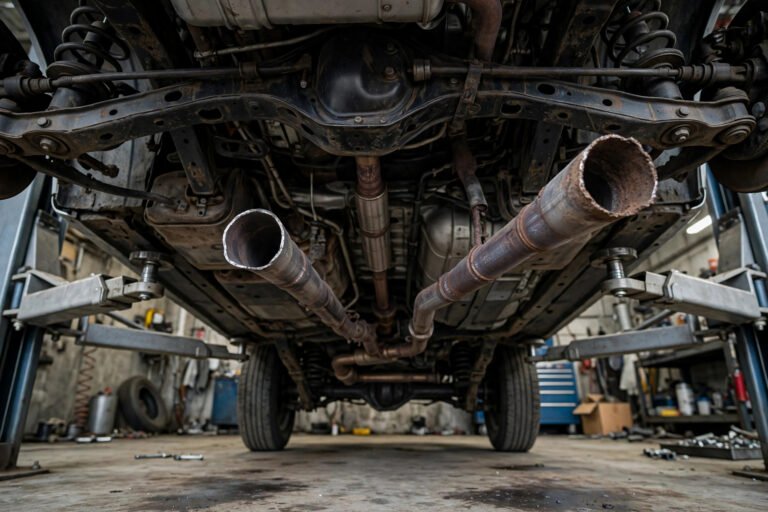
Rear-wheel-drive and all-wheel-drive vehicles have a driveshaft, a long tube that spins at engine output speed to carry power to the rear axle. If it loses a balance weight, gets bent by an impact, or its U-joints wear and develop play, it produces a strong, low-frequency vibration, usually between 60 and 75 mph. The shake is felt through the floor and seat more than the steering wheel.
U-joints are the flexible couplings at each end of the driveshaft. When they wear, they can also clunk when you shift into gear or when you first press the gas, which is a useful clue alongside the shake.
What to check: This is hard to inspect without a lift, but you can note the details that matter: the exact speed range, whether the shake is worst under acceleration from a stop and improves at steady speed, and any clunking on gear changes. Those three facts point a mechanic straight at the driveline.
The fix: A driveshaft shop can rebalance a shaft or replace worn U-joints. A bent shaft usually needs replacement. Because the shaft spins fast, this is not a part to patch with a temporary fix: get it diagnosed properly and promptly.
Cause 6: Worn Suspension Parts
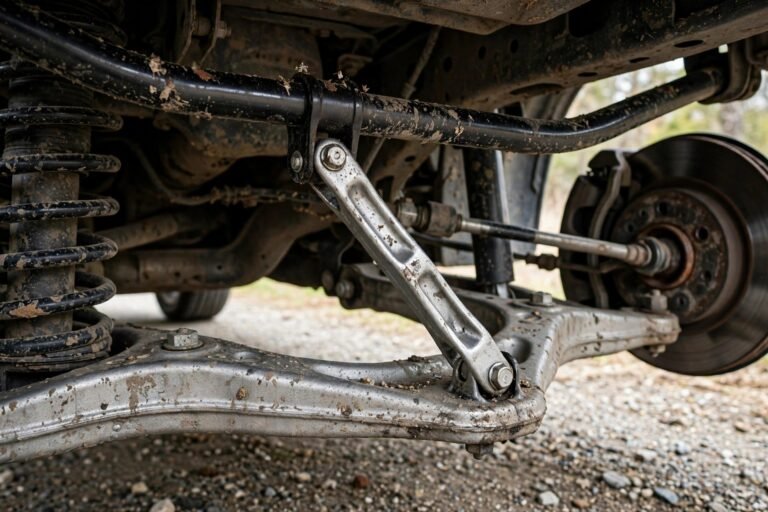
Ball joints, tie rod ends and control arm bushings hold the wheels in precise position while the suspension moves. When they wear, they allow small amounts of extra movement, and at speed that play turns into instability and shaking. A worn tie rod end often shows up as a shimmy in the steering wheel, while worn bushings can add a vague, wandering feeling alongside the shake.
Alignment on its own does not usually cause shaking, but bad alignment causes uneven tire wear, such as feathering or cupping, and that uneven wear then causes vibration. So a car with worn suspension parts often has two problems feeding each other: the loose part and the tire wear it caused.
What to check: Look at the tires for uneven wear patterns, especially cupping (scalloped dips around the tread) or feathering (sharp edges on one side of each tread block). Listen for clunking over bumps, which often comes with worn ball joints or bushings. Any looseness in the steering is a reason to get the front end inspected soon.
The fix: Suspension diagnosis is a shop job, because it needs the car on a lift and the play measured by hand. Worn ball joints and tie rods are safety items: they hold the wheel onto the car, so do not put off the repair once a shop confirms it.
Cause 7: Engine Misfire or Broken Motor Mount
Sometimes the shake comes from the engine rather than the wheels. A cylinder that misfires, because of a fouled spark plug, a bad ignition coil or a vacuum leak, makes the engine run unevenly, and that unevenness is felt as a shudder, usually under load: accelerating, climbing a hill, or pulling away from a stop. A scan tool will usually show misfire codes in the P0300 to P0308 range.
Broken motor mounts cause a similar feeling for a different reason. The mounts are rubber or hydraulic cushions that hold the engine to the chassis and absorb its natural vibration. When one cracks or separates, the engine’s movement reaches the body directly, and you feel it as a shake that is worst under acceleration or when shifting into gear. At a steady highway cruise, mount problems are usually less noticeable, which is one way to tell them apart from a wheel problem.
What to check: Note whether the check engine light is on, and whether the shake is tied to the gas pedal rather than to speed. A shake that appears only when you accelerate, regardless of speed, points to the engine or mounts. If the shake is present at a steady speed with your foot off the gas, it is more likely a wheel or driveline issue.
The fix: Misfires are diagnosed with a scan tool and fixed by replacing the failed plug, coil or leaking hose. Motor mounts are replaced as a shop job. Both are worth fixing promptly, because a misfiring engine can damage the catalytic converter, and a broken mount lets the engine move enough to stress hoses and wiring.
Cause 8: Loose Lug Nuts
This one is rare but urgent, and it usually follows a recent visit to a tire or brake shop. If the lug nuts were not torqued correctly after a wheel was removed, the wheel can wobble on its hub, and the shake starts soon after the work was done. It may be mild at first and get worse fast.
Stop driving. A wheel with loose lug nuts can come off. Pull over somewhere safe, do not drive at highway speed, and check the nuts only if you can do so safely. If any nut turns by hand, or if a stud looks damaged, call for a tow rather than driving to a shop. If the work was just done, call the shop that did it and describe the symptom.
When to Stop Driving
Most shakes can wait for a scheduled shop visit, but some cannot. Stop driving and get the car towed if you notice any of these:
- The shake is violent, or it suddenly gets much worse over a few miles
- You hear grinding from a wheel, which can mean a failed wheel bearing
- The steering feels loose, or the car pulls hard to one side
- A wheel wobbles visibly, or lug nuts are loose after recent work
- A tire has a sidewall bulge, which can blow out without warning
- The shake comes with a flashing check engine light, which signals an active misfire
For anything else on the list above, slow down, avoid highways, and book a shop visit within days, not weeks. A small imbalance is cheap to fix now and expensive later, because the shaking wears out tires, bearings and suspension parts around it.
What to Tell Your Mechanic
A precise description saves diagnostic time and money. Before you call, note these five things:
- The exact speed where the shake starts, and whether it fades above that speed
- Where you feel it: steering wheel, seat, floor, or the whole car
- When it happens: only while accelerating, only at steady cruise, only after braking, or all the time
- Any noise with it: humming, grinding, clicking on turns, or clunking on gear changes
- Any recent work: new tires, a rotation, brake work, or hitting a pothole or curb
A good shop will start with a road test to reproduce the shake, then check tire pressure, spin the wheels on a balancer, and check bearings and suspension play by hand. The road test alone often points to the answer, which is why your notes matter.
What the Fix Costs in 2026
Costs depend on the cause, the vehicle and the shop, but the common fixes fall into clear bands.
| Repair | Typical cost | Notes |
|---|---|---|
| Wheel balancing | $15–$25 per wheel; $80–$120 all four | Fixes most speed-specific shakes |
| Wheel bearing, pressed-in | $346–$504 per wheel | RepairPal September 2026 national estimate |
| Wheel hub assembly | $512–$652 per wheel | RepairPal September 2026 national estimate |
| CV axle replacement | Varies widely by vehicle | Get a quote for your car; trucks cost more |
| Motor mount replacement | Varies widely by vehicle | Usually a few hundred dollars per mount |
| Driveshaft rebalance or U-joints | Varies widely by vehicle | Depends on shaft type and access |
Balancing is the cheapest fix on the list and the most common answer, which is why shops usually start there. If balancing does not cure the shake, the money was not wasted: it rules out the most likely cause and the shop moves to the next suspect with better information.
FAQ
Why does my car shake at 60 mph but not at 40 mph?
Because the shaking part is spinning at a frequency that matches the car’s resonance at that speed. Wheel imbalance is the usual cause: the shake appears in a narrow band, often 50 to 70 mph, and fades above or below it. A part that is bent or worn can also shake only at one speed.
Why does my car shake when I accelerate but not when I coast?
A shake tied to the gas pedal points to a part under load: a worn inner CV joint, a driveshaft or U-joint problem, a motor mount, or an engine misfire. If the shake stays the same while coasting in neutral, the cause is more likely a wheel or tire.
Can unbalanced tires cause shaking at low speed?
Usually not much. A small imbalance is barely noticeable at low speed and grows with speed, because the centrifugal force rises sharply as the wheel spins faster. A shake that is strong at low speed is more likely a damaged tire, a bent rim or a flat spot.
Is it safe to drive with a shaking car?
It depends on the cause. A mild shake from a lost wheel weight is not an emergency, but you should still get it checked within days. Stop driving and tow the car if the shake is violent, comes with grinding, or the steering feels loose. Never ignore a shake that is getting worse.
Will an alignment fix my car shaking?
Usually not on its own. Alignment does not typically cause shaking directly, but it causes uneven tire wear, and that wear causes vibration. If worn suspension parts threw the alignment out, the shop needs to fix the parts and the tires, not just adjust the alignment.
Why is my car trembling when I drive?
Trembling is the same problem as shaking, just described differently. The cause still depends on speed and where you feel it: a tremble at highway speed usually means a wheel balance problem, while a tremble only under acceleration points to a CV joint or motor mount. Work through the speed table above to narrow it down.
Why does my steering wheel shake but not the rest of the car?
Because the problem is at the front. A shake felt mainly through the steering wheel almost always starts with the front wheels or tires, such as a lost balance weight or a bent front rim. A shake felt in the seat or floor points to the rear wheels or the drivetrain.

lily John
The Fixtorial team writes hands-on car troubleshooting guides for everyday drivers — symptom first, honest costs, and fixes you can verify yourself.

One Comment