
AC Compressor Repair: Signs, Costs & Repair vs Replace
Updated Nov 21, 2026
In This Guide
- The Quick Answer: Most AC Compressor Problems Are Not the Compressor
- What the Compressor Does, in Plain Terms
- Signs You Need an AC Compressor Repair
- How a Shop Tests the Compressor Before Replacing Anything
- Repair 1: The Clutch and Clutch Coil
- Repair 2: Relay, Fuse, and Pressure Switch
- Repair 3: Shaft Seal and Small Leaks
- Repair 4: Low Refrigerant From a Leak Elsewhere
- When Repair Is False Economy
- AC Compressor Repair vs Replace: The Quick Call
- What an AC Compressor Repair Costs in 2026
- When to Stop Driving
- What to Tell Your Mechanic
- FAQ
The Quick Answer: Most AC Compressor Problems Are Not the Compressor
AC compressor repair does not always mean replacing the compressor: when a car AC compressor stops working, the compressor itself is often not the part that failed. The clutch that engages it, a relay, a pressure switch, or a small leak somewhere else in the system can all produce the same symptom: warm air from the vents. Many compressors are replaced when the real problem is a low refrigerant charge or a bad relay, and that mistake costs a thousand dollars or more.
A compressor can be repaired, rather than replaced, when the part that failed sits outside the sealed compressor body. A worn clutch, a burned-out clutch coil, a failed relay or pressure switch, and a leaking shaft seal are all real repairs that keep the original compressor in the car. Once the compressor itself has seized, lost internal pressure, or scattered metal debris through the system, repair stops being an option and replacement is the only dependable fix.
This guide covers the repair side of the problem: how to tell what failed, which failures are repairable, what a shop checks before condemning the compressor, and what each fix costs in 2026. It stays on repair. The one symptom of a compressor that never turns on has its own guide, and so do the wider warm-air problems that are not compressor problems at all.
In this guide, you’ll learn:
- The signs your AC compressor is failing
- How a shop tests the compressor before replacing anything
- Which failures can be repaired (clutch, coil, relay, switch, seal)
- When repair is false economy and replacement is the smart call
- What each fix costs in 2026
- When to stop driving and get the car towed
Safety first: Car AC systems hold refrigerant under high pressure. Federal law requires refrigerant to be recovered by an EPA Section 609 certified technician. Venting refrigerant into the air is illegal, and the system must be evacuated and recharged with proper equipment. This guide is diagnosis and decision information only. The actual work belongs with a certified AC shop. Never open AC lines or fittings yourself.
What the Compressor Does, in Plain Terms
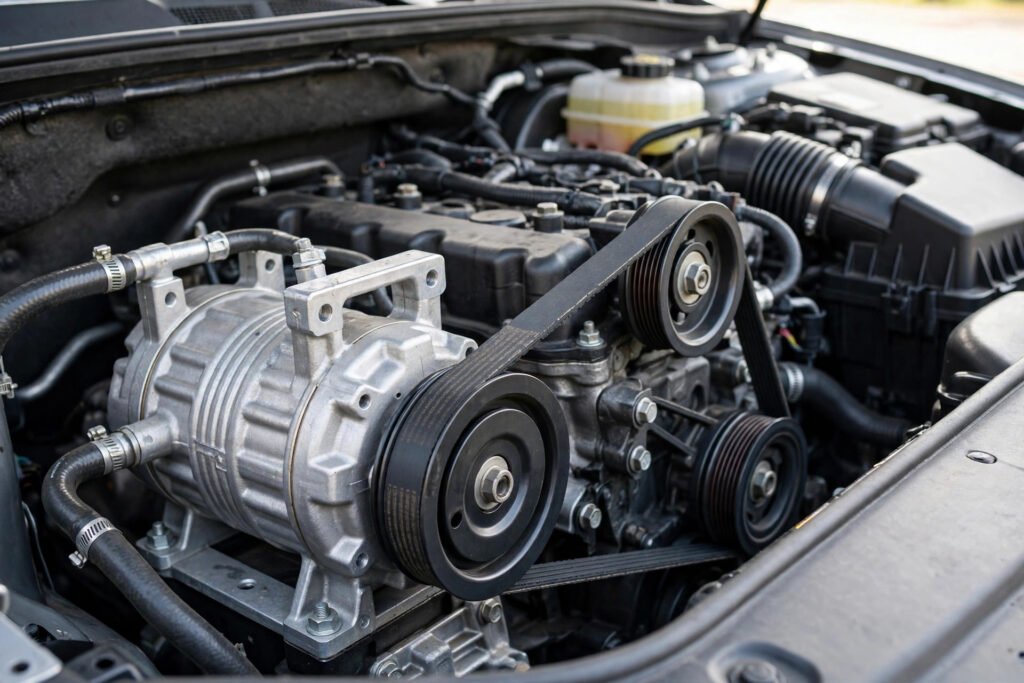
The compressor is the pump at the heart of your car’s air conditioning. Driven by the serpentine belt, it pressurizes refrigerant gas and pushes it around the system. That pressure change is what lets the refrigerant absorb heat from the cabin and release it outside, which is how cold air reaches your vents.
The compressor does not run all the time. An electromagnetic clutch on its front pulley engages and disengages it as the system needs cooling. When you switch the AC on, you should hear a faint click from under the hood as that clutch pulls in. No click, warm air, and a pulley that spins while the clutch plate stays still all point to the engagement side of the system, not necessarily to a dead compressor.
A compressor is a sealed unit with fine internal parts. Most shops prefer full replacement over partial repair when the inside of the unit is the problem, because opening it up rarely gives a lasting fix. The repairs in this guide are the exceptions: parts that sit outside the sealed body and can be swapped without disturbing it.
Signs You Need an AC Compressor Repair
The signs are consistent across the published guides, and they divide neatly into two groups: signs the compressor itself is dying, and signs something around it failed instead.
| Symptom | What it usually suggests |
|---|---|
| Warm air from the vents with the AC on | Clutch not engaging, low refrigerant, or failed compressor |
| Grinding, rattling, or squealing when the AC engages | Internal compressor damage, likely replacement |
| No click from the compressor when you switch the AC on | Clutch, relay, fuse, or pressure switch fault, often repairable |
| Compressor cycles on and off rapidly | Low refrigerant from a leak elsewhere, or a pressure issue |
| Clutch engages, then slips or chatters | Worn clutch plate or weak clutch coil |
| Visible oil or refrigerant residue around the compressor | Shaft seal leak or body leak |
| AC works, then suddenly stops, sometimes with a blown fuse | Seizing compressor drawing excess current |
| Burning smell or smoke from the belt area | Seized compressor or failed pulley bearing, stop driving |
Grinding is the one symptom to take seriously right away. RepairPal warns that if grinding is heard from the compressor pulley, the bearing can fail and throw the serpentine belt off. If that happens, the battery warning light comes on and the engine can stall from loss of electrical power. A compressor problem is usually safe to drive with, but grinding changes that.
How long a compressor lasts depends on use and conditions. CARFAX puts the typical lifespan at 10 to 12 years, and OpenBay gives the same range with 150,000 to 200,000 miles. RepairPal notes that compressors tend to fail after 60,000 to 70,000 miles, though that figure varies widely with use and climate. Age alone is not a diagnosis: a ten-year-old compressor with a bad relay still only needs a relay.
How a Shop Tests the Compressor Before Replacing Anything
A good shop does not order a compressor based on warm air alone. The diagnosis follows a short sequence, and each step can save you from paying for a part you do not need.
First, refrigerant pressure. Low pressure from a leak will keep the system from engaging the clutch at all, by design. The low-pressure switch cuts power to the clutch to protect the compressor from running dry. Adding refrigerant without finding the leak may cool the car briefly, but the clutch will usually stop engaging again once the charge drops.
Second, power and ground at the clutch. With the AC switched on, the shop checks whether voltage is reaching the clutch coil. If voltage is present and the clutch still does not pull in, the clutch or coil is burned out. If no voltage is present, the problem is upstream: a fuse, a relay, a pressure switch, or the AC switch itself. YourMechanic describes exactly this test as the first step in a clutch that will not engage.
Third, the clutch coil and relay. A relay can be swapped in seconds to test it, and the coil’s resistance can be measured with a meter. A relay that clicks but passes no current, or a coil that reads open, points straight at the failed part.
Fourth, whether the compressor turns by hand. With the engine off and the belt removed, the shop checks whether the compressor shaft turns smoothly. A shaft that turns freely with no noise means the compressor body is probably healthy, and a clutch-only repair makes sense. A shaft that will not turn, or grinds, means the compressor is seized and no clutch repair will help.
Fifth, the oil and the system for debris. If the compressor failed internally, its oil carries metal particles. Dark oil or visible metal debris at the service ports means the failure contaminated the system, and the job grows from a compressor swap to a full flush with a new receiver-drier.
Ask for this sequence by name when you book the visit: a performance diagnosis that includes refrigerant charge verification, a leak inspection, compressor command testing, and clutch power and ground checks, before any parts are replaced. A shop that skips straight to quoting a compressor has not earned that quote yet.
Repair 1: The Clutch and Clutch Coil
The clutch is the most common real repair on an AC compressor, and the cheapest one that actually fixes the problem. It is the electromagnetic assembly on the front of the compressor: a pulley that always spins with the belt, a clutch plate that locks to it when energized, and a coil that creates the magnetic pull.
Clutches wear out. The plate’s friction surface thins, the air gap grows too wide for the coil to pull it in, or the coil itself burns out from heat and age. The result is a compressor that never engages, engages and slips, or chatters loudly when it tries. On many vehicles the clutch assembly is sold separately and can be replaced with the compressor still in the car, which keeps the refrigerant system sealed and avoids a recharge.
What it costs: a clutch, coil, or seal repair typically runs $300 to $900 at an independent shop, according to PickHVAC’s 2026 figures. A clutch-only job commonly totals $350 to $1,200 including labor and refrigerant handling, with about $800 as a reasonable middle estimate. RepairPal’s national estimator puts a compressor clutch replacement at $691 to $826. Clutch parts alone usually run $100 to $500, depending on the vehicle and whether the clutch, pulley, and coil are sold as separate pieces.
The catch: not every compressor has a serviceable clutch. Some designs do not offer a practical standalone clutch replacement, and on some cars the compressor must come out anyway because access is so tight. Before approving the repair, confirm that the compressor shaft turns freely and that the diagnosis identifies the clutch rather than the compressor or the electrical circuit. Replacing a clutch on a failing compressor wastes the repair budget.
Repair 2: Relay, Fuse, and Pressure Switch
These are the smallest repairs with the biggest payoff, because they are the failures most often mistaken for a dead compressor.
The relay. The AC clutch relay is a small cube in the fuse box that carries the current to the clutch coil. It can fail silently: the AC switch works, the light comes on, but the clutch never gets power. A relay costs a few dollars for the part, and a shop can test it by swapping in a known-good one in seconds. The related P0645 trouble code, which points to the clutch relay control circuit, is usually fixed by replacing the relay or repairing corroded wiring in its circuit.
The fuse. A blown AC fuse is the simplest possible cause and the first thing to check. If a new fuse blows again immediately, that is useful information, not bad luck: a seizing compressor draws excess current, and the fuse is protecting the circuit from it.
The pressure switches. Low-pressure and high-pressure switches guard the system. The low-pressure switch stops the clutch when refrigerant is low, and the high-pressure switch stops it when pressure climbs dangerously high. A failed switch can keep a healthy system switched off. YourMechanic notes that the AC clutch cycling switch, the switch that opens and closes as system pressure changes, is actually the most common part to fail on many vehicles. It engages and disengages every time the compressor cycles, which wears its contacts out. A cycling switch replacement runs about $116 on a Ford Explorer, with $21 for parts and $95 for labor, and an AC inspection to confirm the diagnosis averages about $111.
The wiring. Corrosion at the clutch connector is common, especially on older cars, and it is repairable. A connector that looks green or crusty may be the entire problem.
None of these repairs opens the refrigerant system, which is why they are cheap. If a shop quotes a compressor before checking the relay and the switches, ask them to check those first.
Repair 3: Shaft Seal and Small Leaks
The shaft seal sits where the compressor’s drive shaft exits the body, and it is one of the few seals on the compressor that can be replaced on its own. When it leaks, you will see oily refrigerant residue around the front of the compressor, and the system slowly loses its charge. The AC gets weaker over weeks, not all at once, and topping it up helps for a while and then stops helping.
A shaft seal repair makes sense only when the compressor itself is healthy: it turns smoothly, makes no noise, and the leak is clearly at the seal rather than through the compressor body. The job still requires recovering the refrigerant, replacing the seal, and evacuating and recharging the system, so it is not a driveway repair. It falls in the same $300 to $900 external-repair range as a clutch job.
A leak through the compressor body itself, or at a cracked housing, is different. That is not a seal repair. It is a compressor replacement, because the sealed body cannot be patched reliably.
Repair 4: Low Refrigerant From a Leak Elsewhere
Sometimes the compressor is fine and the system simply leaked down somewhere else: a hose, an O-ring, the condenser, or the evaporator. The compressor never engages because the low-pressure switch is doing its job, protecting it from running without refrigerant and oil.
This is the repair that gets missed most often. A shop that finds the leak, fixes it, and recharges the system has repaired the AC without touching the compressor at all. The giveaway is history: cooling that faded gradually over weeks, or worked briefly after a top-up and then stopped again. Both point to a leak, not to a failed compressor.
A word of caution that matters here: never keep topping up a leaking system with cans of refrigerant. The leak is still there, the charge will drop again, and running the system low on refrigerant starves the compressor of the oil that circulates with it, which can turn a small leak into a dead compressor.
When Repair Is False Economy
Some failures leave no repair option, and spending money on a partial fix only delays the real bill.
Seized compressor. The shaft will not turn, or turns with grinding. No clutch, coil, or relay will fix this. The whole unit must be replaced.
Internal failure with metal debris. A compressor that came apart inside sends metal particles through the lines and the condenser. Fitting a new compressor without flushing the system and replacing the receiver-drier will kill the new compressor the same way. This is why a compressor replacement bundles several parts: the compressor, a new receiver-drier, a system flush, and a full evacuate and recharge. If the system is contaminated, the job becomes a full overhaul at $1,500 to $3,000.
Lost internal pressure. A compressor that turns but cannot build pressure has worn-out internals. It is a sealed unit with fine internal parts, and most shops prefer full replacement over partial repair for a longer-lasting result.
Repeated clutch failure. If a new clutch burns out quickly, the compressor may be dragging from internal wear, overloading the clutch. Fixing the clutch again without checking the compressor underneath repeats the failure.
The honest test is the one from the diagnosis section: shaft turns freely, no noise, no metal in the oil, and the failed part identified as external. If any of those fail, replacement is the dependable call.
AC Compressor Repair vs Replace: The Quick Call
| What failed | Repairable? | Typical cost |
|---|---|---|
| Clutch plate or clutch coil | Yes, often with the compressor in place | $300–$900 |
| Relay, fuse, or pressure switch | Yes, no refrigerant work needed | $100–$250 |
| Clutch cycling switch | Yes, a common wear item | About $116 |
| Shaft seal leak | Yes, if the compressor body is healthy | $300–$900 |
| Low refrigerant from a leak elsewhere | Yes, fix the leak, not the compressor | Varies by leak location |
| Seized compressor | No, full replacement | $800–$1,800 |
| Internal failure with metal debris | No, replacement plus full flush | $1,500–$3,000 |
| Compressor body leak or crack | No, full replacement | $800–$1,800 |
A diagnosis typically costs $50 to $150, and it is the best money in the whole job. It is what separates a $116 switch from a $1,500 compressor.
What an AC Compressor Repair Costs in 2026
Costs depend on the vehicle, the shop, and what else the job needs, but the published 2026 figures fall into clear bands.
| Repair | Typical cost | Notes |
|---|---|---|
| Diagnosis | $50–$150 | Pressure, clutch power, leak check before parts |
| Relay, fuse, or pressure switch | $100–$250 | Cheapest real fix; no refrigerant work |
| Clutch cycling switch | About $116 | YourMechanic Ford Explorer estimate, $21 parts + $95 labor |
| Clutch, coil, or seal repair | $300–$900 | RepairPal clutch replacement $691–$826 |
| Full compressor replacement | $800–$1,800 | CARFAX typical range $1,000–$2,000 |
| Full system overhaul after internal failure | $1,500–$3,000 | Flush, new receiver-drier, new compressor |
RepairPal’s model-by-model estimates, updated September 3, 2026, show why the spread is so wide. A Chevrolet Silverado 1500 runs $875 to $1,158 for a compressor replacement, a Chevrolet Malibu $1,078 to $1,446, a Toyota Corolla $981 to $1,621, a Toyota Camry $1,347 to $2,141, a Toyota RAV4 $1,280 to $1,920, and a Toyota Highlander $1,513 to $2,336. A 2009 Honda Civic runs $779 to $1,418. Your vehicle, the parts needed around the compressor, and local labor rates decide where you land.
Two costs hide inside a replacement quote and are worth asking about. The receiver-drier must be replaced any time the system is opened, and the evacuate and recharge is a separate service, not a top-up. A quote that leaves either one out is not a complete quote. And if the quote is for a remanufactured compressor, ask about the warranty: a cheaper unit with a short warranty can cost more than a new one if it fails early.
When to Stop Driving
A bad compressor is usually safe to drive with. The AC simply does not cool, and the car runs normally otherwise. Two situations change that.
Stop driving and get the car towed if you notice any of these:
- Grinding or squealing from the compressor pulley, which can mean a bearing about to fail and throw the serpentine belt
- Smoke, a burning rubber smell, or a belt that looks shredded or is slipping off a pulley
- The compressor pulley wobbling visibly, or the belt smoking when the AC is on
- The engine stalling after the battery warning light comes on, which can follow a thrown belt
If the belt comes off, the car loses the alternator, the power steering pump, and the water pump on many vehicles, all at once. That is why grinding from the compressor area is a tow, not a drive-to-the-shop problem. If the compressor is simply not engaging and the belt looks and sounds normal, driving to a shop is fine. Turn the AC off so the clutch stops trying to engage.
What to Tell Your Mechanic
A precise description saves diagnostic time and money. Before you call, note these five things:
- Whether the compressor ever clicks on when you switch the AC on, and whether that click stopped suddenly or faded over time
- Any noise with it: grinding, squealing, rattling, or chattering when the AC engages
- How the cooling failed: suddenly, or weaker over weeks
- Whether a refrigerant top-up ever helped, and for how long
- Any oily residue around the compressor, the hoses, or the condenser
A good shop will start with pressure readings and clutch power checks, not with a parts quote. If the diagnosis comes back as a clutch, relay, or switch, that is good news: the cheapest real repair is also the right one. If it comes back as a seized compressor with metal in the oil, ask for the full quote including the flush and the new receiver-drier, because a compressor fitted without those is a repeat failure waiting to happen.
FAQ
Can an AC compressor be repaired instead of replaced?
Sometimes. If only the clutch, the clutch coil, a relay, a pressure switch, or the shaft seal has failed, a shop can often replace that single part instead of the whole compressor. That is the cheapest AC compressor fix, typically $300 to $900. Once the compressor itself has seized, lost internal pressure, or come apart, the whole unit has to be replaced.
How much does it cost to repair an AC compressor?
A clutch, coil, or seal repair typically costs $300 to $900. A relay, fuse, or pressure switch fix runs $100 to $250. A full compressor replacement costs $800 to $1,800 for most cars, and $1,500 to $3,000 if internal failure contaminated the system and it needs a full flush.
How do I know if my AC compressor is bad or if it is just the clutch?
Watch and listen when you switch the AC on. If the pulley spins but the front clutch plate stays still and there is no click, the clutch, coil, relay, or pressure switch is the suspect. If the clutch engages but the compressor grinds, or the shaft will not turn, the compressor itself is the problem. A shop confirms it by checking clutch voltage and whether the shaft turns freely.
Is it worth repairing an AC compressor clutch?
Yes, when the compressor itself is healthy. A clutch repair at $300 to $900 beats a full replacement at $800 to $1,800, and it keeps the refrigerant system sealed on many cars. It is not worth it if the compressor is noisy, seized, or has metal debris in its oil. Confirm the shaft turns smoothly before approving the repair.
Can I drive with a bad AC compressor?
In most cases, yes. A vehicle with a bad AC compressor is usually safe to drive, because the only loss is cooling. Stop driving and arrange a tow if you hear grinding from the compressor pulley, or if the belt is smoking or shredding. A failed pulley bearing can throw the serpentine belt off, which can stall the engine.
How long does a car AC compressor last?
CARFAX puts the typical lifespan at 10 to 12 years, and OpenBay gives the same range with 150,000 to 200,000 miles. RepairPal notes that compressors tend to fail after 60,000 to 70,000 miles, though that varies widely with use, demand, and operating conditions. Age alone is not a diagnosis.
Why does my AC compressor keep failing?
The most common reason is a missed root cause. A new compressor fitted without flushing metal debris from the old failure, without replacing the receiver-drier, or without fixing the leak that starved it of oil will fail the same way. A clutch that burns out twice usually means the compressor underneath is dragging. The diagnosis matters more than the part.

lily John
The Fixtorial team writes hands-on car troubleshooting guides for everyday drivers — symptom first, honest costs, and fixes you can verify yourself.



One Comment