
Checking your engine oil takes about two minutes, costs nothing, and is the single highest-value maintenance habit you can build. A surprising number of drivers get the reading wrong — not because the procedure is hard, but because the hot-vs-cold question and the “wipe first” step get skipped.
What You’ll Need
- A clean rag or paper towel
- The correct oil for top-ups (the grade on your oil filler cap or in the owner’s manual — e.g. 5W-30)
The Hot-vs-Cold Question, Settled
Both work — but consistency matters more than method:
- Cold check (easiest, most consistent): first thing in the morning, engine off overnight. All oil has drained to the pan. Safest, no waiting, no burn risk.
- Warm check: drive until the engine reaches operating temperature, shut it off, and wait 5–10 minutes for oil to drain back into the pan. Many manufacturers calibrate dipsticks for a warm reading, so check your manual.
- Never check with the engine running. The reading will be meaningless — and it’s a burn hazard.
- Whatever you choose, always compare like with like. Check the same way each time so you can track consumption between changes.
Step-by-Step: The Dipstick Check
- Park on level ground. Even a slight incline lets oil pool to one side of the pan and skews the reading. Engine off.
- Wait for drain-down. Cold: you’re ready immediately. Warm: wait 5–10 minutes.
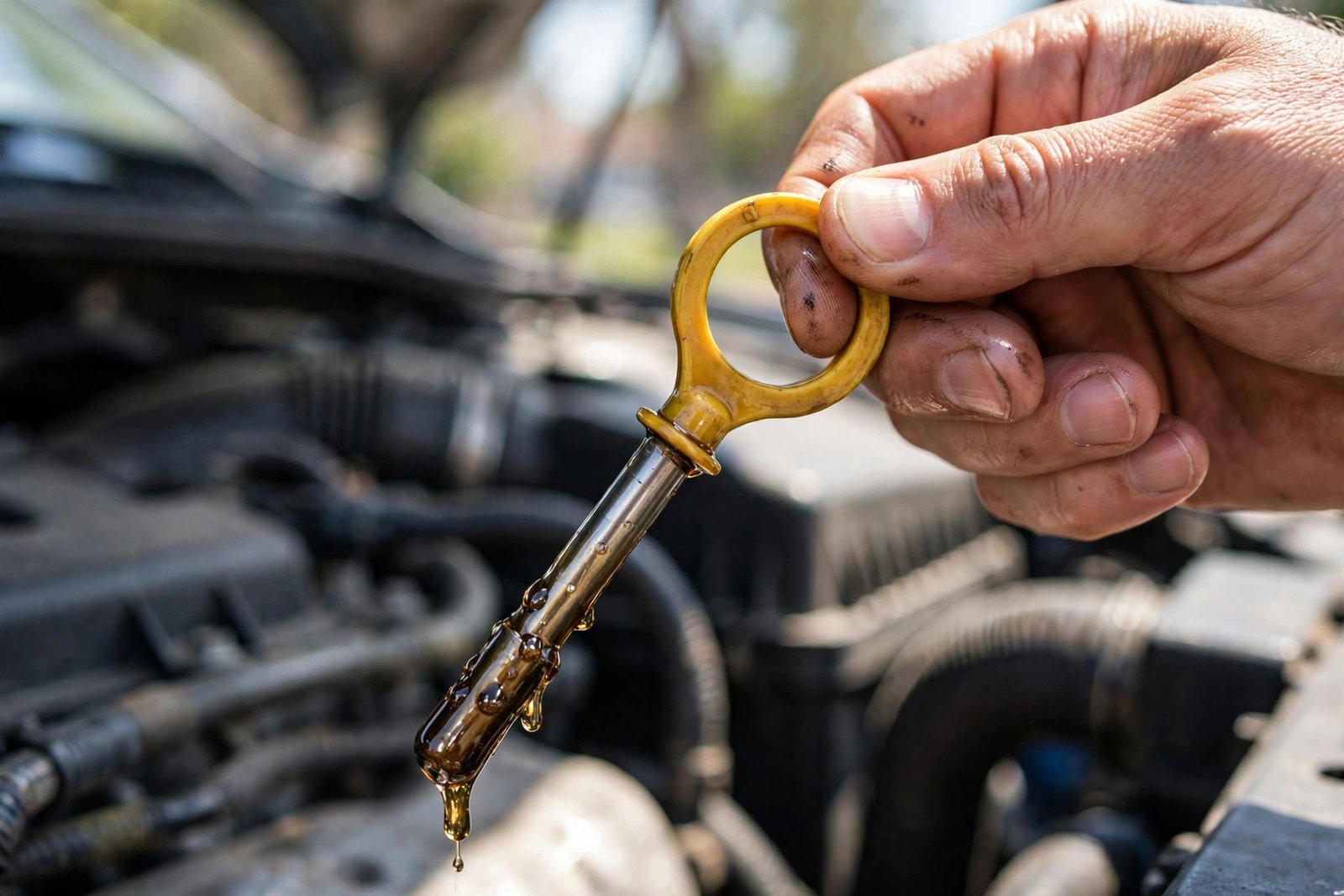
- Open the hood and find the dipstick. It usually has a bright yellow or orange loop handle, marked with an oil-can symbol.
- Pull it out and wipe it completely clean. The first pull smears oil up the tube — that’s not a reading, that’s residue.
- Reinsert it fully — push it all the way back until the handle seats.
- Pull it out again and read it. Hold it level or tip-down so oil doesn’t run up the stick. The oil film should fall between the MIN and MAX marks (or the crosshatched zone), ideally toward the upper mark.
- Reinsert the dipstick fully and close the hood.
What the Dipstick Is Telling You
- Between MIN and MAX: you’re fine. Check again in a few weeks (older engines: weekly).
- At or below MIN/ADD: add the correct oil. A quart bottle through the oil filler cap, poured slowly, then wait a minute and re-check. Don’t guess the amount — re-check after each addition.
- No oil visible on the dipstick: critically low. Add oil before driving. If it was fine recently and is suddenly empty, you have a leak or serious consumption — get it inspected.
- Above MAX: overfilled. This is not a safety margin — excess oil can be whipped into foam by the crankshaft, which causes lubrication failure. If a shop overfilled it, go back and have them correct it.
Reading the Oil’s Condition
While the stick is out, look at what you see:
- Amber/light brown, translucent: healthy.
- Dark brown/black: normal for oil near the end of its interval — oil darkens as it suspends contaminants. Not an emergency by itself.
- Milky or chocolate-milk colored: coolant is mixing with the oil (possible head-gasket issue). Do not drive far — get it diagnosed.
- Gritty texture between your fingers: contaminated — change it.
- Smells strongly of gasoline: fuel dilution. Worth a shop visit.
If Your Car Has No Dipstick
Many newer cars (BMW, Mercedes, Audi, some GM and others) replaced the dipstick with an electronic oil level sensor. The check happens through the dashboard menu or infotainment system — the owner’s manual shows the path (usually: parked on level ground, engine at operating temperature, follow the on-screen prompt). The same rules apply: read it the same way each time.
Common Mistakes
- Reading the first pull. Always wipe and re-dip. The residue on the tube wall gives a false high reading.
- Checking on an incline. Driveways with slopes are the #1 cause of phantom “low oil” panic.
- Checking immediately after shutting off a hot engine. Oil is still up in the engine — you’ll get a false low reading and add oil you don’t need.
- Mixing oil grades on a top-up. An emergency top-up with a slightly different viscosity beats running low, but refill with the correct spec as soon as you can.
- Wiping the stick with a dirty shop rag. Lint and debris in the tube is worse than doing nothing. Use a clean paper towel.
When to See a Mechanic
- Oil is milky, or the level drops noticeably between checks (consumption or leak)
- The oil pressure warning light comes on (red oil-can symbol — shut the engine off safely and get a tow, this is different from a maintenance reminder)
- Metal flakes or glitter in the oil
- You need to add more than a quart between oil changes
FAQ
How often should I check my oil?
Once a month for most cars; weekly for high-mileage or older cars, or if you know yours consumes oil. Always before a long trip.
Can I check oil right after driving?
Only if you wait 5–10 minutes with the engine off. Immediately after shutdown, up to a quart can still be in the upper engine — the reading will show low and you’ll overfill.
Is it bad to add oil if I’m not sure of the type?
Running low is worse than a slightly-off top-up in an emergency. But keep the bottle’s spec close to what’s on the filler cap, and change to the correct oil at the next service.
Why does my new car have no dipstick?
Manufacturers moved to electronic sensors to reduce owner-service errors and emissions (a loose dipstick can affect the sealed crankcase). The sensor reads the same thing the stick did — level in the pan.
Sources
- AutoNation Mobile Service — “How to Check Engine Oil Level: Dipstick Guide” (level surface, wait 5–10 min, wipe and re-dip, between Min/Max, dark/gritty/burnt = change) — https://www.autonationmobileservice.com/i/blog/how-to-check-engine-oil-level/
- EngineerFix — “When Is the Best Time to Check Engine Oil?” (level ground; warm-check with 5–10 min drain-down vs cold check; wipe the smear; 1 qt low-to-full typical) — https://engineerfix.com/when-is-the-best-time-to-check-engine-oil-3/
- EngineerFix — “How Long Should I Wait Before Checking Oil?” (never check with engine running; wait, wipe, reinsert, read) — https://engineerfix.com/how-long-should-i-wait-before-checking-oil/
- Chloe’s Auto Repair — “Check Oil Hot or Cold? Cold Is More Accurate” (cold = most consistent; warm = 5–10 min wait; manual first) — https://www.chloesautorepair.com/blog/should-you-check-oil-hot-or-cold
- LubeOilSales — “How To Check Engine Oil: Step-by-Step Dipstick Guide (2026)” (electronic sensors on dipstick-less cars; overfilling causes foaming/lubrication failure) — https://lubeoilsales.com/how-to-check-engine-oil/