
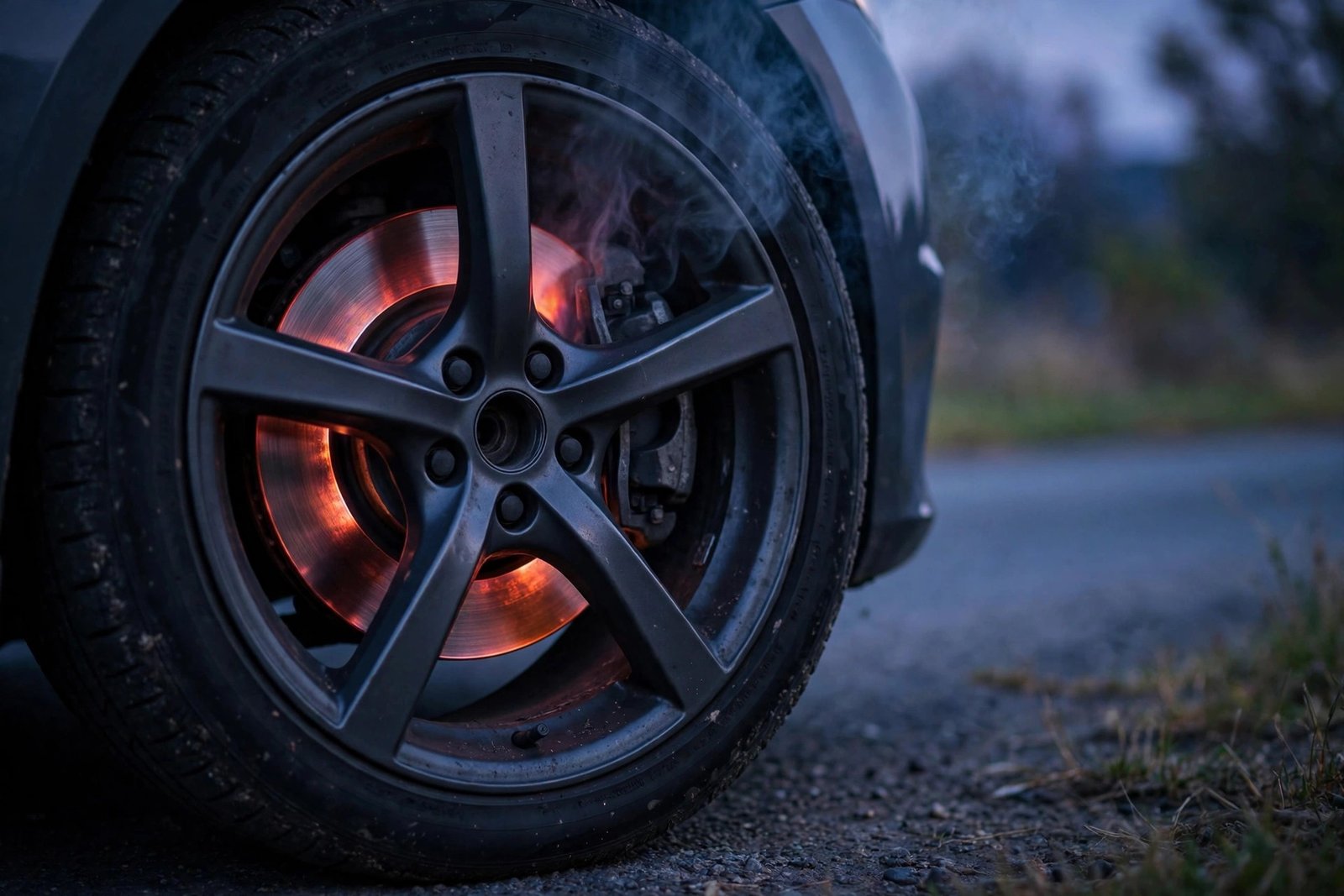
A sharp, acrid, chemical burning smell after using the brakes is your car's way of saying something is too hot. Sometimes it's temporary and explainable — a steep descent, a hard stop, brand-new pads curing. Sometimes it's a mechanical failure creating continuous friction — a stuck caliper, a dragging parking brake — and the heat is destroying parts while you drive.
The skill this guide teaches: telling the two apart. That distinction decides whether you cool down and continue or stop and call a tow.
Safety first: If the smell comes with smoke from a wheel, a hot glowing brake, a spongy or changed pedal, or reduced stopping power, pull over safely right now and let the brakes cool completely before continuing — then see a certified mechanic promptly. Overheated brakes can fade exactly when you need them most. Never touch hot brake components — they can cause serious burns.
In this guide, you'll learn:
- The 3-question test: normal heat vs. mechanical failure
- The most common causes, in order of likelihood
- Which smells are NOT the brakes (clutch, oil, electrical)
- What to do right now if it happens on the road
- What to tell your mechanic
The 3-Question Test
- Did you just brake hard or descend a long hill? Yes → probably heat from heavy use (see #1 below).
- Is the smell coming from ONE wheel? Yes → suspect a stuck caliper or dragging brake on that corner (see #2) — the most urgent pattern.
- Does it happen during normal, gentle driving? Yes → mechanical fault until proven otherwise.
The Most Likely Causes, in Order
1. Overheated brakes from heavy use (most common, often temporary)
Repeated hard braking — long downhill grades, towing, stop-and-go traffic — converts kinetic energy into heat faster than the rotors can shed it. The acrid smell is the pad compounds breaking down under the heat. This usually resolves once the components cool naturally — but repeated episodes glaze the pads and warp the wear pattern.
What to do on the road: pull over safely, let the brakes cool completely, then continue gently. On future descents, use engine braking (downshift) instead of riding the brake pedal.
2. Sticking caliper — brake dragging continuously
If the caliper's piston or slide pins seize, the pad never fully releases — it drags against the rotor constantly, generating heat and smell even during gentle driving. The signature: the smell comes from one wheel, often with that corner feeling hotter, the car pulling slightly, and fuel economy dropping. This one gets worse with miles and can escalate to a locked wheel. car pulls to one side when braking brakes locking up
What to do: This needs prompt professional attention. After a drive, hover the back of your hand a few inches from each wheel — one much hotter than the rest identifies the dragging corner. Report it; don't touch anything.
3. Parking brake partially engaged or dragging
Driving with the parking brake on — even slightly — drags the rear brakes constantly, overheating them fast. Rear drum brakes dissipate heat poorly, so the smell is strong. Check that the parking brake is fully released (the dash indicator helps).
What to do: release it fully, let the rear brakes cool, and note whether the smell stops. If the parking brake itself is sticking, that's a separate diagnosis — don't force-drive on dragging brakes.
4. Worn pads grinding into rotors
Metal-on-metal contact generates intense localized heat and a metallic burning smell, usually with a grinding noise. If the smell arrived alongside grinding, this is likely the story.
5. New brakes curing (normal, temporary)
Fresh pads and rotors carry manufacturing resins and coatings that burn off during the first few dozen miles of use — a mild odor that's expected and fades. The distinguishing feature: it started right after a brake job and fades within days of normal driving.
Smells That Are NOT the Brakes
Not every burning smell after a drive is brake-related. These are the common mimics — worth knowing so you describe the right system to your mechanic:
- Burning rubber: slipping serpentine belt, or a tire rubbing — usually strongest near the engine bay or one wheel arch.
- Burning oil: oil dripping onto hot exhaust — often with a wisp of smoke from under the hood.
- Burning plastic/electrical: wiring or a melting connector — stop and investigate; this one carries a fire risk.
- Burnt-paper smell in a manual: slipping clutch — strongest after shifting or riding the clutch.
Where the smell is strongest (wheel vs. engine bay vs. cabin) is the key clue — note it.
What to Do Right Now (On the Road)
- Pull over safely and stop. Turn off the engine.
- Let the brakes cool completely — at least 20–30 minutes for overheated brakes. Do not pour water on hot brakes.
- Check the parking brake — fully released?
- Hover-check wheel heat (back of the hand, a few inches away, never touch) — one wheel much hotter than the rest means a dragging brake on that corner.
- If the smell returns during gentle driving, or any wheel was smoking, do not continue — call a tow to a certified mechanic.
What to Tell Your Mechanic
"Burning smell after braking" plus: when it happens (after descents? during gentle driving? right after a brake job?), which wheel area it's strongest at, the 3-question-test answers, and any companion symptoms (pull, grinding, pulsing, warning lights). A shop inspects caliper slide function, pad/rotor condition, and parking-brake release — the smell's pattern tells them where to look first.
FAQ
Is a burning brake smell ever normal?
Two cases: mild odor from new brakes curing in the first few dozen miles, and temporary heat smell after genuinely heavy use (long descents, towing). Both fade. A smell during normal driving is not normal.
Can I drive with a stuck caliper?
No — a dragging brake overheats continuously, destroys pads and rotors, lengthens stopping distance, and can escalate to lock-up or boiled brake fluid. Have the car towed.
Why does only one wheel smell?
Single-wheel smell is the stuck-caliper signature: one corner is doing extra work — or refusing to release — while the others run cool.
How long should I let hot brakes cool?
At least 20–30 minutes for genuinely overheated brakes. Never pour cold water on hot brakes — thermal shock can damage the rotors.