
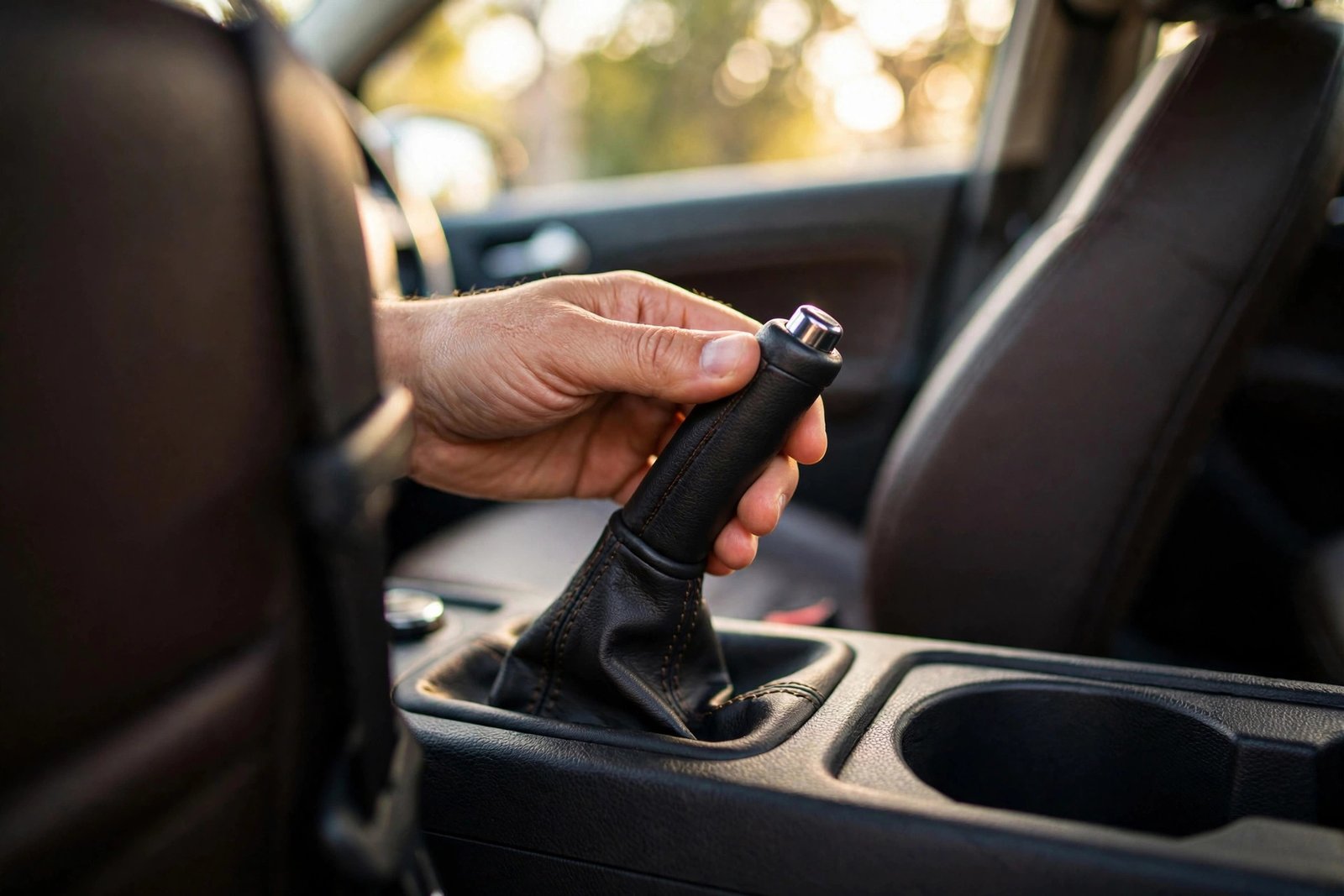
The parking brake is engaged, the car won’t move — and now the brake won’t release. The instinct is to force it: yank the lever harder, or drive through it. Both are wrong. Forcing a stuck parking brake can snap cables, destroy components, or — worst case — send you driving on a dragging brake that overheats and fails. This guide covers the safe steps to try from the cabin, when to stop and call a tow, and what causes it.
Safety first: Do NOT force-drive with the parking brake dragging. A dragging rear brake overheats fast — it destroys pads and rotors, can boil brake fluid, and may start a fire in extreme cases. If the brake won’t release after the safe steps below, call a tow — preferably a flatbed, so the locked wheels don’t have to spin.
In this guide, you’ll learn:
- The safe release attempts to try first (cabin only, no tools)
- When to stop and call a tow
- The most common causes, in order of likelihood
- Why “drive through it” is the worst option
- What to tell your mechanic
Safe Steps to Try (Cabin Only)
These are the non-invasive attempts — all from inside the car, nothing underneath it.
1. Cycle the control
Apply the parking brake fully, then release it with a firm, precise motion — repeat several times. Minor corrosion or a sticky ratchet sometimes frees with repeated cycling. Moderate force only: excessive force can stretch or snap the cable, turning a bind into a break.
2. Gentle rock (manual and cable brakes)
With the engine running, foot firmly on the service brake, shift between Drive and Reverse and ease the car an inch or two each way. This jarring can break the static friction of lightly seized shoes. Goal: an inch or two of movement, not driving. If the brake doesn’t release after a few gentle rocks, stop — deeper trouble needs a tow.
3. Check the basics (electronic parking brake)
For EPB-equipped cars: foot firmly on the brake pedal, seatbelt fastened, driver’s door closed (some systems require this), then press/hold the release button. Some systems also release automatically when you engage Drive and press the accelerator gently. Low battery voltage can disable an EPB — if the battery is weak, that’s the first thing to address.
4. If freezing is the cause
In sub-zero weather, moisture in cables or between shoes and drums can freeze solid. Gentle rocking (step 2) sometimes breaks it. Directed warm (not hot) air — a hairdryer at a distance, never an open flame — on the rear wheel area can thaw it, but keep the heat source moving and away from rubber, plastic, and fuel lines. Once freed, cycle the brake several times to displace the melted water.
If none of this works — stop
Don’t escalate to prying, hammering under the car, or cutting cables. Call a tow. A flatbed or dollies under the locked wheels protect the brakes during transport.
Why “Driving Through It” Is the Worst Option
- You destroy the rear brakes: dragging pads/shoes against rotors/drums for miles overheats and ruins them — turning a cable or corrosion issue into a full brake rebuild.
- You risk fire: extreme heat can ignite grease in nearby wheel bearings.
- You lose the parking brake as a backup: if it breaks free mid-drive in a damaged state, you’ve gained nothing and lost a safety system.
- It doesn’t fix anything: the corrosion or seizure that stuck it is still there.
The Most Likely Causes, in Order
1. Corroded cables or mechanism (most common)
Moisture and road salt corrode steel cables inside their housings, especially in cars where the parking brake sat unused for months. The lever moves, but the corroded cable doesn’t pull evenly — or the rear mechanism doesn’t release. This is the classic “worked last winter, stuck this winter” pattern.
2. Frozen components
Sub-zero temperatures freeze moisture between brake shoes and drums, or inside cable housings. Sudden onset after a cold snap, especially overnight, points here.
3. Electronic parking brake (EPB) faults
Failed actuator motors, sensor miscalibration, module communication errors, or low battery voltage can leave an EPB engaged. EPB faults often pair with a dashboard warning light or error message — note exactly what the display says.
4. Worn or damaged return springs and hardware
Return springs pull the mechanism back when you release; when they weaken or break, the brake stays applied even though the cable released. Often comes on gradually — the brake gets harder to release over weeks before finally sticking.
5. Stuck rear caliper
On rear-disc cars, a seized caliper piston keeps the pad pressed even with the cable released — the parking brake control works, but the brake itself doesn’t let go. If the parking brake releases fine but the wheel still drags, the caliper is suspect.
What to Tell Your Mechanic
“Parking brake won’t release” plus: manual or electronic, what you tried, whether it came on suddenly (freeze?) or gradually (corrosion?), the dash warnings (EPB light? error message?), and whether the car sat unused before it stuck. A shop inspects cable condition, rear hardware, EPB module codes, and caliper function — the history tells them which to check first.
FAQ
Can I cut the parking brake cable to get moving?
No — that’s emergency-only advice from the internet’s worst corners. You’ll destroy a component, still need a tow and a repair, and risk damage mid-cut. Call a tow.
My parking brake releases but the car still drags — what now?
That points past the parking brake to a stuck rear caliper or collapsed hose. Don’t drive on it — the same tow-and-inspect logic applies.
How do I prevent this?
Use the parking brake regularly (weekly at least) — regular use keeps cables moving and corrosion at bay. In winter, avoid engaging a wet parking brake before an overnight freeze when possible, and have the rear brakes inspected at every service.
Is a stuck parking brake dangerous?
The stuck brake itself immobilizes the car — the danger is in forcing it. Driving on a dragging parking brake overheats the rear brakes and can cause brake failure or fire. Immobilized is safe; forced is not.