
When your car won’t start and all you hear is a clicking sound — yet the battery is good — the pattern of that clicking is already pointing at the real problem. This guide translates it, in order of likelihood, so you don’t pay starter money for a corroded terminal.
In this guide, you’ll learn:
- What rapid clicking vs. a single loud click tells you
- The most common causes, in order of likelihood
- Safe checks you can do yourself in the driveway
- When to stop and call a mechanic
- Typical repair cost ranges for each cause
Safety first: Do all terminal inspections with the ignition OFF. Keep hands, clothing, and tools away from moving belts and fans. If you smell burning plastic or see smoke, stop and call for a tow — don’t keep trying.
What the Clicking Sound Tells You
| What you hear | Most likely cause | First check |
|---|---|---|
| Rapid clicking (machine-gun sound) | Weak connection or voltage drop — power isn’t reaching the starter cleanly | Battery terminals and cables |
| One single loud click, then nothing | Starter solenoid engaging, motor not spinning — failing starter or bad connection at the starter | Try again; tap test; starter connections |
| One click, then everything goes dead (dash lights out) | Major connection break, often a loose terminal separating under load | Terminal tightness |
The Most Likely Causes, in Order
1. Corroded or loose battery terminals (most common)
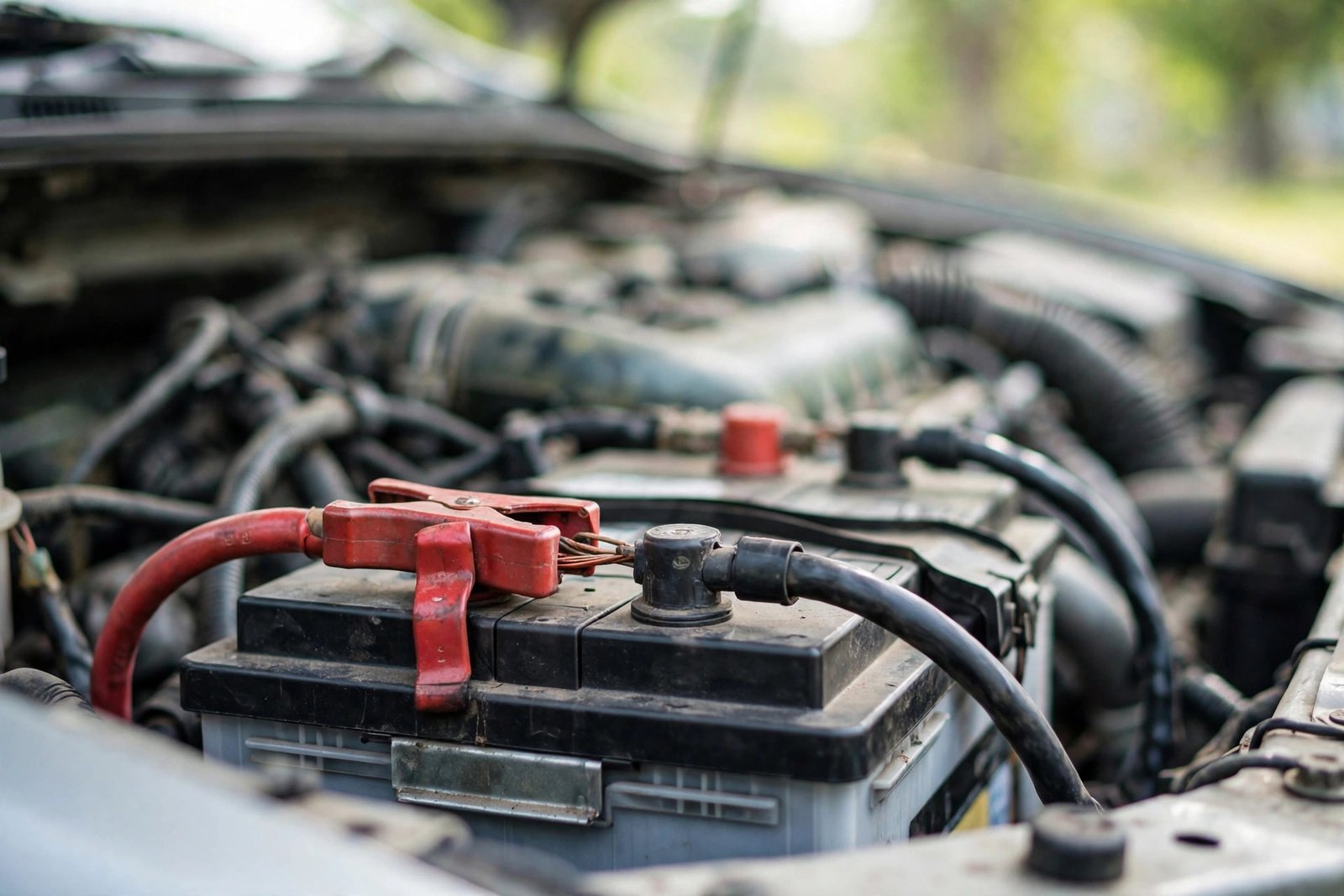
The battery can be perfectly healthy while the starter starves. White, green, or blue crusty buildup on the terminals creates resistance; a clamp you can wiggle by hand is just as bad. With the ignition OFF, disconnect (negative cable first), clean with a wire brush, and reconnect snugly (negative cable last). A cracked clamp that won’t tighten needs replacing — cleaning won’t fix it.
2. Bad engine ground connection
Follow the negative battery cable to where it bolts to the chassis or engine block. A rusty, loose, or frayed ground strap produces exactly this symptom, often with dim or flickering dash lights. The contact point should be tight and clean metal-to-metal.
3. Failing starter motor
The classic sign: one solid click while the dash stays bright. Sometimes a worn starter has a “dead spot” — a few light taps on the starter body (low on the engine, where it meets the transmission) while a helper turns the key can produce one more start. Treat that start as a drive straight to the shop, not a fix.
4. Worn starter solenoid contacts
More likely on higher-mileage cars. Same single-click symptom as a failing starter; a shop distinguishes them with a direct power test.
5. Battery tests “good” but fails under load
A basic voltage reading can look healthy while the battery collapses under cranking load (surface charge). A proper load test — most auto parts stores do this free — is the only way to rule the battery out completely. Batteries over 4–5 years old are prime suspects.
6. Less common: relay, safety switch, ignition switch
No click at all can mean a faulty starter relay. No crank in Park but cranking in Neutral points to the neutral safety switch (automatics); on manuals, press the clutch fully. Clicking plus other electrical quirks (radio/dash cutting out) suggests the ignition switch.
Quick Checks You Can Do Yourself
- Headlight test (30 seconds): Turn headlights on, try to start, watch them. Heavy dimming or blackout during the click = connection/cable problem, not the starter itself.
- Terminal inspection: Look for crusty buildup or loose clamps (ignition OFF). Clean and tighten as described above.
- Try Neutral: Foot firmly on the brake, shift to Neutral, try starting. Works in Neutral but not Park = neutral safety switch.
- Tap test: Light taps on the starter body while a helper turns the key. If it cranks, the starter is dying.
- Voltage drop test (multimeter owners): More than ~0.5V drop across any single connection under cranking load indicates excessive resistance there.
When to Stop and Call a Mechanic
- Burning smell, smoke, or melted wiring — stop immediately, tow it.
- The tap test gets it started — drive straight to a shop without switching off.
- Terminals, cables, and ground all check out but it still clicks — the fault needs professional diagnostic equipment.
- The battery is 4–5+ years old — get a proper load test before spending on anything else.
Typical Cost Ranges
(Verified 2026-10-13 against current US cost sources; ranges vary by vehicle and region.)
- Terminal cleaning: free (DIY)
- Battery replacement: roughly $100–$250 (AGM/start-stop batteries up to ~$300)
- Starter motor replacement: roughly $300–$900+ (luxury models can exceed $1,000)
- The point of diagnosing by symptom first: don’t pay starter money for a corroded terminal.
Cost sources (2026-10-13): battery — costwhale.com national avg $175, range $75–$300; starter — cartalk.com best estimate $600–$900 common / $900–$1,400 luxury, turbokar.com per-brand totals $260–$916.
FAQ
Can the battery test good and still be the problem?
Yes — surface charge fools basic voltage tests. Only a load test rules the battery out.
Is it safe to keep trying to start it?
A few attempts are fine. Don’t crank more than ~10 seconds at a time; let the starter cool a minute between tries.
Will a jump start fix it?
Rarely, if the battery is genuinely good — low charge isn’t the problem. It can occasionally push enough current through a bad connection, but the fault remains.
How urgent is a single loud click?
It won’t fix itself and usually gets worse. If the tap test works, every start could be the last — go straight to a repair shop.