
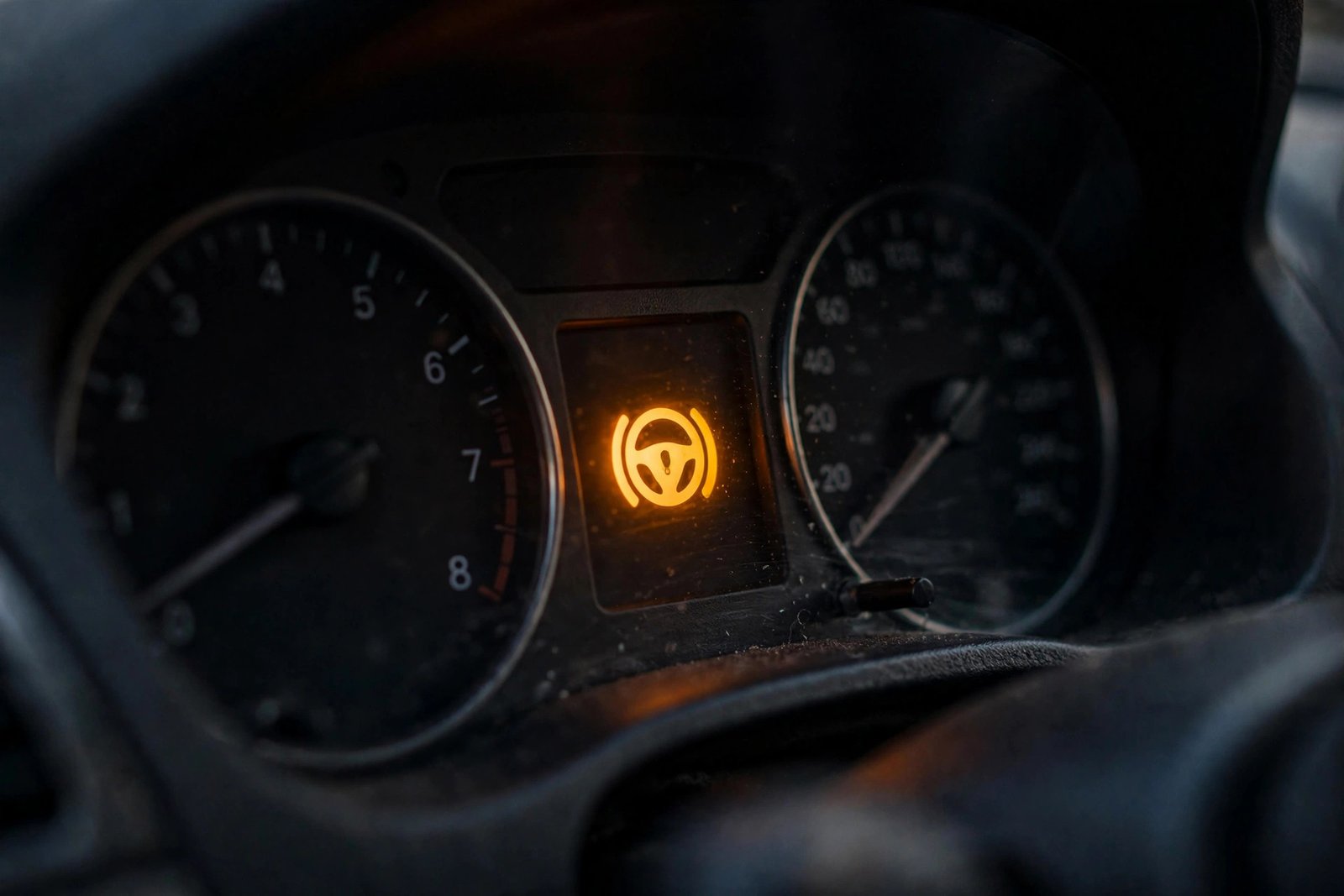
The power steering warning light — a steering wheel icon, sometimes with an exclamation mark or the letters “EPS” — means your steering assistance has a problem. Here’s the critical nuance most guides skip: the correct response depends entirely on whether your car has hydraulic or electric power steering. One has a fluid reservoir you can check in 60 seconds; the other has nothing to top up and needs a scan. This guide branches you to the right path immediately.
In this guide, you’ll learn:
- Red vs. yellow: what the color tells you
- The hydraulic vs. electric decision tree (check this first)
- The most common causes for each system, in order
- Safe driver checks — and what to avoid
- When to see a mechanic
Step 1: Which System Do You Have?
Hydraulic power steering (most cars before ~2010, some later): has a fluid reservoir under the hood, usually with a steering-wheel icon on the cap. The pump is belt-driven.
Electric power steering (EPS/EPAS) (nearly all modern cars): no fluid, no reservoir — an electric motor assists the steering, controlled by a computer.
Don’t know? Check your owner’s manual or look under the hood for the reservoir. This matters because the next steps are completely different.
Step 2: Color Triage
| Color | Meaning | What to do |
|---|---|---|
| Yellow/amber | Partial fault or intermittent issue; assist may be reduced | Drive carefully; diagnose soon |
| Yellow/amber | Partial fault or intermittent issue; assist may be reduced | Drive carefully; diagnose soon |
| Light on at startup, goes out | Normal self-test | Nothing |
A red EPS light with no power assist makes steering dramatically heavier — especially at parking-lot speeds. At highway speed it’s manageable; pulling into a parking spot becomes a workout. Grip the wheel firmly and plan gentle, early turns.
If You Have Hydraulic Power Steering
Most likely causes, in order:
- Low power steering fluid (most common) — usually from a slow leak in a hose, the pump, or the steering rack seals.
- Worn or slipping drive belt — the belt driving the pump can squeal when turning; a broken belt kills assist instantly.
- Failing power steering pump — whining or groaning that gets louder when you turn the wheel.
- Leaking steering rack — fluid loss at the rack boots; steering may feel notchy.
Safe checks:
- Check the reservoir level (engine off): the cap usually has MIN/MAX marks. If it’s low, top up with the exact fluid type your manual specifies (they’re not interchangeable).
- Look under the car for fresh wet spots or drips near the front wheels.
- Listen while turning at low speed — whining points to pump or low fluid.
- Top-up is a temporary measure: if the level was low, fluid leaked out somewhere, and the leak needs fixing.
If You Have Electric Power Steering (EPS)
Most likely causes, in order:
- Software glitch / temporary fault (surprisingly common) — a clean restart (engine fully off, wait 30 seconds, restart) clears many one-time EPS faults.
- Low system voltage — weak battery or failing alternator starves the EPS motor. If other electrical gremlins appear at the same time, test the battery first.
- Faulty torque or steering angle sensor — the computer can’t tell how much assist to give; often follows alignment or steering work.
- EPS motor or module failure — the electric motor or its control module itself. Needs professional diagnosis with a capable scanner.
Safe checks:
- Try the full restart — this genuinely fixes a meaningful share of EPS lights.
- Note when it happens: only at startup? After hitting a pothole? With other warning lights? Patterns help the diagnosis enormously.
- Don’t keep driving long distances with a red EPS light — without assist, emergency maneuvers become dangerous.
When to See a Mechanic
- Red light — pull over safely, then get it diagnosed before driving far.
- Steering is heavy, notchy, making new noises, or the wheel doesn’t return to center.
- Fluid keeps dropping after a top-up — active leak.
- The light returns after a restart — not a glitch.
- Any EPS fault accompanied by ABS or stability-control lights — shared electrical fault.
FAQ
Can I drive with the power steering light on?
Yellow: usually yes, carefully, to a shop. Red: only as far as a safe stop — steering without assist is exhausting and unsafe in an emergency.
My EPS light came on and steering got heavy, then fixed itself. Should I worry?
Note it, but yes, get it checked — intermittent electrical faults usually return, and they tend to fail permanently at the worst moment.
How do I know if my car is hydraulic or electric?
Look under the hood for a power steering fluid reservoir (steering-wheel icon on the cap). No reservoir = electric. Your owner’s manual confirms it.
Is power steering fluid the same as transmission fluid?
Some cars use ATF in the power steering system; others use dedicated fluid. They are not universally interchangeable — use exactly what your owner’s manual specifies.
all dashboard warning lights explained
Sources
- Stoneacre — “Power Steering Warning Light: What Causes It?” (hydraulic fluid checks; pull-over guidance) — https://www.stoneacre.co.uk/blog/power-steering-warning-light-what-causes-it
- Engineer Fix — “What Does the Steering Wheel Light Mean?” (EPS vs. hydraulic; red vs. yellow severity) — https://engineerfix.com/what-does-the-steering-wheel-light-mean/
- Caura — “Power steering warning light: Causes and MOT impact” (hydraulic vs. electric; red vs. yellow severity) — https://www.stoneacre.co.uk/blog/what-causes-the-power-steering-warning-light