
Bald Tires: 7 Signs and When to Replace Them
Updated Nov 21, 2026
In This Guide
- The Quick Answer: Smooth Tread Means Longer Stops
- What “Bald” Actually Means
- 7 Signs Your Tires Are Bald
- How to Check Bald Tires in 2 Minutes
- How Much Longer Bald Tires Take to Stop
- What Uneven Wear Is Telling You
- How Long Do Car Tires Last?
- When to Replace Them
- What to Do Right Now If Your Tires Are Bald
- FAQ
The Quick Answer: Smooth Tread Means Longer Stops
When it comes to bald tires, a tire is bald when its tread has worn down to 2/32 of an inch or less. At that point the National Highway Traffic Safety Administration (NHTSA) says the tire is not safe and should be replaced. The grooves that channel water away from the contact patch are nearly gone, so the tire grips far less on wet roads and can lose contact with the pavement altogether.
New tires start with about 10/32 to 11/32 of an inch of tread. The legal floor of 2/32 is not a target to aim for. Safety experts, including AAA, recommend replacing tires at 4/32 of an inch, because wet braking performance drops sharply below that depth. In AAA testing, all-season tires worn to 4/32 needed about 43 percent more distance to stop on wet roads from 60 mph, roughly 87 extra feet.
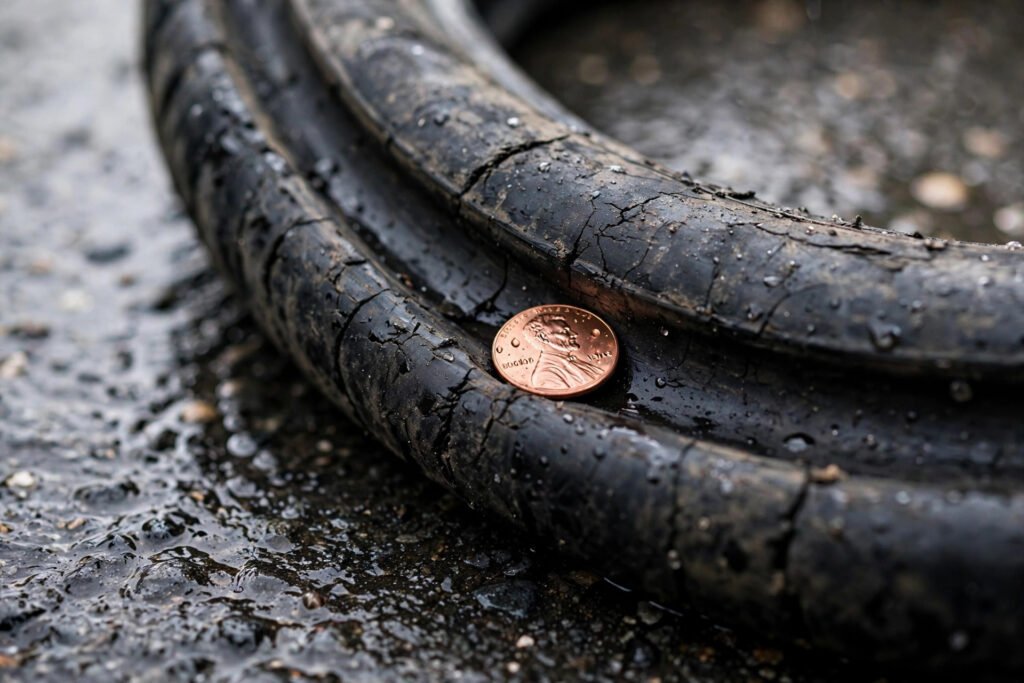
You can spot a bald tire in two minutes with a penny. If you can see the top of Lincoln’s head when the coin sits upside down in a tread groove, the tread is at or below 2/32 and the tire needs to go. This guide covers the signs to look for, the three quick tests, what uneven wear says about your car, how long tires last, and when replacement cannot wait.
In this guide, you’ll learn:
- What “bald” means in tread depth, and the two numbers that matter
- Seven signs your tires are bald or close to it
- How to check tread with a penny, a quarter, the wear bars, and a gauge
- How much longer bald tires take to stop in the rain
- What each uneven wear pattern says about pressure, alignment, or suspension
- How long car tires last in miles and years, and how to read the age code
- When to replace tires, and whether to change two or all four
- What to do right now if your tires are already bald
What “Bald” Actually Means
Tread depth is measured in 32nds of an inch. A new passenger tire has about 10/32 to 11/32 of an inch of tread, which gives the grooves room to push water out from under the tire. As the tire rolls, that tread wears down a little at a time. A tire is called bald when the tread is worn smooth enough that the grooves can no longer do their job.
Two depths matter more than any others:
- 2/32 of an inch: the floor. NHTSA says tires are not safe at this depth and should be replaced. Every tire sold in the US has small rubber wear bars molded into the grooves at exactly this height. When the tread wears down level with a wear bar, the tire is done. Most states use 2/32 as their legal minimum, though a few states set a deeper minimum, and some states require more tread for winter driving.
- 4/32 of an inch: the practical safety line. Below this depth, wet grip falls off fast. AAA and most tire makers recommend replacing tires here, especially if you drive in rain or snow. Waiting for 2/32 means driving for thousands of miles on tires that already stop poorly in the wet.
Age can make a tire unsafe even when the tread looks fine. Rubber hardens and cracks over time, and NHTSA notes that some vehicle and tire makers recommend replacing tires that are six to ten years old regardless of tread wear. A tire with deep tread and dry-rotted sidewalls is still a tire that needs replacing.
7 Signs Your Tires Are Bald
Bald tires rarely fail without warning. The signs show up in the tread, in how the car feels, and sometimes in the sound it makes.
1. The tread looks smooth. Run your hand across the tire. On a healthy tire you feel clear grooves and tread blocks. On a bald tire the surface feels flat and slick, with little or no groove depth left. Compare it with a newer tire and the difference is obvious.
2. The wear bars are flush with the tread. Look inside the grooves for thin rubber bars running across them. These are the treadwear indicators, set at 2/32 of an inch. If the tread surface is level with a bar anywhere on the tire, that tire is at the legal limit. Check several grooves, because the shallowest spot decides.
3. The penny test fails. Put a penny upside down in a tread groove with Lincoln’s head facing you. If you can see the top of his head, the tread is at or below 2/32 and the tire needs replacing. Test the center groove and both shoulders, since a tire can be bald in one spot and fine in another.
4. The rubber is cracked. Small cracks in the sidewall or between the tread blocks mean the rubber is aging and drying out. Cracking often shows up on tires that are six or more years old, even when the tread still measures fine. Cracks plus shallow tread mean replacement, not another season of driving.
5. The car feels loose in the rain. Bald tires hydroplane more easily, which feels like the steering suddenly going light or the car drifting for a moment on wet pavement. If the car has started to feel nervous in rain that never bothered it before, worn tread is a likely reason.
6. Stopping distances feel longer. You notice the car sliding a little further at stop signs in the rain, or the anti-lock brakes kicking in sooner than they used to. That is the tread losing its grip, and it gets worse with every 32nd of an inch that wears away.
7. You feel vibration or hear a hum. Uneven bald spots can make the car shake at highway speed or produce a droning hum that changes with speed. A vibration like this deserves a shop visit, since it can come from a worn tire, a balance problem, or a suspension part, and only an inspection tells them apart.
How to Check Bald Tires in 2 Minutes
You do not need special tools to get a good read on your tires. Pick a flat spot, check all four tires, and check each tire in several places, because wear is often uneven.
The penny test (2/32 of an inch): Place a penny in a tread groove with Lincoln upside down and facing you. If the top of his head is visible, the tread is at or below 2/32 and the tire needs replacing. This is the test NHTSA describes on its tire safety page.
The quarter test (4/32 of an inch): Place a quarter upside down in the groove with Washington’s head facing you. If the tread does not reach the top of Washington’s head, you are at or below 4/32. That is the point where most safety experts recommend planning a replacement, even though the tire is still above the legal floor.
The wear bars: Find the small raised bars inside the tread grooves. When the tread is worn level with a bar, the tire has reached 2/32. Wear bars are a pass or fail check. They tell you the tire is done, not how much life is left.
A tread depth gauge: A simple gauge costs a few dollars at any auto parts store and gives an exact reading in 32nds of an inch. Press the probe into the shallowest groove you can find and read the number. Measure the center and both shoulders of each tire and write down the lowest reading, because that is the number that matters.
| Tread depth | What it means | What to do |
|---|---|---|
| 10/32 to 11/32 | New tire, full tread | Nothing to do, check again in a few months |
| 6/32 to 8/32 | Healthy wear, good grip | Keep driving, check pressure monthly |
| 4/32 | Wet grip is dropping fast | Plan replacement soon, sooner if you drive in rain or snow |
| 2/32 | Legal minimum, NHTSA calls it not safe | Replace before regular driving continues |
| Below 2/32 | Bald, and illegal in most states | Replace now, do not drive at highway speed in the rain |
How Much Longer Bald Tires Take to Stop
The numbers are the reason this topic matters. Tread grooves push water out from under the tire. When they are gone, the tire rides on a thin film of water instead of gripping the road.
AAA tested all-season tires worn to 4/32 of an inch against identical new tires. From 60 mph on wet pavement, the worn tires needed about 87 extra feet to stop, roughly 43 percent more distance. At the moment the car on new tires had stopped, the car on worn tires was still moving at about 40 mph.
Tire Rack ran a similar test from 70 mph on a wet road with a BMW sedan. New tires stopped in 195.2 feet. Tires worn to 4/32 needed 290 feet. Tires at the 2/32 legal minimum needed 378.8 feet, nearly twice the distance of new tires. The same test on a Ford F-150 showed new tires stopping in 255.9 feet and tires at 2/32 needing 499.5 feet.
Dry roads hide the problem. A bald tire can feel almost normal on dry pavement, which is why so many people keep driving on them. The danger shows up the first time it rains, when stopping distances nearly double and the risk of hydroplaning jumps. That is why the 4/32 replacement line matters more than the 2/32 legal floor.
What Uneven Wear Is Telling You
A tire that is bald in one spot and fine in another is telling you something is wrong with the car, not just the tire. Putting new tires on without fixing the cause wears the new set out the same way. These are the common patterns and what usually causes them:
| What you see | Likely cause | First fix |
|---|---|---|
| Center worn, edges still deep | Overinflation, too much air | Set pressure to the number on the driver door sticker |
| Both shoulders worn, center still deep | Underinflation, too little air | Set pressure to the door sticker, check for a slow leak |
| One edge only, inside or outside | Camber or toe alignment out of spec | Wheel alignment, and a check of the parts that hold alignment |
| Sawtooth feel across the tread blocks | Toe misalignment, tire dragged sideways | Wheel alignment, specifically the toe setting |
| Cupping or scalloped dips around the tire | Worn shocks or struts letting the wheel bounce | Suspension inspection, replace worn shocks or struts |
| One bald flat spot | Hard braking or a wheel that locked up | Check brakes and balance, and have the tire inspected |
A full breakdown of these patterns, with photos of what each one looks like, is in our guide to tire tread wear patterns. If your tires show any pattern other than even wear, get an alignment and suspension check with the new tires, or the new set will wear out early too.
How Long Do Car Tires Last?
There are two clocks on a tire: miles and years. Whichever runs out first decides when it is done.
By miles: most all-season tires last 40,000 to 70,000 miles under normal driving. Touring tires built for long life often reach 60,000 to 75,000 miles or more, while performance tires usually last 20,000 to 40,000 miles. Your driving habits, the roads you use, and how well you maintain the tires move those numbers up or down. Proper inflation alone can add thousands of miles to a set, and regular rotation evens out wear between the front and rear axles.
By years: rubber ages even when a car sits still. NHTSA notes that some vehicle and tire makers recommend replacing tires six to ten years after manufacture, regardless of tread depth. Michelin advises a professional inspection once tires pass five years of service and replacement at ten years no matter how good they look. A spare tire ages the same way, so check its date code too.
How to read the age: look for the DOT code on the sidewall. The last four digits are the week and year the tire was made. A code ending in 2622 means the tire was built in the 26th week of 2022. If the code is only three digits, the tire was made before 2000 and should have been replaced long ago.
Tires usually wear out their tread in three to four years for a driver covering 12,000 to 15,000 miles a year, well before age becomes the issue. Low-mileage cars are the opposite: the tread can look fine while the rubber quietly ages past its safe life. Check both numbers, not just one.
When to Replace Them
Replace tires at 4/32 of an inch if you drive in rain, and sooner if winter driving is ahead. At 2/32, replacement is not a suggestion. It is the point NHTSA calls not safe, and in most states it is also the legal limit. A tire that fails the penny test, has a wear bar flush with the tread, or shows sidewall cracking should be replaced before your next long drive.
Two or all four? Replacing all four at once is the simplest choice and keeps handling even. If only two are worn, replace them as a pair on the same axle, and put the new pair on the rear axle, even on a front-wheel-drive car. New tires on the rear keep the back of the car from stepping out in the wet, which is the harder skid to catch. Never mix a new tire with a bald one on the same axle.
Always get an alignment with new tires if the old set showed uneven wear, the car pulls to one side, or the steering wheel sits off center. An alignment costs far less than a second set of tires worn out early by the same bad angle. Have the wheels balanced at the same time, since an unbalanced wheel shakes and wears unevenly.
Keep the new set alive longer. Check pressure monthly against the number on the driver door sticker, not the maximum printed on the tire sidewall. Learn how to check tire pressure the right way, rotate the tires on the schedule in your owner’s manual, and read our guide on how often to rotate tires if you are not sure of the interval. Small habits like these are what stretch a set from 40,000 miles toward 70,000.
What to Do Right Now If Your Tires Are Bald
If your tires fail the penny test today, do not wait for a convenient week. Book a replacement, and until the new tires are on, drive like the grip is gone, because in the rain it nearly is.
Slow down well before you would on good tires, and leave extra space behind the car ahead. Avoid standing water and deep puddles, since hydroplaning starts where water pools. On the highway in heavy rain, drop your speed and stay out of the ruts where water collects. Skip hard braking and sudden steering moves, which are the inputs a worn tire cannot handle.
If a tire is bald and also losing air, bulging, or showing cord, do not drive on it at all. Fit the spare and respect its limits, which are usually 50 mph and 50 miles for a compact spare. Our guide on how far you can drive on a spare tire covers the exact limits for your situation.
A tire shop can measure all four tires in a few minutes and tell you exactly where each one stands. Most shops check tread depth free, and many will flag uneven wear and the alignment or suspension fault behind it in the same visit. That one check is the fastest way from guessing to knowing.
FAQ
Are bald tires illegal?
In most states, yes, once tread drops below 2/32 of an inch. States enforce tire rules themselves, and the exact limit and penalty vary. Some states with safety inspections will fail a car on bald tires, and some states require deeper tread for winter driving. Even where no officer would ever measure your tires, the safety risk is the same.
Can I drive on bald tires in dry weather?
A bald tire grips reasonably well on dry pavement, which is exactly why it is tempting to keep driving on one. The problem is that weather changes. The first rain turns a tire that felt fine into one that needs nearly twice the distance to stop. If you must drive a short distance on a bald tire, keep your speed down, avoid highways in the rain, and replace it as soon as possible.
How long can you drive on bald tires?
There is no safe mileage number. A tire at 2/32 is already at the point NHTSA calls not safe, and every mile after that wears it further. Treat it as a trip to the tire shop, not a few more weeks of commuting. The risk is a blowout or a loss of grip in the rain, and neither gives much warning.
Is it OK to replace just one tire?
Only if the other tire on that axle is nearly new, the same brand and model, and has nearly the same tread depth. A large difference in tread depth on one axle makes the car pull and wears the drivetrain unevenly. In most cases, replacing tires in pairs is the right call, and replacing all four is best when the whole set is worn.
Do bald tires affect gas mileage?
Worn tires can slightly improve rolling resistance on dry roads, but any fuel saving is tiny and not worth the safety trade. Underinflated tires, which often go with neglected tires, do the opposite and cost you fuel. Keep your tires at the pressure on the door sticker and replace them when the tread runs out.

lily John
The Fixtorial team writes hands-on car troubleshooting guides for everyday drivers — symptom first, honest costs, and fixes you can verify yourself.


