
Differential Repair: 7 Warning Signs to Act On
Updated Nov 21, 2026
In This Guide
- The Quick Answer: A Noisy Differential Is a Warning, Not a Quirk
- What a Differential Does
- 7 Signs Your Differential Needs Repair
- Differential Repair: What Causes Differential Problems
- How a Shop Diagnoses a Differential
- Differential Repair Costs in 2026
- Repair, Rebuild, or Replace: How to Decide
- When to Stop Driving Right Away
- What You Can Check Yourself
- Frequently Asked Questions
The Quick Answer: A Noisy Differential Is a Warning, Not a Quirk
Differential repair is about the set of gears that lets your left and right drive wheels turn at different speeds. That sounds like a small job, but it is what lets your car turn a corner without dragging a tire. When those gears, their bearings, or the seals that hold their oil start to fail, the car tells you about it. It whines, it grinds, it clunks, or it leaves a dark stain on the driveway.
A differential problem caught early is often a seal or a bearing, and the bill stays in the hundreds. The same problem ignored for a few thousand miles can wear the gears themselves, and then the bill runs into the thousands. That gap is the whole reason to act on the first sign instead of turning the radio up.
Most differential repairs are shop work. The gears inside are set to tolerances measured in thousandths of an inch, and getting that setup wrong ruins a new gear set in weeks. What you can do is recognize the symptoms, understand what the shop is telling you, and know when the car should not be driven at all.
In this guide, you’ll learn:
- What a differential does, in plain terms
- The warning signs that point to the differential
- What causes differentials to fail
- How a shop figures out what is wrong
- What differential repair costs in 2026
- How to choose between repair, rebuild, and replacement
- When to stop driving right away
What a Differential Does
When your car goes around a corner, the wheel on the outside of the turn travels farther than the wheel on the inside. If both wheels were locked together, one of them would have to skid. The differential solves this. It is a gear set inside the axle housing, or inside the transmission on many front-wheel-drive cars, that splits the engine’s power between the two drive wheels while letting them turn at different speeds.
The heart of it is the ring gear and the pinion gear. The driveshaft spins the pinion, the pinion turns the ring gear, and the ring gear drives the axle shafts through a set of smaller gears. Those small gears, called spider gears, are what allow the speed difference between the two wheels. The whole assembly runs in a bath of thick gear oil, and that oil is the only thing keeping metal from grinding on metal.
Most cars have one differential. Rear-wheel-drive cars have it in the rear axle. Front-wheel-drive cars have it built into the transaxle. All-wheel-drive cars have three: front, center, and rear. The symptoms and the repair costs are similar in all three places, but front and rear differentials do not always cost the same to fix, and units with electronic controls or limited-slip clutches can cost considerably more.
The differential is not a part that wears out on a schedule. With clean oil at the right level, it often lasts the life of the car. Most failures trace back to one of three things: low or dirty oil, a seal that let the oil out, or a bearing that wore down and let the gears run out of alignment. Age and mileage matter, but neglect matters more. Heavy towing, frequent hard launches, and driving with badly mismatched tires all add load that shortens its life.
7 Signs Your Differential Needs Repair
Differential trouble has a sound, a feel, and sometimes a smell. Here are the signs that point at it, roughly in the order drivers notice them.
1. A whine or howl that changes with speed. This is the classic symptom. A high-pitched whine that rises and falls with road speed, not engine speed, usually means the ring and pinion gears are worn or their mesh is off. YourMechanic notes that a whining differential is most often caused by low or dirty gear oil, and the sound gets louder as speed rises. A whine that shows up only while accelerating points at the drive side of the gears. A whine that shows up mainly when you lift off the gas points at the coast side. Either way, it is a sign the gears are running without proper lubrication or proper alignment, and it should be checked soon.
2. Grinding, especially in turns. Grinding is a step past whining. It means metal parts are touching that should never touch. Grinding that gets worse in a turn often points at the spider gears or at a bearing that has failed badly enough to let parts move. Grinding is a stop-driving symptom. Continuing to drive grinds metal through the housing and turns a bearing job into a full replacement.
3. Clunking when you shift or change speed. A single clunk when you shift from reverse to drive, or when you press and release the gas, often means excessive play in the gears or worn splines. Some play is normal in an older differential, but a loud clunk that is getting worse means the clearance has grown past what the parts can tolerate. Broken spider gears can also clunk loudly in turns, and a broken ring gear tooth can make a regular banging sound every few feet.
4. Vibration that grows with speed. A worn differential can send a vibration through the floor and the seat that gets stronger as you go faster. This one is easy to mistake for other problems. A wheel bearing noise also grows with speed, and a bad tire can feel similar. The difference is that differential vibration often changes when you press or release the gas, because the load on the gears changes. A shop can tell them apart by listening with the car on a lift.
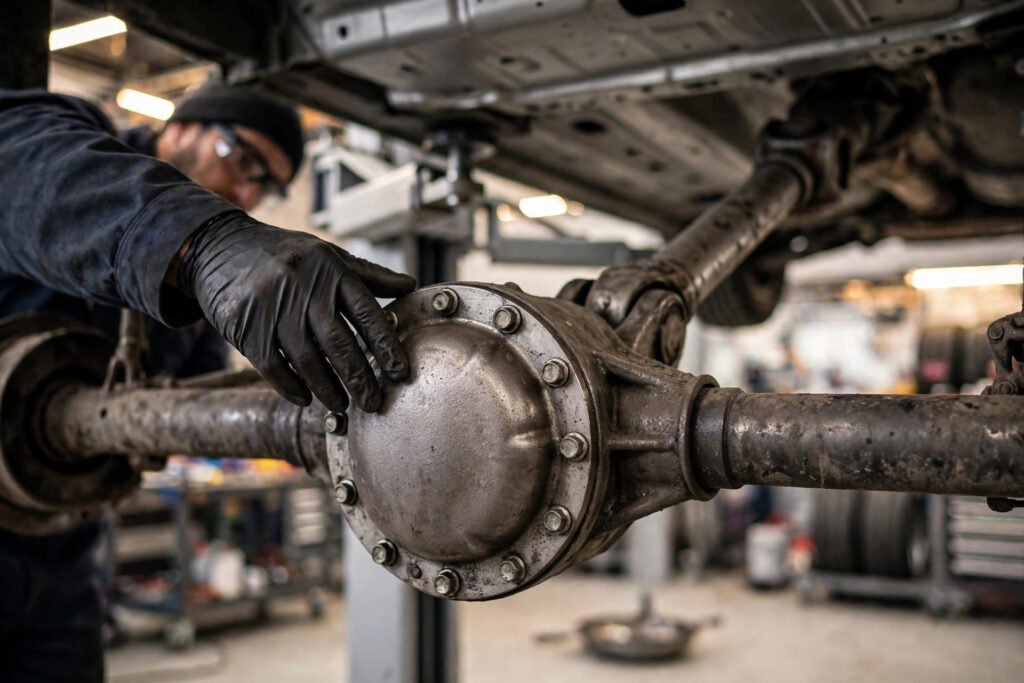
5. A fluid leak under the axle. Gear oil is thick and dark, and it smells strongly, a bit like sulfur. A leak at the round cover on the back of the axle usually means the cover gasket or sealant has failed. A leak where the driveshaft enters the housing points at the pinion seal. A leak where an axle shaft comes out points at an axle seal. Any leak matters, because the differential holds only a small amount of oil, and losing even part of it starves the gears. A leak that leaves the housing nearly dry will kill the gears fast.
6. A burning smell from under the car. Low gear oil lets the gears overheat, and overheated oil smells burnt. YourMechanic lists a burning smell from the gearbox or differential as a warning sign of low or failed gear oil. If you smell it after a drive, check for a leak and have the fluid level checked before driving much farther.
7. The car handles oddly in turns. A differential that is binding or locking up can make the car feel like it is fighting you in a tight turn, with tires chirping or skipping on dry pavement. On a limited-slip differential, worn clutch packs can chatter or grab in slow turns. Handling changes are less common than noise, but they are a real symptom, and they make the car unpredictable.
One more thing worth saying plainly: not every noise from the back of the car is the differential. Tires, wheel bearings, and the driveshaft can all make similar sounds. That is why a proper diagnosis matters, and why you should not approve a differential rebuild based on a noise alone.
Differential Repair: What Causes Differential Problems
Most differential failures come down to a short list of causes, and knowing them helps you understand what the shop finds.
Low or dirty gear oil. This is the leading cause. Oil leaks out through a worn seal, or it is never changed and slowly fills with metal particles and moisture. Without clean oil at the right level, the gears and bearings wear fast. YourMechanic puts it simply: whining caused by a lack of lubrication gets worse as speed increases, and it should be inspected as soon as possible.
Worn pinion or carrier bearings. Bearings hold the gears in exact position. When they wear, the gears shift a fraction of an inch out of alignment, and that tiny shift changes how the gear teeth meet. A worn pinion bearing often makes a whirring sound at all speeds, including while coasting. Worn carrier bearings often make a low rumble above about 20 mph. Bearing wear is the most common reason a differential gets noisy with age.
Worn or damaged ring and pinion gears. Gears wear when they run dry, when they were set up wrong after a previous repair, or when the car has been overloaded or driven hard for years. A gear set that was quiet and starts to howl is usually worn. A gear set that howls only while decelerating may have a preload problem instead. Either way, worn gears are not something a fluid change fixes.
Failed seals. The pinion seal, axle seals, and cover gasket all age, harden, and leak. A seal is cheap. The damage it causes by letting the oil out is not. This is why a small leak is worth fixing right away.
Broken spider gears or a broken ring gear tooth. This is the severe end. Broken spider gears can lock the differential or make a loud crunching sound, and they can leave the car unable to move. A broken ring gear tooth often lets the car move a few feet, then bangs as the damaged section tries to engage. Both mean the differential has to come apart.
Limited-slip clutch wear. On a limited-slip differential, clutch packs control how much slip is allowed between the wheels. When they wear, or when the wrong fluid is used, the clutches chatter and grab in tight turns. This is a fluid and clutch problem, not a gear problem, and it is fixed differently.
How a Shop Diagnoses a Differential
A good diagnosis follows a sequence, and it is worth knowing what that sequence looks like so you can tell a careful shop from a guessing one.
First, the shop listens. A technician drives the car and notes when the noise happens: accelerating, coasting, turning, at what speed. Noise that changes with throttle points at the gears. Noise that stays constant points at a bearing. Noise that follows steering angle and gets faster with wheel speed usually points at an axle or a CV joint instead, not the differential.
Second, the shop checks the fluid. They pull the fill plug, check the level, and look at the oil. Clean gear oil is dark but smooth. Oil full of metal glitter or flakes means internal parts are wearing badly. Burnt-smelling oil means the gears have been running hot. Low oil with no visible leak means the seals need a close look.
Third, the shop inspects the outside. They look for leaks at the cover, the pinion seal, and the axle seals, and they check the driveshaft and the mounts. A loose driveshaft or a worn mount can make noises that sound like a differential problem but are not.
Fourth, if the noise is still unexplained, the shop opens the housing. With the cover off, a technician can see the gear teeth, check the bearings for roughness, and measure the backlash, which is the tiny amount of play between the ring and pinion gears. This is the step that separates a seal job from a rebuild, and it is why a quote given before the cover comes off is only an estimate.
You do not need to understand backlash to make a good decision. You need a shop that can explain, in plain words, which part failed and why, and that shows you the worn part when the job is done.
Differential Repair Costs in 2026
Differential repair costs vary widely because the range runs from a single seal to a whole new assembly. The figures below are planning ranges from 2026 sources, not quotes for your car. Your actual price depends on the vehicle, whether the differential is front or rear, whether it is a limited-slip or electronically controlled unit, and local labor rates.
| Repair | Typical range | What it covers |
|---|---|---|
| Differential fluid change | $100–$300 | Drain and refill with fresh gear oil |
| Cover reseal (gasket or sealant) | $200–$500 | New gasket, fresh fluid, cover condition checked |
| Pinion seal replacement | $419–$558 | RepairPal September 2026 national estimate; seals the driveshaft entry point |
| Axle or output seal repair | $300–$800 | Seal replacement, axle removal, fluid refill |
| Bearing replacement | $200–$400 | One worn bearing plus labor, per Mechanic Base |
| Gear set replacement | $800–$1,500 | New ring and pinion gears, plus setup labor |
| Complete rebuild | $1,000–$2,500 | Bearings, seals, and gears as needed, reassembled and set up |
| Whole differential replacement | $1,000–$4,000 | Used, rebuilt, or new assembly installed |
| New assembly, installed | $3,000–$4,000 | New unit with new parts, per CarBrain |
Mechanic Base, updated in October 2026, puts most minor differential repairs at $200 to $400, a rebuilt differential at $400 to $1,000, and a full rear differential replacement at $1,000 to $4,000. RepairPal’s September 2026 national estimate for a pinion seal replacement is $419 to $558 before taxes and fees. Oards, updated in April 2026, lists a fluid change at $100 to $300, seal work at $200 to $500, gear replacement at $800 to $1,500, a full rebuild at $1,000 to $2,500, and replacement at $1,500 to $4,000.
A few things push the price up. Four-wheel-drive and all-wheel-drive cars have more differentials and tighter access. Luxury and performance cars use more expensive parts. A limited-slip or electronically controlled unit costs more than a standard open differential. And if the housing itself is cracked or the gears have sent metal through the whole assembly, the repair can climb past the ranges above. Always get the quote in writing, with parts and labor listed separately, before approving the work.
Repair, Rebuild, or Replace: How to Decide
The right call depends on what failed and what the car is worth. Here is how the three options usually break down.
Repair makes sense when one part failed and the gears are still good. A leaking seal, a worn bearing caught early, or a bad cover gasket are all repairs. The gears are inspected, the failed part is replaced, the fluid is changed, and the car goes back on the road. This is the cheapest outcome, and it is the reason early diagnosis pays.
A rebuild makes sense when the bearings and gears are worn but the housing is sound. The shop takes the unit apart, replaces the bearings, seals, and any damaged gears, and sets the gear mesh back to specification. A rebuild costs more than a single repair but much less than a new assembly, and it is the standard fix for a differential that has been run low on oil for a while.
Replacement makes sense when the housing is damaged, the gears are destroyed, or the car needs to be back on the road fast. A used assembly is the cheapest replacement, usually around $1,500 to $2,000 installed with a short warranty. A rebuilt assembly costs more and usually carries a better warranty. A brand-new assembly is the most expensive and the most reliable. For an older car, the replacement cost can be more than the car is worth, and that is a real factor in the decision. Get the numbers, compare them with the car’s value, and decide with the full picture in front of you.
One warning about the cheapest option: a used differential from a salvage yard is only as good as its history. Ask about the mileage, the warranty, and whether the fluid was checked. A used unit with worn gears is just a second repair waiting to happen.
When to Stop Driving Right Away
Most differential symptoms give you time to book an appointment. A few do not.
Stop driving if you hear grinding. Grinding means parts are destroying each other. Every mile makes the repair bigger.
Stop driving if the differential locks up or the car binds in turns. A locked differential can break an axle or send the car sideways. Pull over safely and have the car towed.
Stop driving if you find a large puddle of gear oil under the car. A differential with no oil will destroy its gears in a very short drive. Tow it.
Stop driving if the noise appeared suddenly and is getting louder by the mile. A sudden change means something broke, not something wore out. A broken tooth or a failed bearing can seize without much warning.
For anything less severe, drive gently and keep the trip short. Avoid hard acceleration, heavy loads, and high speeds until a shop has looked at it. And if the car has a dashboard warning light tied to the drivetrain, treat that the same way you would any warning light: get it checked before a long drive.
What You Can Check Yourself
You do not need to open a differential to learn something useful. A few simple checks can tell you whether the problem is urgent and give the shop a head start.
Check the ground where you park. A dark, thick stain under the rear axle, or under the front on a front-wheel-drive car, points at a leak. Gear oil smells strong and sharp, different from engine oil. Wipe a little on a white paper towel: fresh gear oil is amber to dark brown, while old or contaminated oil is black and may carry metal glitter.
Listen on a quiet road. Drive at a steady speed, then lift off the gas and coast. Note whether the noise follows speed or follows the engine. Then take a slow, tight turn in a parking lot and listen for clicking, chattering, or binding. Write down what you heard and when. A shop will ask exactly these questions.
Check your tires. Uneven tire wear and badly mismatched tires put extra load on the differential, and a vibration that you think is the differential can turn out to be a tire problem. If your car shakes at low speeds, that points more at tires or wheels than at the differential, but it is worth ruling out before any differential work starts.
Do not open the differential yourself. The fill and drain plugs are simple, but the setup inside is not, and the fluid is hot after a drive. Checking the level and the condition of the oil is a shop job unless your owner’s manual describes it as owner service. The diagnosis, the gear setup, and the rebuild all belong to a technician with the right tools.
Frequently Asked Questions
How long can I drive with a bad differential?
It depends on the symptom. A small leak or a faint whine may let you drive gently to a shop appointment. Grinding, binding, or a large leak means you should not drive the car at all. There is no safe mileage number for a failing differential, because the failure can go from noisy to seized quickly. Book the appointment as soon as you notice a symptom.
Is it worth fixing a differential on an old car?
Compare the repair cost with the car’s value. A $300 seal repair is worth it on almost any running car. A $3,000 replacement on a car worth $2,500 is usually not, unless the car has value to you beyond its market price. Get the quote first, then decide with real numbers.
Can I just change the differential fluid and fix the noise?
Sometimes a fluid change quiets a differential that is noisy because the oil is old or low. But if the noise comes from worn bearings or worn gears, fresh oil will not fix it. A fluid change is a reasonable first step when the noise is mild and the oil is clearly dirty, but if the noise stays after the change, the problem is mechanical.
Does a bad differential affect the transmission?
It can. On a front-wheel-drive car, the differential sits inside the transaxle, so a differential failure can send metal into the transmission. On any car, a failing differential puts extra load on the driveshaft and the axles. That is another reason to fix it early rather than waiting for it to fail completely.
How do I know if the noise is the differential or a wheel bearing?
A wheel bearing noise is usually a steady hum or growl that rises with speed and does not change much when you press or release the gas. A differential whine often changes with throttle, showing up on acceleration or on coast. The two can sound alike, which is why a shop diagnosis, with the car on a lift, is the reliable way to tell them apart.
What is the difference between a differential repair and a rebuild?
A repair replaces one failed part, such as a seal or a bearing, while the gears stay in place. A rebuild takes the whole unit apart, replaces the bearings, seals, and any damaged gears, and sets the gear mesh back to specification. A repair is cheaper and faster. A rebuild is the fix when several parts are worn or the gears themselves are damaged.
Do front and rear differentials cost the same to repair?
Not always. Rear differentials on rear-wheel-drive cars are often easier to reach, which can mean less labor. Front differentials, especially on all-wheel-drive cars, can be harder to access and may be built into the transmission, which adds labor. Electronically controlled and limited-slip units cost more in both positions.

lily John
The Fixtorial team writes hands-on car troubleshooting guides for everyday drivers — symptom first, honest costs, and fixes you can verify yourself.


