Car Battery Swelling: 7 Causes and What to Do Now
Updated Nov 22, 2026
In This Guide
- How to Tell If Your Battery Is Actually Swollen
- Quick Symptom Match
- 1. Overcharging From a Faulty Voltage Regulator
- 2. Extreme Heat
- 3. Age and Sulfation
- 4. The Wrong Charger, or Charging That Never Stops
- 5. Internal Short Circuit or Manufacturing Defect
- 6. Blocked Vents and Sealed-Battery Pressure
- 7. Physical Damage and Vibration
- What to Do Right Now: Step by Step
- What Car Battery Swelling Costs to Fix
- When to Go to a Shop (or Call a Tow)
- Frequently Asked Questions
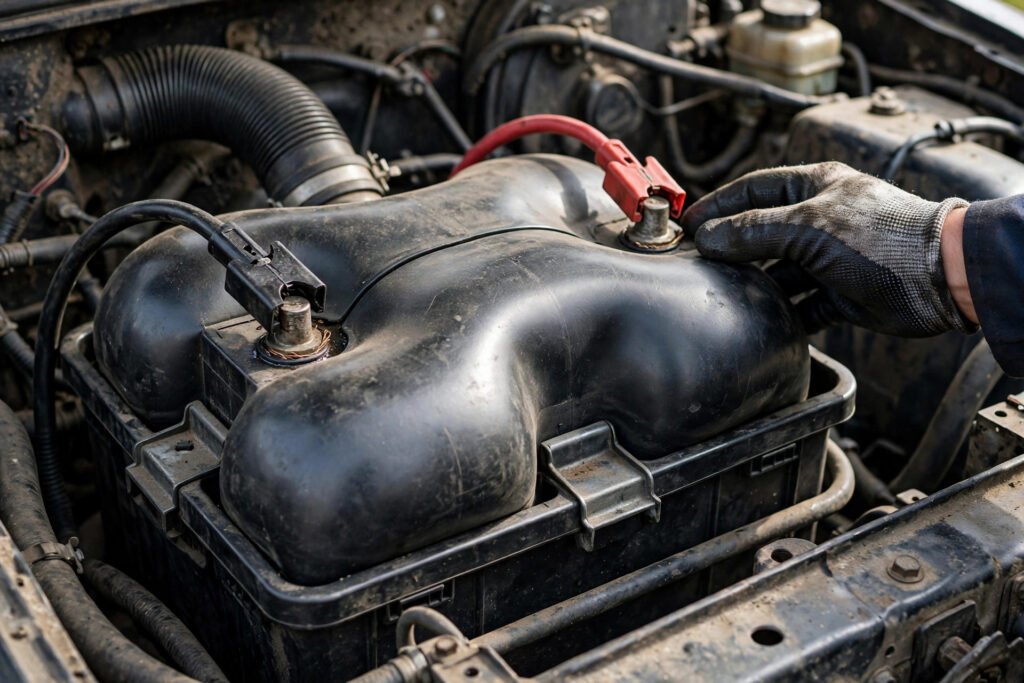
Car battery swelling: open the hood and the battery does not look like it used to. The sides bow outward, the top bulges, the hold-down clamp no longer sits flat, or the case looks stretched and distorted. A car battery is not supposed to change shape. When it swells, gas is building up inside faster than it can escape, and the case is under pressure. That is a safety problem first and a starting problem second: a swollen battery can leak corrosive acid, vent flammable hydrogen gas, and in rare cases rupture.
The good news is that swelling tells a clear story. In most cars it points at one of a handful of causes — usually overcharging from a faulty voltage regulator, extreme heat, or a battery that is simply old — and the fix follows a clear order: make it safe, replace the battery, then find and fix whatever damaged it, or the new battery will swell the same way.
In this guide, you’ll learn:
- How to tell a genuinely swollen battery from a normal battery shape
- The 7 most likely causes, and which one fits your symptoms
- What to do right now — and the things you must never do to a swollen battery
- How to check whether your charging system caused the swelling
- What a replacement costs, and why the cheapest fix can be the most expensive mistake
- When to stop, leave the battery alone, and call a shop or a tow
Safety first: A swollen battery is damaged goods, not a battery with a bit of life left in it. Do NOT charge it, jump-start from it, puncture it, squeeze it, or try to press it back into shape — charging adds more gas to a case that is already under pressure, and puncturing it can release sulfuric acid and flammable hydrogen gas. If the battery is hot to the touch, hissing, cracked, leaking, or giving off a strong rotten-egg smell, do not touch it at all: close the hood, keep sparks, flames, and cigarettes away, ventilate the area if you can do so safely, and call a shop or roadside service. The steps below for disconnecting a battery apply only to a cool, intact, non-leaking swollen battery, and only with gloves and eye protection on. If your car is a hybrid or electric vehicle, do not touch the high-voltage battery pack — this guide covers the conventional 12-volt battery only, and high-voltage work is dealer or specialist territory.
How to Tell If Your Battery Is Actually Swollen
Battery cases are not perfectly flat boxes, so compare, don’t guess. A healthy battery has straight, flat sides and a top that sits level. A swollen battery shows one or more of these:
- Sides that bow outward, so the battery looks fatter in the middle than at the ends
- A top that domes upward or a lid that lifts at the edges
- A hold-down clamp or bracket that no longer sits flat, or a battery that no longer fits its tray neatly
- Cracks, splits, or white, blue, or green crust around the terminals that appeared alongside the bulge
- A case that feels tight or distorted when you look at it from the end — sighting along the side makes a bow obvious
Swelling is not always dramatic. A slight bow on one side still counts: the case is a sealed pressure vessel, and any visible distortion means internal pressure has already deformed it. If you are unsure, compare it with a photo of the same battery model, or ask a parts store to look at it — most will inspect a battery free of charge, and they see swollen cases regularly.
One caution: do not press on the bulge to test it. A swollen case is already stressed, and pressing it can crack it or force acid out through a weak seam. Look, don’t squeeze.
Quick Symptom Match
| What you notice | Most likely cause | What to check first |
|---|---|---|
| Battery swollen + battery warning light on | Overcharging from a faulty voltage regulator | Charging voltage with the engine running |
| Battery swollen + unusually bright lights or bulbs burning out often | Overcharging — voltage too high | Charging voltage; anything above about 14.8 volts is suspect |
| Battery swollen after a long hot summer, or in a hot engine bay | Heat damage, possibly plus age | Battery age; charging voltage to rule out overcharging |
| Battery swollen + heavy corrosion on the terminals | Overcharging — excess gas and acid vapour accelerate corrosion | Charging voltage, then terminal condition |
| Battery swollen + rotten-egg smell | Gas venting from overcharging or an internal fault | Do not touch if hot, leaking, or hissing — get professional help |
| Battery swollen on a battery more than 4–5 years old | Age and sulfation, with heat or charging stress on top | Age first, but still test the charging system before fitting a new battery |
| Battery swollen soon after fitting a new charger, or after long charging sessions | Wrong or unregulated charger | Charger type and settings; charging voltage |
| Battery swollen but the car still starts and runs normally | Early-stage swelling — the fault is present even if symptoms are mild | Charging voltage now, before the case cracks or the battery fails outright |
| Battery swollen + car keeps killing new batteries | Charging-system fault destroying batteries one after another | Charging-system test before buying another battery |
1. Overcharging From a Faulty Voltage Regulator
The most common cause, and the one you must rule out first. Your alternator generates electricity, and the voltage regulator holds its output steady — roughly 13.5 to 14.5 volts with the engine running — regardless of engine speed. When the regulator fails, it can stick in a mode that feeds the battery too much voltage, hour after hour. Inside the battery, that excess energy splits the water in the electrolyte into hydrogen and oxygen gas. In a sealed battery the gas has nowhere to go, pressure builds, and the case swells.
The giveaway: swelling plus other signs of too much voltage — headlights that seem unusually bright, bulbs that burn out far too often, a battery warning light, rapid terminal corrosion, or a rotten-egg smell near the battery. If you have already replaced a battery once and the new one is swelling too, a regulator fault is the prime suspect: batteries do not fail in sequence by coincidence.
The fix: test the charging system before replacing anything. A multimeter across the battery terminals with the engine running should read a steady 13.5 to 14.5 volts. A reading that climbs above about 14.8 volts, or keeps rising with engine speed, points at the regulator. Most parts stores test batteries and alternators free of charge. On most modern cars the regulator is built into the alternator, so the repair is usually a complete alternator replacement — for the full picture, see our guide to alternator failure symptoms. Never fit a new battery to an overcharging car and hope for the best: the new battery will swell the same way, and the excess voltage can damage the car’s electronics in the meantime.
2. Extreme Heat
Heat is a battery’s quiet enemy. High under-hood temperatures accelerate the chemical reactions inside the battery, increasing gas production and pressure, and they degrade the internal plates at the same time. A battery that lives in a hot engine bay, in a car parked in direct sun in a hot climate, or next to a failing cooling component that raises under-hood temperatures, swells sooner than the same battery in a cooler car.
The giveaway: swelling that appears after a long hot summer, or on a car where the battery sits close to the exhaust or turbocharger, or where the engine has been running hotter than normal. Heat damage often arrives together with age — a battery that was already old when the heat hit it.
The fix: there is no reversing heat damage; a swollen battery is replaced, not repaired. The useful question is whether heat acted alone or with overcharging, because that decides whether the new battery needs anything else. Test the charging system, and check that the battery is the correct type and size for the car and that its heat shield, if the car came with one, is still in place — a missing heat shield is a small part that shortens battery life measurably in hot engine bays.
3. Age and Sulfation
Lead-acid batteries age from the inside out. As they cycle through charging and discharging, lead sulfate crystals build up on the plates — sulfation — reducing the battery’s ability to hold a charge. The battery works harder, runs hotter, and generates more gas for the same work. A battery more than about four or five years old is well into the age range where swelling becomes plausible, especially if it has been deeply discharged and recharged repeatedly.
The giveaway: swelling on an older battery, often alongside other age signs — slow cranking, a car that needs jump-starts after sitting, or a battery that tests weak under load even though its resting voltage looks fine. If your battery also dies when the car sits, see our guide to a car battery that keeps dying overnight — a drain and an aged battery can look alike, and the age check comes first because it costs nothing.
The fix: replacement, with a charging-system test alongside it. Age alone is a sufficient reason to replace a swollen battery, but age does not excuse skipping the charging test: an old battery can hide a regulator fault that will eat the new battery too. When buying, match the group size, terminal layout, and rating for your car, and keep the receipt — a swollen battery that is still within its warranty period may be covered, and the warranty claim is worth asking about.
4. The Wrong Charger, or Charging That Never Stops
External chargers cause swelling when they push current into a battery that is already full. Old-style unregulated chargers, a charger set to the wrong voltage or battery type, or a charger left connected for days without an automatic shutoff, all keep forcing energy into a battery that has nowhere to put it. The result is the same gas buildup as alternator overcharging, just from a different source.
The giveaway: swelling that appeared after the battery spent a long time on a charger, or after a new charger was introduced. Flooded, AGM, and lithium 12-volt batteries have different charging profiles, and a charger set for the wrong type is a classic cause.
The fix: stop using that charger on that battery. For future charging, use a smart charger — one that tapers off and shuts down when the battery is full — and set it to the correct battery type. If the car itself is also showing overcharging symptoms, test the alternator as well: a car can have both a bad charger habit and a bad regulator, and fixing only one leaves the other to swell the next battery.
5. Internal Short Circuit or Manufacturing Defect
Sometimes the fault is inside the battery from the start, or develops there. A manufacturing defect — a weak case, a flawed separator between plates, contaminated electrolyte — can let gas build up under normal charging. An internal short, where plates touch or sediment bridges them, generates heat in one cell, and that heat generates gas and pressure in a case that was never designed to contain it.
The giveaway: swelling on a relatively new battery with a healthy charging system and no heat or charger story — especially if one cell or one section of the case bulges more than the rest, or the battery failed suddenly rather than fading over months. A battery that swells within its warranty period deserves a warranty conversation, not just a replacement purchase.
The fix: replacement, and keep the old battery and the receipt. If the battery is nearly new, take it back to the seller with the charging-system test result: a clean charging test strengthens a defect claim considerably, because it rules out the usual external causes. Do not attempt to open, drain, or repair a defective battery yourself.
6. Blocked Vents and Sealed-Battery Pressure
Flooded batteries vent gas through caps; sealed AGM and other valve-regulated batteries vent through a pressure-relief valve. If a vent is blocked — by dirt, corrosion, a misfitted cap, or a battery installed in a way that traps gas — pressure that would normally escape in small amounts builds up instead. The battery may be charging perfectly normally and still swell, because the escape route is closed.
The giveaway: swelling with a normal charging voltage and a battery that is not particularly old, plus visible dirt or crust around the vent area or caps, or a battery fitted without the ventilation tube its housing was designed for.
The fix: this is a diagnosis for a technician to confirm, not a reason to poke at vents yourself — opening a sealed battery’s valve or drilling a vent is dangerous and destroys the battery. What you can do is note the vent condition when you describe the fault, and make sure the replacement battery is fitted with its ventilation arrangement intact and unobstructed, exactly as the car manufacturer intended.
7. Physical Damage and Vibration
A battery that has been dropped, struck, over-tightened in its clamp, or shaken loose in its tray can develop internal damage that leads to swelling. A cracked internal plate, a loosened active-material layer, or a case weakened by an impact creates a local hot spot or a short, and the damaged cell generates gas. Vibration alone rarely swells a healthy battery, but vibration plus a loose hold-down plus age is a combination that finishes off a weak one.
The giveaway: swelling after an accident, a rough off-road trip, or a battery replacement where the hold-down was over-tightened or left loose, or a battery that rattles in its tray. A case that is both swollen and cracked, or swollen on one side only, points more toward damage than toward a system-wide charging fault.
The fix: replacement, plus fixing the mounting. The new battery must sit firmly in its tray with the hold-down snug — tight enough that the battery cannot move, not so tight that the case is stressed. Check the tray for corrosion or damage while the old battery is out, and clean it before fitting the new one.
What to Do Right Now: Step by Step
- Stop using and charging it. Do not start the car to “see if it still works,” do not jump-start from it, and do not connect a charger. Every additional charge adds gas to a pressurised case.
- Look, don’t touch, if anything is wrong beyond the bulge. If the battery is hot, hissing, cracked, leaking, or smells strongly of rotten eggs, close the hood and call a shop or roadside service. Do not disconnect it yourself in that state.
- If it is cool, intact, and not leaking, you may disconnect it — carefully. Put on gloves and eye protection first. With everything switched off, disconnect the negative terminal first, then the positive, and keep the battery upright at all times. Do not tilt it, drop it, or set it on its side: acid can escape through a weakened seam.
- Keep it away from heat, sparks, and flames. Store it upright in a cool, ventilated place away from flammable materials until you can take it for recycling. Do not store it in a living space or a sealed container.
- Never put it in the regular trash. Lead-acid batteries are hazardous waste and are also highly recyclable — most parts stores and garages take old batteries for recycling, often free of charge when you buy the replacement. If acid has leaked, neutralise it with baking soda before wiping it up with a disposable cloth, and dispose of the cloth with the battery, not in household waste.
- Test the charging system before fitting the new battery. This is the step that prevents a repeat. A free battery and alternator test at a parts store, or a multimeter reading of 13.5 to 14.5 volts with the engine running, tells you whether the regulator is at fault. If the voltage is high, fix the charging system first.
- Fit the correct replacement. Match group size, terminal positions, and cold-cranking rating to your car, keep the hold-down snug, and clean the terminals and clamps while you are there — see our guide to corroded battery terminals for the cleaning steps. A new battery on corroded clamps inherits the old fault.
What Car Battery Swelling Costs to Fix
Cost depends on whether the battery is the whole story or just the visible part of a charging-system fault, which is why a single price would be misleading. Published guides put a replacement 12-volt battery alone at roughly $45 to $250 depending on size, type, and quality, with shop-installed battery replacement commonly estimated in the $250 to $310 range for ordinary sedans on RepairPal’s estimator — your exact car and location move that figure. If the voltage regulator is at fault, published guide ranges run roughly $150 to $500 depending on whether the regulator is a separate part or built into the alternator, and a complete alternator replacement is commonly reported at roughly $350 to $900 for parts and labour. A car where the battery is buried under other components, or that needs electronic registration of a new battery after fitting, costs more in labour.
The money-saving rule is the same as with every battery fault: test before replacing. A free charging-system test costs nothing and prevents the most expensive mistake in this whole guide — replacing a swollen battery, then replacing its replacement, while the regulator fault that caused both goes untouched. Get a written quote for your exact car that separates the battery, the charging-system repair, and the diagnosis, and ask whether the shop tested the charging system or just swapped the battery.
When to Go to a Shop (or Call a Tow)
- The battery is hot, hissing, cracked, or leaking, or the rotten-egg smell is strong — do not touch it; call for professional help.
- The battery warning light is on, or the car stalls or struggles to restart — the charging system may be failing, and the next stop could be a tow. For the warning-light picture, see our guide to the battery warning light while driving.
- Acid has leaked onto paint, wiring, or the battery tray — acid damage spreads, and a shop can neutralise it and check what it touched.
- The charging voltage reads above about 14.8 volts, or climbs with engine speed — the regulator is overcharging, and driving on will damage the new battery and the car’s electronics.
- The car is a hybrid or electric vehicle and the swollen battery is the high-voltage pack, not the 12-volt auxiliary battery — high-voltage packs are dealer or specialist work, full stop.
- You are not confident disconnecting a battery safely — an accurate description (how swollen, hot or cool, any smell or leak, battery age, and whether the warning light is on) is itself valuable, and a shop or mobile service will handle the rest.
Frequently Asked Questions
Can I still drive with a swollen battery?
Short, careful trips are sometimes possible if the battery is cool, intact, and not leaking — but it is not a good idea to keep driving on it. A swollen battery can fail without warning, leak, or rupture, and if overcharging caused it, the excess voltage is damaging your car’s electronics the whole time. Get it checked before any long journey, and do not drive at all if it is hot, leaking, hissing, or cracked.
Can a swollen car battery be fixed?
No. Swelling means the internal structure is damaged and the case is deformed under pressure. There is no safe repair: draining, puncturing, or pressing it back into shape risks acid burns, hydrogen gas release, or rupture. Replacement is the only fix, plus repairing whatever caused the swelling.
Can a swollen battery explode?
It can rupture, and in rare cases the released hydrogen gas can ignite. The risk is highest when a swollen battery is charged, jump-started, punctured, dropped, or exposed to heat or sparks. That is why the first rule is always the same: stop charging and using it, and keep it away from ignition sources.
Will a swollen battery still start my car?
Often, yes — at first. Swelling does not always mean the battery has lost all charge, which is exactly why it is dangerous: a car that still starts encourages you to keep driving on a damaged battery. Starting ability says nothing about whether the case is safe.
Is it safe to jump-start a car with a swollen battery?
No. Jump-starting forces current through a damaged, pressurised battery and can trigger leaking or rupture. If the car will not start and the battery is swollen, call roadside service rather than jump-starting it.
My new battery is swelling. What went wrong?
Almost certainly something outside the battery: most often a faulty voltage regulator overcharging it, or the wrong charger. Get the charging system tested before buying another battery, or the next one will swell too. If the charging system tests clean and the battery is nearly new, raise a warranty claim with the seller.
How do I dispose of a swollen battery?
Take it, upright and carefully, to a parts store, garage, or hazardous-waste facility that accepts used batteries — most take them free of charge, and lead-acid batteries are among the most recycled products in the world. Never put one in household trash, a skip, or a recycling bin for general waste.
Can heat alone swell a battery, or is it always overcharging?
Heat alone can do it, especially on an old battery in a hot engine bay — but heat and overcharging often act together, and overcharging is the cause you must rule out first, because it is the one that destroys the replacement too. A charging-voltage test separates them in minutes.

lily John
The Fixtorial team writes hands-on car troubleshooting guides for everyday drivers — symptom first, honest costs, and fixes you can verify yourself.