
Windshield Washer Not Spraying: 7 Causes to Check
Updated Nov 22, 2026
In This Guide
- The 10-Second Test That Splits the Diagnosis
- Cause 1: The Reservoir Is Empty or Low
- Cause 2: Clogged Washer Nozzles
- Cause 3: Frozen Fluid, Hoses, or Nozzles
- Cause 4: Kinked, Disconnected, or Leaking Hoses
- Cause 5: A Blown Washer Fuse
- Cause 6: A Failed Washer Pump
- Cause 7: A Bad Switch, Relay, or Wiring Fault
- Which Fixes Are Safe DIY — and Which Belong With a Mechanic
- Cost Guidance for a Windshield Washer Not Spraying
- FAQ
- Related Guides
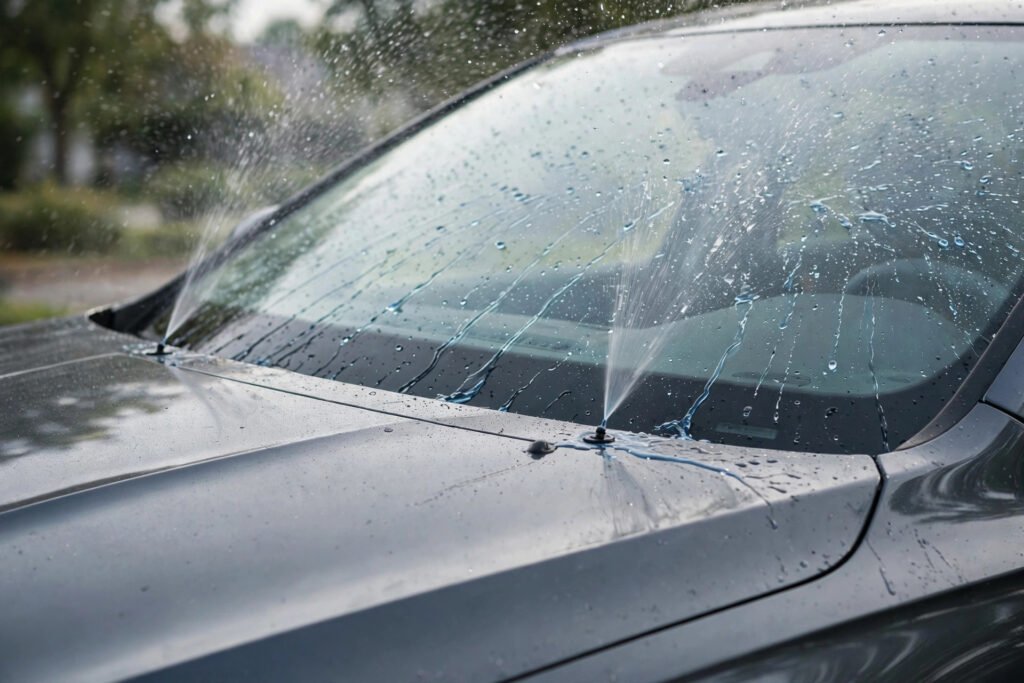
You pull the washer stalk, hear… nothing: your windshield washer not spraying at all. Or maybe you hear the pump hum, but the windshield stays dry. Either way, a washer system that won’t spray is more than an annoyance — in winter, one pass through road slush can coat your windshield in salty film, and wipers alone just smear it around. If your view becomes obscured, the only right move is to pull over safely until you can see clearly again. The good news: most washer failures trace back to a short list of simple causes, and one 10-second listening test splits the diagnosis cleanly in half.
In this guide, you’ll learn:
- The pump-hum test that tells you which half of the system failed
- The 7 causes behind a washer that won’t spray, from trivial to shop-worthy
- Which checks are free driveway fixes and which belong with a mechanic
- The winter freeze angle — and how to stop it happening again
- Honest cost guidance (qualitative, no guesswork) for each repair
Safety first: A working washer system is a visibility system. Don’t drive long stretches in winter slush, road salt spray, or dusty conditions with a dead washer — without fluid, your wipers smear the film instead of clearing it. If the windshield becomes obscured, pull over safely. And if the washer failure comes with other electrical problems (wipers dead too, flickering dash lights), get the electrical side checked by a certified mechanic before it strands you.
The 10-Second Test That Splits the Diagnosis
Turn the key to ON (engine off is fine), activate the washer, and listen closely near the washer fluid reservoir under the hood — or have someone pull the stalk while you stand at the open hood with your ear near the reservoir area. You can also rest a hand on the reservoir and feel for a faint vibration.
| What you notice | Most likely half of the system | Go straight to |
|---|---|---|
| You hear the pump humming or buzzing, but no spray | Pump works — the problem is delivery (blockage, leak, freeze) | Clogged nozzles, kinked hoses, leaks, frozen fluid |
| Complete silence — no hum at all | The pump isn’t getting power or the pump itself is dead | Fuse, wiring, switch, pump motor |
| Weak or uneven dribble from the nozzles | Low fluid, partial blockage, or a weakening pump | Reservoir level, nozzles, pump pressure |
| Fluid sprays, but only from one nozzle | That nozzle or its branch hose | That nozzle/hose only |
| You hear the pump and smell/see fluid leaking under the car | Cracked reservoir, split hose, loose pump seal | Leak hunt |
A pump that hums but delivers nothing points at blockages or leaks. A pump that stays silent points at electrical supply or the pump motor itself. Everything below flows from that split.
Cause 1: The Reservoir Is Empty or Low
Start with the obvious — it causes more “dead washer” calls than everything else combined. If the system worked fine yesterday and suddenly stopped, the tank may simply be dry. Pop the hood, find the washer reservoir (usually a translucent plastic tank with a windshield-spray icon on the cap), and look at the level. Top it up with proper washer fluid — not plain water — and test.
YourMechanic’s standing recommendation: check the washer fluid level regularly (weekly is a good habit), and keep the reservoir more than half full. A pump that repeatedly runs dry can burn out, because the fluid itself cools and lubricates the motor. Running the tank bone dry isn’t just inconvenient — it shortens the pump’s life.
Cause 2: Clogged Washer Nozzles
If the pump hums but nothing reaches the glass — or the spray is weak, uneven, or missing from one jet — the nozzles are the prime suspect. Wax, polish residue, road grime, and mineral scale from tap water all collect in the tiny spray holes, and on some cars a single nozzle blockage is all it takes.
The fix: gently work a sewing needle or thin pin into the spray hole to dislodge the debris, then test. One caution from experienced techs: don’t wiggle the pin up and down or side to side aggressively — you can bend the jet and throw off the spray aim, sending the stream over the roof or onto the hood. If a nozzle is cracked or the jet stays blocked after cleaning, the nozzle itself can be replaced individually.
The prevention: don’t fill the system with plain tap water long-term. Mineral content can leave scale inside the nozzles and hoses; quality washer fluid is cheap insurance.
Cause 3: Frozen Fluid, Hoses, or Nozzles
This is the seasonal killer. Washer fluid with no antifreeze rating — or water added in summer — freezes solid in the reservoir, lines, or nozzles on the first hard cold snap. The telltale signs: the system worked fine in fall, then died during a cold week; or you hear the pump straining against a frozen line. Running the pump against ice can pop the fuse (see Cause 5), so thaw before you keep trying.
The fix: park in a warmer spot (a garage, even an unheated one, helps) and let the system thaw, or let the engine idle with the hood closed so engine heat warms the area. Once thawed, flush out the summer fluid and refill with winter-rated washer fluid rated for your climate — screenwash guides recommend winter formula through the whole cold season, not just on the coldest days. Never pour boiling water on a frozen windshield; the sudden temperature change can crack the glass.
If you’re reading this in October, check now: part of any honest winter prep is making sure the washer system is filled with freeze-rated fluid before the first freeze, not after it.
Cause 4: Kinked, Disconnected, or Leaking Hoses
The pump hums, the reservoir is full, but nothing reaches the glass — and maybe you spot blue or pink fluid dripping under the car when you hold the washer on. Trace the thin hoses from the reservoir up to the hood or cowl nozzles. Look for:
- Hoses pinched by the hood strut, a clamp, or after engine work
- Hoses that popped off their barbed fittings (common after recent repairs)
- Cracked, brittle sections that weep fluid when the pump runs
- Puddles under the car at the reservoir area — a cracked tank or leaking pump seal
This is one of the cheapest possible fixes when caught early: a reseated hose or a short replacement section of tubing (bring the old piece to the parts store to match the diameter). A cracked reservoir is a bigger job — the tank usually has to come out for replacement — but at least the diagnosis is visual and certain.
Cause 5: A Blown Washer Fuse
Silence from the pump means no power — and the first thing to check is the fuse. The washer circuit is usually fused, and the fuse is designed to blow when the pump motor draws excessive current. The classic sequence: fluid freezes, the driver holds the washer stalk repeatedly trying to force it, the straining pump spikes the current, and the fuse gives up to protect the wiring.
The check: consult your owner’s manual or the diagram on the fuse box lid for the washer fuse — it’s often labeled WASHER, WIPER, or a number, and on some vehicles it shares a circuit with the wipers. Pull it and look for a broken filament, or test it with a multimeter. If it’s blown, replace it with a fuse of the exact same rating — never uprate a fuse; the rating protects the wiring.
If the new fuse blows again immediately, don’t keep feeding fuses to it. A repeat blow means a short circuit or a seized pump, and that’s a shop diagnosis. If you’re not sure how to read a fuse or match ratings, the fuse troubleshooting guide walks through the process step by step.
Cause 6: A Failed Washer Pump
You’ve confirmed the reservoir is full, the hoses are intact, the fuse is good — and the pump still stays completely silent when activated. That points at the pump motor itself. The pump usually sits at the base of the reservoir on a rubber grommet, with an electrical connector and a hose attached. Before condemning it, check the easy things: a corroded or loose electrical connector at the pump, and a ground point caked in grime.
Replacing the pump is a moderate DIY job on many cars — disconnect the battery first, unplug the connector, detach the hose, pull the old pump out of its grommet, and push the new one in — but access varies. On some vehicles the reservoir is reachable from the engine bay; on others it’s buried behind a wheel-well liner, which turns a 20-minute job into a lift-and-panel affair. If access looks grim, or the car is under warranty, let a shop handle it.
Cause 7: A Bad Switch, Relay, or Wiring Fault
This is the least common and the hardest to chase: the stalk switch, a relay, or a wiring fault between them and the pump. The giveaway is that everything else checks out — fluid full, fuse good, pump connector has no power when the switch is activated (verified with a test light or multimeter). On modern cars, body-control modules can also be involved, and some models tie washer faults to driver-assistance cameras.
This is firmly shop territory. Electrical chasing needs proper test equipment and wiring diagrams, and miswiring a pump circuit can cause more damage than the original fault. A certified mechanic with a scan tool can confirm a dead switch or relay quickly.
Which Fixes Are Safe DIY — and Which Belong With a Mechanic
| Fix | Difficulty | Who should do it |
|---|---|---|
| Refill the reservoir | Trivial | You — proper washer fluid, not water |
| Clear clogged nozzles with a needle | Easy | You — gently, don’t bend the jet |
| Thaw a frozen system, switch to winter fluid | Easy | You — no boiling water on glass |
| Reseat a disconnected hose, replace a hose section | Easy to moderate | You, if the hose is reachable |
| Replace a blown fuse (correct rating) | Easy | You — same rating only |
| Replace the washer pump | Moderate | You if access is easy; shop if it’s behind panels |
| Electrical: switch, relay, wiring, module faults | Advanced | Certified mechanic |
Cost Guidance for a Windshield Washer Not Spraying
No fixed numbers here — the range depends on the car and the market — but the relative picture is consistent. Nozzle cleaning and fuse replacement are essentially free. A washer pump is one of the least expensive motorized parts on a car; when owners pay real money, it’s usually for the shop’s diagnostic time and the labor to access a buried reservoir, not the part itself. A full reservoir replacement or electrical-module diagnosis runs higher because of labor and parts. The expensive outcome is the one you avoid: don’t keep hammering a frozen pump, because a cascade of a blown fuse, a burned-out pump, and a cracked reservoir turns a fluid top-up into a real repair bill.
FAQ
Why does my washer work on the rear window but not the windshield?
Many vehicles use separate pumps or separate outlets from one reservoir for front and rear. One side working proves the fluid and the switch circuit are partly fine — chase the dead side’s nozzle, hose, or pump specifically.
Can I use plain water instead of washer fluid?
In a pinch, yes — but don’t make it a habit. Water freezes at 32°F, leaves mineral deposits that clog nozzles, and cleans road film worse than purpose-made fluid. For winter, winter-rated fluid isn’t optional.
The pump hums but only one nozzle sprays. Do I need a new pump?
Almost certainly not. One dead jet with a humming pump is a nozzle or branch-hose problem on that side. Clear or replace that nozzle first.
My washer stopped working right after the car was serviced. Coincidence?
Possibly not — a hose disconnected during engine work is a classic. Pop the hood and trace the hoses from the reservoir; a loose line at a fitting is a 10-second fix.
Is it legal to drive without working washers?
Rules vary by state, and washers are checked in many vehicle safety inspections. Beyond the letter of the law, a smeared windshield is a genuine hazard — treat a dead washer as a fix-it-now item, not a someday item.
Could cold weather alone kill the pump permanently?
Yes, if the pump ran dry against ice repeatedly. The fluid cools the motor; running it against a frozen blockage overheats it. That’s why thawing before repeated attempts matters.
Related Guides

lily John
The Fixtorial team writes hands-on car troubleshooting guides for everyday drivers — symptom first, honest costs, and fixes you can verify yourself.


3 Comments