
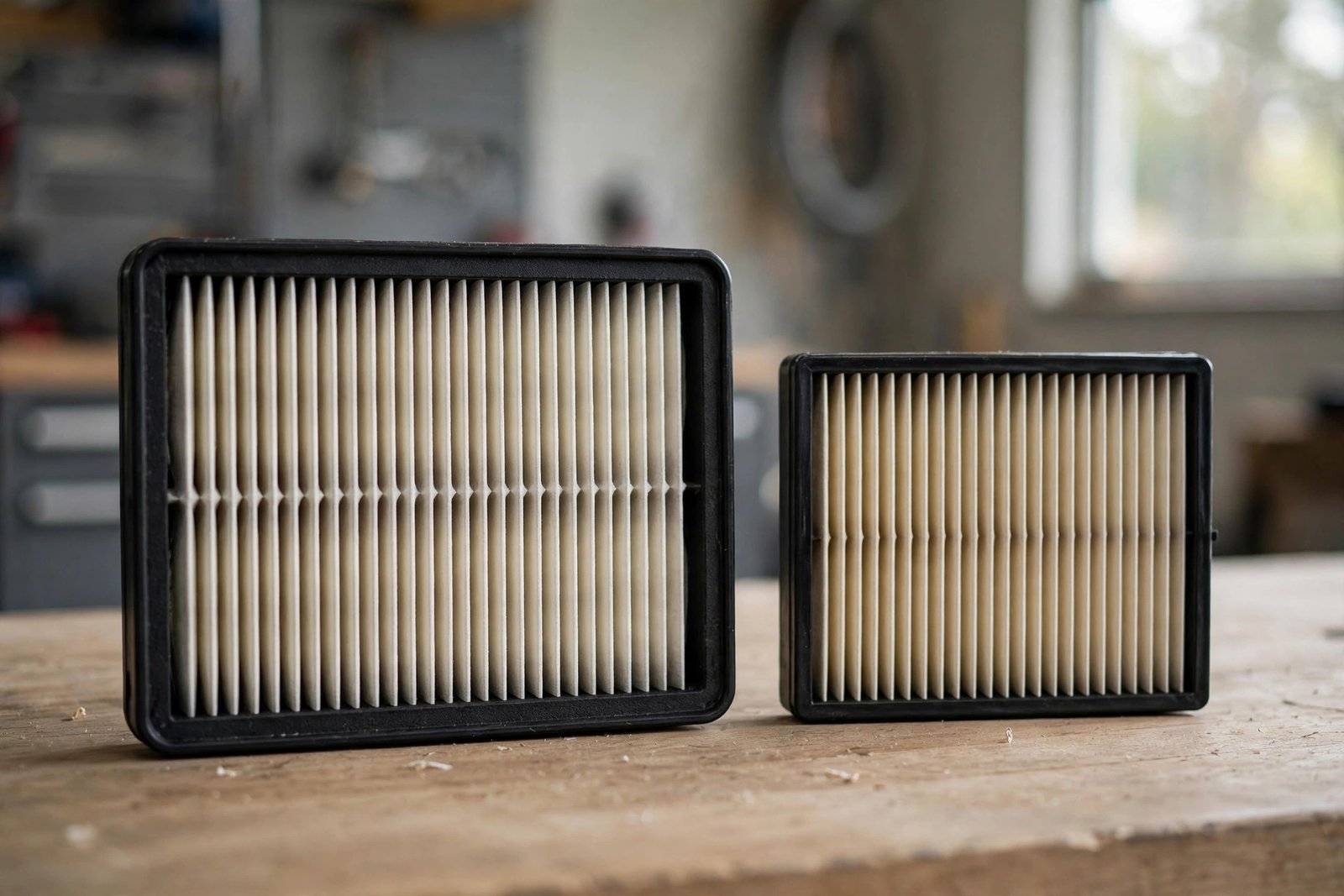
Most drivers discover they have two air filters by accident — someone mentions it at an oil change, or they find a plastic door behind the glovebox. Yes, you have two. They do completely different jobs, they fail differently, and replacing the wrong one won’t fix your symptom. Here’s how to tell them apart.
The 10-Second Version
| Engine Air Filter | Cabin Air Filter | |
|---|---|---|
| Protects | The engine’s intake air | The air you breathe |
| Lives | Under the hood, in a plastic airbox | Inside the car, usually behind the glovebox |
| Dirty symptoms | Sluggish acceleration, worse fuel economy, check engine light, misfire-like stumbling | Weak airflow from vents, musty smells, foggy windows, noisy blower |
| Typical interval | ~15,000–30,000 miles (manual rules; dusty roads = sooner) | ~12,000–15,000 miles or yearly (manual rules; pollen/dust = sooner) |
Same word, two separate systems. The engine filter never touches the air you breathe. The cabin filter never touches the air the engine breathes.
Symptoms of a Dirty ENGINE Air Filter
The engine filter feeds clean air to combustion. When it’s badly clogged:
- Sluggish acceleration / reduced power — the engine is starved of air
- Weak airflow from the vents, even on high fan speed
- Musty or stale smell when the AC or heat runs (bacteria/mildew growing in trapped debris)
- Windows fog up and stay foggy — poor airflow can’t clear moisture
- Blower motor sounds louder — it’s working harder to push air through a packed filter
- More dust on the dashboard and worse allergy symptoms while driving
The blower-motor point is underappreciated: a clogged cabin filter makes the blower work overtime, and blower motors are not cheap parts.
The 5-Minute Driveway Check (Both Filters)
Engine filter:
- Open the hood, find the large plastic airbox (follow the big intake hose from the engine).
- Undo the clips or screws on the lid, lift the filter out.
- Hold it up to the light. If you can’t see light through the pleats, it’s done. Heavy visible dirt, leaves, or oil saturation = replace.
Cabin filter:
- Empty the glovebox, squeeze or unhook its stops so it drops down fully (most cars).
- Behind it you’ll find a rectangular plastic door — open it and slide the filter out.
- Same light test. Note the airflow direction arrow printed on the frame — the new one goes in the same way.
Don’t wash disposable paper filters. Most engine and cabin filters are paper-element and designed for replacement — washing doesn’t restore their filtration. (Reusable oiled-cotton performance filters are the exception and have their own cleaning kits.)
Which One Do You Replace?
- Problem is under the hood (power, MPG, engine behavior) → engine filter
- Problem is in the vents (airflow, smell, fogging) → cabin filter
- Doing routine maintenance anyway → check both; they breathe the same dirty air and often clog on similar schedules
When to See a Mechanic
- Check engine light with misfire codes after filter replacement (the filter may not have been the problem — coils, plugs, or sensors could be)
- Persistent musty smell after a new cabin filter (possible mold in the evaporator or ducts)
- The cabin filter housing is damaged or the door won’t seal (unfiltered air bypasses the filter)
FAQ
Are the engine and cabin air filters the same part?
No. Different sizes, different media, different locations. They aren’t interchangeable.
Can a dirty engine air filter really hurt fuel economy?
On modern fuel-injected cars the effect is smaller than old carburetor-era claims suggested — the computer compensates. But a severely restricted filter still costs you power and efficiency, and lets fine grit toward parts that don’t like grit.
Does a dirty cabin filter affect the AC’s cooling?
It reduces airflow, which feels like weak cooling even when the AC system itself is fine. If the vents blow cold but weakly, suspect the cabin filter before the refrigerant.
How often, really?
There’s no universal number — your owner’s manual’s maintenance schedule is the authority. The commonly cited ranges are 15,000–30,000 miles for the engine filter and 12,000–15,000 miles (or yearly) for the cabin filter, shortened by dusty roads, heavy traffic, or bad pollen seasons. When in doubt, inspect rather than guess.
Sources
- AutoZone — “Engine Air Filter vs Cabin Air Filter: What’s the Difference?” (dirty engine filter: fuel economy, power, popping/misfire, check engine light; dirty cabin filter: weak HVAC airflow, smell, defrost capacity, fan noise; ~2-year interval) — https://www.autozone.com/diy/filters/engine-air-filter-vs-cabin-air-filter/
- CarsInfos — “Engine Air Filter vs Cabin Air Filter: Key Differences” (comparison table; manual-first intervals; disposable filters not meant to be washed) — https://carsinfos.com/engine-air-filter-vs-cabin-air-filter/
- Johnny’s Automotive — “Engine vs cabin air filter” (the two-systems framing; engine filter fails quietly on modern cars; blower motor strain from clogged cabin filter) — https://johnnysautomotivellc.com/blog/engine-vs-cabin-air-filter-what-each-one-does
- Kwik Kar Auto Dallas — “What’s the Difference of Cabin Filter and Engine Air Filter” (cabin: 12,000–15,000 mi; engine: 15,000–30,000 mi; symptom lists) — https://kwikkarautodallas.com/cabin-filter-vs-engine-air-filter/