
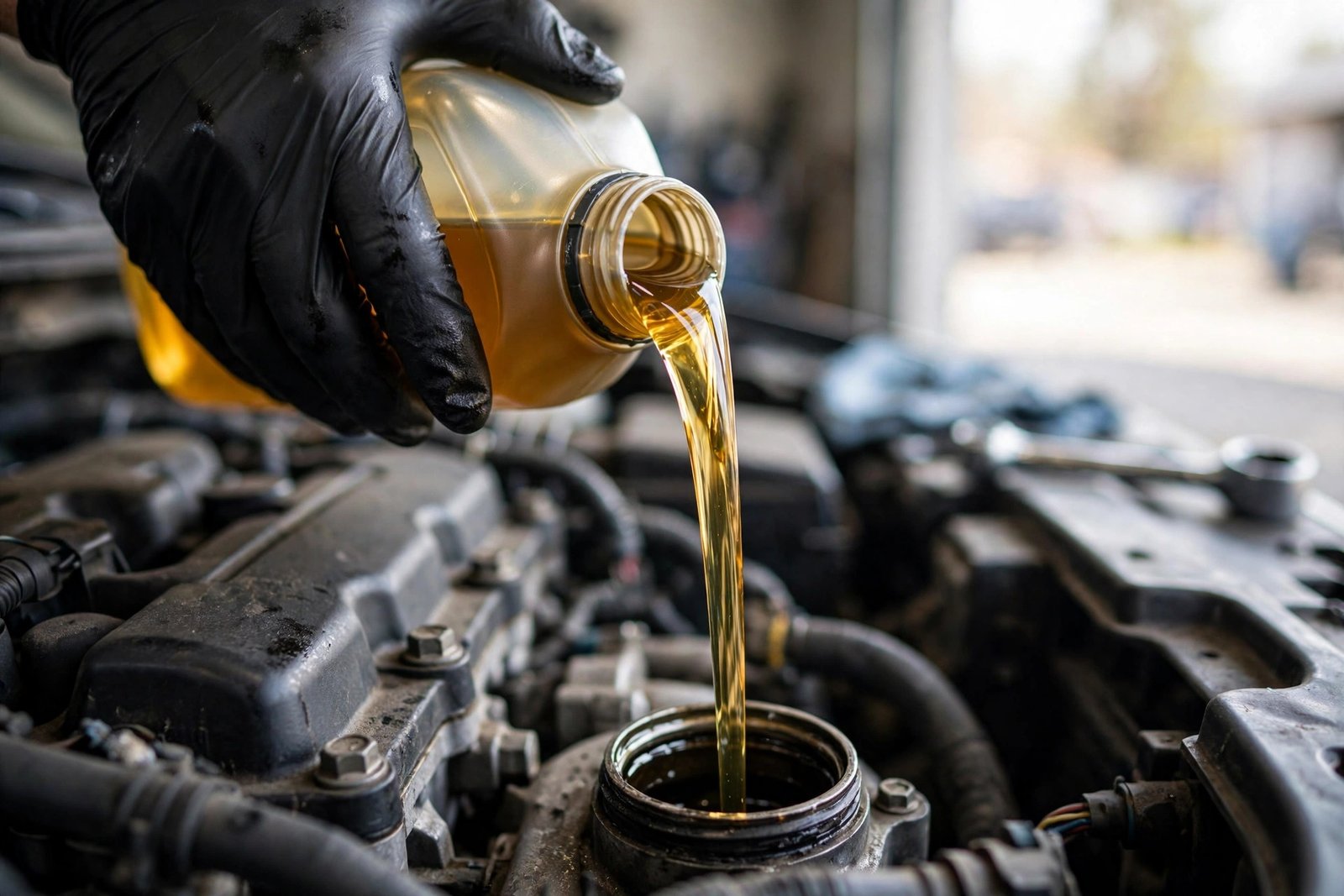
Engine oil is the one maintenance item where outdated advice refuses to die. Ask five people when to change your oil and you’ll hear everything from “every 3,000 miles, no exceptions” to “the car tells me.” The honest answer sits in the middle — and it depends on three things: what oil your engine uses, how you drive, and what your owner’s manual says.
The Short Answer
- Conventional oil: roughly every 3,000–5,000 miles (or 3–6 months)
- Synthetic blend: roughly every 5,000–7,500 miles (or 6–12 months)
- Full synthetic: roughly every 7,500–10,000 miles — some formulas go up to 15,000 miles (or about once a year)
- Whatever the interval, one year maximum — oil degrades with time even if you barely drive, as moisture and fuel vapors contaminate it sitting in the crankcase
The final word is your owner’s manual. These ranges are the industry consensus you’ll find across maintenance guides; your manufacturer’s schedule is written for your specific engine and overrides any general chart.
Where the 3,000-Mile Rule Came From
The 3,000-mile rule dates to an era when most cars ran conventional oil and engines ran hotter and dirtier. Both have changed: modern oils have far better additive packages, engines run cleaner, and oil-life monitoring systems track actual conditions. For most cars built in the last 15 years running synthetic oil, 3,000-mile changes are simply unnecessary — though some quick-lube shops still push them, because frequent changes are good for their business.
Note: if your car uses conventional oil (common in older cars and some budget models), the shorter end of these ranges still applies. The 3,000-mile figure isn’t wrong — it’s just wrong for most modern cars on synthetic oil.
Severe Service: You Probably Drive Like This
Manufacturers define two schedules — normal and severe — and most owners fall into severe without knowing it. You’re on severe service if you regularly:
- Take frequent short trips (under ~10 miles, where the engine never fully warms up)
- Sit in stop-and-go traffic or idle a lot
- Drive in extreme heat or cold
- Tow trailers or carry heavy loads
- Drive on dusty or unpaved roads
Under severe conditions, cut the normal interval roughly in half. That 10,000-mile synthetic interval becomes ~5,000 miles. This is also why “I barely drive” doesn’t mean you can skip changes — short trips that never warm the engine are actually harder on oil than highway miles.
Oil-Life Monitors: Trust Them (Mostly)
If your dashboard shows an oil-life percentage, that’s your car’s computer estimating oil degradation from real driving data — temperature cycles, RPM, load, idling. Major auto clubs and repair associations generally advise following the monitor rather than a fixed mileage number. Two caveats:
- Change the oil when the monitor says so — and don’t stretch past one year regardless of what it shows.
- The monitor doesn’t know the oil level. A monitor at 50% oil life means nothing if the level is a quart low. Check the dipstick regularly anyway — that’s a separate job (see our guide linked below).
Common Mistakes
- Going by mileage alone and ignoring time. “I only drove 2,000 miles this year” still means an annual change.
- Using the wrong oil. Your manual specifies a grade (like 5W-30 or 0W-20) and a type (conventional vs synthetic). The wrong viscosity can affect engine protection and may matter for warranty coverage.
- Ignoring the maintenance light. The “maintenance required” light is a reminder, not a fault — but it means service is due. Get the service done, then reset it (resetting without servicing just silences the reminder).
- The monitor doesn’t know the oil level. A monitor at 50% oil life means nothing if the level is a quart low. Check the dipstick regularly anyway — that’s a separate job (see our guide linked below).
When to See a Mechanic
- Oil looks milky or like chocolate milk on the dipstick (possible coolant contamination)
- Oil smells strongly of gasoline
- The oil level drops noticeably between changes (consumption or leak)
- The oil pressure warning light comes on — this is different from the maintenance reminder and needs attention now, not at the next service
FAQ
Can I switch from conventional to synthetic oil?
Yes — it’s safe in either direction. Use the viscosity your manual specifies. There’s rarely a performance reason to switch back to conventional unless cost is the priority and your car doesn’t require synthetic.
Do I need to change the filter every time?
Yes. The filter traps contaminants; putting fresh oil through a saturated filter defeats the purpose. Always change the filter with the oil.
Does dark oil mean it’s worn out?
Not by itself. Oil darkens as it does its job — suspending soot and contaminants. Judge by mileage/time and the manual’s interval, not color alone. Gritty texture or a burnt smell are more meaningful signs.
What about high-mileage oil for older cars?
High-mileage formulations (marketed for cars over ~75,000 miles) contain seal conditioners and extra additives. They can help with minor consumption and weeping seals. The change intervals are roughly the same as their conventional/synthetic counterparts.
Sources
- Car Talk Service Advice: Oil Changes (owner’s manual variance 3,000–10,000 miles; 5,000-mile rule of thumb; severe-service factors) — https://www.cartalk.com/content/car-talk-service-advice-oil-changes
- EngineCrux — “Understanding How Often to Change Your Car Engine Oil” (conventional 3,000–5,000 mi; blend 5,000–7,500 mi; synthetic 7,500–10,000 mi; severe-service list) — https://enginecrux.com/how-often-should-you-change-your-car-engine-oil/
- iCarTea — “How Often Should You Change Your Engine Oil” (conventional vs synthetic intervals; oil degrades with time even undriven) — https://www.icartea.com/en/news/how-often-should-you-change-your-engine-oil
- Credit Acceptance — “How Often Should You Change Your Oil?” (synthetic 7,500–10,000 mi; conventional 3,000–5,000 mi; severe-service halves intervals) — https://www.creditacceptance.com/car-buyers/express-lane/how-often-change-oil
- HowStuffWorks — “Oil Changing Frequency” (traditional 3-month/3,000-mile standard vs manufacturer schedules) — https://auto.howstuffworks.com/under-the-hood/vehicle-maintenance/change-oil5.htm