
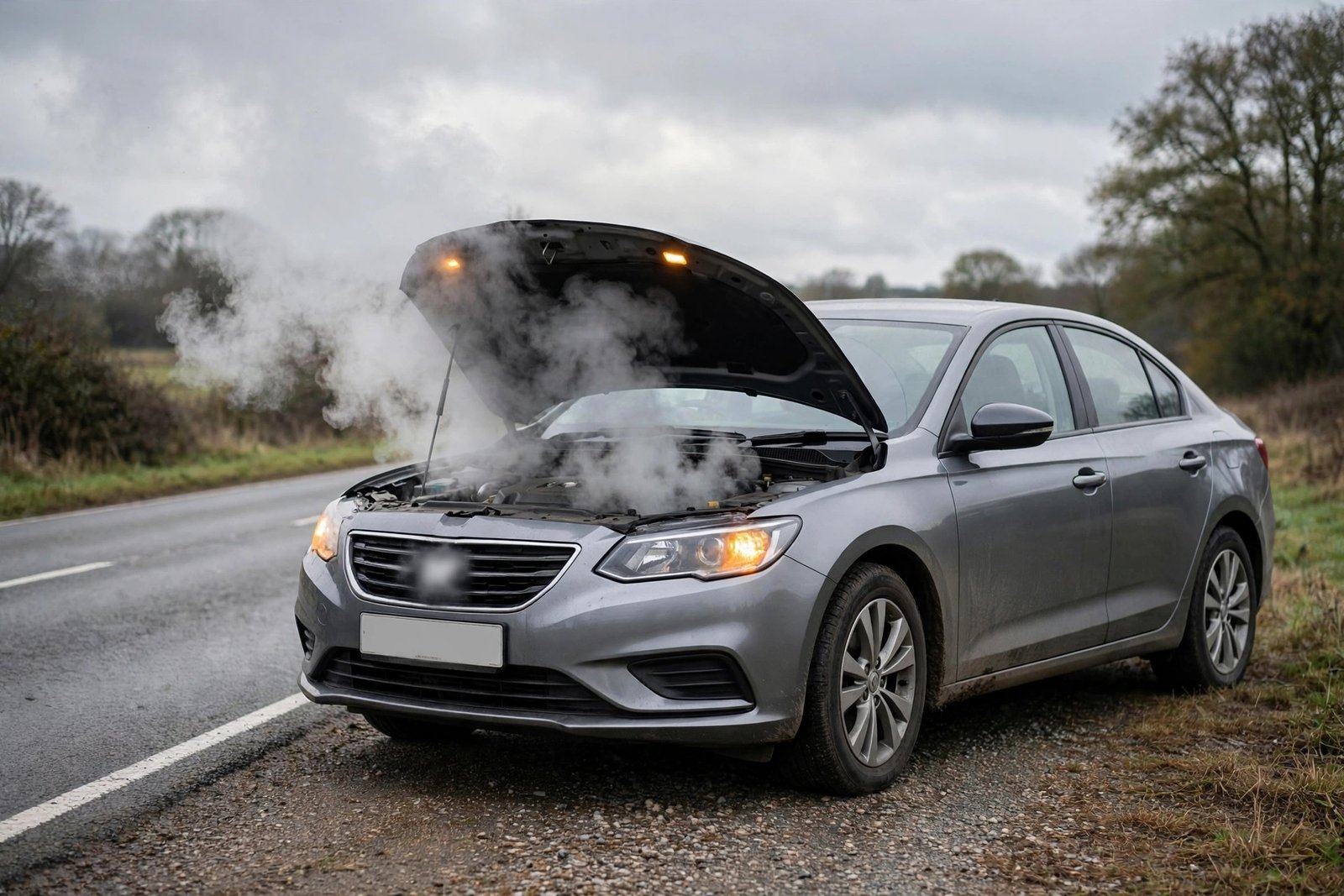
First, do this: pull over safely, shut off the engine, and get everyone out of the car and away from traffic. White vapor from under the hood can be harmless steam — or the first sign of a failure that will destroy the engine if you keep driving. You cannot tell which from the driver's seat, so the safe sequence is: stop first, diagnose second.
Once you're safely stopped with the engine off, use three senses — sight, smell, and the temperature gauge — to tell steam from smoke.
Safety first: NEVER open the radiator or reservoir cap on a hot engine — pressurized coolant causes severe burns. Do not keep driving to "see if it stops." If you see flames, smell burning plastic strongly, or the smoke is thick and dark, move away from the car and call emergency services.
Step 1: Steam or Smoke? The 3-Sense Test
| What you observe | Likely meaning |
|---|---|
| White, wispy, dissipates fast, sweet smell | Steam from coolant — cooling system leak (most common) |
| White/gray, lingers, burnt oil smell | Oil dripping onto hot exhaust (valve cover gasket, etc.) |
| Dark or black, acrid / burning plastic smell | Electrical short or burning wires — potential fire risk |
| White vapor on a cold start that fades in minutes | Normal condensation — not a problem |
Sweet + white + temperature gauge high = coolant boiling out of a leak. That's the most common scenario and the one this guide focuses on.
Step 2: Read the Temperature Gauge (Before You Shut Off)
Glance at the gauge as you pull over:
- Gauge in the red or climbing fast → the engine is overheating. The steam is boiling coolant escaping from a hose, the radiator, or the water pump. Shut off immediately and tow it.
- Gauge normal, steam present → a smaller leak spraying onto hot parts, or spilled fluid burning off. Still needs inspection, but less immediately catastrophic.
- Gauge normal, smoke smells like burning oil → an oil leak onto the exhaust. Check oil level (when safe); top up if low and drive gently to a shop.
The Most Likely Causes of Coolant Steam, in Order
1. Burst or split radiator hose (most common)
A hose lets go under pressure and sprays coolant onto the hot engine — instant white steam cloud, sweet smell, gauge climbing. The fix is the hose (and a check of why pressure spiked).
2. Cracked radiator or failed seam
Similar steam, often with visible coolant spraying or dripping at the front.
3. Water pump failure
Coolant escaping at the pump, sometimes with prior whining or seepage as a warning.
4. Overheating from another cause boiling the coolant
A stuck thermostat, dead fan, or low coolant lets the engine overheat; the boiling coolant then escapes through the overflow or the weakest hose. The steam is the result, not the root cause — see car overheats in traffic and car overheating even with full coolant.
5. Head gasket failure
White steam from the exhaust (not the hood) plus overheating and coolant loss = combustion gases in the cooling system or coolant in the cylinders. Professional diagnosis required.
6. Overfilling (the innocent one)
If you filled past the MAX line, the system simply expels the excess through the overflow until it stabilizes. If the level drops once and then holds steady at the correct mark, that was it.
What to Do After You're Stopped
- Engine OFF, hazards on, everyone out and clear of traffic.
- Do NOT open the hood immediately if steam is billowing — let it settle a few minutes. (Opening it won't hurt once the worst passes, but scalding steam can burn.)
- Do NOT open any coolant cap. Ever, while hot. This is the single most important rule.
- Look (from a safe distance): Can you see where the steam is coming from? A hose? The radiator area?
- Wait at least 30–45 minutes before even thinking about checking the coolant level — and only then with a rag, slowly.
- Decide: tow or top-up-and-drive. If the gauge was in the red, if steam was heavy, or if you can see an obvious burst hose — tow it. If it was light steam, the gauge stayed normal, and the reservoir just needs topping up, you may top up with the correct coolant (or water in an emergency) and drive gently to the nearest shop while watching the gauge like a hawk.
When It's an Emergency, Not a Breakdown
- Flames or thick black smoke → move away, call emergency services
- Strong burning-plastic smell → possible electrical fire; don't try to diagnose it yourself
- Smoke coming from inside the cabin → get out, call for help
FAQ
Can I pour water on it to cool it down?
No — thermal shock can crack hot metal components. Let it cool naturally.
It steamed once, then stopped. Am I fine?
No — something failed or boiled over, and it will happen again, probably worse. Get the cooling system inspected before driving normally.
What's the difference between steam and smoke here?
Steam is vaporized coolant or water — white, wispy, sweet-smelling, dissipates quickly. Smoke is burning material — oil, plastic, or wiring — usually darker, acrid, and lingering.
How long before I can open the hood or check coolant?
Wait until the engine is cool to the touch — typically 45+ minutes after shutdown. Even then, open any cap slowly with a rag, standing back.
Sources
- Rick's Free Auto Repair Advice — "White Smoke from Under the Hood: Common Causes" (pull over + shut off first; coolant steam vs oil smoke; tow don't drive) — https://ricksfreeautorepairadvice.com/white-smoke-from-under-the-hood-common-causes/
- AutoAid Rescue — "My Car is Smoking Under the Hood. What Should I Do Now?" (white steam vs white smoke density/odor; immediate pull-over) — https://autoaidrescue.com/blog/my-car-is-smoking-under-the-hood-what-should-i-do-now/
- Freeman Motor Company — "Help! There's Smoke Coming from Under My Hood!" (color/smell decoder: sweet white = coolant hose; gray = transmission; black = electrical) — https://freemanmotor.com/blog/help-theres-smoke-coming-from-under-my-hood/
- Mechanic Times — "Why Is Smoke Coming From Under Hood But Not Overheating?" (not-overheating branch: oil/fluid on exhaust; battery; wiring) — https://mechanictimes.com/unusual-smoke-why-is-smoke-coming-from-under-hood-but-not-overheating/
- Vroom Zone — "Car White Smoke From Hood" (coolant vs oil vs condensation branches) — https://vroom.zone/car-white-smoke-from-hood/