
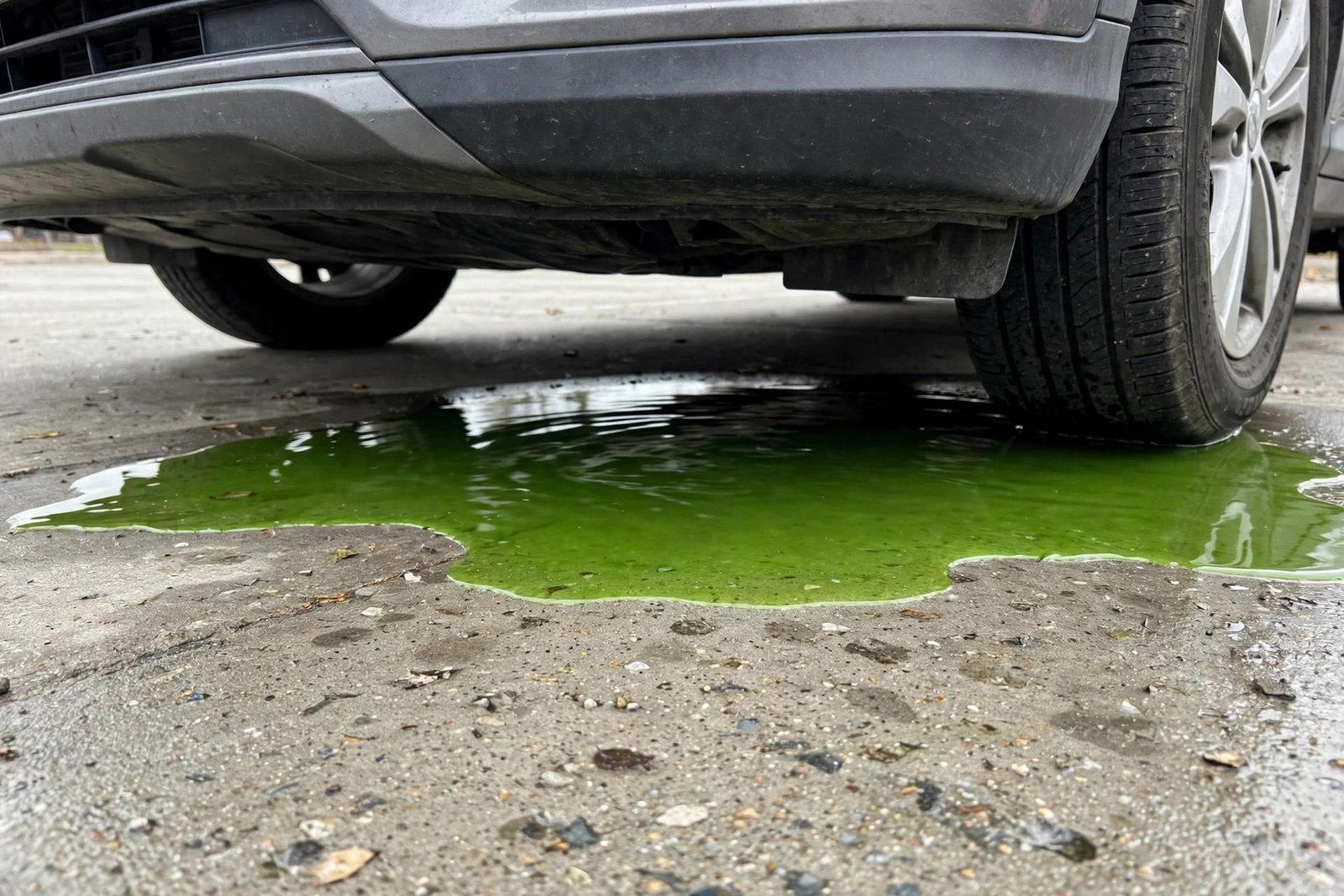
A bright-colored puddle under your car and a sweet, syrupy smell after driving is almost certainly engine coolant (antifreeze). Coolant leaks are never “just a drip” — the cooling system is pressurized and sealed, so every drop that escapes is cooling capacity your engine is losing. This guide helps you confirm it’s coolant, trace where it’s coming from, and decide whether to drive or tow.
In this guide, you’ll learn:
- How to confirm the puddle is coolant (and rule out AC water)
- The most common leak sources, in order of likelihood
- A cold-engine inspection sequence that finds most leaks
- When to drive, when to top up and drive, and when to tow
- Why coolant is dangerous to pets and kids
Safety first: Inspect only with the engine completely cold — never open the radiator or reservoir cap on a hot engine. If the temperature gauge climbs while driving, pull over and shut off immediately. And a critical warning: coolant (ethylene glycol) is toxic and tastes sweet — it is lethal to pets and dangerous to children. Clean up any spill, don’t leave puddles in the driveway, and keep animals away from the area.
Step 1: Confirm It’s Coolant, Not AC Water
Normal AC condensation is clear, odorless water that drips from under the car on hot days — harmless. Coolant is different:
| Feature | Coolant | AC condensation |
|---|---|---|
| Color | Green, orange, pink, blue, or yellow | Clear |
| Smell | Sweet, syrupy | None |
| Feel | Slightly slippery/slimy | Watery |
| Location | Front of car, near engine | Anywhere under the cabin |
If it has any color, any sweet smell, or any oily feel — treat it as coolant.
Step 2: Trace the Leak (Cold Engine Only)
With the engine fully cold, work through the usual suspects in order. Look for wet spots, drips, and dried crusty residue (white, orange, or green crust is dried coolant and marks the exact spot):
- Radiator hoses and clamps — the most common external leak points. Squeeze hoses: soft, mushy, cracked, or bulging hoses need replacing. Tighten loose clamps.
- Water pump weep hole — a small hole at the bottom of the pump; any coolant there means the pump seal is failing.
- Thermostat housing — staining around the gasket.
- Heater hoses — run to the firewall; check both ends.
- Reservoir and its hose — cracks in the plastic tank or its overflow hose.
- Radiator cap — a weak cap vents steam instead of holding pressure (you’ll smell sweet vapor without seeing a drip).
Can’t find anything wet? Small leaks only open under pressure, then evaporate on hot engine parts. The fix is a cooling-system pressure test — most shops do it quickly, and it makes hidden leaks visible. See coolant reservoir empty but no visible leak.
The Most Likely Sources, in Order
1. Worn radiator hoses and clamps (most common)
Rubber degrades with heat and age. A hose that’s soft, swollen, or cracked at the clamp is living on borrowed time.
2. Radiator cracks or seam leaks
Plastic end tanks crack from heat cycling; aluminum cores corrode. Pinholes may only leak under pressure.
3. Water pump seal failure
Coolant from the weep hole = the pump’s internal seal is gone. Pumps are replaced, not repaired.
4. Thermostat housing gasket
A relatively cheap fix — staining around the housing gives it away.
5. Heater core leak
Sweet smell inside the cabin, foggy windows with an oily film, or damp passenger footwell = the core under the dash is leaking. Labor-intensive to replace (dash usually comes out).
6. Head gasket (internal leak)
White exhaust smoke with a sweet smell, or milky “chocolate milk” residue on the oil cap/dipstick = coolant entering the combustion chamber or oil. Do not keep driving — this is professional-repair territory.
Drive, Top Up, or Tow?
- Small drip, gauge normal, reservoir near full: Top up with the correct coolant (cold engine) and drive to a shop soon — don’t postpone.
- Steady drip, reservoir dropping, gauge normal: Top up, drive directly to a shop, watch the gauge constantly.
- Gauge climbing, steam, or large puddle: Pull over, shut off, call a tow. Driving an overheating engine risks a blown head gasket or cracked head — thousands of dollars of damage.
- Milky oil or white exhaust smoke: Tow it. Internal leaks get worse with every mile.
Pet and Child Safety
Ethylene glycol tastes sweet, and a few tablespoons can kill a cat; dogs are equally at risk. Cats and dogs are drawn to the smell. Wipe up every spill immediately, don’t leave drained coolant in open pans, and store coolant bottles sealed and out of reach. If you suspect a pet drank coolant, it’s a veterinary emergency — minutes matter.
FAQ
My coolant keeps dropping but I see no puddle — where is it going?
It’s either evaporating off hot parts before it hits the ground, leaking internally (head gasket), or venting as steam through a weak cap. See the no-visible-leak guide: coolant reservoir empty but no visible leak.
Can I use stop-leak products?
They’re a gamble — they can clog the heater core and radiator passages along with the leak. Consider them a last-resort temporary measure, not a repair.
Is it the water pump if the leak is at the front-center?
Often, yes — the pump sits at the front of the engine. Coolant from the weep hole confirms it. But front-center drips can also be the lower radiator hose or radiator drain, so inspect before concluding.
How urgent is a small coolant leak?
More urgent than it looks. Cooling systems are pressurized; small leaks grow, and the margin between “low” and “overheating” is thin. Get it found and fixed promptly.
Sources
- TrendingCar — “How to Fix Leaking Coolant?” (symptom→source→fix table; cold-engine inspection order; pressure test) — https://trendingcar.com/how-to-fix-leaking-coolant/
- AutoGarageServices — “Car Leaking Coolant – Causes, Fixes & Prevention Guide” (puddle ID, sweet smell, steam = pull over) — https://autogarageservices.com/blog/car-leaking-coolant/
- InstantCarFix — “Coolant Leak Diagnosis: Symptoms, Causes, Cost” (external vs internal leaks; hoses and water pumps fail most) — https://www.instantcarfix.com/amp/services/coolant-is-leaking-diagnosis
- Blog.DriveHH — “What Is Leaking From My Car? Fluid Colors, Smells & When to Worry” (fluid color/smell identification; overheating response) — https://blog.drivehh.com/what-is-leaking-from-my-car-fluid-color-guide
- Eastwood Garage — “How to Tell if Your Car Has a Coolant Leak” (sweet smell ID; heater core test; visual inspection points) — https://www.eastwood.com/garage/how-to-tell-if-your-car-has-a-coolant-leak/
- 1A Auto — “Sweet Smell from Your Car? How to Find a Coolant Leak” (hose-by-hose inspection sequence; radiator cap) — https://blog.1aauto.com/how-to-find-a-coolant-leak/