
Tire pressure is the most neglected five-minute job on a car — and one of the most consequential. Under-inflated tires wear faster, hurt fuel economy, handle worse, and run hotter (which is what leads to blowouts). Over-inflated tires grip less and wear the center of the tread. The fix is a gauge that costs less than a tank of gas and a monthly habit.
The Two Rules That Matter Most
- Check tires COLD. That means before driving, or at least 3 hours after driving. Driving heats the air inside and raises the pressure 3–5 PSI — a hot reading is always misleading. First thing in the morning is ideal.
- Use the DOOR PLACARD, not the tire sidewall. The sticker inside the driver’s door jamb (or the owner’s manual) lists the pressure your car needs. The number molded into the tire sidewall is the tire’s maximum pressure — not the recommended one. This is the single most common mistake.
What You’ll Need
- A tire pressure gauge (stick, dial, or digital — digital is easiest to read; keep one in the car)
- An air source: gas station pump, home compressor, or portable 12V inflator
Step-by-Step: Checking and Adjusting
- Find your target pressure on the driver’s door jamb placard. Note that front and rear can differ. Also check the spare — it has a target too.
- Remove the valve cap from the first tire. Put it in your pocket (they vanish).
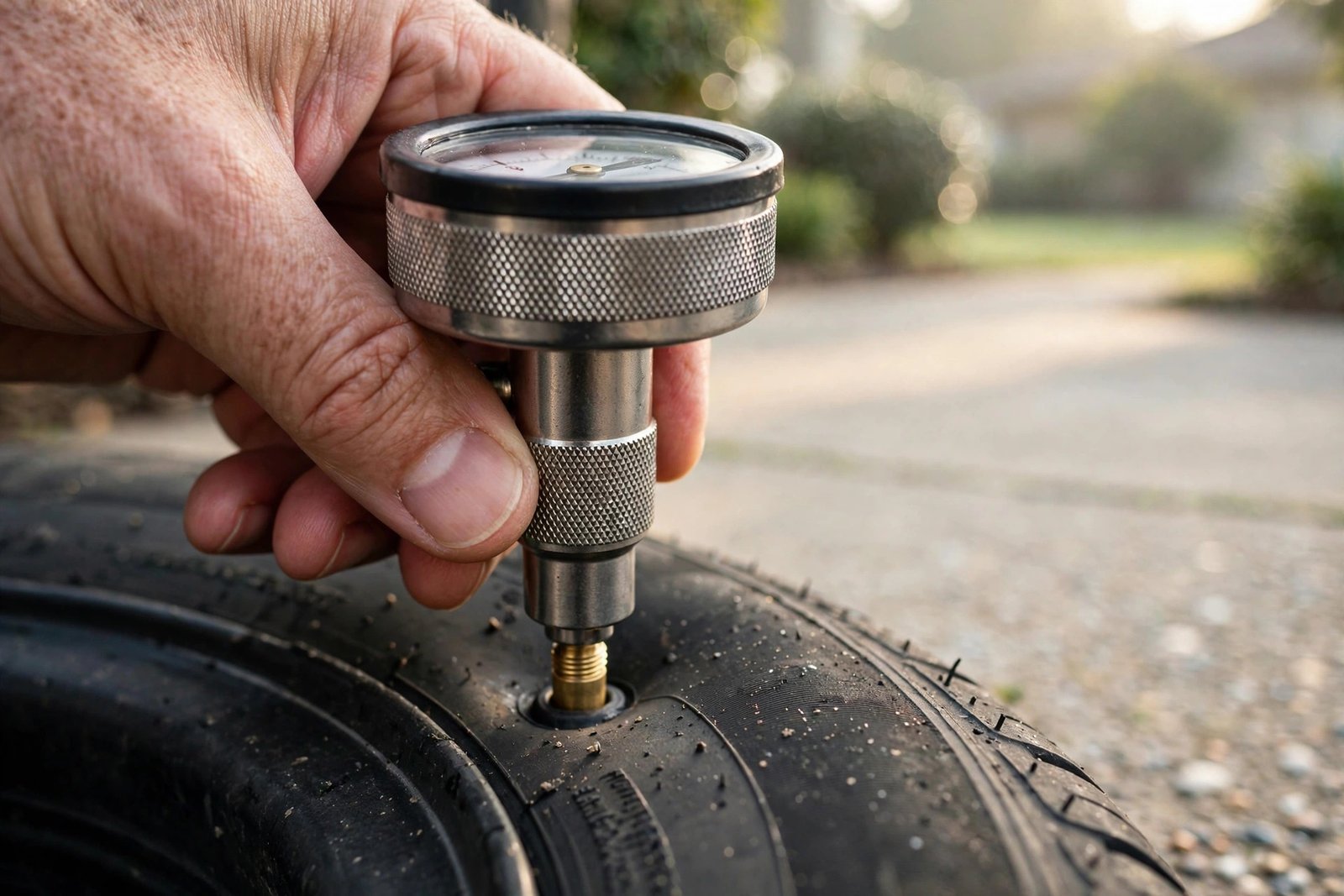
- Press the gauge squarely onto the valve stem. There’ll be a brief hiss; press firmly until it stops. Read the number.
- Compare to the placard. If it’s low, add air in short bursts and re-check. If it’s high, press the small pin in the valve center to release a little air, then re-check.
- Replace the valve cap and repeat for all four tires — then the spare.
- Recheck after temperature swings. Tire pressure drops roughly 1 PSI for every 10°F drop in temperature. That first cold morning of fall is the classic trigger for the TPMS light.
How Often?
- Monthly. Tires lose pressure slowly through the rubber itself — even without a leak.
- Before any long trip.
- When the seasons change (temperature-driven pressure changes are the whole story).
- If you only check when the TPMS light comes on, you’re already late: most systems don’t warn until pressure is ~25% below spec.
What Under/Over-Inflation Does
- Under-inflated: edges wear fast, sidewalls flex and overheat, fuel economy drops, steering feels vague, blowout risk rises.
- Over-inflated: center of tread wears fast, contact patch shrinks (less grip, longer braking), ride gets harsh, potholes hit harder.
Emergency: No Gauge?
These methods won’t give you a PSI number, but they catch a dangerously soft tire:
- Hand-press: crouch by the tire and press your palm firmly against the sidewall midway up. A properly inflated tire feels solid and unyielding; a noticeably soft one is significantly under-inflated.
- Visual sag: compare the flat contact patch at the bottom of each tire — a tire with a much wider flat spot than the others needs air first.
- Then drive to the nearest air pump and check properly. A $10 gauge in the glovebox makes this whole section unnecessary.
Common Mistakes
- Using the sidewall MAX as the target. It’s the tire’s structural limit, not your car’s recommendation.
- Checking after driving to the gas station. A 10-minute drive is enough to skew the reading. If you must, check cold at home with a portable gauge.
- Forgetting the spare. A flat spare discovered during a real flat is a double problem.
- Ignoring the TPMS light because “the tires look fine.” Radial tires can be 10+ PSI low before they look visibly soft.
- Bleeding pressure off a hot tire to hit the cold target. The pressure will be low when cold. Always set pressure on cold tires.
When to See a Mechanic
- One tire keeps losing pressure (slow leak — nail, bead seal, valve stem)
- Visible bulges, cracks, or cords on any tire
- The TPMS light blinks then stays solid (system fault, not just low pressure)
- Uneven wear patterns suggesting alignment issues (see our tread-wear guide)
FAQ
What’s the right pressure for my car?
The door jamb placard — not the internet, not the tire sidewall. It was set by the engineers who designed your car’s handling.
Can I use the gas station air pump’s gauge?
In a pinch, yes — but built-in gauges are often abused and inaccurate. Check with your own gauge afterward.
Why does my TPMS light come on in cold weather?
Pressure falls ~1 PSI per 10°F. A tire set at 35 PSI in 70°F weather reads ~32 PSI at 40°F — enough to trip the light on many cars. Top up to spec; the light resets after driving a few miles.
Should pressure be different for a loaded car or long highway trip?
Some placards list a higher “full load” pressure. Follow it when carrying heavy loads or towing. Otherwise use the standard figure.
Sources
- NAPA Know How — “Tire Pressure and Cold Weather” (door jamb placard; gauge reading procedure; check when cold) — https://knowhow.napaonline.com/tire-pressure-and-cold-weather-how-to-avoid-getting-a-winter-flat/
- Toyota — “How To Check Tire Pressure” (measure before driving or 3+ hours after; 4-step gauge procedure; over-inflation effects) — https://WWW.TOYOTA.COM/car-tips/check-tire-pressure/
- CroAuto — “How To Check Tire Pressure Correctly Without Guesswork” (placard over sidewall; monthly habit; cold check) — https://croauto.net/how-to-check-tire-pressure-correctly/
- WhatCar — “How to check your car’s tyres” (weekly check guidance; front/rear and load variations; under/over-inflation effects) — https://whatcar.com/advice/owning/how-to-check-a-car-tyre/n27307
- Microgreen Filter — “How To Check Tire Pressure Without A Gauge” (hand-press and visual-sag emergency methods; limitations) — https://www.microgreenfilter.com/check-tire-pressure-without-gauge/