
You’re braking gently — a parking lot, a slow crawl to a stoplight — and the pedal starts buzzing and pushing back under your foot, sometimes with a grinding noise from the front. That’s the ABS (anti-lock braking system) firing. The problem: ABS is supposed to fire only when a wheel is actually about to lock — during hard or slippery braking. On dry pavement at low speed, with gentle pressure, it has no business activating.
This is called false ABS activation, and it’s a real fault with a real consequence: while the ABS is cycling, it’s releasing brake pressure — which means your stopping distance gets longer, exactly when you expect the car to stop. This guide explains why it happens and how it’s diagnosed. Diagnosis only — ABS components are certified-mechanic territory.
Safety first: False ABS activation lengthens stopping distances in exactly the low-speed situations (parking lots, intersections) where space is tight. If your ABS fires during gentle dry-pavement braking, increase following distance and get the system diagnosed by a certified mechanic promptly. If the ABS warning light is also on, the system may be disabled entirely — your base brakes still work, but without anti-lock protection.
In this guide, you’ll learn:
- What false ABS activation feels like (vs. normal ABS)
- Why it happens almost exclusively at low speed
- The most common causes, in order of likelihood
- Why this fault often has no warning light
- What to tell your mechanic
What It Feels Like
False activation has a distinct signature:
- A buzzing or grinding noise from the front wheels during gentle braking.
- The pedal pushing back or dropping under your foot, then pulsing.
- It happens at low speed — typically under ~10–15 mph — on dry pavement with light pedal pressure.
- It often feels like the brakes let go for a moment — because they do: the ABS is dumping pressure it shouldn’t be dumping.
- The ABS warning light is often off — which is why drivers doubt themselves. (More on why below.)
If that matches your experience, keep reading. If the pulsing happens during hard emergency braking instead, that’s normal ABS — hold firm pressure and don’t lift off.
Why Low Speed? The Signal-Strength Problem
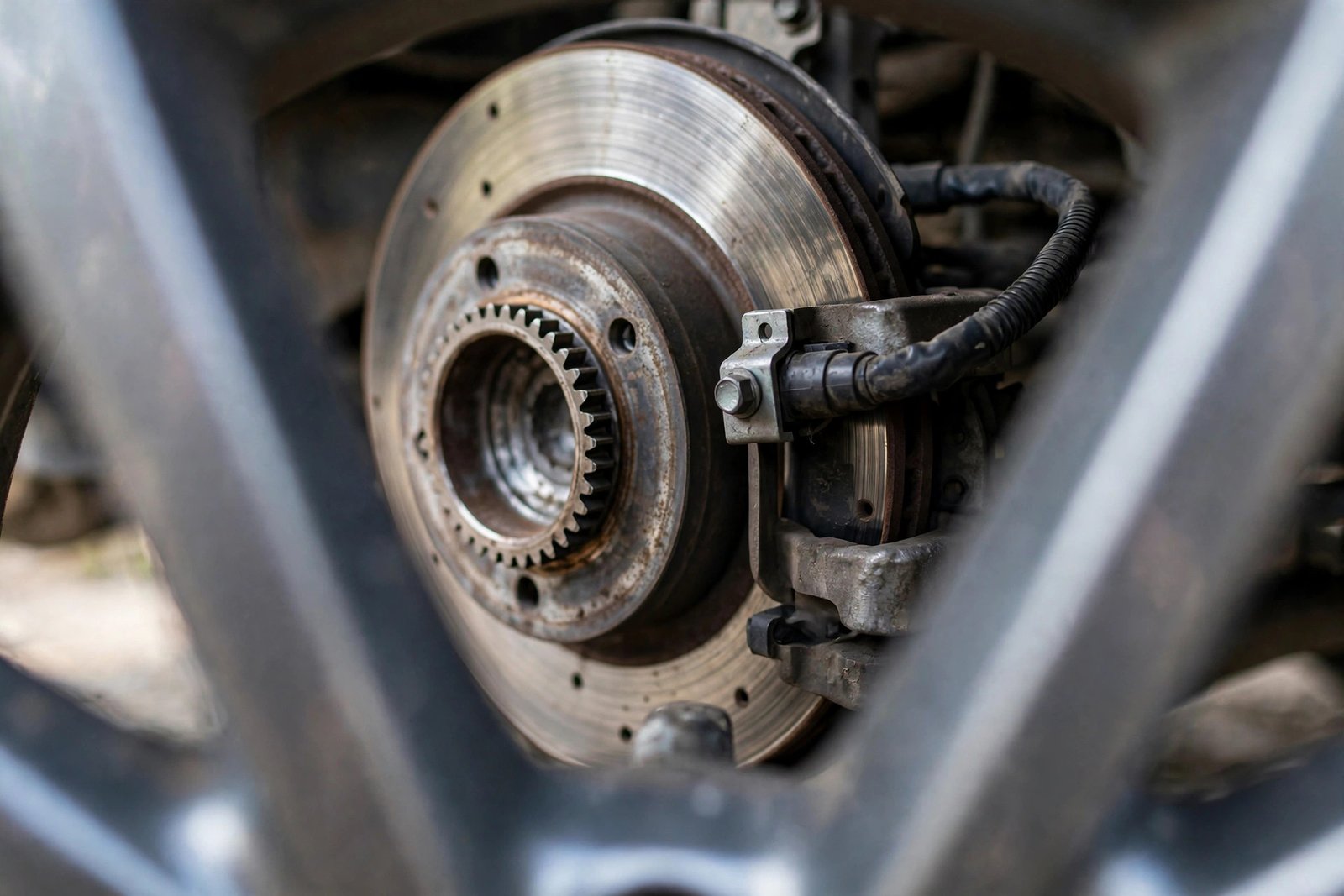
The ABS computer watches wheel speed sensors — magnetic sensors reading a toothed tone ring (reluctor ring) at each wheel. The sensor’s signal gets weaker as the wheel slows down: at low speed, each tooth spends more time in the sensor’s field, and any corrosion, rust, or air-gap issue that was marginal at 50 mph becomes a dropout at 10 mph.
The computer can’t distinguish “weak signal” from “wheel stopped.” It reads the dropout as a wheel locking up — and fires the ABS to “save” it. That’s why this fault is speed-dependent: fine on the highway, buzzing in the parking lot. Industry technical bulletins (e.g., Raybestos BPI bulletins on slow-speed false modulation) document exactly this mechanism: rust buildup under the sensor increases the air gap, weakening the signal until low-speed dropouts trigger the ABS.
The Most Likely Causes, in Order
1. Rusted or contaminated wheel speed sensor / tone ring (most common)
Rust builds up under the sensor mounting, lifting it slightly away from the tone ring and increasing the air gap — weakening the already-faint low-speed signal. Corroded tone-ring teeth scatter the magnetic signal the same way. Road salt regions see this most. This is the cause documented in manufacturer technical bulletins, and it’s the first thing a proper diagnosis checks.
2. Damaged wiring or connectors
The sensor’s wiring runs through the wheel well — flexing, road debris, and corrosion damage it over time. An intermittent connection produces the same dropout signature as a weak sensor. Often invisible without a proper inspection.
3. Excessive wheel bearing play
A worn bearing lets the hub (and its tone ring) wobble relative to the fixed sensor — varying the air gap with each rotation. The signal modulates, the computer reads lock-up, the ABS fires. Bearing play can also follow a recent hub replacement if the new unit’s signal differs from the old one.
4. ABS module fault (least common)
The control module itself misinterpreting good signals is rare — sensors, rings, and wiring account for the vast majority of false-activation cases. “Replace the module” without testing the sensors first is a guess, not a diagnosis.
Why There’s Often No Warning Light
This confuses everyone. The ABS light comes on when the computer detects a hard fault — a dead sensor, an open circuit. But false activation comes from a marginal signal: strong enough to pass the computer’s self-test, weak enough to drop out at low speed. The computer thinks the system is healthy and the wheel is locking — so it fires the ABS instead of lighting the warning. No light does not mean no fault.
The “Over Bumps” Variant
Some drivers notice the ABS kicking in when braking over bumps or potholes at low speed. Same mechanism, different trigger: the jolt momentarily unloads a wheel (or jars a marginal sensor), the computer reads a speed anomaly, and the ABS fires. If it happens consistently over bumps, the sensor/ring/wiring suspects apply — with bearing play as a strong candidate.
What to Tell Your Mechanic
“ABS activates during gentle low-speed braking on dry pavement” plus: the speed range (under ~10 mph?), whether the ABS light ever comes on, whether it happens over bumps, which corner the noise comes from if you can tell, and your region (road-salt winters matter for this fault). A proper diagnosis reads ABS codes with an ABS-capable scanner and tests sensor signal strength at low wheel speed — a road test at 50 mph won’t reproduce it. Ask specifically whether the tone rings and sensor air gaps were inspected.
FAQ
Is it safe to drive with false ABS activation?
Cautiously, to a shop — with extra following distance. The ABS is lengthening your stops in low-speed situations, and you can’t predict when it will fire. It’s a prompt-inspection item, not an ignore-it item.
Why does it only happen when I’m almost stopped?
Signal strength falls with wheel speed. The marginal sensor/ring produces a usable signal at 40 mph and a dropout at 8 mph — so the fault appears exactly in the last moments before a stop.
Will an OBD-II scanner find it?
A basic engine-code scanner usually won’t — ABS faults live in the chassis module. You need an ABS-capable scanner, and even then, a marginal signal may not set a code. Low-speed signal testing is the definitive check.
My ABS light IS on — is that the same problem?
Related but different: a lit ABS light means the computer detected a hard fault and likely disabled the ABS (base brakes still work, no anti-lock). False activation with no light means the computer thinks everything is fine and keeps firing. Both need a certified mechanic’s diagnosis.