
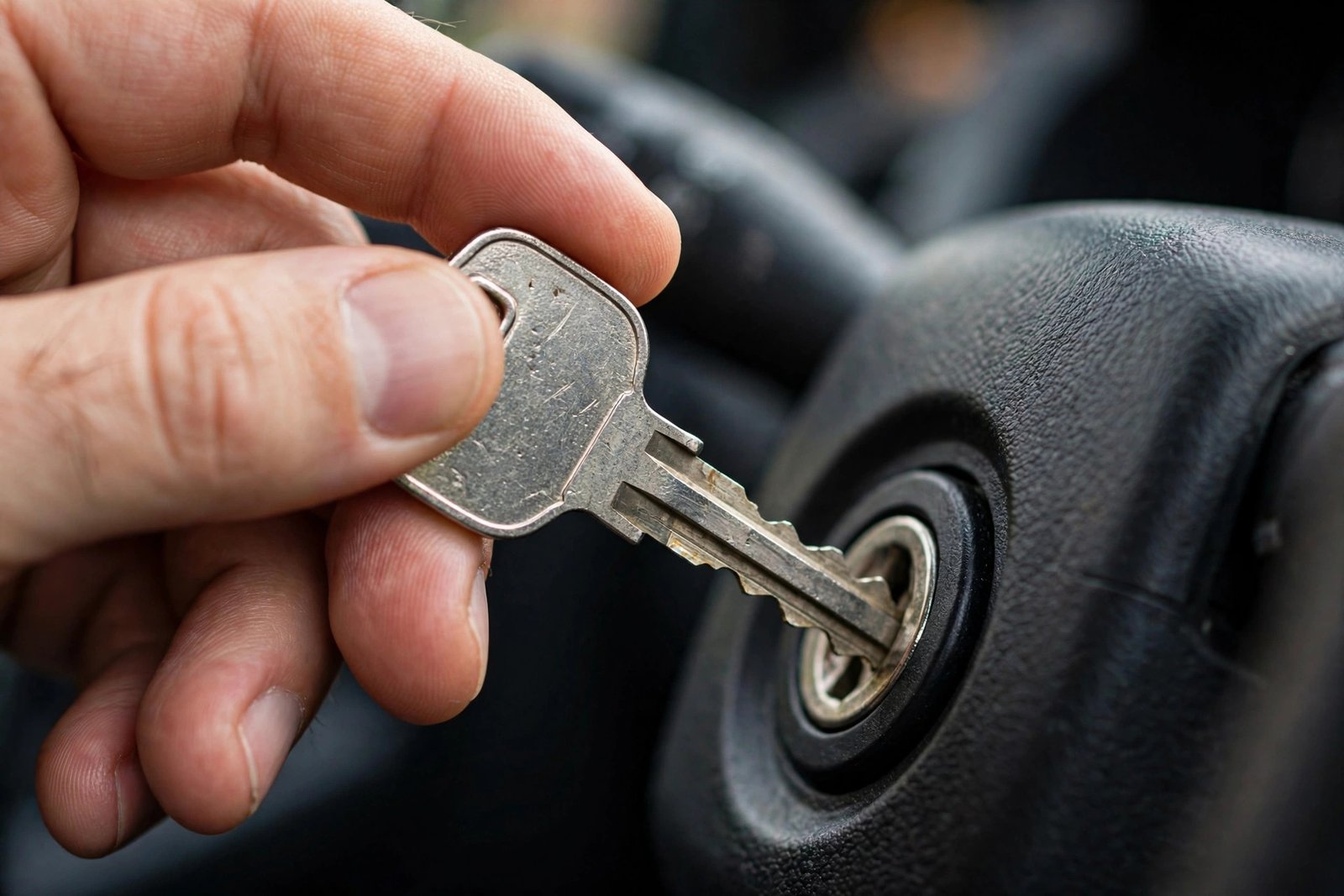
The key goes in, but it won’t turn. Before you reach for pliers or muscle, stop: forcing a stuck key is how a free fix becomes a snapped key and a destroyed ignition cylinder. In most cases the cause is one of three simple things, and the fix takes under a minute. Work this sequence in order — each step rules something out.
In this guide, you’ll learn:
- The 60-second fix sequence, in order
- Why each cause stops the key from turning
- The right lubricant (and the wrong ones)
- When to call an automotive locksmith
- What never to do
Safety first: Never force the key. A snapped key turns a 60-second fix into a locksmith extraction plus a new ignition cylinder. If the key needs muscle, stop — that’s the signal to call a pro.
The 60-Second Fix Sequence
Step 1: Release the steering wheel lock (fixes most cases)
This is the #1 cause. When you removed the key last time with the wheels turned, the steering lock engaged — and now it’s putting pressure on the ignition cylinder, blocking the key.
- Do this: With one hand, gently turn the steering wheel left and right (just a little — find the direction with slight give). With the other hand, gently turn the key at the same time.
- The lock releases with a small click, and the key turns. No force needed.
Step 2: Confirm the gear position (automatics)
Many automatics won’t let the key turn unless the shifter is fully in Park. Push the shifter firmly into P — sometimes it looks seated but isn’t quite there. Try wiggling it into Park again, then turn the key. (Manuals: make sure you’re in neutral with the clutch pressed, per your owner’s manual.)
Step 3: Inspect the key
Pull the key out and look at it. Bent, twisted, or heavily worn keys don’t align the cylinder’s pins properly.
- Try your spare key. If the spare turns smoothly, your main key is worn out — get a new one cut (a locksmith can cut from the spare or from the key code).
- Never use a damaged key “just this once” — that’s when they snap.
Step 4: Lubricate the cylinder (the right way)
A dry or gummy cylinder resists turning.
- Use: dry graphite powder or a lock-specific lubricant — a tiny amount on the key, then work the key gently in and out.
- Don’t use: cooking oil, and avoid WD-40 as a long-term fix — oils attract dust and gum up the pins over time.
- If lubrication makes it worse, stop — the cylinder may be worn, not dry.
Step 5: Clear debris
Dust, pocket lint, or (after winter) road salt can jam the pins. A short blast of compressed air into the cylinder can clear it. Don’t probe with pins or wires — you’ll damage the wafers.
Step 6: Check the battery (electronic ignitions)
On cars with electronic ignition interlocks, a completely dead battery can prevent the key from turning. If the dome light doesn’t come on either, you may have a dead battery, not a key problem. See no sound, no lights.
Step 7: Call an automotive locksmith
If the sequence above didn’t work, the ignition cylinder itself is likely worn or damaged internally. An automotive locksmith can usually repair or replace the cylinder — often without replacing the entire ignition system — and cut a fresh key to match.
What Never to Do
- Never force the key. Snapped keys, bent keys, and destroyed cylinders all start with “just a little more pressure.”
- Never use pliers or a wrench on the key. You’ll snap it or twist the cylinder housing.
- Never spray random household lubricants deep into the cylinder — gummed pins are worse than dry ones.
- Never disassemble the ignition yourself unless you know exactly what you’re doing — airbag wiring and anti-theft components live in the steering column.
When It’s Not the Key At All
The key turns but the car won’t start — different problem. If you hear a click, see single click; if nothing happens, see no sound, no lights.
Push-button start, steering feels locked — electronic steering locks don’t release the same way; this is usually an electronic fault. See push-button start not working or see a dealer.
The key won’t come OUT — often the same causes in reverse (not fully in Park, steering lock tension). Work the sequence backward: confirm Park, wiggle the wheel gently.
FAQ
Can I use WD-40 in the ignition?
As an emergency measure it can free a sticky cylinder, but it’s not a proper lock lubricant — it attracts dust and gums up over time. Follow up with graphite or a lock-specific lubricant, or have a locksmith service the cylinder.
How do I know if it’s the key or the cylinder?
The spare-key test is the decider: spare works = your key is worn; spare also fails = the cylinder is the problem.
Will a locksmith be expensive?
It varies widely by car and region — get a quote before authorizing. It’s almost always cheaper than the damage from forcing the key and breaking it off inside.
My key is a fob with no blade — does any of this apply?
Mostly no. Fob-based cars don’t have a mechanical cylinder to jam; a non-starting fob car is usually a fob battery, 12V battery, or electronic issue. See push-button start not working.