
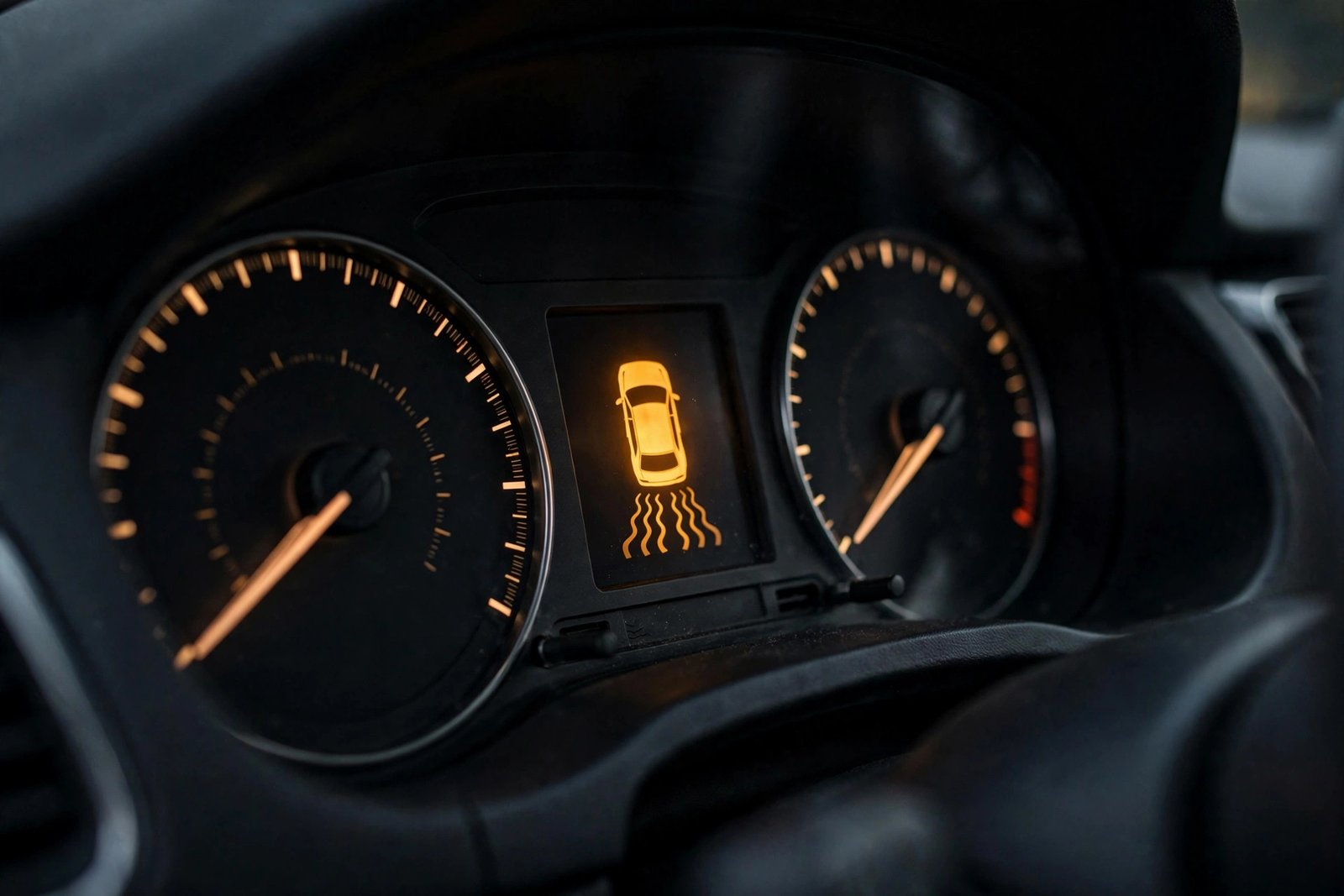
The traction control light is the warning light drivers misread most often — because it has two completely different meanings depending on whether it flashes or stays steady. Get this one distinction right and you’ve already done the hard part of the diagnosis.
In this guide, you’ll learn:
- Flashing vs. steady: what each one means (this is the whole game)
- The “I turned it off by accident” check that takes 10 seconds
- The most common real causes, in order of likelihood
- Why this light so often arrives with the ABS light
- When to see a mechanic
The One Distinction That Matters
| What you see | What it means | What to do |
|---|---|---|
| Flashing briefly (e.g., on a wet road, snow, gravel) | The system is working — it detected wheel slip and intervened. | Nothing. This is normal and good. |
| Steady / stays on in normal driving | The system detected a fault and disabled itself. You’re driving without traction or stability assistance. | Check the off-button first; if it’s genuinely on, book a diagnosis. |
| TCS + ABS lights together | Shared component fault (usually a wheel speed sensor or the ABS module). | Diagnose soon — both safety systems are down. |
| TCS + check engine light | On many cars (notably Toyota), an engine fault auto-disables traction control. Fix the engine issue first. | Read the engine code first. |
The 10-Second Accidental-Off Check
Many cars let you switch traction control off with a dashboard button (often marked with the same skidding-car icon, near the shifter or steering wheel). Drivers bump it constantly — especially when reaching for other controls. If the light is steady, press that button once and see if the light goes out. On some cars the system reactivates at the next restart anyway.
The Most Likely Causes, in Order
1. The system was switched off (most common non-fault)
See above. Always rule this out before anything else.
2. Faulty wheel speed sensor
Traction control needs to know each wheel’s exact speed. A sensor fouled by road debris, damaged by a pothole, or killed by corrosion sends bad data; the computer can’t do its job and shuts the system down. This is also why the ABS light so often joins it — both systems share these sensors.
3. Steering angle sensor fault
The system needs to know which way you’re trying to go to detect a skid. A miscalibrated or failed steering angle sensor confuses the logic and trips the light. Often follows alignment work or steering repairs.
4. ABS system fault
On most modern cars, traction control is built on the ABS hardware — same sensors, same module, same hydraulic unit. An ABS fault frequently disables traction control as a side effect.
5. Blown fuse or wiring fault
A blown fuse feeding the ABS/TCS module or damaged wiring at a wheel sensor kills the whole chain. Worth checking before paying for module-level diagnosis.
6. Low system voltage
A weak battery or failing alternator can starve the control modules, causing intermittent TCS lights that clear after the car runs a while. If the light flickers at startup and vanishes, get the battery and charging system tested.
7. Mismatched tires
Different tire sizes, or badly worn tires mixed with new ones, make wheel speeds “disagree” permanently. The system reads it as constant slip.
8. Faulty TCS/ABS control module
Least common. Diagnose by elimination — don’t assume this until sensors, fuses, and wiring are ruled out.
What You Can Safely Do Yourself
- Check the off-button — press it once, watch the dash.
- Restart the car. A one-time sensor glitch can self-clear.
- Check tire pressures and sizes. All four tires should match and be correctly inflated.
- Scan for codes. An ABS-capable scanner reads the chassis codes (C-codes) that generic readers miss.
- While driving with it steady: you’re without electronic skid assistance — slow down in rain and snow, brake earlier, and avoid sudden maneuvers.
When to See a Mechanic
- The light stays on in dry conditions after the off-button check and a restart.
- TCS + ABS lights together — shared-component fault.
- The light appeared after alignment, steering, brake, or wheel work.
- Intermittent light that keeps returning — wiring or voltage issue that needs proper tracing.
FAQ
Is it safe to drive with the traction control light on?
That’s the system doing its job: it flashes while actively correcting wheel slip. Worry only if it stays on steadily.
Why are my traction control and check engine lights both on?
On many vehicles an engine fault automatically disables traction control. Diagnose the engine code first — the TCS light usually clears with it.
all dashboard warning lights explained
Sources
- Engineer Fix — “Why Is My Traction Control Off?” (wheel speed sensors, voltage, fuse, brake-light-switch faults) — https://engineerfix.com/why-is-my-traction-control-off/
- DIY Car Expert — “Traction Control Light: Causes, Meaning & How to Fix It” (engine-fault auto-disable on Toyotas; misfire + both lights) — https://diycarexpert.com/traction-control-light/
- Stoneacre — “Traction Control Warning Light: What You Need to Know” (flashing vs. steady distinction) — https://www.stoneacre.co.uk/blog/traction-control-warning-light/