EV AC Not Cold: 8 Causes and How to Diagnose It
Updated Nov 22, 2026
In This Guide
- How EV Air Conditioning Is Different
- Quick Cause Match: Symptoms That Point to Each Cause
- Cause 1: Settings, Eco Mode, or Energy Management
- Cause 2: A Clogged Cabin Air Filter or Weak Airflow
- Cause 3: Low Refrigerant From a Slow Leak
- Cause 4: A Failed Electric Compressor
- Cause 5: A Blocked Condenser or Weak Condenser Fan
- Cause 6: Heat-Pump Valve, Sensor, or Software Fault
- Cause 7: Battery Thermal Demand Taking Priority
- Cause 8: Blend Door, Actuator, or Air Distribution Fault
- EV AC Not Cold Checks to Run, in Order
- Repair or Keep Driving? Making the Call
- Frequently Asked Questions
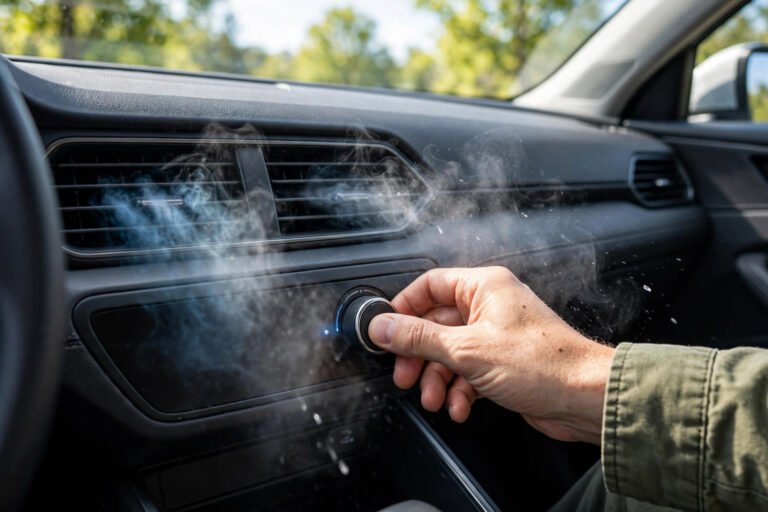
With your EV AC not cold, you set the climate to its coldest setting, the fan is blowing hard, and the air coming out of the vents is barely cool — or warm outright. In a gasoline car, the first suspect is usually a belt-driven compressor. In an electric car, the diagnosis is different, and that difference matters: there is no engine belt turning the compressor, no engine heat to borrow, and in many models the same cooling system that chills your cabin is also keeping the high-voltage battery at a safe temperature.
This guide is specifically about electric vehicles — battery EVs and, where noted, plug-in hybrids running in electric mode. If you drive a conventional gasoline car, the companion guide to an AC not cold enough (https://fixtorial.online/car-ac-not-cold-enough/) covers the gas-car causes. Here, we focus on what is unique to EVs first, then the shared causes that still apply.
High-voltage safety warning — read this first: an EV’s air-conditioning compressor runs on high voltage, straight from the traction battery, and the orange high-voltage cables and inverter components around it can seriously injure or kill. This guide covers diagnosis and education only for anything high-voltage. Never open high-voltage covers, never touch orange cables, and never attempt a do-it-yourself repair on the compressor, the refrigerant loop, or the battery cooling system. Refrigerant handling also requires EPA Section 609 certification. The owner-safe checks in this guide are limited to settings, filters the owner’s manual lists as owner-serviceable, and observation — everything else belongs to a certified EV technician.
How EV Air Conditioning Is Different
Understanding the difference is half the diagnosis, because several EV “faults” turn out to be the system working as designed.
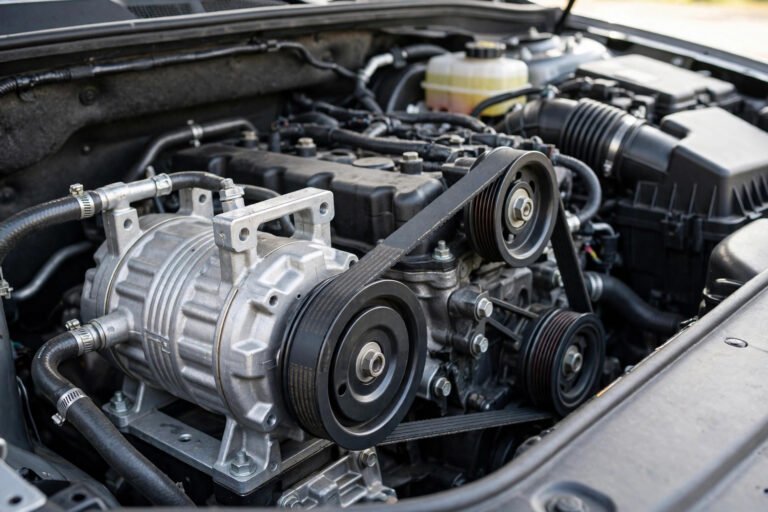
- An electric compressor, not a belt-driven one. Instead of a compressor spun by the engine through a belt and clutch, an EV uses a variable-speed electric compressor powered directly from the high-voltage battery. It can run even when the car is parked and “off” in the traditional sense, it speeds up and slows down on demand rather than cycling on and off with a clutch, and there is no belt or clutch for you to eyeball. When it fails, it usually just goes quiet or throws a fault — there is no squealing belt to warn you first.
- One thermal system, two jobs. In many EVs, the same refrigerant loop cools both the cabin and the battery pack, drive unit, and power electronics through heat exchangers. That sharing is efficient, but it means a cooling problem is not always just a comfort problem: if the system cannot reject heat, the car may protect the battery first and give the cabin what is left.
- A heat pump on many newer models. A heat pump moves heat in either direction — out of the cabin in summer, into it in winter — using valves to reverse the flow. A valve, sensor, or software fault in that shared system can therefore affect cooling even though the compressor itself is healthy.
- Energy management that trims cooling. To protect range, many EVs deliberately limit climate output in Eco drive modes, at very low battery charge, or while fast charging, when battery cooling takes priority. Weak cooling in those specific situations may be a setting or a priority decision, not a broken part.
Keep those four differences in mind as you work through the causes: the fix for “Eco mode limited my AC” costs nothing, while the fix for “the electric compressor failed” is a shop job. The checks below are ordered so you rule out the free ones first.
Quick Cause Match: Symptoms That Point to Each Cause
- Air is cool but weak, or cooling is limited in Eco mode or at low charge: Settings, Eco mode, or energy management
- Airflow itself is weak, even on high fan speed: Clogged cabin air filter or blower problem
- Cooling faded gradually over weeks or months: Low refrigerant from a slow leak
- No cooling at all, compressor silent, possibly a warning message: Failed electric compressor or high-voltage fault
- Cold while driving, warm at idle or in traffic: Blocked condenser or weak condenser fan
- Cooling comes and goes, or heat and cooling seem confused: Heat-pump valve, sensor, or software fault
- Cooling drops during or just after fast charging, or on a very hot day: Battery thermal demand taking priority
- Cold on one side only, clicking behind the dash, or air stuck on one vent: Blend door, actuator, or air distribution fault
Cause 1: Settings, Eco Mode, or Energy Management
This is the most common “fault” that is not a fault at all, and it costs nothing to check.
Eco or efficiency drive modes on many EVs deliberately cap climate power to save range. The fan may still blow hard, but the compressor runs at reduced speed, so the air never gets properly cold. The same limiting can happen at a very low state of charge, when the car preserves energy to reach a charger, or when a scheduled departure or preconditioning setting is fighting your manual setting.
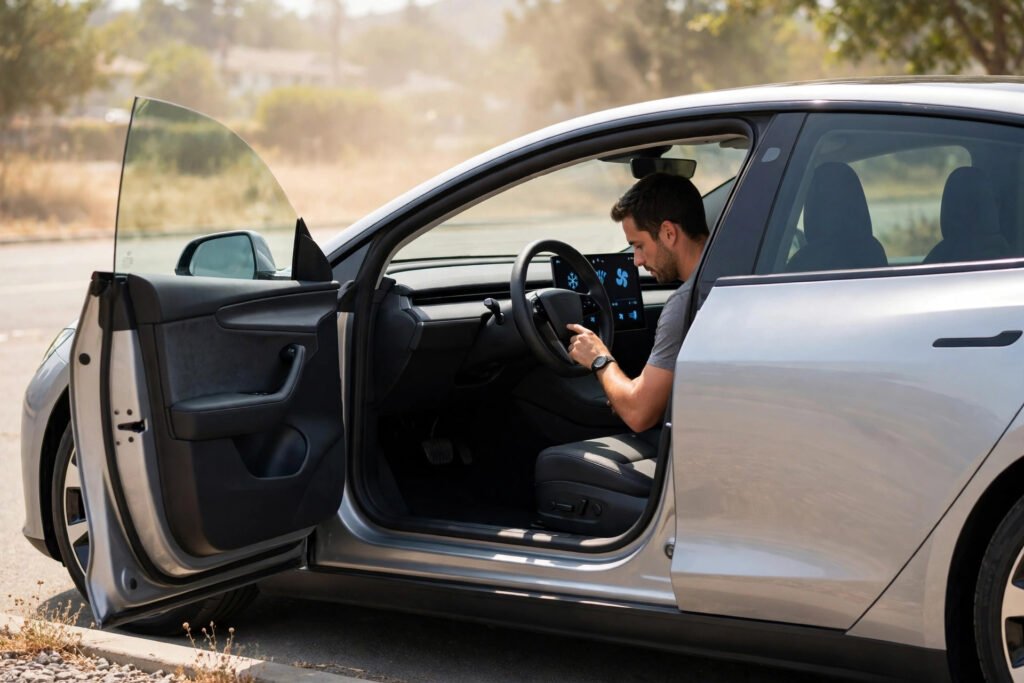
What to check: turn Eco mode off, set the temperature to its lowest setting, make sure the AC button itself is actually on (not just the fan), and try fresh-air mode versus recirculation — recirculation usually cools faster once the cabin is already cool, but on a heat-soaked car it first recirculates hot cabin air. If cooling returns to normal with Eco off and a healthy charge level, you found it. Also check whether the car was mid-preconditioning or charging: some cars limit cabin cooling while they prioritize the battery, and normal cooling returns once charging slows or finishes.
Cause 2: A Clogged Cabin Air Filter or Weak Airflow
Weak cooling and weak airflow are different complaints, and telling them apart saves a misdiagnosis. If the air coming out feels cold when it does come out, but there is barely any of it even on the highest fan speed, the problem is usually airflow, not refrigeration.
The cabin air filter is the usual culprit. It traps dust, pollen, and debris before air reaches the cabin, and when it clogs, airflow collapses. Some EVs have two cabin filters, so check your owner’s manual for the count and location rather than assuming one. A filter the manual lists as owner-serviceable is a safe DIY check; if the manual does not list it, leave it to a shop.
What to check: learn the warning signs of cabin air filter symptoms (https://fixtorial.online/engine-vs-cabin-air-filter-symptoms/) — weak airflow, a musty smell, dust on the dash, windows fogging more than usual. If airflow is strong but the air is warm, skip ahead: the filter is not your problem. If the fan itself sounds strained, runs on only one speed, or does not run at all, that is a blower or blower-control fault, and it goes to a shop.
Cause 3: Low Refrigerant From a Slow Leak
This is the most common genuine refrigeration fault, in EVs just as in gas cars. The air-conditioning system is a sealed loop: refrigerant does not get “used up” in normal operation, so a low charge almost always means a leak somewhere — a seal, a hose connection, a condenser damaged by road debris, or the compressor shaft seal. Cooling typically fades gradually over weeks or months rather than vanishing overnight, and the compressor may run longer and harder trying to compensate.
What to check — and what not to do: this is professional-only work. Refrigerant is a dangerous chemical that can cause injury if mishandled, and it is damaging to the environment if vented. Most modern EVs use R-1234yf refrigerant, which requires the correct equipment, the correct charge weight, and the correct oil — EV electric compressors use non-conductive POE oil, and mixing in the wrong oil can damage the compressor. Do not use a DIY refill can: without gauges on both sides of the system you cannot tell how much is in there, and overcharging can destroy a compressor just as surely as running it low. A certified technician will recover and weigh the remaining refrigerant, pressure-test the system, find the leak with dye or an electronic detector, repair it, and recharge to the exact specification. RepairPal notes that compressor leaks are colorless, odorless, and invisible to the naked eye, which is exactly why this diagnosis needs professional equipment rather than a visual inspection.
Cause 4: A Failed Electric Compressor
If the air is warm and the compressor is silent — no faint hum or whir from the front of the car when AC is demanded — the electric compressor itself may have failed, lost its high-voltage supply, or been shut down by the car’s protection logic. Unlike a gas car’s compressor, there is no clutch to watch engage and no belt to inspect, so the absence of that quiet electric whir is itself a clue, along with any thermal-system or “check EV system” warning message.
Electric compressors can fail from internal wear, from running with low refrigerant and therefore low oil circulation, from a high-voltage fuse or inverter fault, or from contamination after an incorrect service. A compressor that runs but makes a loud grinding, rattling, or screeching noise is also failing — shut the AC off and book a shop visit rather than running it until it seizes.
What to check: this is diagnosis only, and it is high-voltage diagnosis. Do not probe compressor wiring, do not open any orange-cabled component, and do not attempt to “force” the compressor to run. A certified EV technician with factory-level scan data can read the thermal-system fault codes, check whether the compressor is being commanded on, and test its high-voltage supply safely. If the compressor has failed, replacement is a shop job, and the system must be flushed, correctly oiled, and recharged to specification — a shortcut here can kill the new compressor too.
Cause 5: A Blocked Condenser or Weak Condenser Fan
This cause has a distinctive signature: the AC is cold while you are driving, but turns warm at idle or in slow traffic. At speed, ram air pushes through the condenser at the front of the car and carries heat away even if the fan is weak. At a standstill, the condenser fan has to do all of that work alone — and if it cannot, pressures rise, the system protects itself by cutting compressor output, and the vents go warm.
The condenser sits at the front of the car, where it collects road debris, leaves, bugs, and winter road salt. A face matted with debris cannot reject heat, and a fan that runs slowly, intermittently, or not at all has the same effect. The companion guide to AC blowing warm air at idle (https://fixtorial.online/car-ac-warm-air-at-idle/) describes this pattern in detail for conventional cars; the physics is identical in an EV, even though the compressor driving it is electric.
What to check: look — without touching any high-voltage component — at the front grille and condenser area for a visible mat of debris, and listen at idle with the AC on for the condenser fan running. If the fan is silent at idle on a hot day with AC demanded, or the condenser face is visibly blocked, book a shop visit: fan diagnosis involves electrical testing, and condenser cleaning on an EV must avoid the high-voltage and refrigerant components mounted nearby. Do not spray high-pressure water blindly into the front end.
Cause 6: Heat-Pump Valve, Sensor, or Software Fault
On heat-pump-equipped EVs, cooling and heating share valves, sensors, and control software. A valve stuck in the wrong position, a temperature or pressure sensor reading incorrectly, or a software glitch can leave the system confused: cooling that comes and goes, air that is cool but never cold, heating and cooling fighting each other, or a system that works after a restart and then fails again.
This is also the cause most likely to be fixed by something embarrassingly simple — or to need a dealer-level reflash. Start with the simple end: some climate glitches clear after the car is fully powered down and restarted following the owner’s manual procedure, and some follow a failed or interrupted over-the-air software update. But do not repeatedly power-cycle the car, pull fuses, or disconnect the 12-volt battery to “reset” the climate system: on an EV, that can create new faults or interrupt a battery-management process.
What to check: note the pattern — does cooling fail only after a software update, only in one mode, or only when switching between heating and cooling? Does a full power-down and restart, done exactly as the manual describes, restore it? If the fault returns, or if any warning message accompanies it, the car needs a certified EV technician with the right scan tool: pressure and temperature sensor faults, valve faults, and HVAC software faults all read out as codes that a generic code reader may miss entirely.
Cause 7: Battery Thermal Demand Taking Priority
This one surprises EV owners, because the car is behaving correctly — it is just not prioritizing your comfort. When the battery is hot — after fast charging, after sustained high-speed driving on a very hot day, or during a hot-weather DC fast-charging session — the thermal system may divert most of its cooling capacity to the battery pack and power electronics. Cabin cooling weakens or pauses until the battery is back in its safe temperature window. The same priority shift can happen when the battery is very cold and the system is warming it instead.
The tell-tale pattern is timing: cooling was fine, then faded during or just after fast charging or hard driving in extreme heat, then recovered on its own once the battery cooled. If cooling never recovers, or if a battery-temperature or power-limit warning appears, that is no longer normal prioritization — that is a thermal-system fault, and the car should go to a certified EV technician promptly, because an overheating battery is a safety issue, not a comfort one.
What to check: compare cooling while parked and unplugged on a mild day with cooling during fast charging on a hot day. If the first is fine and the second is weak, and cooling recovers after charging, you are seeing thermal prioritization. In that case, the practical fixes are preconditioning the cabin while still plugged in before a hot drive, and avoiding back-to-back fast-charging sessions in extreme heat where you can. If the car limits power, shows a battery warning, or refuses to charge, stop troubleshooting comfort and book service.
Cause 8: Blend Door, Actuator, or Air Distribution Fault
If the system is producing cold air but it is not reaching you properly, the fault is in air distribution, not refrigeration. The classic signs are cold air on one side of the car and warm air on the other, a clicking or tapping noise from behind the dashboard when you change temperature or mode, air stuck on the windshield or floor no matter what you select, or temperature that does not change when you move the setting.
Behind the dashboard, small electric actuators move blend doors that mix cooled and heated air and direct it to the vents you selected. When an actuator fails or a door sticks, one side can go warm while the other stays cold, or the system can blow cold air at your feet while the face vents stay warm. A frozen evaporator — ice building up on the evaporator core and blocking airflow — can mimic this, with airflow fading after a period of strong cooling and returning after the car sits switched off.
What to check: test each side and each vent mode separately, and listen for clicking behind the dash when you change settings. If only one side is affected, or mode selection does nothing, the refrigeration system is probably fine and the distribution system is not. Dashboard work involves airbags and trim that is easy to break, so actuator and door diagnosis and repair belong to a shop. If airflow fades after extended cooling and returns after a rest, mention that pattern to the technician — it points toward evaporator icing, which usually traces back to a sensor, airflow, or refrigerant-charge problem rather than the blower itself.
EV AC Not Cold Checks to Run, in Order
Work cheapest and simplest first, and stop as soon as cooling returns:
- Settings first — Eco mode off, AC actually on, lowest temperature, try fresh-air and recirculation, and check charge level and whether the car is fast charging.
- Airflow check — fan on high: is air actually moving? Weak airflow points to the cabin filter or blower, not the refrigerant.
- Pattern check — cold while driving but warm at idle points to the condenser or fan; weak only while fast charging points to battery thermal priority; one side warm points to a blend door.
- Listen and look — a silent compressor with no cooling, a loud compressor, or any thermal-system warning message means a shop visit, not further DIY.
- Restart properly — one full power-down and restart exactly as the owner’s manual describes, for a suspected software glitch only.
- Book a certified EV technician if cooling is still weak, if any warning appears, or if the fault involves the compressor, refrigerant, heat-pump valves, or battery cooling. Ask for a thermal-system scan, not just a generic code read, and for the refrigerant to be recovered and weighed rather than topped up blindly.
Never add refrigerant from a DIY can, never open a high-voltage cover, and never keep running a noisy compressor to “see if it clears.” Each of those turns a repairable fault into a much bigger one.
Repair or Keep Driving? Making the Call
A settings fix, a fresh cabin filter, or a cleared debris blockage needs no further repair — just re-test cooling on a hot day and confirm it holds. A refrigerant leak, a compressor fault, a valve or sensor fault, or a battery-cooling fault needs professional diagnosis before you decide anything, because the repair cost depends entirely on which component failed and on your model: a sensor or a valve is a very different job from a compressor, and a warranty may still cover a newer car, so get the diagnosis and the warranty answer before authorizing parts.
Keep driving with weak AC is usually safe if the car shows no warnings, the battery is not overheating, and you can stay hydrated and alert — but do not keep driving if a battery-temperature or thermal-system warning appears, if the car limits power, or if you smell burning or chemical odors from the vents. In those cases, pull over safely, switch the climate off, and call for service or a tow. And if the car will not cool at all in extreme heat, treat it like any other car without AC: plan stops, carry water, and never leave children or pets in a parked car to “test” whether the AC recovers.
Frequently Asked Questions
Why does my EV’s AC work while driving but go warm at idle?
That pattern points to the condenser or its fan. At speed, ram air carries heat away from the condenser; at idle, the fan must do it alone. A blocked condenser face or a weak fan lets pressures rise until the system cuts compressor output to protect itself. If your AC compressor keeps turning on and off (https://fixtorial.online/ac-compressor-turning-on-and-off/) in a conventional car, the same idle-weakness logic applies — in an EV the compressor is electric, but the condenser physics is identical.
Is weak AC in Eco mode a fault?
Usually not. Eco modes deliberately limit compressor speed to save range, so cooling feels weaker even though nothing is broken. Turn Eco off and re-test at a healthy charge level before booking a diagnosis. If cooling is still weak with Eco off, work through the other causes.
Can I top up my EV’s AC refrigerant myself?
No — not safely, and not accurately. EV systems use specific refrigerant and non-conductive POE oil, require the exact charge weight, and run at high voltage. A DIY can cannot measure what is already in the system, and overcharging can destroy the compressor. Refrigerant handling requires EPA Section 609 certification, so this is a certified-technician job.
Does a weak AC mean my EV battery is in danger?
Not on its own. Weak cabin cooling with no warnings is usually a comfort fault. But if weak cooling comes with a battery-temperature warning, power limiting, or a refusal to charge, the battery thermal system may be struggling, and that does need prompt professional attention. When in doubt, let a certified EV technician read the thermal-system codes.
My EV blows cold on the driver’s side but warm on the passenger side. Is the compressor bad?
Probably not. One-side-only symptoms point to air distribution — a blend door or actuator — rather than the compressor, which feeds the whole system. If the compressor had failed, both sides would go warm together. Mention the one-side pattern to the technician; it narrows the diagnosis considerably.

lily John
The Fixtorial team writes hands-on car troubleshooting guides for everyday drivers — symptom first, honest costs, and fixes you can verify yourself.