Car Heater Only Blows Hot Air? 7 Causes and the Click Test
Updated Nov 22, 2026
In This Guide
- Quick Symptom Match
- How the Blend Door Works
- 1. Failed Blend Door Actuator — The Most Common Cause
- 2. Broken Blend Door Itself
- 3. Actuator Lost Its Calibration
- 4. Heater Control Valve Stuck Open
- 5. Climate Control Module or Control Head Fault
- 6. Cabin Temperature Sensor Fault
- 7. The AC System Cannot Cool
- Quick Checks You Can Do Yourself
- Car Heater Only Blows Hot Air: When to See a Mechanic
- Cost Guidance
- FAQ
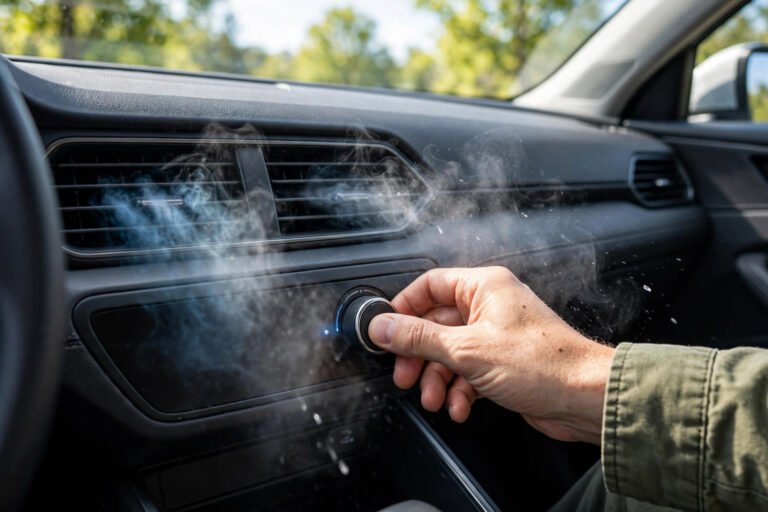
Car heater only blows hot air? You turn the temperature dial all the way to cold, and the vents keep blasting hot air. The fan works, the air moves, but the temperature control might as well not exist. This is a different problem from a heater blowing cold air — your heater works fine. The problem is that nothing can turn the heat off.
The short answer is that a stuck blend door actuator is behind most cases. Inside your dashboard, a small electric motor moves a plastic flap — the blend door — that mixes air from the hot heater core with cool air to hit the temperature you set. When that motor’s plastic gears strip, or the door itself breaks, the flap gets stuck on the hot side and no dial setting can move it. That is not the only possibility, though: a stuck heater valve, a lost calibration, a faulty control module, or an air-conditioning system that cannot cool will all produce the same symptom, and each one points to a different repair.
In this guide, you’ll learn:
- How the blend door controls your cabin temperature
- The 7 causes of hot-only air, matched to the symptom you notice
- The clicking-noise test that identifies a failed actuator in seconds
- Simple checks you can do in the driveway before paying for diagnosis
- When the fix is a cheap reset and when it is a dashboard-out job
- Honest 2026 repair costs for each likely repair
Safety first: blend door actuators live deep behind the dashboard, right where the passenger airbag sits. Disconnect the negative battery terminal before touching anything behind the dash, and never work around an airbag with the battery connected. Hot coolant is a burn risk too — never open the cooling system or touch heater hoses on a hot engine. This guide helps you diagnose; the repair itself belongs with a certified mechanic unless the actuator in your car is easily accessible and you are confident working around the dash.
Quick Symptom Match
| What you notice | Most likely cause | What to check first |
|---|---|---|
| Hot air plus a clicking or tapping noise behind the dash when you change the temperature | Failed blend door actuator (stripped gears) | Listen while cycling the dial from cold to hot |
| Air gets hotter as the engine warms up, even with the dial on cold | Blend door stuck open on the heater core | The warm-up test below |
| Only hot air right after a battery replacement or jump start | Actuator lost its calibration | Try the recalibration reset |
| Hot air in an older car or truck, AC slow to cool after warm-up | Heater control valve stuck open | Look for the valve in the heater hose line |
| Temperature stuck on hot in a car with automatic climate control, no noise at all | Climate control module or cabin temperature sensor fault | Scan for HVAC codes at a shop |
| One side blows hot while the other side cools normally (dual-zone) | That side’s own blend door actuator failed | Test each side separately |
| Air is warm rather than scorching, and the AC never feels cold either | AC system not cooling (compressor or refrigerant) | Check whether the AC compressor engages |
How the Blend Door Works
In most modern cars, hot coolant flows through the heater core all the time — there is no valve shutting it off. Temperature is controlled entirely by the blend door: a flap inside the heating and cooling (HVAC) housing that decides how much of the incoming air passes over the hot heater core and how much bypasses it. Turn the dial to cold and the door should block the heater core completely, routing air past the air-conditioning evaporator instead. Turn it to hot and the door opens the heater-core path.
That is why a stuck door is such a stubborn fault. The heater core’s surface can exceed 180°F, so even a door that is only slightly open lets enough hot air through to overwhelm the system. When the door is stuck fully on the hot side, no dial setting, fan speed, or vent selection makes any difference — the air has only one path, and it runs straight across the heater core.
1. Failed Blend Door Actuator — The Most Common Cause
The blend door actuator is a small electric motor, usually a black plastic box with one electrical connector, mounted on the side of the HVAC housing behind the dashboard — often reachable from the passenger side after removing the glove box or a lower trim panel. Inside it are small plastic gears. Over years of use, those gears strip or break, and the motor can no longer move the door to the position the climate controls command.
The giveaway: a repetitive clicking, tapping, or knocking sound from behind the dashboard when you change the temperature setting. The motor is still trying to turn the door shaft, but the stripped gears skip and hit the housing over and over. A healthy actuator makes a brief whir for a few seconds when you adjust the temperature and then stops. A clicking that goes on and on is the classic sign of a failed actuator. Temperature stuck on one extreme — full heat or full cold no matter where you set the dial — is the other signature symptom.
2. Broken Blend Door Itself
Sometimes the motor is fine and the door is the problem. The blend door is a plastic flap on a shaft, and that shaft can snap — a well-known failure on some Jeep Grand Cherokees, among others. When the door breaks free of its axle, the actuator turns uselessly and the door sits wherever gravity and airflow leave it, usually letting hot air through.
The giveaway: if the actuator is removed, a healthy door moves about 90 degrees and hits firm stops at both ends. A broken door spins 360 degrees freely with no stops at all. That test is the dividing line between an actuator problem and a door problem — and it matters, because a broken door means the repair goes inside the HVAC case itself, which is a much bigger job than swapping the motor.
3. Actuator Lost Its Calibration
Actuators do not just move — they learn their end positions. After a battery replacement, a jump start, or a long period with the battery disconnected, the climate control module can lose track of where the door actually is, and the actuator ends up parked in the wrong position. The system may blow only hot air even though every part is mechanically sound.
The giveaway: the problem started right after battery work — a new battery, a jump start, or a dead battery that was recharged. On many GM vehicles, a calibration reset is a documented owner-level procedure: set the controls to a neutral temperature, remove the HVAC fuse for about 60 seconds, refit it, start the engine, and let it idle for a minute or two without touching the controls while the actuators run through a calibration cycle. A battery-disconnect reset works similarly on some models. Check your owner’s manual for the exact fuse and procedure for your car — the steps vary by make and model, and the reset only helps if the actuator and door are mechanically intact.
4. Heater Control Valve Stuck Open
In older cars and many trucks, temperature is controlled differently: a heater control valve in the heater hose line under the hood regulates how much hot coolant reaches the heater core. If that valve fails in the open position, hot coolant flows into the core continuously, regardless of the temperature setting — and the constant heat can overwhelm the blend door’s ability to isolate the air path.
The giveaway: this one mostly affects older vehicles and trucks, and the symptom often has a timing pattern — extremely hot air for the first few minutes after the engine warms up, with the AC eventually starting to cool, or heat that returns after the engine is switched off and restarted. Look for the valve in the heater hose line near the firewall and check it and its vacuum line for damage or a stuck linkage. A vacuum leak can also leave the valve defaulted open, and on vacuum-operated systems a leaking line can push the dampers into the wrong position as well.
5. Climate Control Module or Control Head Fault
The control head — the buttons or dials on your dashboard — tells the actuator where to go. If the control head or the climate control module itself fails, it can send a continuous “heat” signal to a perfectly healthy actuator, holding the door open on the hot side no matter what the display says. A fault in the module can also make the system ignore your inputs entirely.
The giveaway: no clicking, no noise at all when you change the temperature, and no change in air temperature from any setting. Diagnosis means verifying that the actuator is receiving the correct signal from the control head before condemning the mechanical parts — a job for a shop with a scan tool that can read HVAC data, not a parts swap. If the module is the fault, the repair is replacement and programming of the module, not the actuator.
6. Cabin Temperature Sensor Fault
Cars with automatic climate control measure the cabin temperature with a small sensor, usually hidden behind a grille in the dashboard, and adjust the blend door to match your set temperature. If that sensor fails or reads wrong — say it reports the cabin is freezing when it is actually warm — the system keeps calling for heat and never moves the door toward cold.
The giveaway: the problem appears on automatic climate control systems, often with the temperature drifting or behaving inconsistently rather than being stuck at one extreme. The sensor itself is cheap, but finding it requires confirming the fault with a scan tool, because a sensor reading fault looks identical to a module fault from the driver’s seat.
7. The AC System Cannot Cool
Sometimes the heat side is innocent and the cold side is broken. When you set the temperature to cold, the blend door moves correctly — but the air-conditioning system that is supposed to cool the air is not working, so the air coming through the vents is warm, and on a hot day it feels hot. A compressor that is not engaging, low refrigerant, or a failed AC relay will all produce this pattern.
The giveaway: the air is warm rather than scorching, and the AC never feels cold on any setting — the same symptom our guide to a car AC not cold enough covers in detail. The quick separator: if the air gets noticeably hotter as the engine warms up, the blend door is still letting heat through, and the problem is on the heat side. If the air temperature stays roughly the same from a cold start, the problem is on the cooling side.
Quick Checks You Can Do Yourself
- Listen for the click: with the engine running, turn the temperature dial slowly from full cold to full hot and back. A repetitive clicking or tapping from behind the dash points straight at a failed actuator.
- Run the warm-up test: start the car cold with the temperature set to full cold. If the air gets hotter as the engine warms up, the blend door is letting heat through. If it stays the same temperature, suspect the AC side instead.
- Feel the heater hoses: once the engine is at operating temperature, carefully feel both heater hoses where they enter the firewall — use the back of your hand and never touch a hot engine’s hoses bare-handed. If both hoses are hot, the heater core is working fine and the problem is the door, not the heat supply.
- Test each side separately: on dual-zone systems, set the driver and passenger sides to opposite extremes. If one side cools and the other stays hot, that side’s actuator is the fault.
- Try a recalibration reset: if the fault began after battery work, try the fuse-pull or battery-disconnect reset described in Cause 3, following your owner’s manual for the exact steps. If the actuator is mechanically sound, this can fix it for free.
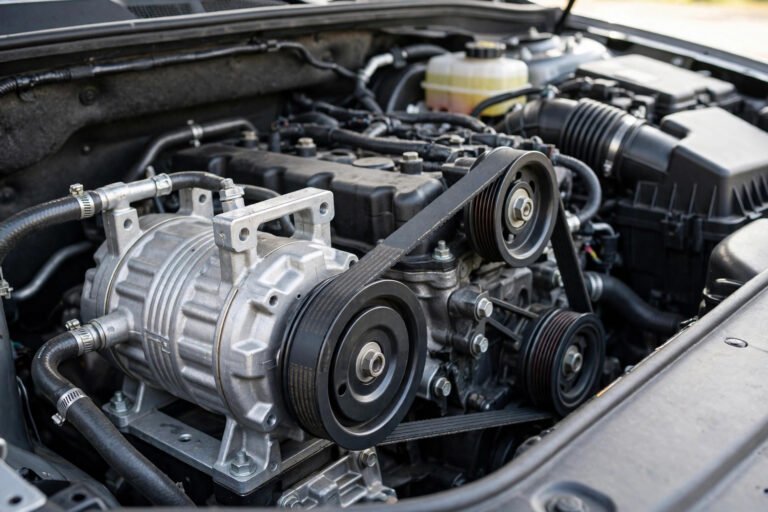
- Check the AC compressor: with the AC on and the engine running, look at the compressor pulley — the clutch should engage and spin with the pulley. If it never engages, the cooling side needs its own diagnosis.
Car Heater Only Blows Hot Air: When to See a Mechanic
Get a shop involved if the actuator is buried behind the dashboard, if the blend door itself is broken, if the fault is in the control module or a sensor, or if the recalibration reset does not work. Actuator replacement on some cars is a simple glove-box-out job; on others it means removing the dashboard, which is an 8-hour repair on some trucks — and working around the passenger airbag is not a beginner task. A shop can also run the actuator calibration routine with a scan tool and confirm the door position, which separates a motor fault from a door fault before any parts are ordered. If the air is stuck on hot and the engine temperature gauge is also climbing, stop and get the car checked the same day — that is a cooling-system problem, not a blend-door problem.
Cost Guidance
Blend door actuator replacement is a job where access decides the bill. RepairPal’s national estimator, updated September 3, 2026, puts professional replacement at $452 to $592 including parts and labour — about $153 for the actuator and $299 to $439 for labour. The typical range across US vehicles is roughly $200 to $600, but the spread is wide because the same part can be a one-hour job in one car and a dashboard-out job in another.
| Vehicle | RepairPal estimate (Sept 2026) |
|---|---|
| 2024 Ford F-150 | $149–$183 |
| 2009 Hyundai Veracruz | $165–$193 |
| 2008 Ford Taurus X | $187–$267 |
| Honda Civic | $199–$233 |
| 2001 Ford Ranger | $239–$319 |
| 2004 Nissan 350Z | $277–$357 |
| 2018 Chevrolet Camaro | $1,022–$1,473 |
| 2008 Toyota Avalon | $1,136–$1,472 |
The pattern in that table is the lesson: accessible actuators cost under $250 all-in, while cars that need extensive dashboard disassembly run past $1,000. A heater control valve, where fitted, is usually a far smaller job than a dashboard-deep actuator replacement, and a recalibration reset costs nothing if it works. A control module or sensor fault needs a shop diagnosis first — get the quote before authorising the repair, and ask whether the quote is parts and labour installed, and whether calibration is included.
FAQ
Can I drive with the heater stuck on hot?
Yes, for short trips in cool weather — the car is safe to drive. It becomes miserable in summer and can fog the windows, so get it fixed before hot weather. If the fogging is the main problem, our guide to a windshield defroster not working covers that separately. If the engine temperature gauge is also rising, that is a different problem: stop and get the cooling system checked.
The temperature is fine, but the fan only works on high — is that the same fault?
No. That is a blower motor resistor fault, not a blend door problem — the air temperature changes correctly, but the fan has lost its lower speeds. See our guide to a heater only works on high for that fault.
Is it the heater core?
Almost certainly not. A bad heater core causes no heat, a sweet smell, or coolant leaking into the cabin — the opposite of this problem. If both heater hoses are hot, the core is doing its job and the fault is the door that controls the air.
Why did this start right after I replaced the battery?
The climate control module lost the actuator’s learned positions when power was cut. Try the recalibration reset in Cause 3 — on many cars it restores normal operation without any parts.
Why does only one side blow hot?
Dual-zone cars have a separate blend door actuator for each side. One side cooling normally while the other stays hot means that side’s actuator has failed, not the whole system.
How long does the repair take?
An accessible actuator can be under an hour. A dashboard-out replacement can take a full day, and a broken blend door inside the HVAC case takes longer still — the shop needs the car, not just the part.
Will the clicking noise go away on its own?
No. The clicking is stripped gears skipping, and it only gets worse. The actuator will eventually stop moving the door at all, leaving the temperature stuck wherever the door ends up.

lily John
The Fixtorial team writes hands-on car troubleshooting guides for everyday drivers — symptom first, honest costs, and fixes you can verify yourself.