
EV Charging Slower Than Expected at Home: 8 Causes to Check
Updated Nov 22, 2026

In This Guide
- Quick Cause Match: What You Notice, and What It Points To
- EV Charging Slower Than Expected at Home: Read the Numbers First
- Cause 1: The Wall Unit’s Amperage Setting Is Lower Than You Think
- Cause 2: Your Car’s Onboard Charger Is the Limit
- Cause 3: A Car Setting Is Quietly Limiting Current or Delaying the Charge
- Cause 4: Load Management or Power Sharing Is Splitting the Circuit
- Cause 5: A Cold Battery Accepts Charge More Slowly
- Cause 6: Charging Naturally Slows as the Battery Fills
- Cause 7: Voltage Drop, a Worn Receptacle, or Heat Is Forcing the Charger to Derate
- Cause 8: The Circuit Is Shared, or a Utility Program Is Throttling You
- The Checks to Run, in Order
- When to Call an Electrician, and When to Call the Car Maker
- Frequently Asked Questions
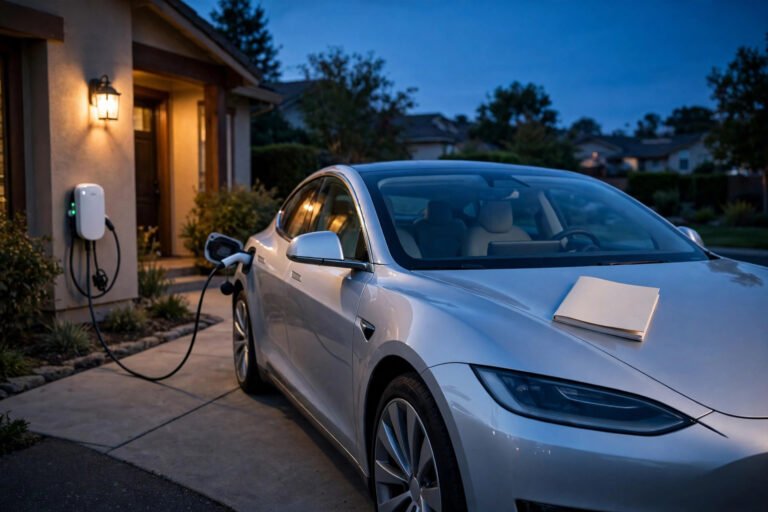
EV charging slower than expected at home starts like this: you bought a 48-amp home charger, or had one installed, and expected the car to fill overnight in a few hours. Instead it crawls along at half the rate you expected, or it used to charge faster and now it does not. The car is charging — this is not a dead charger or a car that refuses to charge at all — it is just slower than it should be, and the reason is rarely obvious, because home charging speed is set by the weakest link in a chain, not by the biggest number on the box.
That chain has four links: the wall unit (properly called the EVSE, or electric vehicle supply equipment), the circuit feeding it, the car’s onboard charger, and the battery itself. The wall unit does not actually charge the car. It supplies alternating current and tells the car how much current is available. The real charger lives inside the car: the onboard charger converts that AC power into DC power the battery can store. So a wall unit rated for 48 amps cannot force a car whose onboard charger accepts only 32 amps to take more — the car simply takes what it can, and the wall unit follows the car’s lead.
High-voltage and electrical safety warning — read this first: home EV charging runs on 240-volt household wiring, and the car itself carries a high-voltage traction battery with orange cables that can seriously injure or kill. This guide covers diagnosis and education only for anything high-voltage or inside the electrical panel. Never open the charger unit, never open high-voltage covers on the car, never touch orange cables, never replace a breaker with a larger one yourself, and never repeatedly reset a breaker that keeps tripping. Breaker, wiring, receptacle, and panel work belongs to a licensed electrician, and anything involving the traction battery, inverter, or onboard charger belongs to a certified EV technician. If you smell burning plastic, see scorch marks on an outlet or plug, or find a plug that is hot to the touch, stop charging immediately and call a professional — do not keep using that outlet to “see if it clears up.”
Quick Cause Match: What You Notice, and What It Points To
| What you notice | Most likely cause |
|---|---|
| Charging at a steady rate well below the wall unit’s rating, every night | EVSE amperage setting, or the car’s onboard-charger limit |
| The car charges at full speed sometimes, slower at others | Load management, power sharing, or a second EV charging at the same time |
| Charging is slow only on cold mornings, or after the car sat outside overnight | Cold battery limiting how fast it accepts charge |
| Charging starts fast, then slows as the battery fills | Normal taper near full, as the battery management system protects the pack |
| Charging slowed after a charger install, a move, or an electrician visit | Commissioning setting, circuit capacity, or voltage drop on a long run |
| The plug, cable, or outlet feels warm, or the charger derates itself | Heat, a worn receptacle, or a connection fault — stop and get it checked |
| Charging is slow only at certain hours, or only on some nights | A scheduled-charging window, a utility managed-charging program, or a car setting |
| The car used to charge faster and nothing else changed | A setting changed by an update, a new load on the circuit, or a developing fault |
EV Charging Slower Than Expected at Home: Read the Numbers First
Before chasing causes, find out what the car is actually receiving. Most EVs show charging power in kilowatts (kW), current in amps, or miles of range added per hour on the dashboard charging screen or in the car’s app. Your wall unit’s app may show the same. Write down three numbers during a charge: the power in kW, the current in amps if shown, and the battery’s state of charge. Those three numbers are what every cause below is judged against.
The basic maths is simple: power is roughly volts multiplied by amps. At 240 volts, the common Level 2 settings work out like this, using ChargePoint’s published Home Flex figures:
| Wall-unit setting | Power at 240V | Breaker the circuit needs |
|---|---|---|
| 16 amps | About 3.8 kW | 20-amp breaker |
| 24 amps | About 5.8 kW | 30-amp breaker |
| 32 amps | About 7.7 kW | 40-amp breaker |
| 40 amps | About 9.6 kW | 50-amp breaker |
| 48 amps | About 11.5 kW | 60-amp breaker |
| 50 amps | About 12 kW | 70- or 80-amp breaker |
Notice the pattern: because EV charging is a continuous load — it runs for hours, not minutes — the circuit breaker must be rated at 125% of the charging current. A 40-amp charge needs a 50-amp breaker; a 32-amp charge needs a 40-amp breaker. If your car is charging at 32 amps on a wall unit you believed was set to 48, the table above already tells you where to look: either the wall unit was commissioned at 32, or the car is the limiter. Typical Level 2 home charging adds roughly 25 to 40 miles of range per hour and fills most EVs in about 4 to 10 hours — if your overnight numbers sit far below that, one of the causes below is throttling you.
Cause 1: The Wall Unit’s Amperage Setting Is Lower Than You Think
This is the most common fixable cause, and the most embarrassing one, because nothing is broken — the charger is simply configured below its headline rating. Many smart wall units are adjustable: ChargePoint’s Home Flex, for example, can be set to 16, 24, 32, 40, 48, or 50 amps, and the setting is chosen at installation to match the circuit and the panel. If the installer commissioned it at 32 amps because that was what the circuit allowed, it will charge at 32 amps forever, no matter what the box advertised. Some units also ship in a low default state until they are properly activated and configured.
What to check: open the wall unit’s app and look for its configured amperage or power limit — not the model name, the actual setting. Compare it with the breaker size on the circuit feeding it: a 40-amp breaker means the charger should be set no higher than 32 amps, and a 50-amp breaker means no higher than 40. If the setting is lower than the circuit allows, do not just crank it up yourself: the setting must match the wiring and breaker, and changing it without verifying the circuit is how breakers trip and wires overheat. If the setting is correct for the circuit but lower than you expected, the circuit — not the charger — is your limit, and that is an electrician conversation about a panel or circuit upgrade, not a settings fix.
Cause 2: Your Car’s Onboard Charger Is the Limit
If the wall unit is set correctly and the car still charges slowly, the car itself may be the ceiling. Every EV has a maximum AC charging rate set by its onboard charger, and it varies widely: some cars accept 11.5 kW on AC, others top out around 7.7 kW or even lower, and many plug-in hybrids accept far less on AC than a pure EV does. A 48-amp wall unit connected to a car with a 32-amp onboard charger will deliver 32 amps, and that is the system working correctly, not failing.
What to check: look up your exact model and model year in the owner’s manual or the manufacturer’s specifications — not a review site’s headline figure, which may describe a different trim or an optional upgrade. Compare the car’s maximum AC charging rate with what you are actually seeing. If they match, you have found your answer, and no wall-unit upgrade will make that car charge faster on AC. This is also why a neighbour’s car can charge much faster on your charger, or yours much slower on theirs: the car, not the wall unit, sets the pace. If your car charges far below its own rated AC maximum, keep going — something else is throttling it.
Cause 3: A Car Setting Is Quietly Limiting Current or Delaying the Charge
Modern EVs let owners limit charging current, cap the charge level, or schedule charging for off-peak hours — and those settings survive software updates, valet visits, and changes of owner. A current limit set low to protect old wiring at a previous address, a charge cap set for daily commuting, or a departure-time schedule that delays charging until the small hours will all make charging look slow, even though the hardware is fine. A schedule is a particularly sneaky cause: the car may sit plugged in for hours drawing nothing, then charge at full speed inside its window, and the owner only notices that the battery was not full by morning.
What to check: on the car’s charging screen or app, check three settings: the maximum charging current (sometimes called charge rate or AC charge limit), any scheduled or off-peak charging window, and any utility or managed-charging enrolment. Turn nothing up permanently until you know why it was set that way — a current limit set for a weak circuit at an old address is a safety setting, not a mistake. If a setting explains the slowness, change it deliberately, charge once, and confirm the rate actually rose before assuming the case is closed.
Cause 4: Load Management or Power Sharing Is Splitting the Circuit
If your home has two EVs, a smart panel, or a home energy manager, your charger may be sharing its circuit on purpose. Power-sharing setups split one circuit’s capacity between two wall units, so each car gets a fraction of the total while both are charging. Load-management systems do the same thing dynamically: when the house’s other big loads switch on — an electric range, a dryer, a heat pump, an air conditioner — the charger throttles back to keep the total household load inside the panel’s capacity, then ramps back up when the load drops off. The result is charging that is fast at 2 a.m. and slow at 7 p.m., which looks like a fault but is the system protecting your panel.
What to check: does the slow charging track the time of day, or track whether a second car is plugged in? If yes, check the wall-unit app or energy manager for a power-sharing or load-management setting, and check whether a second EVSE is on the same circuit. Power sharing is a design choice, not a defect — but if it was never explained to you at installation, it feels exactly like one. If you need both cars charged by morning and sharing cannot deliver that, an electrician can advise whether a second dedicated circuit or a panel upgrade is feasible; do not defeat load management by rewiring anything yourself.
Cause 5: A Cold Battery Accepts Charge More Slowly
Batteries are chemistry, and cold chemistry is slow chemistry. When an EV battery is cold — after sitting outside overnight in winter, or after a cold start with no preconditioning — the battery management system limits charging current to protect the cells, and charging stays slow until the pack warms up. This is most visible on the first charge of a cold day, and it can make a car that charges briskly in summer look broken in January. Heat has the opposite effect at the other extreme: a very hot pack, after hard driving or fast charging, can also be throttled while the cooling system catches up, though that is rarer at home than cold is.
What to check: compare a cold charge with a warm one on the same charger. If charging is slow when the battery is cold and normal once the car has been driven or the battery has warmed, cold is your answer. Many EVs offer battery preconditioning — warming the pack while still plugged in, or before a planned departure — and using it on cold mornings can restore much of the lost speed. The companion guide to how to winterize your car covers the seasonal side of this in more depth, and the cold-weather pattern is worth noting before you pay for any diagnosis: a fault does not care about the temperature, but a cold battery does.
Cause 6: Charging Naturally Slows as the Battery Fills
Even a perfectly healthy system charges more slowly near the top of the battery. As the state of charge climbs — particularly through the last stretch toward full — the battery management system reduces current to protect the cells and to balance them, so the final 10 to 20 percent can take disproportionately long. If you only ever notice the slowness when the car is nearly full, or if your “miles per hour” figure falls steadily through a session, you may be watching normal behaviour, not a fault.
What to check: watch the rate across a whole session, not just at the end. If charging is brisk from low charge and only fades near full, that is the battery management system doing its job. The practical fix is a habit change, not a repair: for daily driving, charging to a lower daily limit (where your manual recommends one) and charging overnight rather than watching the last few percent will make the “slowness” disappear. If charging is slow from the very start at a low state of charge, this cause does not explain it — go back to Causes 1 to 4.
Cause 7: Voltage Drop, a Worn Receptacle, or Heat Is Forcing the Charger to Derate
Electricity loses voltage as it travels through wire, and the longer and thinner the run from your panel to the charger, the more is lost. A long run in undersized wire can deliver noticeably less than 240 volts at the charger, and lower voltage means lower power at the same current — plus wasted energy as heat. Separately, a worn or damaged receptacle (particularly a plug-in NEMA 14-50 outlet that has been plugged and unplugged many times), a loose connection, or a damaged cable can make the charger sense heat or a poor connection and derate itself to a lower, safer rate. This cause has a warning sign the others lack: warmth. A plug, cable, or outlet that is warm to the touch during charging, or any sign of discoloration or a burning smell, is not a minor symptom.
What to check: this is an observation-only cause for owners. Note whether the plug or outlet feels warm, whether charging slowed after a charger move or a new outlet, and whether the run from panel to charger is unusually long. Do not open the outlet, tighten panel connections, or replace receptacles yourself — that is licensed-electrician work, and a hot or discoloured receptacle is a stop-using-it-immediately finding, not a monitor-it finding. Tell the electrician exactly what you observed: warm plug, slow rate, and the length of the run are the three facts that let them check voltage drop and connection quality quickly.
Cause 8: The Circuit Is Shared, or a Utility Program Is Throttling You
A Level 2 charger needs a dedicated circuit, but not every installation has one. If the charger shares a circuit with another large load — a dryer outlet pressed into service, a garage subpanel feeding other equipment — that load steals capacity whenever it runs, and the charger slows or the breaker trips. Separately, some utilities run managed-charging or demand-response programs that throttle charging during peak hours in exchange for a bill credit; if a previous owner enrolled the charger, or you enrolled and forgot, the charger may be obeying the utility’s schedule rather than yours.
What to check: is the charger on its own dedicated breaker, or does the breaker also feed something else? Check the panel labelling, and check the wall-unit app for any utility program, demand-response, or managed-charging enrolment. A shared circuit is an electrician fix — a dedicated circuit for the charger — and a forgotten utility enrolment is a settings fix you can reverse in the app once you have found it. Either way, the clue is the pattern: slowness that tracks other loads or certain hours points here, while slowness that is constant points back to Causes 1 and 2.
The Checks to Run, in Order
Follow this sequence before booking any visit. It costs nothing and it separates a settings problem from a hardware problem:
- Record the actual numbers. Note the kW, amps, and state of charge during a charge. Compare them with the table above — that comparison alone identifies most cases.
- Check the wall unit’s configured amperage. Compare it with the breaker size. If the setting is below what the circuit allows, ask the installer or an electrician why before changing it.
- Check the car’s onboard-charger limit. If the car is already charging at its rated AC maximum, the system is working as designed.
- Check the car’s settings. Current limit, schedule, charge cap, and any managed-charging enrolment — in that order.
- Compare cold and warm, and early and late in a session. Cold-only slowness points to the battery; late-session fading points to normal taper; time-of-day slowness points to load management or a shared circuit.
- Look, smell, and feel — once. A warm plug, discoloration, or burning smell ends the home diagnosis immediately: stop charging and call an electrician.
- Try the other half of the system. If you can, charge on a different Level 2 unit (a friend’s, a workplace charger, a public Level 2 post). If the car is slow there too, the car is the suspect; if it is fast there, your home installation is.
When to Call an Electrician, and When to Call the Car Maker
Call a licensed electrician when the limit is on the house side: the wall unit’s setting is below what you need but the circuit cannot support more, the breaker trips, the plug or outlet is warm or discoloured, the run is long and voltage drop is suspected, the circuit is shared, or you want a dedicated circuit or panel upgrade. Bring the numbers from step 1 — the actual kW and amps, the breaker size, and the wall unit’s configured setting — because those three facts let an electrician diagnose in one visit what guessing would take three to find.
Call the car maker or a certified EV technician when the limit is on the car side: the car charges far below its own rated AC maximum on more than one charger, charging slowed suddenly after a software update, the car shows a charging fault or warning, or the onboard charger itself is suspected. Anything involving the traction battery, the inverter, or the onboard charger is high-voltage work — diagnosis and education only for owners, repair only for certified technicians. And if the car also shows other electrical oddities, note them before the visit: a car fuse that keeps blowing is a different system, but a pattern of electrical symptoms helps any technician more than a single complaint.
One last distinction worth keeping: slow AC charging at home is a different fault from slow DC fast charging on the road, which has its own causes — station power sharing, a cold battery on arrival, and high state of charge among them. If your car is slow at home but fast at a public DC charger, the home installation is almost certainly where the limit lives. If it is slow everywhere, start with the car’s onboard systems. Either way, the numbers from a single charging session will tell you more than a week of guessing — and they are free.
Frequently Asked Questions
Why is my EV charging at only 16 amps on a 48-amp charger?
Most likely the wall unit was commissioned at a lower setting to match its circuit, or it is still in a default low state from installation. Check the configured amperage in the charger’s app and compare it with the breaker size — a 20-amp breaker means 16 amps is the correct maximum for that circuit. Raising the setting without a circuit to match it is an electrician job, not a settings tweak.
Will a bigger, faster wall charger make my car charge faster?
Only if your car can accept more AC power than your current charger delivers. If your car’s onboard charger tops out at 32 amps, a 48-amp or 50-amp wall unit will still deliver 32 amps. Check your car’s maximum AC charging rate first — that number decides whether a charger upgrade helps at all.
Is it normal for charging to slow down near 100%?
Yes. The battery management system reduces current as the battery fills, to protect the cells and balance them. The last stretch toward full is always slower than charging from a low state of charge, and that is normal behaviour, not a fault.
Does cold weather really slow home charging that much?
Yes, noticeably. A cold battery accepts charge more slowly until it warms up, so the first charge on a cold morning can be far slower than the same charge on a warm evening. Preconditioning the battery while plugged in, where your car offers it, reduces the effect.
My charger used to be fast and now it is slow. What changed?
Work through the settings first: a software update can change a current limit or re-enable a schedule, a second EV or a new large appliance can trigger load management, and a utility program enrolment can throttle peak-hour charging. If nothing in settings changed, check for warmth or damage at the plug and outlet, then try a different Level 2 charger to separate a car fault from a home-installation fault.
Should I upgrade my breaker so the charger can run faster?
No — never upsize a breaker yourself, and never ask for a larger breaker without a wiring check. The breaker size is set by the wire feeding the circuit, not by the charger: a breaker larger than the wire can safely carry is a fire risk. A licensed electrician must verify the wire size and panel capacity before any breaker or circuit upgrade.
I drive a plug-in hybrid — should I expect slower AC charging?
Often, yes. Many plug-in hybrids have smaller onboard chargers than pure EVs, so they top out at a lower AC rate even on a powerful wall unit — and because they switch between engine and electric power, their charging and driving behaviour can look odd to a new owner. The guide to a hybrid that won’t stay in EV mode explains why the engine starts and stops as often as it does, which is part of the same picture.
Sources: ChargePoint Home Flex installation FAQ (amperage settings, breaker ratings, and the 125% continuous-load rule); Amped Habitat, “Level 2 Charger Charging Slowly? The Complete Diagnostic Guide (2026)” (weakest-link diagnosis, volts × amps figures, and load-management effects); EngineerFix, “Why Is My EV Charging So Slow?” (onboard charger vs EVSE distinction and settings causes); WireTech Company, “Why Is My EV Charger Charging So Slowly?” (typical Level 2 rates and state-of-charge effects).
- ChargePoint Home Flex installation FAQ: https://WWW.CHARGEPOINT.COM/drivers/home/installation/flex
- Amped Habitat — Level 2 Charger Charging Slowly? The Complete Diagnostic Guide (2026): https://www.ampedhabitat.com/2026/01/slow-ev-charging-how-best-level-2.html
- EngineerFix — Why Is My EV Charging So Slow?: https://engineerfix.com/why-is-my-ev-charging-so-slow/
- WireTech Company — Why Is My EV Charger Charging So Slowly?: https://wiretechcompany.com/blog/why-is-my-ev-charger-charging-so-slowly/

lily John
The Fixtorial team writes hands-on car troubleshooting guides for everyday drivers — symptom first, honest costs, and fixes you can verify yourself.


7 Comments