
EV Battery Replacement Cost: What to Expect by Model
Updated Nov 22, 2026
In This Guide
- The Quick Answer: What a New EV Battery Costs
- EV Battery Replacement Cost: What Your Quote Actually Includes
- EV Battery Replacement Cost by Model
- Why $108 per kWh Doesn’t Mean a Cheap Bill
- Labour: What the Job Involves and What It Costs
- Step One: Check the Warranty Before You Pay Anything
- How Rarely This Actually Happens
- New vs Remanufactured vs Refurbished vs Module Repair
- When Module-Level Repair Works (and When It Doesn’t)
- Replace, Repair, or Sell the Car?
- Signs You Actually Need a New Pack — vs a Smaller Fault
- What to Ask the Shop Before You Authorise the Work
- Frequently Asked Questions
EV battery replacement cost? A dealer quotes $18,000 for a new battery. A forum post says someone got it done for $6,000. A YouTube video insists the real price is $30,000. All three can be describing a real price — because “EV battery replacement” is not one job with one price. It is several different jobs: a new factory pack, a remanufactured pack, a refurbished pack, or a repair of one bad module inside the pack. The car you drive, the size of its battery, and which of those options you choose decide the bill far more than the badge on the car does.
The short answer, from 2026 pricing guides, is that most full EV battery replacements cost roughly $5,000 to $20,000 or more installed, with mainstream cars typically landing between $10,000 and $20,000 and large electric trucks and luxury SUVs running far higher. Before you pay anything, though, there is a step that can reduce the bill to zero — and a piece of data that puts the whole fear in perspective: for cars built in 2022 or later, only about 0.3% have ever needed a battery replacement at all.
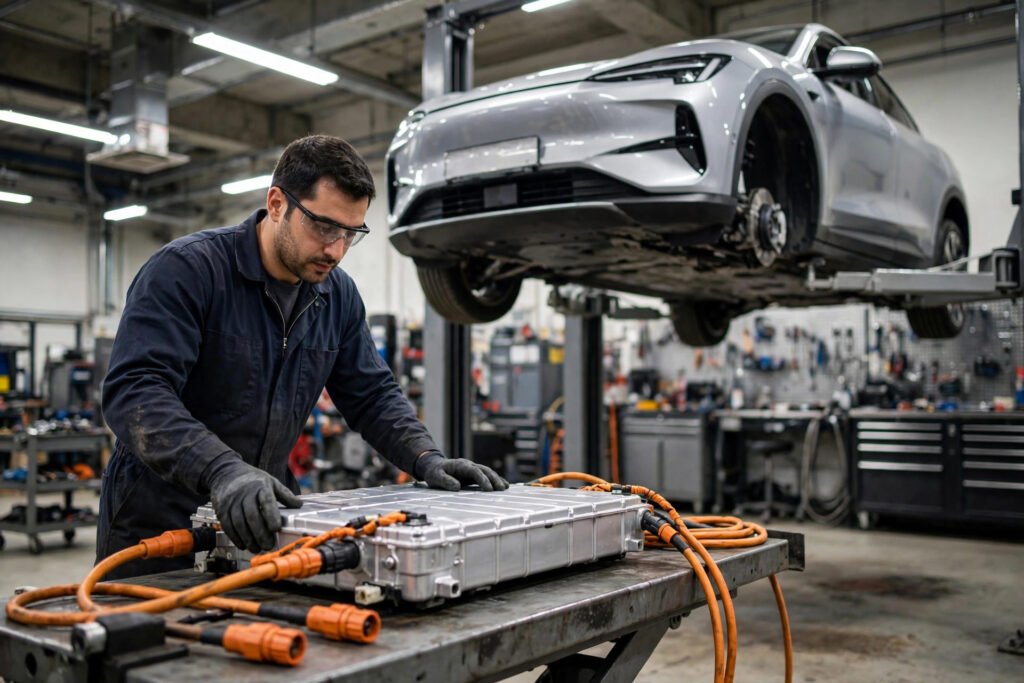
High-voltage safety warning — read this first: the EV traction battery is a high-voltage component, connected by orange cables that can seriously injure or kill. This guide is diagnosis and education only for anything high-voltage. Never open the battery pack, never touch orange cables or high-voltage covers, never attempt to replace cells or modules yourself, and never work on the pack with the system energised. Battery replacement, module work, and any diagnosis beyond reading a warning light, checking the 12-volt auxiliary battery, and noting the symptoms belong to a certified EV technician with the right insulated tools and lockout procedure. If you smell burning, see swelling or leaking from the pack area, or get a battery warning together with a loss of power, stop driving safely, switch the car off, and call for professional help. The small 12-volt auxiliary battery is a different, ordinary part — but do not confuse the two, and never treat a traction-battery fault as a 12-volt job.
In this guide, you’ll learn:
- What a full EV battery replacement costs in 2026, by pack size and by model
- Why one quote says $7,000 and another says $30,000 for the same car
- What labour actually costs, and how long the job takes
- The warranty check that can make the whole bill disappear
- How rarely replacements actually happen — and what the fleet data really shows
- When a module repair beats a full pack, and when to repair, replace, or sell the car
The Quick Answer: What a New EV Battery Costs
| Pack size | Typical installed cost (2026 guides) | Examples |
|---|---|---|
| Small older EV packs (24–40 kWh) | $3,500–$8,000, often refurbished or rebuilt | Early Nissan Leaf |
| Common EV sedan / crossover packs (60–85 kWh) | $10,000–$20,000 | Tesla Model 3/Y, Hyundai Ioniq 5, Chevy Equinox EV |
| Luxury EV packs (80–110 kWh) | $15,000–$30,000+ | BMW i4, Mercedes EQS, VW ID.4 |
| Electric truck / large SUV packs (98–200+ kWh) | $20,000–$50,000+ | Ford F-150 Lightning, Rivian R1T/R1S, GMC Hummer EV |
Those are the ranges published by Find My Electric in its 2026 guide, and they line up with the other 2026 pricing sources: evbattery.us puts a full replacement at roughly $5,000 to $20,000+ installed, while evcostpermile puts mainstream models at $12,000–$22,000 installed. The ranges overlap because guides draw the line differently — some quote part-only prices, some quote installed totals, and labour rates vary by region. A price that does not say whether it is part-only or installed, and whether a core charge is included, is not a quote you can compare. Always ask for the installed total in writing.
One comparison that helps: this is a different world from hybrid battery replacement, which typically runs $1,500–$5,500. A hybrid pack is 1–2 kWh; a pure EV pack is 40–200+ kWh. The EV pack is a far bigger part, a far heavier job, and a far bigger bill — which is exactly why the warranty check in this guide matters so much.
EV Battery Replacement Cost: What Your Quote Actually Includes
A battery replacement quote is not one number. It is a stack of charges, and knowing the stack is how you spot a quote that is missing something — or padding something. Find My Electric lists the items a real quote can include:
- Pack assembly cost — the battery itself, by far the largest item
- Dealer or service-centre markup on the part
- Diagnostics — confirming the pack, not a sensor, a contactor, or the 12-volt system, is the fault
- Labour — removing and refitting a pack that often weighs 1,000 lb or more
- Coolant and related hardware — the pack’s thermal system is drained and refilled as part of the job
- Shipping and handling — large packs are expensive to move and store
- Core charges or credits — the old pack has value, and the quote should say how that is handled
- Programming and calibration — the new pack must be matched to the car’s battery management system
- Taxes and shop fees
It also depends on whether the pack is new, refurbished, remanufactured, or repaired at the module level — the four options covered later in this guide. Two quotes for the “same” job can differ by thousands of dollars purely because one is a new factory pack and the other is a refurbished one.
EV Battery Replacement Cost by Model
Model-by-model prices from the 2026 guides (Find My Electric, updated July 2026; BatteryJoule, reviewed July 2026; evbattery.us; evcostpermile, June 2026; AutoEdgeView). All are out-of-warranty estimates, installed, and all vary by model year, trim, pack size, and region.
| Model | Typical full-pack replacement (2026 guides) |
|---|---|
| Nissan Leaf (24 kWh) | $3,500–$6,000 |
| Nissan Leaf (40 kWh) | $7,000–$10,000 |
| Nissan Leaf (60/62 kWh) | $10,000–$15,000+ |
| Chevrolet Bolt EV / EUV | $12,000–$18,000+ |
| Tesla Model 3 | $9,000–$16,000 |
| Tesla Model Y | $10,000–$16,000 |
| Tesla Model S | $13,000–$20,000+ |
| Tesla Model X | $14,000–$22,000+ |
| Hyundai Ioniq 5 | $9,500–$25,000+ |
| Hyundai Kona Electric | $12,000–$20,000+ |
| Chevrolet Equinox EV | $10,000–$14,000 |
| Ford Mustang Mach-E | $16,000–$35,000+ |
| Volkswagen ID.4 | $18,000–$30,000+ |
| BMW i4 | $15,000–$25,000+ |
| Ford F-150 Lightning | $16,000–$50,000+ |
| Rivian R1T / R1S | $20,000–$35,000+ |
| GMC Hummer EV | $30,000–$50,000+ |
A few notes on the numbers that look inconsistent, because they are — and understanding why keeps you from being misled:
- The Leaf is the cheapest and the most variable. It is the oldest mass-market EV in the US, and the only one with a mature refurbished-pack market. A 24 kWh pack can be $3,500–$6,000 refurbished, while a new 62 kWh pack runs $10,000–$15,000+. BatteryJoule’s range for the Leaf is $4,000–$12,000; Find My Electric’s is $3,500–$18,000+. Both are right — they are pricing different pack sizes and different pack conditions.
- Tesla’s range is wide because Tesla’s fleet is wide. A Model 3 with a smaller LFP pack sits at the low end (AutoEdgeView puts a Model 3 RWD at $7,500–$9,500); a Long Range Model 3 or a Model X sits at the high end. Find My Electric’s Tesla range is $10,000–$25,000+; BatteryJoule’s is $7,000–$20,000.
- The F-150 Lightning shows the biggest spread in the table — $16,000 to $50,000+. The low end reflects module-level repair and remanufactured options; the high end is a brand-new extended-range pack at a dealer. Find My Electric puts a full Lightning pack at $30,000–$50,000+, while BatteryJoule’s range is $13,000–$30,000. The difference is the repair path, not a mistake.
- The Hummer EV is the extreme case. Its pack is enormous — far larger than a typical crossover’s — and Find My Electric puts a full replacement at $30,000–$50,000+, possibly more. There is very little out-of-warranty data yet, because almost no Hummer EV is out of warranty.
- The Cybertruck has almost no out-of-warranty data. Find My Electric estimates $20,000–$30,000+ for a full pack, but calls it a developing story: the structural pack and 4680-cell architecture are new, and real-world pricing does not exist yet.
Why $108 per kWh Doesn’t Mean a Cheap Bill
You will see one number quoted everywhere in EV battery coverage: BloombergNEF reported that the average lithium-ion battery pack price fell to $108 per kWh in 2025, with battery-electric-vehicle packs averaging below $100/kWh for the second year running — down from over $1,000/kWh in the early EV era. BatteryJoule, citing the same BloombergNEF survey published December 9, 2025, notes the $108/kWh figure was down 8% from 2024.
That is real, and it is good news. It does not mean you can multiply your car’s battery size by $108 and expect that to be the repair bill. As Find My Electric puts it, that $108/kWh number is an industry average, not a retail service invoice. Three reasons the invoice is much higher:
- $108/kWh is a factory-gate manufacturing average. Your quote is a retail parts-counter price, with dealer markup, shipping, and a core charge on top. Retail pricing in 2026 runs roughly $130–$200 per kWh of pack capacity, according to evcostpermile — and evbattery.us puts dealer-counter pack prices at $130–$160/kWh.
- Packs got much bigger. The average EV pack in the US is now 60–100 kWh, and electric trucks run 98–200+ kWh. Even at falling per-kWh prices, the total bill stays high because the pack itself is large. A 75 kWh pack at $150/kWh retail is $11,250 before a single hour of labour.
- The pack is not the whole job. Labour, diagnostics, coolant, programming, and shop fees sit on top — see the next section.
The falling per-kWh price still matters: it is why replacement costs are 30–40% lower than equivalent replacements in 2019–2020, according to AutoEdgeView, and why refurbished and remanufactured options keep getting cheaper. But the trend helps future owners more than today’s out-of-warranty owner facing a dealer quote.
Labour: What the Job Involves and What It Costs
Replacing an EV battery is a heavy, high-voltage job. The car goes on a lift, the old pack — often 1,000 lb or more — is unbolted and lowered, cooling lines and high-voltage connectors are transferred, and the new pack is installed, torqued, and reprogrammed. Shops in the West and Northeast typically charge 10–15% more for that labour than shops in the Midwest and South, according to evbattery.us.
What labour costs: Find My Electric puts dealer or manufacturer service-centre labour at roughly $175–$250+ per hour in 2026, with total labour for a battery replacement running about $750 to $3,500+ depending on the vehicle and the complexity of the job. evcostpermile and evbattery.us both put dealer labour at roughly $1,500–$3,000 for a typical pack swap. Simpler swaps — some older EVs such as the Nissan Leaf are relatively straightforward — sit at the low end. Large electric trucks, luxury EVs, structural packs, and vehicles needing extensive diagnosis climb quickly.
How long it takes: the physical swap itself may only take a day or two for many vehicles. But the full process — from diagnosis to parts ordering to getting the vehicle back — can take anywhere from a few days to several months, according to Find My Electric. The delays come from parts availability (not every dealer stocks packs), the need for high-voltage-trained technicians or manufacturer field engineers, and the fact that many replacements use refurbished or remanufactured packs that must be sourced and matched to the vehicle. If you are facing a replacement, ask the service centre whether the car is safe to drive while waiting for parts, whether a loaner will be provided, and how long the replacement pack is covered.
Step One: Check the Warranty Before You Pay Anything
This is the single most valuable section in this guide. EV traction batteries carry a separate, longer warranty than the rest of the car, and it transfers to later owners:
- Federal minimum: every EV sold in the US carries a battery warranty of at least 8 years or 100,000 miles. Most manufacturers warrant the pack to retain at least 70% of its original capacity over that period — if it degrades below the threshold, the replacement is free.
- California-emission states: on 2026 and newer models, California’s rules extend battery coverage to 10 years or 150,000 miles, and the same rules apply in the states that follow California’s standards.
- Longer manufacturer warranties exist. Tesla, for example, warrants Model 3 and Model Y Long Range packs for 8 years or 120,000 miles. Hyundai and Kia offer 10 years or 100,000 miles on their EV batteries.
That changes the arithmetic completely. A 2021 Model 3 with 90,000 miles may still be inside its battery warranty, while a 2016 Leaf with 120,000 miles is outside coverage and facing the full retail price. Before accepting any quote, call a dealer with your VIN and ask two questions: “Is the battery still under warranty?” and “Is there any goodwill or extended coverage on this pack?” The call is free, and it is the only way to be sure — warranty terms changed by model year and by state, and a guide’s summary is no substitute for your car’s own record.
Also check for recalls and service campaigns before you pay. The Chevrolet Bolt and Hyundai Kona Electric both had major battery recalls, and many of those cars received replacement packs under recall or warranty. A used Bolt or Kona may have a far newer pack than its model year suggests — and a car that already had a recall replacement may still have warranty coverage tied to that replacement pack.
How Rarely This Actually Happens
Here is the context that the scary quotes leave out: most EV owners will never pay for a battery replacement at all. The fleet data, published through 2026, is remarkably consistent:
- Replacement is rare and getting rarer. Recurrent, which tracks more than 30,000 EVs, reported in its November 2025 update that fewer than 4% of the EVs it tracks have ever had a battery replaced, excluding the major Bolt and Kona recall campaigns — including cars more than ten years old. Broken down by generation, the rate is about 8.5% for pre-2016 cars, about 2% for second-generation cars, and 0.3% for cars built in 2022 or later.
- Degradation is slow. Geotab’s 2026 study of 22,700 EVs across 21 models found an average degradation rate of about 2.3% per year, working out to 81.6% of original capacity after eight years. An earlier Geotab study measured 1.8% per year; the increase is attributed largely to more DC fast charging across the fleet.
- Fast charging matters, but not catastrophically. Geotab found that batteries fast-charged heavily lose range at roughly twice the rate of lightly fast-charged ones — about 3.0% per year against 1.5% — and hot climates add roughly 0.4% per year. Tesla’s own Impact Report figures put Model 3 and Model Y at 85% capacity retention after 200,000 miles, and Model S and Model X at 88% over the same distance.
- Recurrent’s own summary is blunt: modern EV batteries “should outlast the cars themselves.”
That is why the $10,000–$20,000 replacement figure reads differently once you know the probability: for a modern EV, the chance of ever needing it sits below one in three hundred. The number matters most for buyers of older, high-mileage EVs, cars with short remaining battery warranty, salvage-title vehicles, and large-pack trucks and luxury SUVs — exactly the cases Find My Electric flags for extra research before buying.
New vs Remanufactured vs Refurbished vs Module Repair
If you are out of warranty and the pack genuinely needs work, there are four paths — and they are not the same job at different prices:
- New OEM pack: a brand-new battery supplied by the carmaker through a dealer. Highest upfront cost, guaranteed compatibility, and the longest warranty on the new pack. The default choice for a newer car, and the most expensive choice for an older one.
- New aftermarket pack: brand-new cells in a pack built by an independent manufacturer. Noticeably below dealer pricing where available, with a warranty that varies by supplier — read it before you buy.
- Remanufactured pack: a used pack fully tested, with defective modules replaced and the pack rebalanced. The value sweet spot for most out-of-warranty cars, typically at a large discount to a new OEM pack.
- Refurbished / reconditioned pack: a used pack with weak cells replaced and the pack balanced. Cheapest full-pack option, and the most common path for older cars such as early Leafs — but the warranty is the shortest, and the remaining life of the other cells is unknown.
- Module repair: not a full pack at all — replacing one bad module, contactor, or cooling component inside the existing pack. Covered in the next section, because it changes the decision completely.
Pin down the definition before you compare prices. Sellers use these words loosely, and a “remanufactured” pack from one seller can be a “refurbished” pack from another. Ask in writing: is the pack new, remanufactured, or refurbished? What is the warranty on the replacement pack, in years and miles? Is the quoted price the installed total, and does it include a core charge?
When Module-Level Repair Works (and When It Doesn’t)
Sometimes a full pack replacement is not the only repair. If only one section of the pack has failed, trained technicians may be able to isolate the problem through diagnostics and replace a module, a group of cells, a contactor, a cooling component, or a battery-management component instead of replacing the entire battery.
In practice, many EV battery packs are still easier to replace as a full assembly than to repair at the cell or module level. Find My Electric gives the reasons: some manufacturers do not support module-level repair in normal service channels, some dealers are not equipped or trained for internal pack repair, some packs are sealed or structural, modules must be matched carefully by age, voltage, chemistry, and condition, and improper high-voltage battery repair can be dangerous.
But module-level service is becoming more important as EVs age, and it is the single biggest lever on the bill:
- Ford F-150 Lightning and Mustang Mach-E were designed with module-level service in mind. A failed section may not require replacing the whole pack, and a module repair can land in the mid-four-figure to low-five-figure range instead of $20,000–$50,000+.
- Hyundai Ioniq 5 and Kia EV6 use serviceable battery modules, which may reduce the cost of certain repairs — though Hyundai’s approved service process and dealer capability decide whether a given fault qualifies.
- Volkswagen ID.4 may be serviceable at the module level in certain cases, but a repairable module issue and a full pack replacement are very different cost scenarios.
- Older Teslas and Leafs have the most mature independent-specialist support for module and component repair, including contactor and coolant-intrusion faults that a dealer would quote as a full pack.
The question to ask is not “what does the whole battery cost?” It is “can this specific failure be repaired at the module level?” Get that answer in writing before authorising a full pack.
Replace, Repair, or Sell the Car?
A $15,000 battery quote on a car worth $18,000 is a different decision from the same quote on a car worth $45,000. Work through it in this order:
- Warranty first. If any battery warranty, recall coverage, or goodwill remains, the bill may be zero. Do not authorise paid work until the dealer has checked the VIN.
- Get the diagnosis in writing. Is it the whole pack, or one module, a contactor, a cooling fault, or the 12-volt system? A full-pack quote for a module fault is a quote you should challenge — get a second opinion from an independent EV specialist.
- Compare repair paths, not just prices. A remanufactured pack with a 3-year warranty and a module repair with a 1-year warranty are not the same value at different prices. Compare installed totals, warranty length, and expected remaining life.
- Compare the repair against the car’s value. If the repair costs more than half the car’s market value, selling the car as-is — or selling it to a buyer who understands the fault — may be the better financial move. A car that needs a battery still has value: the rest of the car, and the old pack itself, are worth something.
- Factor in what the car gives you after the repair. A new pack resets the battery’s life. If the rest of the car is sound and you plan to keep it for years, a $12,000 pack on a car you keep for five more years costs $200 a month — less than a new car payment. If you were planning to sell within a year anyway, the maths rarely works.
- Check the used-EV market before deciding. Used EV prices already reflect battery anxiety — often more than the actual risk justifies, given the 0.3% replacement rate on modern cars. That cuts both ways: it makes selling as-is cheaper, and it makes buying a replacement car cheaper too.
Signs You Actually Need a New Pack — vs a Smaller Fault
Not every battery warning means a new battery. Several faults look like a dying pack but are cheaper problems, and the site’s other guides cover the most common ones:
- Sudden power loss with a turtle warning. If the car drops into EV turtle mode — a reduced-power warning, usually with a turtle icon — the pack may be overheating, deeply discharged, or genuinely degraded. But it can also be a cooling fault, a sensor fault, or a software issue. Turtle mode is a symptom, not a diagnosis.
- Charging much slower than usual. If EV charging is slower than expected, the cause is often the charger, the temperature, or the state of charge — not the pack. A pack that charges slowly only at one station, or only when cold, is usually not a pack that needs replacing.
- Range estimate jumping around. If your EV range estimate keeps changing, the estimate itself is often the problem: the car’s prediction adapts to recent driving, temperature, and heater use. A range estimate that drops is not the same as a battery that has lost capacity.
- A warning light with no other symptom. A battery warning with normal driving, normal charging, and normal range deserves a diagnostic scan before any parts are ordered. It can be a sensor, a software fault, or the 12-volt auxiliary battery — all far cheaper than a pack.
The signs that genuinely point toward the pack are: range that has fallen far and keeps falling, measured capacity well below the warranty threshold (usually 70%), repeated overheating warnings, a pack that will not charge at all, or physical damage, swelling, or leaking. Even then, a certified EV technician’s diagnosis — not a dashboard warning alone — is what confirms it.
What to Ask the Shop Before You Authorise the Work
Take this list to the service centre. The answers matter almost as much as the price:
- Is the battery still under warranty, and has the VIN been checked for recalls or goodwill coverage?
- Is the replacement pack new, refurbished, remanufactured, or a module repair — and what is the warranty on it, in years and miles?
- Is the quoted price the installed total, and does it include diagnostics, coolant, programming, taxes, and any core charge or credit?
- Can this specific failure be repaired at the module level instead of a full pack?
- How long will the car be in the shop, and is it safe to drive while waiting for parts?
- Will a loaner vehicle be provided?
- Will the repair affect any remaining warranty coverage?
- What is the expected range after the repair — and is that in writing?
If a shop cannot answer these clearly, or pressures you to authorise a full pack before the diagnosis is complete, get a second opinion from an independent EV specialist. The most expensive word in this whole subject is “urgent” spoken by someone selling you a battery.
Frequently Asked Questions
How much does it cost to replace an EV battery?
In 2026, a full out-of-warranty EV battery replacement typically costs $5,000–$20,000+ installed, according to evbattery.us, with mainstream models at $12,000–$22,000 installed per evcostpermile and most full replacements at $7,000–$25,000 per Find My Electric. Small older packs can be $3,500–$8,000 refurbished; large electric-truck packs can reach $30,000–$50,000+.
How long do EV batteries last?
Fleet data says a long time. Geotab’s 2026 study of 22,700 EVs found average degradation of 2.3% per year, or 81.6% of original capacity after eight years. Tesla’s own figures put Model 3 and Model Y at 85% capacity after 200,000 miles. Recurrent puts age-related replacement at roughly 10 to 20 years.
How often do EV batteries need replacing?
Rarely. Recurrent’s November 2025 data, covering 30,000+ EVs, puts the replacement rate at 0.3% for cars built in 2022 or later, about 2% for second-generation cars, and about 8.5% for pre-2016 cars — all excluding the major Bolt and Kona recalls. Fewer than 4% of tracked EVs have ever had a battery replaced.
Is the battery covered under warranty?
Every EV sold in the US carries a battery warranty of at least 8 years or 100,000 miles, usually guaranteeing at least 70% of original capacity. California-emission states extend coverage to 10 years or 150,000 miles on 2026 and newer models. Check your VIN with a dealer before paying anything.
Can an EV battery be repaired instead of replaced?
Sometimes. If one module, contactor, or cooling component has failed, a trained technician may be able to repair that section instead of replacing the whole pack — particularly on the F-150 Lightning, Mach-E, Ioniq 5, and EV6, which were designed with serviceable modules. Many packs, however, are sealed or structural, and some manufacturers do not support module-level repair through dealers. High-voltage work is certified-technician-only either way.
Does replacing the battery cost more than the car is worth?
Sometimes, yes — especially for older EVs. A $12,000–$18,000 pack on a Bolt whose market value is similar is a genuine dilemma. Compare the repair against the car’s value, get a module-repair opinion, and consider selling as-is before authorising a full pack. A new pack resets the battery’s life, so the maths depends on how long you plan to keep the car.
Is an EV battery replacement a DIY job?
No. The traction battery is a high-voltage component connected by orange cables. Replacement involves lifting a 1,000-lb-plus pack, high-voltage disconnection under lockout procedure, coolant handling, and reprogramming. It belongs to a certified EV technician or the manufacturer’s service centre — never attempt it yourself.

lily John
The Fixtorial team writes hands-on car troubleshooting guides for everyday drivers — symptom first, honest costs, and fixes you can verify yourself.


2 Comments