
EV Range Estimate Keeps Changing? 8 Reasons Why It Moves
Updated Nov 22, 2026
In This Guide
- The Quick Answer: What the Number Really Is
- Pattern Match: What Each Kind of Jump Usually Means
- 1. Your Recent Driving Is the Biggest Input When Your EV Range Estimate Keeps Changing
- 2. Speed Changes Everything
- 3. Cold Weather Re-Rates the Same Charge
- 4. Heating, Air Conditioning, and Short Trips
- 5. Hills, Headwinds, Loads, and Towing
- 6. Trip Resets, Software Updates, and Other Drivers
- 7. Charging Differences: Target, Balancing, and Battery Temperature
- 8. Battery Aging: Gradual, Not Overnight
- When a Changing Estimate IS a Real Problem
- Battery Warranty: What to Check Before You Pay Anything
- Simple Checks That Settle It in a Week
- Cost Guidance
- FAQ
Your EV range estimate keeps changing when you charge to 100% and the dashboard promises 280 miles. The next morning it says 252 — and you haven’t driven anywhere. On the highway it drops faster than the miles pass, then on the drive home through town it barely moves at all. It feels like the car is losing energy it never used, or hiding a battery problem. In most cases, neither is true.
The number that keeps moving is not a measurement of the energy in your battery. It is a prediction, and predictions change whenever the inputs change. EV drivers nicknamed it the “guess-o-meter” for exactly that reason: it guesses how far your remaining charge will take you, based on how you have been driving lately and the conditions right now. Once you understand what it is actually calculating, the jumps stop feeling like faults — and the rare ones that do matter become much easier to spot.
High-voltage safety note, up front: this article is diagnosis and education only. The traction battery pack, orange high-voltage cables, inverter, and onboard charger are not do-it-yourself territory — never open, probe, or attempt to repair them. Everything below is either a dashboard reading, a driving habit, or a setting you can check safely. Any suspected battery, inverter, or thermal-system fault goes to a certified EV technician or dealer.
The Quick Answer: What the Number Really Is
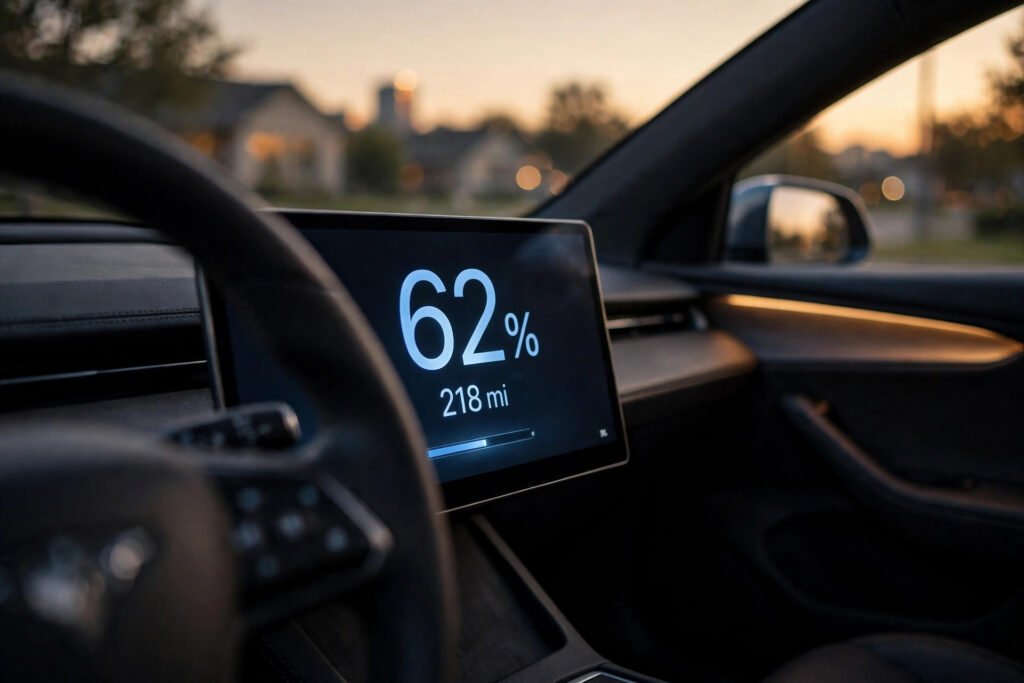
The range estimate is the car’s answer to a simple multiplication: remaining usable energy × recent efficiency. The battery management system estimates how much energy is left, then multiplies it by how efficiently you have been driving recently — miles per kilowatt-hour, over roughly your last stretch of driving. Change either side of that equation and the estimate moves, even if the battery itself is unchanged.
That is why the battery percentage is the steadier number. A percentage tells you roughly how much of the battery’s available energy remains, whatever you do next. The miles figure tells you how far that energy might go if you keep driving the way you just did. On a gentle city trip, that can look generous. Merge onto a fast highway with the heater on, and the same percentage suddenly buys fewer miles — so the estimate falls faster than the odometer climbs.
In this guide, you’ll learn:
- How the guess-o-meter calculates its number — and why it is not a fuel gauge
- The 8 everyday reasons the estimate jumps, in order of likelihood
- How to tell a normal swing from a genuine battery or system fault
- Simple checks that settle the question in a week of normal driving
- How to plan trips using percentage instead of the miles figure
Pattern Match: What Each Kind of Jump Usually Means
| What you notice | Most likely explanation | Worry level |
|---|---|---|
| Estimate lower on a cold morning than the night before | Cold battery + heater demand; the car re-rates the same charge for winter conditions | Normal |
| Estimate drops fast on the highway, slowly in town | Speed and wind resistance raise consumption sharply; city driving is far more efficient | Normal |
| Estimate changes right after a software update or trip reset | The car lost its driving-history data and is relearning your efficiency | Normal |
| Estimate higher after a week of gentle city driving | Recent efficiency improved, so the same charge is projected further | Normal |
| Estimate falls a little every winter, recovers in spring | Seasonal temperature effect, not permanent capacity loss | Normal |
| Estimate collapses suddenly in mild weather, with the same driving | Possible battery, thermal, or sensor fault — needs diagnosis | Get it checked |
| Battery percentage itself drops far faster than miles driven | Real energy loss or a fault, not an estimate quirk | Get it checked |
| A warning message appears with the change (check EV system, power limited) | The car has detected a fault — do not treat it as a display issue | Get it checked promptly |
1. Your Recent Driving Is the Biggest Input When Your EV Range Estimate Keeps Changing
The estimate leans heavily on what you did most recently. A week of short, gentle city trips — with lots of regenerative braking and low speeds — teaches the car that you are an efficient driver, so it projects a generous range. One long, fast highway run teaches it the opposite, and the estimate can fall by a noticeable amount after a single trip, even though the battery is fine.
This is also why the number can seem to “recover.” Drive gently for a few days and the rolling average improves, so the estimate climbs again at the same charge level. The battery did not heal; the prediction simply caught up with calmer driving. The same effect works in reverse after a weekend of towing, roof-box driving, or sustained high speeds.
The giveaway: the estimate tracks your last few trips, not your car’s age. If it rose after gentle driving and fell after fast driving, that is the guess-o-meter doing its job.
2. Speed Changes Everything
Aerodynamic drag rises steeply with speed, so highway cruising is the least efficient way to use an EV battery, and the estimate knows it. Join a fast highway and the car recalculates for that kind of driving: the miles figure can drop noticeably in the first few minutes, then settle once your speed steadies. Leave the highway for slower roads and the rate of loss slows again.
This is the single most common reason drivers feel the estimate “lies” on road trips. It is not lying — it is switching, mid-trip, from a city-driving assumption to a highway-driving reality. Planning a long trip on the estimate you saw in the driveway is the mistake, not the car: use the navigation system’s trip estimate instead, where available, because it accounts for your actual route, speeds, and charging stops rather than your recent average.
3. Cold Weather Re-Rates the Same Charge
Cold affects an EV twice over. The battery chemistry itself delivers energy less readily when cold, and heating the cabin draws a large amount of power — far more, proportionally, than heating a gasoline car, which gets cabin heat nearly free from engine waste heat. The US Department of Energy and EPA’s fueleconomy.gov reports that EV range can drop by about 41% in mixed city and highway driving at 20°F with the heater in use, and by about 12% even with the cabin heater off. About two-thirds of the extra energy in the cold-weather case goes to heating the cabin.
So a lower estimate on a frosty morning is expected, and a lower estimate all winter is expected too. The key test is seasonal: if the estimate — and your actual miles per charge — recover when warm weather returns, the battery was never damaged. Cold-related range loss is temporary. Permanent capacity loss does not come back in spring.
If you want to soften the winter effect, preheat the cabin while the car is still plugged in, so the energy for warming comes from the charger rather than the battery, and lean on heated seats and a lower cabin temperature rather than blasting the heater. These are the same cold-weather habits that help any car — see our guide on how to winterize your car — but they matter more in an EV because cabin heat is such a large share of winter energy use.
4. Heating, Air Conditioning, and Short Trips
Cabin heating is the biggest auxiliary load, but air conditioning, defrosters, heated seats, and even a cold-soaked battery that limits regenerative braking at the start of a trip all feed into the estimate. Short trips look especially bad: the car spends a large share of each trip warming the cabin and battery, so the efficiency for those miles is poor, and the estimate reflects that.
A cold battery also limits regenerative braking until the pack warms up, which removes one of the EV’s efficiency advantages exactly when you need it. None of this is a fault — it is the car honestly reporting that cold, short, heater-heavy driving costs more energy per mile.
5. Hills, Headwinds, Loads, and Towing
A hilly route, a strong headwind, a loaded car, a roof box, or a trailer all raise consumption, and the estimate adjusts as it learns that from your driving. The effect can be dramatic on a single trip and then vanish on the next flat, calm one. If the estimate fell sharply on one specific journey, compare it with a familiar flat route before worrying: a route effect disappears when the route changes, while a battery problem follows you everywhere.
Towing deserves a special note. Towing can more than halve usable range on some setups, and the estimate will swing wildly as it relearns. That is not a defect — it is the car discovering, in real time, how much energy towing actually costs.
6. Trip Resets, Software Updates, and Other Drivers
Resetting a trip meter, or having the car reset its long-term efficiency data after a software update or service visit, wipes the driving history the estimate was built on. With no history, the car falls back to a factory or default efficiency figure — which can be optimistic or pessimistic compared with your real driving — and then relearns over the next few trips. If your estimate jumped the morning after an update, this is the first suspect, not the battery.
The same applies when someone else drives the car. A partner’s heavier foot, a valet’s short trips, or a teenager’s highway run all feed the same rolling average. The estimate is describing the car’s recent drivers, plural.
7. Charging Differences: Target, Balancing, and Battery Temperature
Charging to a different target changes the starting point, obviously — 80% simply holds less energy than 100% — but subtler charging effects move the estimate too. After a full charge, the battery management system may spend time balancing the individual cells, and the estimate can shift slightly once balancing finishes. Charging a cold battery, or charging at a public fast charger on a trip, can also leave the estimate based on different temperature assumptions than your usual overnight home charge.
If charging itself seems slower than it used to be, that is a separate question with its own causes — see our guide to EV charging slower than expected — and if you are weighing a home charger setup, our breakdown of home EV charger installation cost covers what that installation typically involves. A slower charge does not automatically mean a weaker battery, and neither does a shifting estimate after charging.
8. Battery Aging: Gradual, Not Overnight
Real battery degradation is slow. Capacity fades gradually over years of use and charging cycles, and a healthy pack does not lose a large chunk of its capacity in a week. That distinction is your best diagnostic tool: a sudden, large drop in range is almost never aging, and gradual decline over years is almost never a sudden fault.
Aging also shows up in actual miles driven per charge, not just in the estimate. If you consistently get fewer real miles from a full charge in similar weather and driving than you did a year ago, that is worth a battery health check. If only the estimate moved — and your real miles per percentage stayed roughly steady — the battery is almost certainly not the story. Note that the estimate itself can drift as the battery ages, because the system is estimating state of charge from voltage, current, and temperature rather than measuring energy directly like a fuel tank’s float gauge. Small estimation errors are normal, and they grow slightly as a pack ages.
When a Changing Estimate IS a Real Problem
Book a diagnosis with a certified EV technician or dealer if you notice any of these:
- A sudden, lasting drop in mild weather. Range falls sharply and stays down across different routes, speeds, and temperatures, with no change in driving habits.
- Percentage drops far faster than miles. You use far more battery percentage for a familiar trip than you used to, even in warm weather. That is real energy going somewhere, not a display quirk.
- The estimate swings wildly trip to trip with no pattern — up and down by large amounts on identical routes — which can point to a battery management or sensor issue.
- A warning appears alongside the change. Messages about the EV system, reduced power, or battery temperature, or a turtle/limited-power warning, mean the car has detected a fault. Follow the car’s guidance, reduce speed, and get it checked — do not keep driving through a power-limit warning on the assumption that it is just the estimate.
- Charging behaves differently too. The car stops charging early, charges far more slowly than usual at a known-good charger, or the battery will not reach its usual charge level. Combined with a shifting estimate, that strengthens the case for a real fault.
A dealer or EV-qualified shop can run a battery health (state-of-health) check, which measures actual capacity rather than trusting the dashboard. That single test separates “the estimate is pessimistic” from “the pack has genuinely lost capacity” — and it is the result to ask for, rather than a guess based on the dashboard figure.
Battery Warranty: What to Check Before You Pay Anything
Most new EVs sold in the US carry a traction-battery warranty of 8 years or 100,000 miles, commonly with a capacity-retention threshold around 70% — meaning a claim typically requires the pack to have fallen below that retained capacity within the warranty term, not merely to show a lower estimate. Terms vary by manufacturer, model year, and state, so your own warranty booklet controls, not a general rule.
That distinction matters for this topic: a pessimistic estimate is not a warranty claim, and a battery that has lost some capacity through normal aging is usually not one either. What qualifies is a measured state of health below the booklet’s threshold, or a genuine defect or failure. If a health check shows a real shortfall inside the warranty term, take that report to the dealer rather than arguing from the dashboard number. And if a shop quotes a battery replacement outside warranty, get a second opinion first — the cost can be very large, and our guide to hybrid battery replacement cost shows how much replacement pricing varies by vehicle and pack, which is why a measured diagnosis must come before any replacement decision.
Simple Checks That Settle It in a Week
- Switch your attention to percentage. Drive a familiar route and note the battery percentage used, not just the miles estimate. Percentage is far more stable from trip to trip.
- Track miles per 10% of charge. Over a week of similar driving, this figure should stay roughly steady. A steady figure with a jumpy estimate means the estimate is the problem, not the battery.
- Compare like with like. Judge range on the same route, in similar weather, at similar speeds. Comparing a winter highway trip with a summer city trip proves nothing.
- Check the easy variables first. Tire pressure (cold weather drops it, raising rolling resistance), a roof box you forgot to remove, and a recent trip reset or software update all move the estimate without any fault.
- Precondition while plugged in. Warming the cabin and battery on charger power before departure removes one of the biggest cold-weather penalties from your first miles.
- Use navigation for trips, not the driveway estimate. A route-aware estimate accounts for your actual journey; the dashboard’s rolling average does not know where you are going.
Cost Guidance
There is usually no cost at all here, because most estimate jumps need no repair — they need a change in how you read the dashboard. The checks above are free, and a battery health check at a dealer or EV shop is the sensible paid step only when the warning signs in the “real problem” section apply. Never pay for a battery replacement, module repair, or any high-voltage work on the basis of a dashboard estimate alone; high-voltage work is certified-technician-only, and a measured state-of-health result must come first.
FAQ
Why did my range estimate drop overnight when I didn’t drive?
Usually temperature. A colder morning makes the car re-rate the same charge for colder, heater-heavy driving, and overnight thermal management or a parked-car feature can use a small amount of energy. A small overnight drop is normal; a large one, night after night in mild weather, is worth checking.
Should I trust the miles figure or the battery percentage?
Percentage, for day-to-day confidence. The miles figure is a prediction based on recent driving; the percentage is a much more direct statement of how much charge remains. Use the miles figure as a rough guide and the percentage — plus your known miles per 10% — for real decisions.
My estimate went up after charging. Did my battery get better?
No. The estimate rose because recent driving was efficient, the weather warmed up, or the system recalculated after charging. Batteries do not regain lost capacity from a charge; only the prediction changed.
Does charging to 100% every day damage the estimate or the battery?
Daily charging to 100% can accelerate long-term degradation on many EVs, which is why many manufacturers suggest a lower daily limit, but it does not directly corrupt the estimate. Follow your owner’s manual for daily charge limits — it varies by battery chemistry and model.
Why is the estimate always optimistic when I leave home and pessimistic on the highway?
At home, the estimate reflects your recent average, which often includes efficient city driving. On the highway, consumption rises sharply, so the car revises its prediction downward as it learns you are driving fast. It is adjusting to reality, not malfunctioning.
When should I actually worry about my EV’s range?
When real miles per charge fall suddenly and stay down in similar conditions, when battery percentage drops far faster than miles on a familiar route, or when a warning message appears. Those three patterns — not a jumpy estimate on its own — are the ones that justify a battery health check.

lily John
The Fixtorial team writes hands-on car troubleshooting guides for everyday drivers — symptom first, honest costs, and fixes you can verify yourself.


5 Comments