
EV Turtle Mode: 8 Causes and What to Do Safely
Updated Nov 22, 2026
In This Guide
- The Quick Answer: Do These Four Things First
- Pattern Match: What Each Situation Usually Means
- What Turtle Mode Actually Is (and Is Not)
- How the Battery Management System Decides to Limit Power
- 1. The Battery Is Nearly Empty: The Most Common EV Turtle Mode Trigger
- 2. The Battery Is Too Hot — Thermal Protection After Hard Use
- 3. The Battery Is Too Cold — Winter Power Limits
- 4. Motor or Inverter Overheating, or a Power-Electronics Fault
- 5. Cell Imbalance, Degradation, or a Battery Management Fault
- 6. A Software Glitch, Sensor Error, or Failed Update
- 7. Demand Exceeding What the Pack Can Deliver Right Now
- 8. A Battery Cooling-System Fault
- What to Do in the Moment: The Safe Sequence
- When to Stop Driving and Call for Recovery
- How to Avoid Turtle Mode
- Frequently Asked Questions
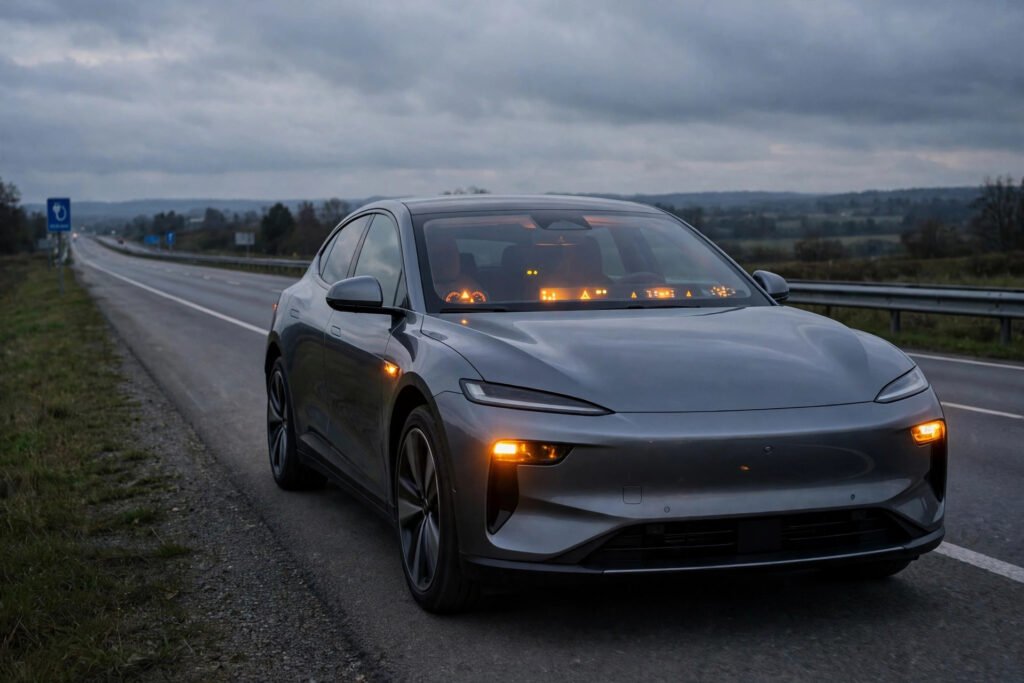
EV turtle mode can strike while your electric car is accelerating normally. The next, the accelerator feels dead, the car will barely hold highway speed, and a small turtle symbol — or a message like “Power limited” — has appeared on the dashboard. Nothing has broken off, nothing is smoking, and yet the car has clearly decided it will not give you full power anymore.
That decision is the point. Turtle mode, also called reduced-power or power-limited mode, is a protective state, not a driving mode you select. When the car’s battery management system decides the battery, motor, or power electronics can no longer safely deliver full power, it caps output so you can reach a safe place to stop or charge instead of stopping dead in traffic. Understanding which trigger fired matters, because the right response is completely different for a nearly empty battery, an overheated battery, and a genuine fault.
High-voltage safety first: an electric car’s traction battery, inverter, onboard charger, and the orange high-voltage cables that connect them are not DIY territory. This guide covers diagnosis and education only for anything high-voltage: reading the warnings, checking charge level and temperature context, power-cycling the car, and charging it. Never open the battery pack, never touch orange cables or high-voltage connectors, and never attempt a repair on the traction battery, inverter, or onboard charger yourself. If a warning stays on, if you smell burning, see smoke, or notice leaking coolant under the car, stop in a safe place, switch the car off, and call roadside assistance or a certified EV/hybrid technician. The same rule applies to towing: many EVs must be recovered on a flatbed, so follow your owner’s manual and let trained recovery staff handle it rather than towing the car with its drive wheels on the ground.
The Quick Answer: Do These Four Things First
If reduced power has just appeared, work in this order before you diagnose anything:
- Get out of fast traffic, safely. Ease off the accelerator, switch the hazard lights on, and move to the shoulder or the nearest safe stopping place. Do not try to force highway speed — the car is limiting power on purpose, and fighting it will only drain the remaining energy faster.
- Read the exact message and the battery level. A turtle icon with 1–2% charge left is a very different situation from the same icon at 60% charge. Note the state of charge, any temperature warning, and the exact wording on the display, and photograph it if you can — a shop will ask for exactly this.
- Charge, cool down, or warm up — whichever fits the trigger. Nearly empty means charge as soon as you safely can. Overheated means stop, switch off, and let the car cool. Very cold means charge and let the battery warm before expecting full power back.
- If the warning returns after charging and a restart, book a certified EV technician. A power limit that appears with a healthy charge level, in normal weather, and without hard driving is a fault until proven otherwise, and it needs a scan tool and high-voltage diagnosis — not repeated restarts.
In this guide, you’ll learn:
- What turtle mode and “Power limited” actually mean, and what they are not
- The 8 causes behind reduced power, with the check that points to each one
- What to do in the moment, step by step, so you stay safe
- How to tell a one-off protection event from a fault that needs a shop
- How to avoid triggering reduced power in the first place
Pattern Match: What Each Situation Usually Means
| What you notice | Most likely explanation | First check |
|---|---|---|
| Turtle icon or “Power limited” at very low charge, car crawls along | Battery nearly empty — the intended trigger | State of charge; nearest charger, not your destination |
| Power limit after repeated fast charging, towing, or hard hill driving | Battery or motor too hot; thermal protection | Temperature warnings; stop and cool down |
| Power limit on a freezing morning, weaker acceleration and regen | Battery too cold; power temporarily restricted | Charge and warm the battery; check for a cold-battery symbol |
| Power limit at a healthy charge level, in mild weather, after normal driving | System fault, sensor fault, or cooling fault | Restart once; if it returns, scan tool + certified technician |
| Power limit that clears after charging and stays away | Low charge or a temporary thermal limit | Note the trigger and avoid repeating it |
| Power limit that returns every drive, or worsens | Battery, cooling, or power-electronics fault | Stop guessing; book diagnosis promptly |
| Burning smell, smoke, leaking fluid, or a red battery warning | Serious fault — do not keep driving | Stop safely, switch off, call for recovery |
What Turtle Mode Actually Is (and Is Not)
Turtle mode is the electric-car version of limp mode. In a gasoline car, limp mode caps engine speed and power when the engine computer detects a problem serious enough to risk damage. In an EV, the battery management system (BMS) does the same job for the high-voltage battery: it watches cell voltage, temperature, and current, and when any of those move outside the safe window, it limits how much power the motor may draw.
The turtle symbol is most associated with the Nissan Leaf, where a yellow turtle lights up when available power is severely limited, typically as the battery approaches empty. Other brands do not all use a turtle: Kia’s manuals, for example, use a “Power limited” message and a power-down indicator, and other manufacturers use messages such as “Power reduced” or a battery-temperature warning. The symbol differs; the logic is the same — the car is protecting its high-voltage system and buying you distance to safety.
Three things turtle mode is not:
- It is not Eco mode. Eco mode is a driver-selected efficiency setting you can switch off. Turtle mode is imposed by the car and cannot be switched off with a button.
- It is not proof the battery has failed. A low battery or a hot battery triggers the same protection as a fault, and in those cases the limit clears once the underlying condition clears.
- It is not a fixed distance guarantee. How far a car will go in turtle mode depends on the model, the remaining charge, temperature, speed, hills, and whether heating or air conditioning is running. Treat any remaining distance as an estimate to the nearest safe stopping place or charger — never as a promise you can reach a charger miles away.
How the Battery Management System Decides to Limit Power
Think of the BMS as a supervisor standing between the battery and the motor. It continuously monitors the pack’s voltage, temperature, and the current flowing in and out. Lithium-ion cells only deliver power happily inside a fairly narrow window of charge and temperature. Push a nearly empty pack hard, and cell voltage sags. Push a hot pack hard, and heat builds faster than the cooling system can remove it. Ask a freezing pack for full power, and its internal resistance is too high to deliver it safely.
When the supervisor sees a limit approaching, it does not wait for damage. It trims motor current, which you feel as sluggish acceleration and a lower top speed, and it may also trim charging speed for the same reason — the same protection that limits driving power also limits how fast a hot or cold battery may accept charge. That is why a car that went into turtle mode for heat may also charge slowly at first: both limits come from the same protective logic.
1. The Battery Is Nearly Empty: The Most Common EV Turtle Mode Trigger
This is the trigger turtle mode was most visibly designed for. As the battery drops to its final few percent, the car sheds power to stretch the remaining energy and to protect cells from deep discharge. Reports on the Leaf describe the turtle appearing at around 1% charge, with speed capped to roughly the mid-20s mph and only a short distance left, though the exact cap and distance vary by model, year, battery condition, and driving conditions. Independent range testing of an early Leaf found the car still moving several miles past zero on the gauge in turtle mode — but that is a test result on one car, not a distance you should plan around.
The check: look at the state of charge first, not the speed limit. If the gauge is at or near empty, or showing dashes instead of a range number, the cause is almost certainly low charge. Do not interpret a crawling car as “still fine” — it is telling you it is nearly done.
The fix: charge, and do it at the nearest safe charger rather than the one you originally planned for. Switch off heating and air conditioning, keep speed low and steady, and avoid hills and hard acceleration. If the car stops completely, it cannot be restarted by waiting: it needs charge, and if it cannot be charged where it stopped, it needs recovery. Running a battery to empty repeatedly is also hard on it, so treat turtle mode as an emergency reserve, not a regular way to squeeze out extra miles.
2. The Battery Is Too Hot — Thermal Protection After Hard Use
Heat is the second major trigger. Repeated DC fast charging, towing, sustained high-speed driving, or long climbs all pour heat into the battery and the power electronics. When temperature approaches the safe limit, the BMS cuts power to slow further heating, and if temperature keeps rising, it may cut power to the minimum needed to reach safety.
The check: ask what the car has just been through. Two or three fast charges in a row without a cooling break, a tow on a hot day, or a long mountain climb are classic setups. A battery-temperature or overheating warning alongside the power limit strengthens this diagnosis. Slower charging after a hot run points the same way: a hot battery is deliberately charged more slowly to protect its cells.
The fix: stop in a safe place, switch the car off, and let it cool. Do not keep driving hard and hope the limit lifts — that is exactly what the protection is trying to prevent. Once the battery has cooled and the warning has cleared, drive gently and avoid another immediate fast charge. If the car overheats in normal driving, without hard use or hot weather, that is not normal thermal protection: it suggests a cooling-system fault (see cause 8) and belongs in a shop.
3. The Battery Is Too Cold — Winter Power Limits
Cold is the mirror image of heat. In freezing weather, a lithium-ion battery’s chemistry slows and its internal resistance rises, so it cannot deliver or accept full power until it warms. Some cars show this with a cold-battery symbol — Tesla, for example, uses a blue snowflake to indicate that some stored energy is temporarily unavailable because the pack is cold — while others simply show reduced power or a low-temperature warning.
The check: temperature and timing. A power limit on a freezing morning, after the car sat outside overnight unplugged, that improves as the car warms up, is a cold-battery limit until proven otherwise. Weakened regenerative braking in the same conditions is a supporting clue, because the cold pack also cannot accept regenerated energy at full rate. If you are preparing for winter driving generally, our guide to how to winterize your car covers the wider cold-weather checklist.
The fix: charge the car, which warms the pack, and give it time before expecting full performance. Where your car offers battery preconditioning for driving or charging, use it before departure on very cold days. Do not judge the battery’s health by a cold morning’s performance: energy that is temporarily unavailable because the pack is cold is not the same as capacity that has been permanently lost.
4. Motor or Inverter Overheating, or a Power-Electronics Fault
The battery is not the only high-voltage component with a temperature limit. The motor and the inverter — the unit that converts the battery’s DC power into the AC the motor uses — also heat up under load, and a fault in either can trigger a power limit even when the battery itself is fine.
The check: this cause is hard to separate from battery overheating by feel alone, which is exactly why it is a shop diagnosis. Supporting clues include a power limit that appears under load but with a healthy charge level, repeated limits on the same stretch of hard driving, or a motor-temperature warning. What matters for you is not naming the exact component — it is recognising that the limit is load-related and persistent.
The fix: there is no driveway fix here. Stop, cool down, and if the limit recurs, book a certified EV technician with a scan tool. Never open the inverter or motor housings, and never ignore a recurring load-related limit: a power-electronics fault that is driven through can turn a repair into a replacement.
5. Cell Imbalance, Degradation, or a Battery Management Fault
A battery pack is hundreds of cells working together, and the BMS limits the whole pack based on its weakest cells. If cells drift out of balance, or if a cell or a sensor inside the pack develops a fault, the BMS may limit power to protect the weakest part of the pack — even when the dashboard’s overall charge percentage looks healthy.
The check: look for a pattern rather than a single event. A power limit that appears at middling charge levels, that comes with a battery-system warning, or that follows a noticeable change in range is more suspicious than a one-off limit at 1% charge. A range estimate that jumps around can be another clue that the car’s view of the pack is unsettled; our guide on why an EV range estimate keeps changing explains how those estimates are calculated and when a moving estimate actually signals a problem.
The fix: shop diagnosis, and ask specifically for a battery-health report — cell voltages, balance, and any stored fault codes. Check your battery and drivetrain warranty position before authorising work: high-voltage battery coverage is often longer than the car’s general warranty, and the exact terms vary by manufacturer and market, so confirm yours in writing rather than assuming. For context on what a pack replacement involves when it is genuinely needed, our hybrid battery replacement guide covers the cost-and-warranty questions to ask, even though the chemistry and coverage differ for a pure EV.
6. A Software Glitch, Sensor Error, or Failed Update
Modern EVs are computers on wheels, and like any computer, they can suffer a transient software or sensor error. A faulty sensor reading — a temperature sensor reporting an impossible value, for example — can make the BMS limit power for a problem that does not physically exist. A failed or interrupted software update can leave driver-assistance or infotainment systems confused, and occasionally a power-related warning with them.
The check: a limit that appears suddenly with no change in charge, temperature, or driving demand, especially right after an update or a 12V-battery hiccup, is a candidate for a transient fault. A single power-cycle that clears it permanently supports that reading. But a warning that returns on the next drive is not transient, however much you wish it were.
The fix: try one clean restart — switch the car fully off, wait a minute or two, and switch it back on — and check whether the car is offering a software update or reporting one as failed. Do not repeatedly clear fault codes with a consumer scan tool to make the warning go away: clearing the code does not fix the cause, and it erases information a technician needs. If a warning light is on but the car otherwise seems to run normally, our guide on a check engine light on but the car runs fine explains which lights can wait for a booked visit and which cannot. If the warning returns, or if an update repeatedly fails, book diagnosis and report the update history to the shop.
7. Demand Exceeding What the Pack Can Deliver Right Now
Sometimes there is no single broken part and no extreme temperature — the car is simply being asked for more than the pack can safely give at that moment. Towing a heavy trailer up a grade, climbing a long hill with a low battery, or holding high speed into a headwind all raise demand while the battery’s ability to deliver falls. The BMS resolves that mismatch by capping power.
The check: the context is the giveaway. The limit appears under sustained heavy demand and eases when demand drops — slower speed, flatter road, trailer unhitched. This cause often overlaps with causes 1 and 2: low charge plus high demand, or heat plus high demand, reaches the limit sooner than either would alone.
The fix: reduce demand before the car forces you to: slow down, drop the trailer load if you can do so safely, and charge before a demanding leg rather than during it. Plan towing and mountain routes around charging stops with a buffer, because a pack that is fine on flat ground at 30% may not be fine climbing at 30%.
8. A Battery Cooling-System Fault
The battery’s cooling loop — pump, coolant, hoses, and heat exchanger — is what keeps causes 2 and 4 from happening in normal driving. If the pump fails, coolant leaks, or a valve sticks, the pack heats up faster than it should and the BMS limits power earlier and more often. Cabin heating or cooling trouble on its own does not prove a battery-cooling fault, but a power limit that appears in mild weather, during ordinary driving, with no hard use, should make a technician check the cooling loop.
The check: this is a pattern diagnosis. Frequent limits without heat, hard driving, or low charge, slower-than-usual charging, or a battery-overheating warning in ordinary conditions all point here. A visible coolant leak under the car, or a falling coolant level, is a stronger clue — but battery coolant loops are high-voltage-adjacent systems, so inspection is a shop job, not a driveway top-up.
The fix: book a certified EV technician and describe the pattern: when the limit appears, what the charge level and weather were, and whether charging has also slowed. Do not open the battery cooling loop yourself, do not mix coolant types, and do not keep driving through repeated thermal limits while waiting for an appointment — each one is the car telling you its cooling margin is gone.
What to Do in the Moment: The Safe Sequence
- Hazards on, move to safety. Ease off, avoid sudden braking if the car is still rolling, and get fully off the travel lane where possible. On a highway, the shoulder is better than a live lane at crawling speed.
- Read and record. State of charge, exact warning wording, temperature warnings, and what you were doing when it appeared (speed, hill, towing, just finished charging). A photo of the dashboard helps the shop enormously.
- Decide: charge, cool, or recover. Low charge means the nearest charger. Heat means stop and cool. A red warning, smoke, smell, or leak means stop, switch off, and call for recovery — do not nurse the car onward.
- One restart, then judge. If the warning clears after a full power-cycle and charging or cooling, drive gently and watch for a return. If it returns, or never clears, do not keep restarting in the hope it stays away.
- Charge at a sensible rate. After a thermal limit, do not immediately hammer the car with the fastest charger available and then drive hard — you are rebuilding the same heat that triggered the limit. If charging itself is running far slower than usual, that is useful information, not a separate mystery: our guide on EV charging slower than expected walks through how to tell a charger limit from a car limit.
When to Stop Driving and Call for Recovery
Stop and call, rather than driving on, if any of these apply: a red battery or high-voltage warning; smoke, a burning smell, or leaking fluid; the car will not maintain a safe speed for the road you are on; the power limit appeared with a healthy charge in mild weather and will not clear; or the limit keeps returning on every drive. If the car stops completely, do not attempt to push-start it or jump it like a gasoline car — an EV that has shut down for a high-voltage reason needs charge or recovery by people equipped for it. Tell the recovery operator it is an electric car and follow the manual’s recovery method, which for many models means a flatbed.
How to Avoid Turtle Mode
Most turtle-mode events are avoidable, because most are low-charge or heat events rather than faults:
- Keep a charge buffer. Do not plan arrivals at near-zero charge, and treat the last portion of the battery as a reserve, not usable range. Charge before demanding legs — hills, towing, fast highways — not after them.
- Precondition in extreme weather. Warm or cool the battery while plugged in where your car offers it, before driving or fast charging, so the pack starts inside its comfortable window.
- Space out fast charges. Back-to-back DC fast charging on a hot day is the classic heat setup. Where a trip allows it, alternate a fast charge with a slower one, or build in a cooling break.
- Watch the warnings before they become limits. A low-battery warning, a temperature warning, or a “power limited” message at partial power is an early signal. Acting on it — slowing down, charging sooner — often prevents the full turtle-mode limit.
- Keep software and the 12V battery healthy. Install updates when the car asks, on a stable charge, and have the 12V battery tested if warnings become erratic — a weak 12V system can produce confusing warnings across the car, and it is a cheap check before assuming a high-voltage fault.
- Get recurring limits diagnosed early. A limit that returns is the car’s diagnostic system doing its job. Early diagnosis is usually cheaper and safer than driving through it until something stops working entirely.
Frequently Asked Questions
Can I turn turtle mode off?
No. It is a protective limit imposed by the car’s battery management system, not a setting. It clears when the underlying condition clears — charge restored, temperature back in range — or when a fault is repaired. If it will not clear, that is information, not a switch you have missed.
How far can I drive in turtle mode?
It varies too much by model, remaining charge, temperature, speed, and terrain to give a single number. Some Leaf reports describe roughly a few miles at a capped speed of around 26 mph, but other models cap differently and conditions change everything. Drive only to the nearest safe place or charger, and assume less distance than you hope for.
Is turtle mode bad for the battery?
The mode itself protects the battery; the situation that triggered it is what matters. Running to near-empty repeatedly, or repeatedly overheating the pack, wears it over time. A single turtle-mode event because you misjudged a trip is not a battery death sentence — but making a habit of it is poor for long-term pack health.
Will charging fix turtle mode?
If low charge was the trigger, yes — charge restores normal power, usually progressively as the battery gains charge and, in cold weather, warms up. If heat was the trigger, charging alone will not immediately restore full power until the pack cools. If a fault was the trigger, charging will not clear it, and that persistence is itself the diagnosis.
My car says “Power limited” but shows no turtle. Is that the same thing?
Essentially, yes. Different manufacturers use different symbols and wording — a turtle icon, a “Power limited” message, a “Power reduced” message, or a battery-temperature warning — for the same protective behaviour. Follow the same sequence: get safe, read the charge and temperature context, and treat a recurring limit as a fault.
Should I worry if it happened once and never again?
Not necessarily, but do note what caused it. A one-off limit at 1% charge or after three fast charges on a hot day has an obvious explanation and an obvious prevention. A one-off limit with no explanation deserves a mention at the next service, so a stored fault code can be checked before it becomes a pattern.

lily John
The Fixtorial team writes hands-on car troubleshooting guides for everyday drivers — symptom first, honest costs, and fixes you can verify yourself.


2 Comments