
Tire Load Rating Chart: Load Index Explained
Updated Nov 21, 2026
In This Guide
- The Quick Answer: Your Tire’s Load Index Is a Weight Limit, Not a Suggestion
- What Is a Tire Load Rating?
- Tire Load Rating Chart: Load Index 70 to 98
- Tire Load Rating Chart: Load Index 99 to 126
- How to Read the Tire Load Rating Chart and the Load Index on Your Tire
- Where to Find the Load Index Your Car Needs: Tire Load Rating Chart
- Common Load Indexes by Vehicle Type
- Standard Load vs Extra Load (XL): What the Letters Mean
- Load Range Letters on Light Truck Tires
- What Happens If the Load Index Is Too Low
- Can You Go Higher Than Your Car’s Load Index?
- Load Index and Tire Pressure: The Part People Miss
- The P-Metric Derating Rule on Light Trucks
- What to Tell Your Tire Shop
- FAQ
The Quick Answer: Your Tire’s Load Index Is a Weight Limit, Not a Suggestion
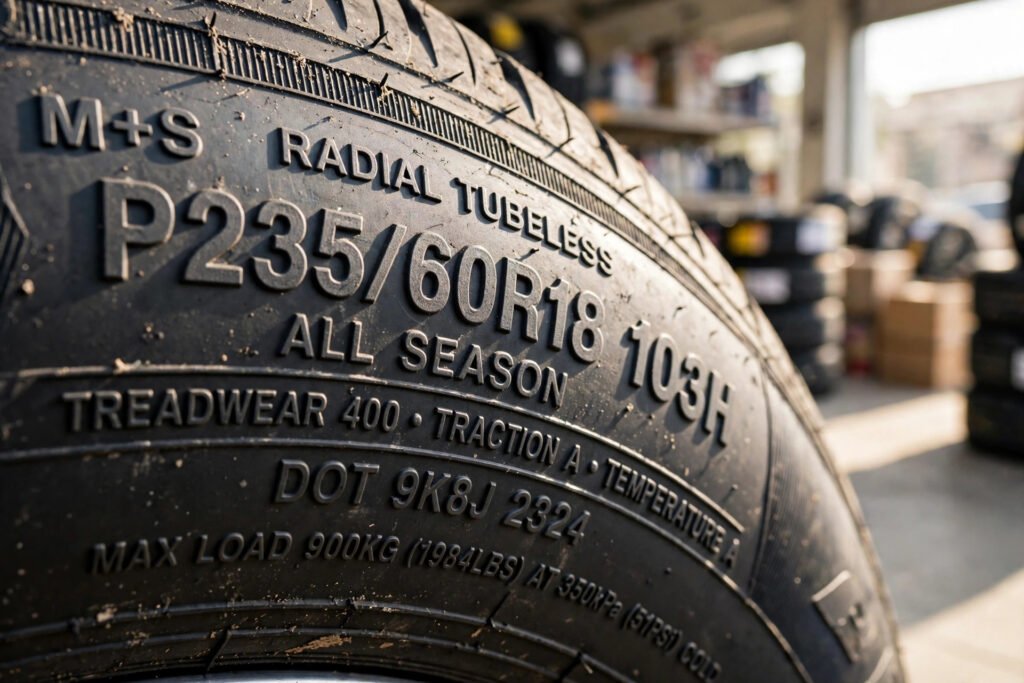
The tire load rating chart is how you read the small number near the end of a tire’s size code: that number is a weight limit in code. On a tire marked P235/60R18 103H, the 103 is the load index. Look it up in the chart below and it means each tire can carry up to 1,929 pounds when properly inflated. The H after it is the speed rating, a separate code for maximum sustained speed.
The rule for buying replacement tires is short: match or exceed the load index your car came with, and never go lower. A tire with a lower load index than your car needs cannot safely carry the weight, and it will run hotter, wear faster, and carry a real risk of sudden failure under load. Going higher is fine. Going lower is not a bargain, it is a safety downgrade.
This guide gives you the full chart, shows you where to find the number your car needs, and explains the traps that catch people out: standard load versus extra load, load range letters on truck tires, and the pressure rule that makes the whole rating work.
In this guide, you’ll learn:
- What the load index number on your tire means
- The full load rating chart, index 70 to 126, in pounds and kilograms
- How to find the load index your car requires
- What standard load, XL, and load range letters mean
- What happens when the load index is too low
- When going higher makes sense, and when it does not
Safety first: The load index is a safety rating, not a suggestion. Never fit a tire with a lower load index than your vehicle maker specifies. A tire that cannot carry the weight runs hot, and a hot tire is the tire most likely to fail at highway speed. If you are unsure what your car needs, a tire shop can confirm it from the door jamb label in under a minute. This guide is diagnosis and decision information only. Tire fitting and any work on wheels, suspension, or steering belongs with a qualified shop.
What Is a Tire Load Rating?
The load rating, usually called the load index, is a standardized number that tells you the maximum weight one tire can carry at its rated inflation pressure. It is not the weight itself. It is a code, and the code only means something when you look it up in the chart. A higher number means a higher weight limit. Tire Rack puts the range for passenger cars and light trucks at 70 to 126, which covers 739 pounds per tire at the bottom end and 3,748 pounds at the top.
The number sits in the service description at the end of the size code: the two or three digits just before the speed rating letter. In P235/60R18 103H, the 103 is the load index and the H is the speed rating. In 225/45R17 94V, the 94 is the load index (1,477 pounds) and the V is the speed rating. The two codes are a pair, and a replacement tire has to meet or beat both of them.
Three things about the rating are easy to get wrong, so they are worth stating plainly up front.
First, the rating is per tire, not per car. A load index of 94 means 1,477 pounds on each tire. Four of them give a nominal total of 5,908 pounds, but that total is a planning figure, not a guarantee. The axle weight ratings on the door jamb label are the real limits, and the rear axle usually runs closest to its limit when the car is loaded.
Second, the rating only exists at the right pressure. A tire rated for 1,477 pounds delivers that capacity only when inflated to its rated pressure. Run it low and the capacity drops with it, while the tire runs hotter at the same time. Underinflation plus a heavy load is one of the most common causes of a highway blowout.
Third, the chart is standardized. The numbers come from the tire industry standards bodies, the Tire and Rim Association in the US and ETRTO in Europe. The two systems agree almost everywhere, with differences of only a pound or two on a few high indexes. Any chart from a reputable source will give you the same figures used here.
Tire Load Rating Chart: Load Index 70 to 98
This is the lower half of the chart, covering the indexes found on most passenger cars, from small compacts up to larger sedans and crossovers. Find your tire’s number in the left column and read across for the maximum weight that one tire can carry.
| Load index | Max load per tire (lb) | Max load per tire (kg) |
|---|---|---|
| 70 | 739 | 335 |
| 71 | 761 | 345 |
| 72 | 783 | 355 |
| 73 | 805 | 365 |
| 74 | 827 | 375 |
| 75 | 853 | 387 |
| 76 | 882 | 400 |
| 77 | 908 | 412 |
| 78 | 937 | 425 |
| 79 | 963 | 437 |
| 80 | 992 | 450 |
| 81 | 1,019 | 462 |
| 82 | 1,047 | 475 |
| 83 | 1,074 | 487 |
| 84 | 1,102 | 500 |
| 85 | 1,135 | 515 |
| 86 | 1,168 | 530 |
| 87 | 1,201 | 545 |
| 88 | 1,235 | 560 |
| 89 | 1,279 | 580 |
| 90 | 1,323 | 600 |
| 91 | 1,356 | 615 |
| 92 | 1,389 | 630 |
| 93 | 1,433 | 650 |
| 94 | 1,477 | 670 |
| 95 | 1,521 | 690 |
| 96 | 1,565 | 710 |
| 97 | 1,609 | 730 |
| 98 | 1,653 | 750 |
A few of these numbers come up constantly. Load index 87, at 1,201 pounds, is common on compact cars. Index 91, at 1,356 pounds, is one of the most common ratings on the road. Index 94, at 1,477 pounds, is the standard fitment on many midsize sedans. And index 95, at 1,521 pounds, is the number printed on the tire in our guide to how to read tire sidewall size, where a 95 means exactly 1,521 pounds per tire.
Tire Load Rating Chart: Load Index 99 to 126
This is the upper half of the chart, covering the indexes found on larger crossovers and SUVs, pickups, and light trucks. The same rule applies: find your number, read across for the maximum weight per tire.
| Load index | Max load per tire (lb) | Max load per tire (kg) |
|---|---|---|
| 99 | 1,709 | 775 |
| 100 | 1,764 | 800 |
| 101 | 1,819 | 825 |
| 102 | 1,874 | 850 |
| 103 | 1,929 | 875 |
| 104 | 1,984 | 900 |
| 105 | 2,039 | 925 |
| 106 | 2,094 | 950 |
| 107 | 2,149 | 975 |
| 108 | 2,205 | 1,000 |
| 109 | 2,271 | 1,030 |
| 110 | 2,337 | 1,060 |
| 111 | 2,403 | 1,090 |
| 112 | 2,469 | 1,120 |
| 113 | 2,535 | 1,150 |
| 114 | 2,601 | 1,180 |
| 115 | 2,679 | 1,215 |
| 116 | 2,756 | 1,250 |
| 117 | 2,833 | 1,285 |
| 118 | 2,910 | 1,320 |
| 119 | 2,998 | 1,360 |
| 120 | 3,086 | 1,400 |
| 121 | 3,197 | 1,450 |
| 122 | 3,307 | 1,500 |
| 123 | 3,417 | 1,550 |
| 124 | 3,527 | 1,600 |
| 125 | 3,638 | 1,650 |
| 126 | 3,748 | 1,700 |
Note that the steps between indexes are not even. Going from 91 to 92 adds 33 pounds, while going from 100 to 101 adds 55 pounds, and from 120 to 121 adds 111 pounds. That is why you cannot guess the weight from the number, and why the chart matters: two indexes that look close together can be hundreds of pounds apart at the top of the range.
How to Read the Tire Load Rating Chart and the Load Index on Your Tire
You do not need any tools. Walk out to the car and read the sidewall.
Step 1: Find the size code. It is the large raised lettering on the sidewall, something like P235/60R18 103H or 225/45R17 94V. It is usually on the outer sidewall, facing you.
Step 2: Look at the last two or three digits before the final letter. In P235/60R18 103H, the number is 103 and the letter H is the speed rating. In 225/45R17 94V, the number is 94 and the letter V is the speed rating. That number is your tire’s load index.
Step 3: Look it up in the chart above. 103 means 1,929 pounds per tire. 94 means 1,477 pounds per tire. That is the maximum weight that one tire can carry when inflated to its rated pressure.
Step 4: Check the maximum load printed on the sidewall. Many tires also print the limit in plain text, such as “MAX LOAD 900KG (1984LBS) AT 350kPa (51PSI) COLD.” That printed figure should agree with the chart. If it does not, trust the printed maximum load on your specific tire and ask a tire professional, because the chart value and the printed value come from the same standard and should match.
A few tires carry two load indexes separated by a slash, such as 104/101. That is a light truck tire made for dual rear wheels, covered in the load range section below. The first number is the capacity for a single tire, and the second is the capacity for each tire in a dual pair.
Where to Find the Load Index Your Car Needs: Tire Load Rating Chart
The number on your current tires is not necessarily the number your car needs. Tires get replaced, sometimes with the wrong ones, so the authoritative figure is the one your vehicle maker published, not the one on the rubber that happens to be on the car now.
The door jamb label comes first. Open the driver’s door and look at the Tire and Loading Information placard on the door jamb. It lists the original tire size, the minimum load index, and the recommended cold inflation pressure. This is the single most important reference point for any tire purchase, and it takes ten seconds to read.
The owner’s manual comes second. The manual lists the same original size and load requirement, usually in the specifications or tires section. It is the backup if the door jamb label is worn, damaged, or missing.
The glove box sticker is a third spot on some cars. A few makers put a tire information label inside the glove box or on the fuel filler door. It carries the same figures as the door jamb label.
What to do with the number: the replacement tire’s load index must be equal to or higher than the number on the placard. That is the whole rule. If the placard says 94, a 94 is fine, a 95 is fine, and a 91 is not. If the placard calls for an XL tire, the replacement must be an XL tire too, which is covered in the next section but one.
One more check worth doing: look at all four tires. They should all carry the same load index, or at least the same index on each axle. Mixed indexes across an axle mean the two tires on that axle cannot carry the same weight, which is a handling and safety problem even before you get to the numbers.
Common Load Indexes by Vehicle Type
The chart covers a wide range, so it helps to know roughly where your kind of car lands. These are typical original-equipment figures, not a rule. Your door jamb label always wins over any table like this one.
| Vehicle type | Typical load index | Typical max load per tire |
|---|---|---|
| Small compact car | 82 to 88 | 1,047 to 1,235 lb |
| Compact sedan or hatchback | 87 to 91 | 1,201 to 1,356 lb |
| Midsize sedan | 91 to 95 | 1,356 to 1,521 lb |
| Compact crossover or SUV | 99 to 103 | 1,709 to 1,929 lb |
| Midsize SUV | 102 to 108 | 1,874 to 2,205 lb |
| Full-size SUV or pickup | 110 to 120 | 2,337 to 3,086 lb |
| Heavy-duty pickup (LT tires) | 120 to 126 | 3,086 to 3,748 lb |
A few real examples make the pattern concrete. A Honda Civic on 215/55R16 93 tires carries a load index of 93, which is 1,433 pounds per tire. A Toyota Camry on 235/45R18 94 tires carries a 94, which is 1,477 pounds. A Toyota RAV4 on 225/65R17 102 tires carries a 102, which is 1,874 pounds. A Ford F-150 on P275/65R18 116 tires carries a 116, which is 2,756 pounds. The heavier the vehicle and the more it is expected to tow or haul, the higher the number climbs, and on a heavy pickup the number climbs fast.
Electric vehicles deserve a special note here. EVs are heavy for their size, because the battery pack adds hundreds of pounds low in the chassis, and they make instant torque that works the tires hard. Many EVs come from the factory on XL tires with a higher load index than a gasoline car of the same size. If your EV came with XL tires, the replacement must be XL too, even if the size looks identical to a standard tire.
Standard Load vs Extra Load (XL): What the Letters Mean
Passenger tires come in two load classifications: Standard Load, marked SL or with no marking at all, and Extra Load, marked XL (sometimes EL or RF for reinforced). For the same tire size, the XL version carries a higher load index, usually 3 to 4 points higher, because its reinforced construction lets it run at a higher maximum pressure.
| Classification | Marking | Max pressure for rated load |
|---|---|---|
| Standard Load (P-metric) | SL or none | 35 psi (newer tires 36 psi) |
| Extra Load (P-metric) | XL | 41 psi (newer tires 42 psi) |
| Standard Load (Euro-metric) | None | 36 psi (250 kPa) |
| Extra Load (Euro-metric) | XL or RF | 42 psi (290 kPa) |
A concrete example: a 225/45R17 tire in standard form carries a load index of 91, which is 615 kg per tire at its maximum rated pressure. The same size in XL form carries a load index of 94, which is 670 kg, at a higher maximum pressure. Same size, same tread pattern, different capacity, and the difference is entirely in the construction and the pressure it is built to hold.
The XL trap is the one that catches people. If your car came with XL tires and you fit standard load tires of the same size, the load index drops even though the size matches, and the tires cannot carry the weight the car needs. The size on the sidewall looks right. The number does not. Always match the XL marking when the placard calls for it.
There is a pressure catch too. An XL tire only delivers its rated capacity at its higher pressure. Continental’s plus-sizing guidance gives the adjustment when an XL tire replaces a standard load original: if the XL tire has the same load index as the original, add 6 psi over the original pressure; if it is one point higher, add 4 psi; two points higher, add 3 psi; three points higher, add 2 psi; four or more points higher, keep the original pressure. Never go above the maximum pressure printed on the sidewall, and never below the pressure on the door jamb label. Pressure tables vary by tire maker, so confirm the figure for your exact tires with the maker or a tire professional.
Load Range Letters on Light Truck Tires
Light truck tires, marked LT, do not use the same system as passenger tires. Instead of a single load index, they carry a load range letter that describes the construction strength and maximum inflation pressure. The letter replaced the old ply rating system, and the letters still carry their ply equivalents.
| Load range | Ply rating equivalent | Typical max pressure | Typical use |
|---|---|---|---|
| C | 6-ply | 50 psi | Light pickups, vans |
| D | 8-ply | 65 psi | Heavier pickups, towing |
| E | 10-ply | 80 psi | Heavy-duty pickups, towing and hauling |
An LT tire also carries its own load index, and on tires made for dual rear wheels it carries two of them, separated by a slash. An LT235/75R15 104/101S means 1,984 pounds per tire when fitted singly, and 1,819 pounds for each tire when fitted as a dual pair. The dual number is lower because two tires sharing the load on one side of an axle do not each carry a full single-tire load, and the standard accounts for that.
Do not mix a P-metric tire and an LT tire on the same vehicle and expect the numbers to compare directly. A P-metric tire fitted to a light truck or SUV has its rated load reduced by a factor of 1.10 under the standard. Toyo’s technical bulletin gives the example: a P245/75R16 109 is rated at 2,271 pounds at 35 psi, but only about 2,065 pounds when fitted to a light truck. If your truck came with LT tires, the replacement should be LT tires. If it came with P-metric tires, the derating is already built into the maker’s specification, so fit what the placard says.
What Happens If the Load Index Is Too Low
A tire with too low a load index does not fail the moment you drive on it. It fails slowly, then suddenly, which is what makes it dangerous.
Heat is the mechanism. A tire carrying more weight than it is rated for flexes more with every rotation. Flexing generates heat, and heat is what breaks a tire down from the inside. The tire runs hotter than it was designed to run, the internal structure weakens, and the risk of a blowout climbs, especially at highway speed on a hot day with a loaded car.
Handling and stopping suffer first. Before anything fails, an overloaded tire responds more slowly to steering, feels vague in corners, and takes longer to stop. The tread wears unevenly and faster, usually at the shoulders, and the tire’s speed rating stops being reliable, because the speed rating assumes the tire is carrying a load within its rating.
The warning signs are easy to miss. The car feels a little soft in the handling, the tires look fine, and nothing warns you on the dashboard. The first real sign is often the failure itself. That is why the rule is absolute rather than advisory: never fit a lower load index than the placard specifies, even if the tire is the right size and a good price.
A reputable shop will refuse the job. Tire shops know the liability, and most will not install a tire with a lower load index than the vehicle maker specifies. If a shop offers to fit one anyway, that is a reason to leave, not a reason to save money. The same applies to insurance: a tire fitted below the maker’s specification can become a question in a claim after an accident, because the car was running outside its rated limits.
Overloading the car is the same problem from the other side. Even with the right tires, loading the car past its gross vehicle weight rating overloads the tires. The four-tire total from the chart should clear the GVWR on the door jamb label, and the axle ratings on that label are the real limits. A roof box, a trailer, and four passengers add up faster than most people expect, so check the numbers before a long loaded trip.
Can You Go Higher Than Your Car’s Load Index?
Yes, and it is the only direction the rule allows. A tire with a higher load index than your car needs is safe to fit, as long as the size and speed rating also match or exceed the specification. The tire can carry more weight than the car will ever ask of it, which leaves a larger safety margin.
There are two trade-offs, and both are small.
The ride gets firmer. A higher load index usually means a stiffer tire construction, and a stiffer tire transmits more road feel into the cabin. On a small car, jumping several indexes up can make the ride noticeably harder. One or two points is rarely noticeable. Five or more is.
The tire gets heavier. A heavier tire costs a little fuel economy and a little unsprung weight, which is the weight the suspension has to control. Again, the effect is small for a modest step up, and it is not a reason to avoid a higher index when that is what is available.
The sensible approach is simple: fit the index on the placard, or the next one or two up if that is what is in stock or on sale. Do not chase the highest number on the shelf. A 126 on a compact sedan is not better, it is just stiffer and heavier than the car needs. And if the placard calls for XL, a higher index in a standard load tire is not a substitute: the XL marking matters on its own, because it is about the pressure the tire is built to hold.
Load Index and Tire Pressure: The Part People Miss
The load index and the tire pressure are one system, not two. The rating in the chart assumes the tire is inflated to its rated pressure, and every pound below that pressure takes capacity away with it.
Underinflation is the quiet killer here. A tire 10 psi low can lose a meaningful share of its rated capacity while looking almost normal from the outside. It also runs hotter, which is the same failure mechanism as overloading. A tire that is both underinflated and carrying a full load is doing the two things that cause blowouts at the same time.
Check pressure monthly, and before towing. Use the pressure on the door jamb label, not the maximum pressure printed on the tire sidewall. The sidewall number is the ceiling, the label number is the setting for your car. Check it cold, before driving, because driving warms the air inside and raises the reading. Our guide to how to check tire pressure walks through the whole process, including what to do when the readings differ across the four tires.
Pressure does not fix a wrong index. Adding air to a tire with too low a load index does not raise its rating. The rating is set by the tire’s construction, and no amount of pressure changes the number in the chart. Pressure keeps a correct tire at its rated capacity. It cannot make an incorrect tire correct.
The P-Metric Derating Rule on Light Trucks
This is the detail that surprises even experienced owners, and it matters when a pickup or SUV wears P-metric tires.
When a P-metric tire is fitted to a light truck or SUV, the tire industry standard requires its rated load to be reduced by a factor of 1.10. The reason is that light trucks are expected to carry heavier loads and to work harder than passenger cars, so the same tire is rated more conservatively on them. Toyo’s technical bulletin gives the example: a P245/75R16 109 is rated at 2,271 pounds at 35 psi on a passenger car, but only about 2,065 pounds when fitted to a light truck.
In practice, this rarely changes what you buy, because the vehicle maker already accounted for it when choosing the original tire size and load index. The placard figure is the correct one for your truck, derating included. It matters in one situation: when you are comparing a P-metric tire against an LT tire for a truck, or when a tire shop suggests a P-metric tire as a cheaper substitute for an LT tire. The numbers on the two tires do not compare directly, and the P-metric tire gives up about a tenth of its rated capacity on the truck. If the truck came with LT tires, fit LT tires.
What to Tell Your Tire Shop
A tire purchase goes smoothly when you walk in with the right information. Before you call or visit, note these five things:
- The size and load index on the door jamb label, not just the size on your current tires. Photograph the label so you have it with you.
- Whether the placard calls for XL tires. If it does, say so first, because it rules out half the tires in your size.
- How the car is used. Daily commuting, regular towing, or frequent fully loaded trips all push toward the higher end of what fits, and a shop can advise on the trade-off between ride comfort and margin.
- Whether all four tires are being replaced. If only two are, the new pair goes on the rear axle, and the load index must match across the axle.
- The age of the tires coming off. A tire that is six or more years old is due for replacement on age alone, whatever the tread looks like. The DOT date code on the sidewall tells you the week and year it was made.
A good shop will check the placard itself before quoting, and will refuse to fit a lower load index. If a quote comes back with a lower index than the placard, or with standard load tires where XL is specified, ask for a corrected quote. The cheapest tire that meets the specification is a good buy. The cheapest tire that does not meet it is not a tire for your car.
FAQ
What does the number after the tire size mean?
It is the load index, and it is a code for the maximum weight one tire can carry. On a tire marked P235/60R18 103H, the 103 means 1,929 pounds per tire when properly inflated. The letter after it, H, is the speed rating. Look the number up in the chart above to get the weight.
Where do I find the load index my car needs?
On the Tire and Loading Information placard inside the driver’s door jamb. It lists the original tire size, the minimum load index, and the recommended cold pressure. The owner’s manual lists the same figures. Never go below the placard number.
Can I use a tire with a lower load index if it is cheaper?
No. A lower load index than your car needs cannot safely carry the weight, and it will run hot, wear fast, and carry a real blowout risk at highway speed. A reputable shop will refuse to fit one. Saving money on the wrong tire is the most expensive tire decision you can make.
Is a higher load index better?
It is safe, but it is not automatically better. A higher index gives a larger safety margin, which is good, but it usually means a stiffer tire and a firmer ride. Fit the index on the placard, or one or two points above it. Do not chase the highest number on the shelf.
What does XL mean on a tire?
XL stands for Extra Load. It is a reinforced tire that carries a higher load index than a standard load tire of the same size, usually 3 to 4 points higher, and it needs a higher maximum pressure to deliver it, typically 41 psi instead of 35 psi. If your car came with XL tires, the replacement must be XL too.
Does tire pressure change the load rating?
Pressure does not change the rating, but it decides whether the tire actually delivers it. The chart figures assume the tire is inflated to its rated pressure. Run it low and the capacity drops while the tire runs hotter. Check pressure monthly, cold, using the figure on the door jamb label.
What is the difference between load index and load range?
The load index is a number that gives an exact maximum weight per tire, used on passenger tires. The load range is a letter, C, D, or E, used on light truck tires to describe construction strength and maximum pressure, with ply rating equivalents of 6, 8, and 10. An LT tire carries both: a load range letter and its own load index, sometimes two of them for dual rear wheels.

lily John
The Fixtorial team writes hands-on car troubleshooting guides for everyday drivers — symptom first, honest costs, and fixes you can verify yourself.


