
Intake Air Temperature Sensor: What It Does & Failure Signs
Updated Nov 21, 2026
In This Guide
- The Quick Answer: A Small Sensor With a Big Say in Your Fuel Mixture
- What the Intake Air Temperature Sensor Does
- Where the Intake Air Temperature Sensor Is Located
- 7 Signs Your Intake Air Temperature Sensor Is Failing
- Symptoms at a Glance
- How a Shop Tests the Intake Air Temperature Sensor
- IAT Sensor vs MAF Sensor vs Coolant Temperature Sensor
- What an IAT Sensor Replacement Costs in 2026
- Can You Drive With a Bad IAT Sensor?
- When to See a Mechanic
- FAQ
The Quick Answer: A Small Sensor With a Big Say in Your Fuel Mixture
Your engine needs the right mix of air and fuel to run well, and the intake air temperature sensor helps set that mix by reporting the temperature of the air coming in. Cold air is denser than warm air, so it carries more oxygen per gulp, and the engine needs more fuel to match it. Warm air is thinner and needs less fuel. Usually called the IAT sensor, it reports that temperature to the engine computer. When it works, you never think about it. When it starts sending wrong numbers, the fuel mixture goes off, and you get a check engine light, worse gas mileage, a rough idle, and hard starts, especially on cold mornings. A failing IAT sensor is a cheap part to replace, usually $50 to $300 in total, but it is easy to misdiagnose because its symptoms look like several other problems.
In this guide, you’ll learn:
- What the IAT sensor does and where it lives
- The 7 warning signs that it is failing
- How a shop tests it before replacing anything
- How it differs from the MAF sensor and the coolant temperature sensor
- What replacement costs in 2026
- Whether you can keep driving with a bad one
What the Intake Air Temperature Sensor Does
The IAT sensor is a thermistor, a small resistor whose electrical resistance changes with temperature. As the incoming air gets hotter, the sensor’s resistance drops in a steady, predictable way. The engine computer reads that changing resistance as a voltage signal, typically around 4.5 volts when the air is cold and closer to 0.5 volts when it is hot, and turns it into a temperature reading.
That reading matters because the computer uses it to work out air density. Denser cold air needs a richer fuel mixture, and thinner hot air needs a leaner one. Get the temperature wrong and the mixture is wrong in the same direction. If the sensor tells the computer the air is much colder than it really is, the computer adds too much fuel and the engine runs rich. If it reports the air as hotter than it is, the computer holds fuel back and the engine runs lean. Either way, the engine burns fuel badly, and that shows up as the symptoms below.
The sensor also feeds into cold start and warm up decisions. On a cold morning, the computer leans on the IAT reading to set the right idle speed and fuel rate while the engine warms up. A wrong reading at startup is why hard starting and stalling show up so often with this fault.
Where the Intake Air Temperature Sensor Is Located
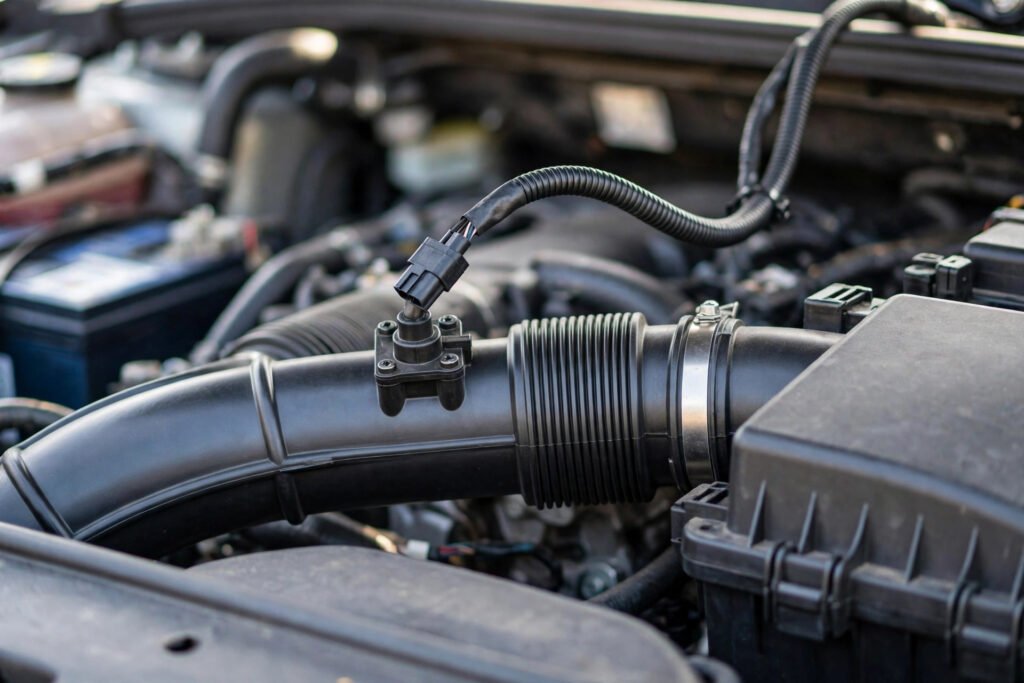
On most cars, the IAT sensor sits in the air intake duct or in the air filter housing, somewhere between the air filter and the throttle body, so it reads the air on its way into the engine. It is a small plastic probe with a two wire electrical connector, often held in by a single bolt or a push fit.
On many newer cars, there is no separate IAT sensor to find. The sensor is built into the mass airflow (MAF) sensor housing, and the two share one connector and one assembly. That matters for the repair bill: if the IAT element is part of the MAF assembly and it fails, you replace the whole MAF assembly, which costs more than a standalone sensor. Your owner’s manual or a parts lookup for your exact year, make, and model will tell you which setup your car has.
7 Signs Your Intake Air Temperature Sensor Is Failing
1. The check engine light comes on
This is the most common first sign. The computer watches the IAT signal constantly, and if the reading is out of range, stuck, or jumps in a way that makes no sense, it stores a fault code and turns on the check engine light. The codes tied to this sensor are P0110 (circuit malfunction), P0111 (range or performance problem), P0112 (low input), and P0113 (high input). A free code read at most parts stores will show whether one of these is stored. Keep in mind that a check engine light on its own proves very little, since dozens of faults can turn it on. If your check engine light is on but the car runs fine, that guide explains what to check first.
2. Gas mileage drops for no clear reason
A sensor that reports cold air when the air is actually warm makes the computer overfuel the engine around the clock. You will notice it at the pump before you notice it anywhere else: the same commute starts costing more in gas, with no change in your driving. This is one of the most reliable clues, because few other small faults hurt fuel economy so steadily without an obvious noise or smell to go with it.
3. The engine idles rough or stalls
With the wrong fuel mixture, the engine struggles to hold a steady idle. It may shake at a stop, surge up and down, or stall when you come off the gas. Cold starts are the worst, because the computer is depending on the IAT reading the most right then. If the idle is rough but the engine smooths out once warm, the IAT sensor belongs on the suspect list, along with vacuum leaks and a dirty throttle body. A car that idles high is a different problem with different causes, so do not mix the two up.
4. Hard starting, especially in cold weather
When the sensor reports the wrong temperature at startup, the computer sets the wrong fuel rate for a cold engine. Too much fuel floods the cylinders and the engine cranks without catching. Too little fuel and it catches, then dies. If your car is hard to start on cold mornings but fine once it has run, and the battery and starter test good, the IAT sensor is worth checking.
5. Hesitation and poor acceleration
A lean mixture from a sensor that reports hot air when the air is cold leaves the engine short of fuel when you ask for power. The car hesitates when you press the gas, feels flat when merging or climbing a hill, and loses the crisp response it used to have. In severe cases the computer gives up on the bad reading and drops into a limp mode, limiting power to protect the engine until the fault is fixed. Poor acceleration has other causes too, including fuel delivery trouble, so compare the symptoms with the signs of bad fuel pump symptoms before deciding what to test first.
6. The engine misfires
A mixture that is too rich or too lean can fail to burn cleanly in one or more cylinders, and the result is a misfire: a stumble, a shake under load, or a flashing check engine light. Misfires have many causes, from spark plugs to coils to injectors, so a misfire alone never proves the IAT sensor is bad. It only earns the sensor a place in the diagnosis when it shows up together with the other signs on this list.
7. Black smoke or a failed emissions test
When the computer overfuels because of a bad temperature reading, the extra fuel does not all burn. Some of it leaves as black smoke from the tailpipe, and the exhaust runs dirty enough to fail an emissions inspection. If your car puffs black smoke on acceleration and drinks more fuel than usual, a bad IAT sensor is a real possibility. Blue or white smoke points elsewhere, so the color matters.
Symptoms at a Glance
| Symptom | What the sensor is probably reporting | Check first |
|---|---|---|
| Check engine light, codes P0110 to P0113 | Out of range, stuck, or implausible temperature | Free code read, then live data |
| Worse gas mileage | Air colder than it is, engine overfueled | Fuel economy trend, then scan data |
| Rough idle or stalling | Wrong mixture at idle, worst when cold | Idle behavior cold vs warm |
| Hard cold starts | Wrong fuel rate at startup | Battery and starter ruled out first |
| Hesitation, poor acceleration | Air hotter than it is, engine underfueled | MAF and fuel delivery ruled out |
| Misfires | Mixture too rich or too lean to burn cleanly | Plugs, coils, and injectors ruled out |
| Black smoke, failed emissions | Chronic overfueling | Exhaust color and emissions readings |
How a Shop Tests the Intake Air Temperature Sensor
A good shop does not replace the sensor on a hunch. The diagnosis is quick and it follows a set order.
Scan tool live data. With a scan tool plugged in, the mechanic watches the intake air temperature reading in real time. On a cold engine that has sat overnight, the reading should be close to the outside air temperature. A reading of minus 38 degrees Fahrenheit on a mild morning, or 300 degrees on a cold engine, is an implausible value, and it points straight at the sensor circuit. Those two numbers are the giveaway values for the P0113 and P0112 codes.
Resistance check. With the sensor unplugged, a multimeter across its terminals measures resistance, and the mechanic warms the sensor tip gently and watches the reading. On a good thermistor, resistance drops steadily as temperature rises. A reading that does not move, or one that jumps around, means the sensor itself has failed.
Wiring and connector inspection. Many supposed sensor failures turn out to be wiring. The mechanic checks the connector for corrosion, loose pins, and cracked insulation, and checks the wiring where it bends near the intake duct. A dirty or corroded connector can produce exactly the same codes as a dead sensor, and it costs nothing to clean and reseat it.
Comparison with other sensors. The IAT reading should agree with the ambient air temperature and, on a cold engine, with the coolant temperature sensor. If one reading is far off from the rest, the odd one out is the suspect.
This is diagnosis work, and the electrical checks are low voltage and safe, but if you are not comfortable with a multimeter, a shop will run the whole sequence in well under an hour of labor. Do not replace parts by guessing: a new sensor will not fix a wiring fault, and a new MAF assembly will not fix a dirty connector.
IAT Sensor vs MAF Sensor vs Coolant Temperature Sensor
These three sensors all feed temperature or airflow data to the computer, and they get confused with each other constantly. They are not the same part, and they fail differently.
| Sensor | What it measures | Where it lives | If it fails |
|---|---|---|---|
| Intake air temperature (IAT) | Temperature of incoming air | Intake duct, airbox, or inside the MAF housing | Wrong fuel mixture, poor mileage, rough idle |
| Mass airflow (MAF) | How much air is entering the engine | In the intake duct after the air filter | Hesitation, stalling, poor acceleration, lean codes |
| Coolant temperature (ECT) | Temperature of the engine coolant | On the engine, near the thermostat housing | Hard starts, overheating gauge errors, fan problems |
The key point for diagnosis: a bad IAT sensor corrupts the fuel mixture through a wrong temperature reading, while a bad MAF sensor corrupts it through a wrong airflow reading. The symptoms overlap heavily, which is why a scan tool reading, not a guess, decides which one to replace. On cars where the IAT element is built into the MAF housing, the two fail together as one assembly.
What an IAT Sensor Replacement Costs in 2026
A standalone IAT sensor is one of the cheaper engine sensors to replace. Total cost at an independent shop typically runs $50 to $300, with the part itself accounting for $20 to $125 and labor and shop charges making up the rest. The sensor is usually easy to reach, so labor is often well under an hour.
If the IAT element is integrated into the MAF sensor on your car, the bill is higher, because you are replacing the whole MAF assembly. Repairs tied to the P0112 and P0113 codes run about $50 to $450 in that case, depending on whether a standalone sensor or a full MAF assembly is needed. A diagnostic fee of roughly $100 to $200 is common when a shop runs the scan and testing sequence first. Dealers and luxury brands run higher, and prices vary by region, so get a written quote that separates parts from labor before approving the work.
Can You Drive With a Bad IAT Sensor?
For short trips, usually yes, but do not ignore it for weeks. The engine will keep running, often in a default fuel strategy that is richer than normal to protect itself, but the costs add up quietly. Fuel economy stays bad, the extra fuel can foul spark plugs and wear the catalytic converter over time, and a persistent misfire can damage the converter faster. If the computer has dropped the car into limp mode, or the check engine light is flashing, which signals an active misfire, stop driving and get it checked promptly. A flashing check engine light is never a wait and see situation.
When to See a Mechanic
Book a diagnosis soon if the check engine light stays on with a P0110 to P0113 code, if the engine stalls at idle, or if fuel economy has dropped sharply with no other explanation. Go promptly, not eventually, if the engine misfires under load or the check engine light is flashing. And if you smell raw fuel around the car, stop and have it towed: a fuel smell is a leak until proven otherwise, and that is a safety problem, not a sensor problem.
FAQ
How long does an IAT sensor last?
There is no set replacement interval. The sensor often lasts the life of the car, and when it fails it is usually heat, age, contamination, or wiring damage that does it, not mileage. Cars that run hot under the hood or see a lot of stop and go traffic tend to see sensor failures sooner.
Can I clean the IAT sensor instead of replacing it?
Cleaning sometimes helps if the problem is dirt or oil film on the sensor tip, and a gentle clean with a sensor safe cleaner is a reasonable first try when the sensor is easy to reach. But cleaning cannot fix a failed thermistor, a cracked housing, or damaged wiring. If the scan reading is still implausible after a clean, the sensor needs replacing.
Will a bad IAT sensor affect my air conditioning?
No. The IAT sensor has nothing to do with the AC system. It measures intake air for the engine computer only. If the AC is acting up at the same time, that is a separate problem.
Can a bad IAT sensor cause my car to fail an emissions test?
Yes. A sensor that makes the engine run rich pushes unburned fuel through the exhaust, which raises emissions readings and can fail the test. Fix the sensor, clear the code, drive the car through a few normal trips so the computer relearns, and retest.
Can I replace the IAT sensor myself?
On many cars, yes: it is a small sensor with one connector and one bolt, and the swap takes minutes once you know where it is. Check your owner’s manual for the location first, and never force a connector that will not release. If the sensor is built into the MAF assembly, replace the assembly as a unit. If the fault is in the wiring rather than the sensor, leave that to a shop.
Does the IAT sensor need calibration after replacement?
No. The engine computer reads the new sensor’s resistance directly, and there is nothing to program. Clear the stored fault code with a scan tool after the repair, or let the light clear itself over a few drive cycles once the reading is back in range.

lily John
The Fixtorial team writes hands-on car troubleshooting guides for everyday drivers — symptom first, honest costs, and fixes you can verify yourself.



One Comment