
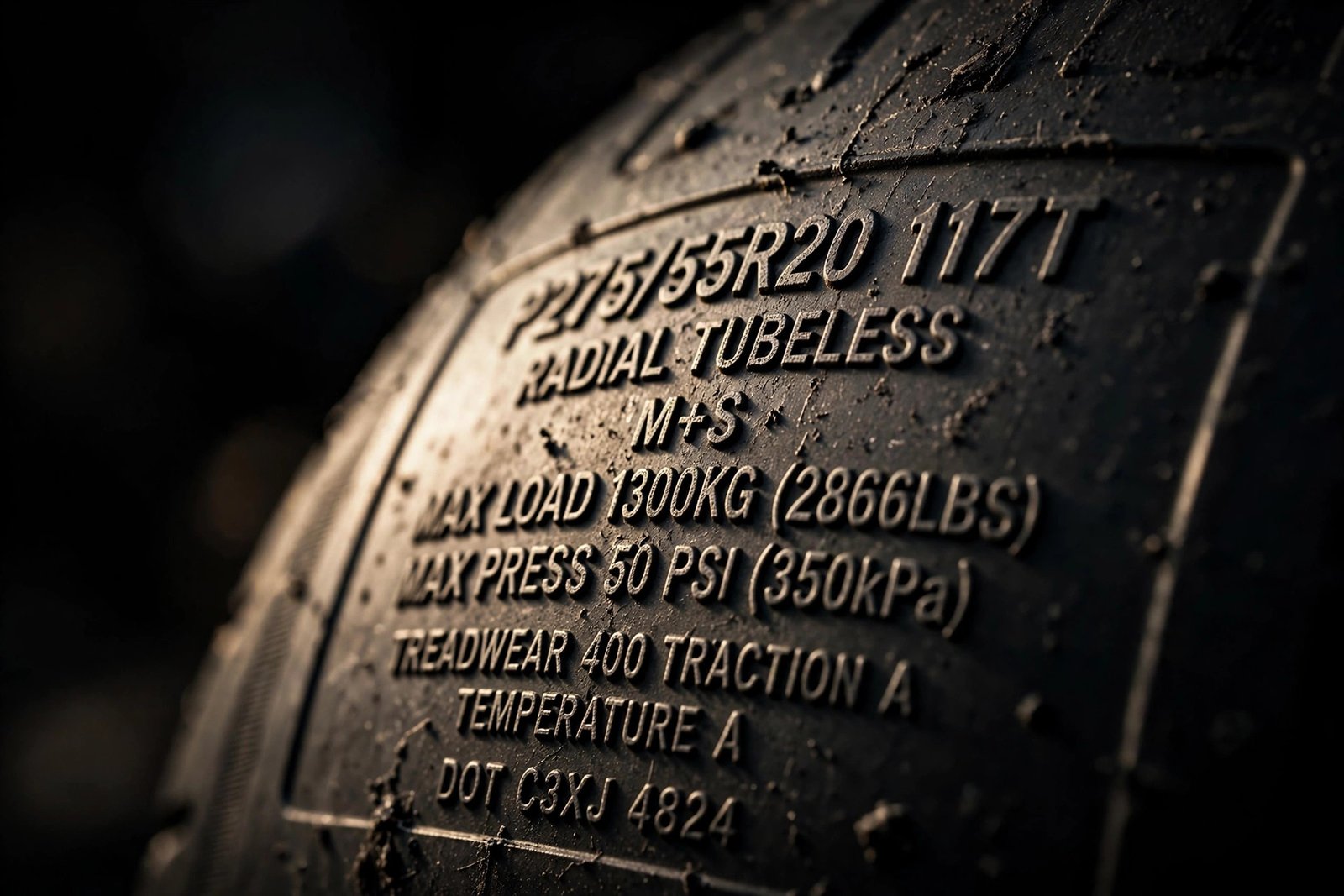
That string of numbers and letters on your tire's sidewall — P225/65R17 95H — is a complete specification. Decoding it takes two minutes, and it matters most when you're buying replacement tires: some parts of the code must match your car exactly, and some can vary. This guide covers both.
Decoding the Size: P225/65R17 95H
- P — Tire type. P = passenger (P-metric). LT = light truck (heavier construction for loads/towing). No letter = Euro-metric. ST = special trailer. Match this to your vehicle type.
- 225 — Section width. Tire width in millimeters, sidewall to sidewall. Wider = more grip but usually more noise and lower MPG; narrower = better in deep snow.
- 65 — Aspect ratio. Sidewall height as a percentage of the width — here, the sidewall is 65% of 225mm. Lower number = shorter, stiffer sidewall (sharper handling, harsher ride). Higher = taller sidewall (more cushion).
- R — Construction. R = radial — virtually every modern passenger tire. (D = diagonal/bias-ply, mostly trailers and vintage cars now.)
- 17 — Wheel diameter. The wheel (rim) size in inches this tire fits. This is absolute — a 17" tire never goes on a 16" or 18" wheel.
- 95 — Load index. A coded number for maximum weight per tire when properly inflated. 95 = 1,521 lbs per tire. Never go below your vehicle's specified load index — it's a safety limit, not a suggestion.
- H — Speed rating. The maximum sustained speed the tire is certified for (H = 130 mph). This is really about heat tolerance at sustained speed, not how fast you plan to drive. Common ratings: T (118), H (130), V (149), W (168), Y (186 mph).
Buying Replacements: What Must Match vs What Can Vary
Must match (or meet/exceed):
- Wheel diameter — exact. No exceptions.
- Load index — meet or exceed your car's spec. Never go lower.
- Tire type (P vs LT) — don't put passenger tires on a truck that tows, or LT tires on a sedan needlessly.
- Speed rating — meet or exceed the original. A lower rating is a downgrade in heat tolerance.
Can vary (with care):
- Width and aspect ratio — "plus sizing" (wider tire, lower profile, same overall diameter) is common, but changes handling, ride, speedometer accuracy, and clearance. Stay within what your car was designed for; when in doubt, stick with the factory size.
- Brand and model — your choice, but keep all four the same model for even handling (especially on AWD, where mismatched tires can stress the drivetrain).
The golden rule: the size on your door jamb placard (not just what's currently on the car — a previous owner may have changed it) is what the manufacturer engineered the car around.
The DOT Code: How Old Are Your Tires?
Find the DOT marking on the sidewall, then the 4-digit date code at the end — week + year of manufacture. DOT XXXX 2424 = made in week 24 of 2024.
Tires age out even with good tread: rubber degrades from sunlight, ozone, and heat. The tire industry's widely cited guidance is to replace tires at around 6 years from manufacture regardless of tread depth, and never run them past 10. Check the date code on your spare too — spares age in the trunk.
Other Markings You'll See
- Treadwear / Traction / Temperature grades (UTQG) — the treadwear number is a relative rating for comparing tires within a brand, not a mileage promise.
- M+S / 3PMSF (three-peak mountain snowflake) — M+S is a tread-pattern designation; the snowflake symbol means the tire passed actual snow-traction testing. Only the snowflake counts as a true winter rating.
- Rotation arrows — directional tires must rotate in the indicated direction.
- MAX PRESSURE — the tire's structural limit, not your car's recommended pressure (that's the door placard).
Common Mistakes
- Buying by price alone and dropping the load index. A cheaper tire with a lower load index than spec is a safety downgrade.
- Mixing tire models across axles (or worse, on the same axle) — uneven grip, especially in rain.
- Ignoring the DOT date on "new" tires. A tire that's been warehoused for 4 years is already middle-aged. Check before you buy.
- Upsizing wheels/tires without checking clearance and speedometer effect. Bigger isn't automatically better.
- Assuming the sidewall MAX pressure is the target. It's the ceiling; the placard is the target.
FAQ
Can I put a different size tire on my car?
Minor variations are possible (plus-sizing), but the overall diameter should stay close to stock to keep the speedometer, gearing, and clearance correct. The safest move is the placard size.
What do the numbers after the size (95H) actually limit?
Load index 95 = max 1,521 lbs per tire at proper inflation; speed rating H = certified to 130 mph sustained. Both are about safety margins under load and heat.
How do I find my tire's age?
The last four digits of the DOT code: first two = week, last two = year (e.g., 2424 = week 24, 2024). Tires made before 2000 used a 3-digit code — if you see one, the tire is ancient; replace it.
Do all four tires need to be the same?
Ideally yes — same size, model, and similar wear. On AWD vehicles it's close to mandatory (mismatched diameters stress differentials). At minimum, never mix across the same axle.
Sources
- General Tire — "Tires 101: How To Read Your Tire Sidewall" (metric/P-metric sizing; width, aspect ratio, construction, wheel diameter, load index, speed rating; American truck sizing) — https://generaltire.com/our-world/latest-news/how-to-read-your-tire-sidewall
- VIP Tires & Service — "How to Read Your Tire Sidewall" (tire type codes P/LT/ST/T; DOT date code week/year; load index as safety limit) — https://www.vipauto.com/education-center-appearance-proper-washing-and-waxing-add-value-vehicle-how-read-tire-sidewall/
- SimpleTire — "Understanding Tire Size: How to Read Sidewall Numbers" (width/aspect-ratio effects on grip, MPG, ride; radial vs bias-ply) — https://simpletire.com/learn/tire-buying-guides/how-to-read-tire-size
- Tire Shop Jacksonville — "How to Read a Tire Sidewall" (six-piece breakdown; load index as safety limit; speed rating as heat tolerance) — https://www.tireshopjacksonville.com/blog-read-tire-sidewall-jacksonville.html
- Dunlop Motorcycle Tires — "How to Read a Motorcycle Tire Sidewall" (DOT date code format; 6-year working-life guidance) — https://www.dunlopmotorcycletires.com/about/how-to-read-tire-sidewall/