
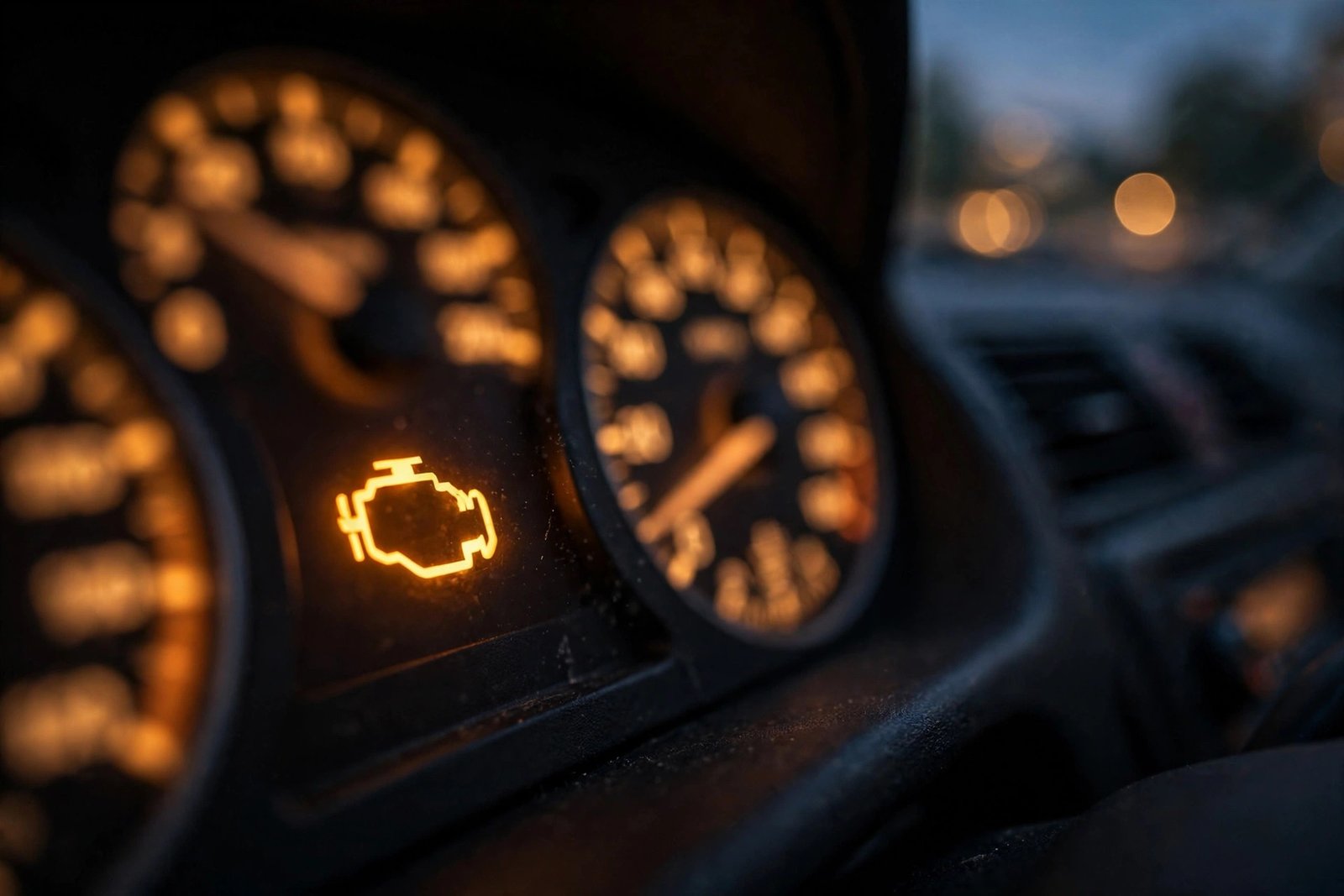
Your check engine light started flashing — then went back to solid, or off entirely. It’s tempting to relax. Don’t. A flashing check engine light is your car’s way of reporting an active engine misfire, and even when the flashing stops, the underlying fault (and its stored code) is usually still there.
In this guide, you’ll learn:
- What flashing vs. solid check engine light means
- Why “it stopped flashing” doesn’t mean the problem is gone
- The most common causes of intermittent misfires
- What to check and what to tell your mechanic
- Typical repair cost ranges
Safety first: If the light is currently flashing and the engine is shaking badly, losing power, or you smell rotten eggs (overheating catalytic converter), ease off the throttle, avoid hard acceleration, and get it diagnosed promptly. A flashing light means potential catalytic converter damage — that turns a small repair into a big one.
Flashing vs. Solid — the Critical Difference
| Light behavior | What it means | Urgency |
|---|---|---|
| Flashing | Active misfire happening right now — unburned fuel is reaching the exhaust | High: reduce load, diagnose soon; don’t ignore |
| Solid/steady | A fault was detected and stored, but no active misfire at this moment | Moderate: schedule diagnosis; don’t panic |
| Flashing then stops | Intermittent misfire — it was active, now it isn’t. The code is almost certainly still stored | Moderate-High: the fault will return; diagnose before it worsens |
| Comes and goes over days | Intermittent fault, often load-dependent (hills, acceleration, cold starts) | Get codes read — pattern matters |
The single most important point: the computer remembers. Even if the light is off now, the misfire event is stored as a diagnostic trouble code (often a P0300-series code). Any shop — and many auto parts stores, free of charge — can read it.
The Most Likely Causes of an Intermittent Misfire
1. Worn spark plugs (most common)
Plugs wear gradually, and misfires start under load first — accelerating, climbing hills — which is exactly when drivers notice flashing that then stops. If your plugs are past their service interval, they’re suspect number one.
2. Failing ignition coil(s)
One weak coil misfires only under certain conditions (heat, load, moisture). Coil-on-plug designs mean a single bad coil affects one cylinder — the code will often tell you which one (P0301 = cylinder 1, P0302 = cylinder 2, etc.).
3. Clogged or failing fuel injector
An injector that doesn’t deliver a clean spray pattern causes a lean misfire on one cylinder — often intermittent at first.
4. Vacuum leak
Unmetered air leans out the mixture. Small leaks cause misfires mainly at idle or light load; the light may flash briefly and stop as conditions change.
5. Low fuel pressure / weak fuel pump
Shows up first under high demand (hard acceleration, uphill). If flashing correlates with load, fuel delivery belongs on the suspect list.
6. Worn spark plug wires (older vehicles)
Cracked insulation arcs to ground intermittently — classic “flashes when damp or under load” behavior.
What You Can Do Right Now
- Note the pattern. When did it flash — accelerating? Uphill? Cold start? At idle? This is the single most useful thing you can tell a mechanic.
- Get the codes read. Don’t clear them first — the stored and pending codes are the diagnosis. Many auto parts stores read codes free.
- Check the basics: Is the fuel cap tight (a loose cap sets evaporative codes, though rarely flashing)? Any recent work done (plugs, coils, intake parts)?
- Don’t just disconnect the battery to clear it. That erases the codes your mechanic needs and resets emissions readiness monitors — the fault will return, and you’ll have wasted the evidence.
- Reduce load until diagnosed: gentle acceleration, avoid steep hills at full throttle. You’re protecting the catalytic converter.
When to See a Mechanic Promptly
- The flashing returns, especially under load
- Noticeable shaking, power loss, or stalling
- Rotten-egg smell from the exhaust (converter overheating)
- The light is now solid but the engine runs rough
- You don’t know when the spark plugs were last changed — start there
Tell the mechanic when it flashes, not just that it flashed. “Flashes only going uphill” points somewhere very different from “flashes at idle.”
Typical Cost Ranges
(Verified 2026-10-13 against current US cost sources; ranges vary by vehicle and region.)
- OBD-II code read at parts store: usually free
- Spark plug replacement: roughly $100–$300 (4-cylinder; more for V6/V8 or hard-to-reach plugs)
- Single ignition coil: roughly $100–$300+ depending on vehicle (advanced coil-on-plug systems can run higher)
- Fuel injector service/replacement: roughly $150–$400+ per injector
- Catalytic converter (if ignored too long): roughly $1,000–$2,500+ — the reason flashing deserves prompt attention
FAQ
My check engine light flashed then stopped — am I fine?
Not necessarily. The misfire stopped, but the cause didn’t fix itself. Get the stored codes read — that’s a 5-minute job that tells you exactly what happened.
Can I keep driving with a flashing check engine light?
Briefly and gently, to reach diagnosis. A flashing light means active misfire that can overheat and destroy the catalytic converter — prolonged driving turns a minor repair into a major one.
Why does it only flash uphill or when accelerating?
Load-dependent misfires are classic for worn plugs, weak coils, or fuel delivery issues — components that cope at light load but fail when demand rises.
Will the code clear itself?
Intermittent codes can self-clear after many drive cycles without recurrence — but if the underlying fault persists, it will be back. Don’t wait for that cycle.
Is a flashing light always a misfire?
Overwhelmingly, yes — that’s what the flashing designation is reserved for. A solid light covers hundreds of other faults.