
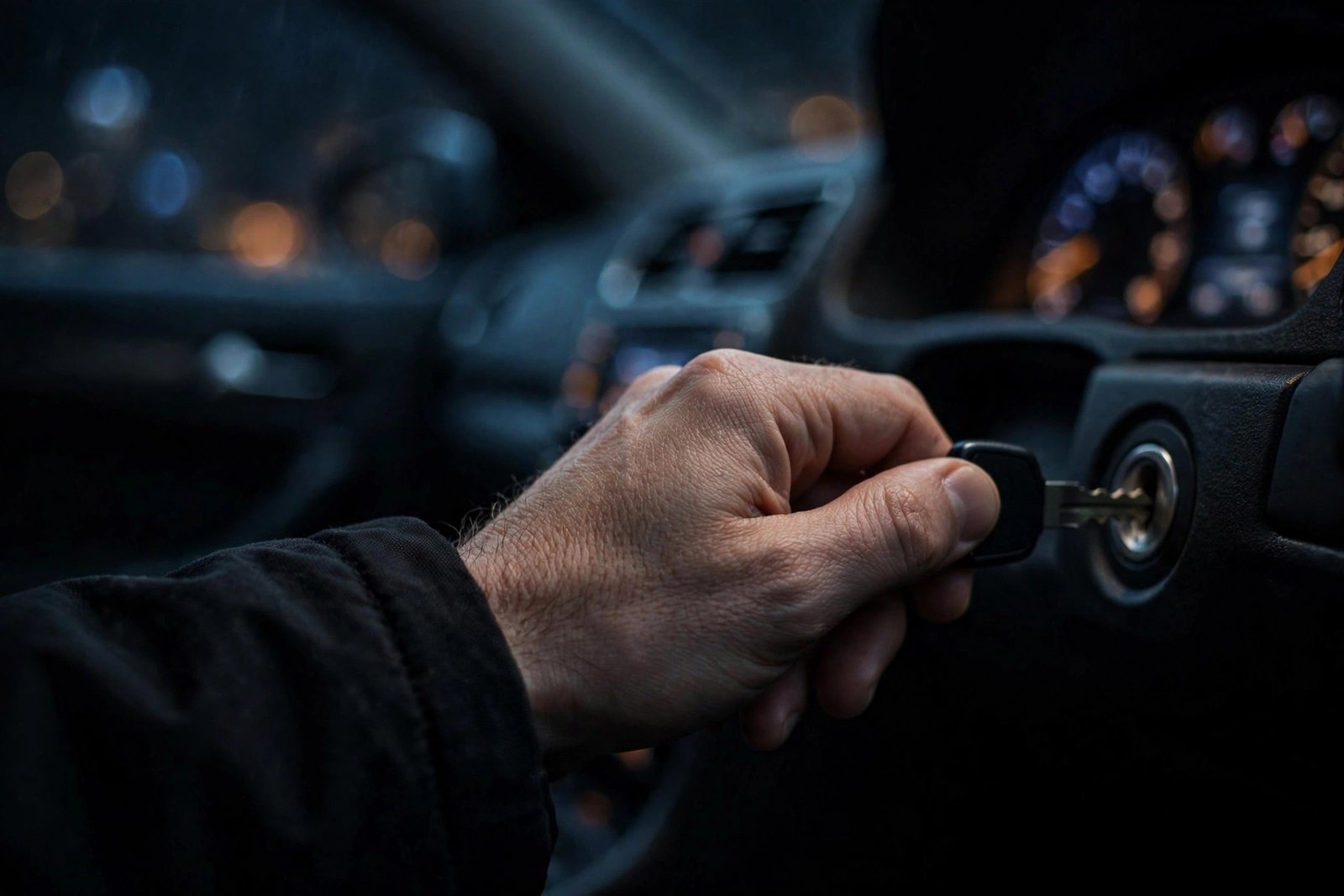
One solid click — then nothing. Not the machine-gun rapid clicking of a weak connection (that’s a different symptom, covered here), and not the slow labored turning of a dying battery (covered here). Exactly one click means the starter solenoid engaged — it got the signal — but the starter motor never spun the engine. That single sound is already narrowing your suspect list.
In this guide, you’ll learn:
- What one single click (vs. rapid clicks, vs. silence) tells you
- The most likely causes, in order of likelihood
- The quick checks that separate a connection problem from a dead starter
- When to stop and call a mechanic
- Typical repair cost ranges (verified 2026-10-14)
Safety first: Do all terminal inspections with the ignition OFF. Never hold the key in START for more than ~10 seconds at a time — let the starter cool a minute between attempts. If you smell burning plastic or see smoke, stop and call for a tow.
First: What Happens Along With the Click?
Turn the key once more and watch the dashboard while you listen. The combination is the diagnosis:
One click + dash lights stay bright — The car’s electrical systems have full power, so the battery and main connections are probably fine. The signal reached the starter solenoid, but the motor itself didn’t spin. Suspect: failing starter motor or its power feed.
One click + dash lights die or dim heavily — A connection is collapsing under the starter’s load. Suspect: loose or corroded battery terminals/cables, or a battery that reads fine at rest but fails under load.
One click on the first try, rapid clicking on later tries — Your repeated attempts have drained the battery down. The first click was the truth; the rest is just a now-weak battery joining in.
The click comes from the fuse box area, not the engine — That’s the starter relay clicking, not the solenoid. Suspect: relay or the signal path to it.
No click at all in Park, but it cranks in Neutral — Not a single-click case at all: neutral safety switch. Shift firmly into Neutral (foot on the brake) and retry.
The Most Likely Causes, in Order
1. Failing starter motor or worn solenoid contacts (most common with bright dash)
The classic single-click signature: solenoid engages, motor never spins. Heat and age wear the brushes and contacts until the motor lands on a “dead spot.” As a last-resort confirmation (not a fix): light taps with a rubber mallet or screwdriver handle on the starter’s motor body — never the solenoid, never a heavy hammer — while a helper turns the key can free stuck brushes for one more start. Only try this if the starter is safely reachable without touching hot or moving parts; on many modern cars it’s buried and this test isn’t practical. If the car starts, drive straight to a repair shop without switching it off — it will strand you again, soon.
2. Corroded or loose battery terminals and cables
Even with a decent battery, white/green crusty buildup or a clamp you can wiggle by hand starves the starter of the 100–200+ amps it needs. With the ignition OFF, disconnect the negative cable first, clean posts and clamps with a wire brush, and reconnect snugly (negative last). Follow the ground cable to the chassis/engine block too — a rusty ground bolt causes the same symptom. A cracked clamp that won’t tighten needs replacing; see corroded battery terminals.
3. Battery fails under load
A voltmeter can read a healthy 12.6V while the battery collapses the moment the starter pulls hundreds of amps. If the dash dims heavily at the click, get a proper load test — most auto parts stores do it free. Batteries typically last 3–5 years.
4. Bad starter relay
If the click is coming from the relay box rather than the engine, swap the starter relay with an identical one from the fuse box (many cars use the same relay type for non-critical circuits — check your manual) and retry. If the car starts, buy a new relay.
5. Neutral safety switch (automatics) / clutch switch (manuals)
No crank in Park but cranks in Neutral points to the neutral safety switch. On manuals, make sure the clutch pedal is pressed fully to the floor — a worn clutch switch blocks the start signal.
6. Worn ignition switch
Clicking plus other electrical quirks — dash cutting out, accessories dying when you turn to START — suggests the ignition switch itself is losing contact.
7. Seized engine (rare)
If the battery, cables, and starter all check out and the engine won’t budge, the engine itself may be seized (from overheating, oil loss, or timing failure). A mechanic confirms this by trying to turn the crankshaft by hand. This is rare — rule out everything else first.
Quick Checks You Can Do Yourself
- Headlight test (30 seconds): Headlights on, try to start, watch them. If they stay bright through the click → starter/motor side. If they die or dim heavily → connection/battery side.
- Terminal inspection: Ignition OFF. Look for crusty buildup or clamps that move by hand. Clean and tighten.
- Try Neutral: Foot firmly on the brake, shift to Neutral, retry. Starts in Neutral = safety switch.
- Locate the click: Have a helper turn the key while you listen at the engine (starter solenoid, near the transmission) vs. the fuse box (relay). The location decides your next step.
- Load-test the battery: Free at most auto parts stores — the only way to rule the battery out completely.
When to Stop and Call a Mechanic
- Burning smell, smoke, or melted wiring — stop immediately, tow it.
- The tap trick got it started — drive straight to a shop without switching off; every start could be the last.
- Terminals, cables, and ground all check out but it still single-clicks — the starter needs professional testing.
- The engine won’t turn by any means and nothing electrical is wrong — possible seized engine, tow it.
Typical Cost Ranges
(Verified 2026-10-14; ranges vary widely by vehicle, region, and shop labor rates.)
- Terminal cleaning: free (DIY)
- Battery replacement: roughly $100–$250; AGM/start-stop batteries roughly $150–$300 (CostWhale 2026: national average ~$175, range $75–$300)
- Starter motor replacement: roughly $300–$900+; luxury models and hard-to-reach starters can exceed $1,000 due to labor (Car Talk best estimate: $600–$900 common, $900–$1,400 luxury)
- The point of diagnosing first: a single click with bright dash lights usually means starter money — but a corroded terminal mimics it for free.
FAQ
Can a weak battery really cause just one click instead of rapid clicking?
Yes — a battery right on the edge, or a bad connection, can engage the solenoid once and then collapse. That’s why the headlight test matters: dimming at the click points to the battery/connection side.
Is the tap test safe?
As a one-time confirmation, yes — light taps with a rubber mallet on the motor body only, with a helper turning the key. Never hit the solenoid or wiring, and never use it as a “fix” — drive straight to a shop.
Will a jump start fix a single click?
Sometimes. If the cause is a weak battery, extra current can push through. If it’s the starter motor, worn solenoid contacts, or a bad connection, a jump changes nothing.
How urgent is this?
It never fixes itself and usually strands you without warning. If the tap trick buys you one start, use it to get to a shop immediately.