
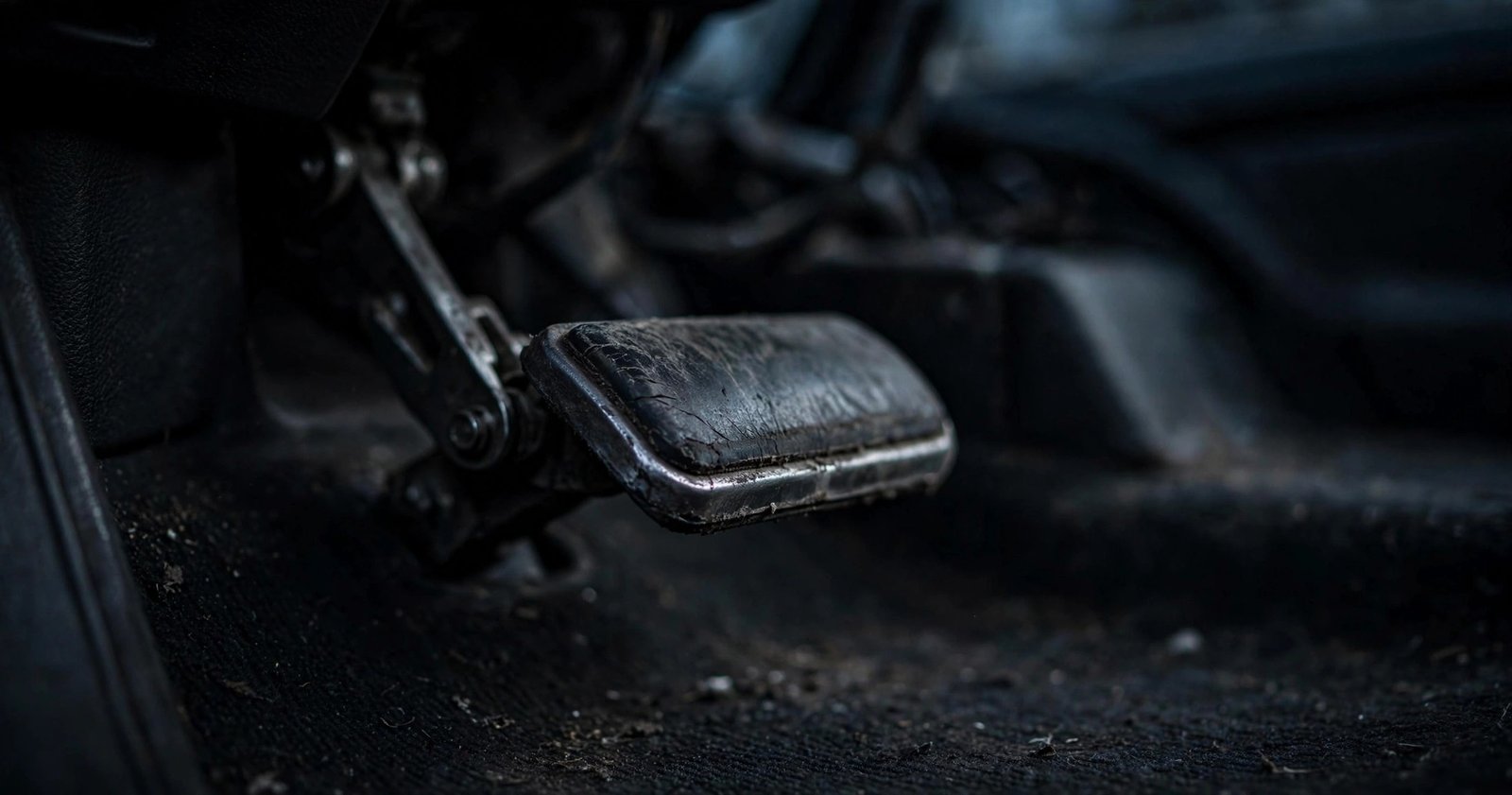
When your brake pedal feels spongy or goes to the floor, something in the hydraulic system is no longer building pressure the way it should. A firm pedal is the sign of a healthy brake system; a soft, mushy, or sinking pedal is the sign of a compromised one. Do not drive with this symptom. This guide is strictly for diagnosing what the pedal is telling you — every repair below is described as what a certified mechanic will do, not as instructions for you to follow.
In this guide, you’ll learn:
- The symptom-keyed decision tree — match what your pedal does to the likely cause
- The six causes, in order of likelihood, with mechanic-only framing
- Safe, observation-only checks you can do in the driveway
- The exact warning signs that mean “stop and get a tow right now”
- Typical shop cost ranges for each repair (verified 2026-10-14)
⚠️ SAFETY — READ FIRST: A spongy or sinking brake pedal can mean fluid loss or hydraulic failure. Do not drive the car. If you are on the road when this starts, slow down gently, use engine braking, get to a safe stop, set the parking brake, and call a tow truck. Nothing in this article is a repair procedure — there are no bleeding walkthroughs, no replacement steps, and no encouragement to keep driving. Diagnosis only.
Decision Tree: What Your Pedal Is Telling You
A healthy pedal feels firm throughout its travel — the harder you push, the firmer it gets (HowStuffWorks). A spongy or sinking pedal means hydraulic pressure is escaping somewhere. Match your exact symptom to narrow the cause, then scroll to the matching section:
Pedal sinks slowly under steady pressure (keep holding it, engine off)
→ Most likely: master cylinder internal seal bypass — see §3. This is the classic signature: no visible leak, pedal keeps creeping down.
Pedal feels mushy/soft from the top, but pumping it restores firmness temporarily
→ Most likely: air trapped in the brake lines — see §2.
Brake warning light is on, OR the reservoir looks low, OR you see clear/yellowish oily spots under the car
→ Most likely: brake fluid leak or low fluid — see §1. Do not drive. Tow it.
Spongy pedal started right after brake work (pads, fluid, lines)
→ Most likely: air introduced during the service — see §2. Return to the shop that did the work.
Pedal sits lower than usual but still feels firm and consistent
→ Most likely: worn brake pads — see §5. Book an inspection promptly.
Pedal drops slightly (about ½–1 inch) with the engine running, then stops and holds firm
→ Most likely: normal vacuum-booster behavior, not a fault (7zap). No action needed — but if it keeps sinking past that point, treat it as §3.
The Most Likely Causes, in Order
1. Brake fluid leak / low fluid (most urgent — treat as a no-drive fault)
Fluid loss is one of the most common reasons a pedal goes soft or sinks to the floor (HowStuffWorks). Because the system is hydraulic, any leak — a corroded metal line, a cracked rubber hose, a weeping caliper or wheel-cylinder seal — drops pressure exactly where it shouldn’t. Clues: fluid level at or below the MIN mark in the translucent reservoir, clear-to-amber oily spots under the car (often near a wheel or under the firewall), a red brake warning light on the dash, or a pedal that needs pumping to build any pressure. FMVSS No. 105 requires the brake warning lamp to alert you to pressure loss or low fluid (NHTSA) — if that light is on, believe it.
What a certified mechanic will do: pressure-test the system, trace the wet component, replace the failed line/hose/caliper/seal, refill with the manufacturer-specified fluid, and bleed the system to remove introduced air. You don’t need to (and shouldn’t) touch any of it.
2. Air in the brake lines
Air compresses; brake fluid doesn’t. Even a small pocket of trapped air makes the pedal feel mushy from the top, and pumping temporarily restores firmness by forcing the air to one side — which is why the firmness always fades again. The usual suspects: a leak that let air in, fluid that ran too low, or a recent service where the system wasn’t bled properly (HowStuffWorks, teelesqauto).
What a certified mechanic will do: find and fix the source of the air entry (often a leak), then bleed or flush the system with pressure equipment and verify a firm pedal on a controlled test.
3. Failing master cylinder (internal seal bypass)
The master cylinder is the hydraulic heart of the system: its pistons push fluid to all four wheels. When its internal rubber cup seals wear or the bore corrodes, fluid slips past the seals under pressure — no fluid ever leaves the system, so there’s nothing to see under the car. The telltale: with the engine off, press the pedal firmly and hold steady pressure for 30 seconds. If it keeps sinking slowly toward the floor, that’s internal bypass (7zap). If it only drops slightly (¼–1 inch) with the engine running and then holds firm, that’s normal vacuum-booster settle, not a fault.
What a certified mechanic will do: confirm with hold tests and a pressure test, replace the master cylinder, and flush the system with the manufacturer-specified fluid (old, contaminated fluid is what degrades the seals in the first place).
4. Old or contaminated fluid (moisture absorption)
DOT 3 and DOT 4 brake fluids are glycol-ether-based and hygroscopic — they absorb moisture from the air over time (FMVSS No. 116). Water has a far lower boiling point than brake fluid, so as water content rises, the fluid’s boiling point drops: a fresh DOT 4 boils at 446°F dry but only 311°F when moisture-saturated — both are federal minimums, not estimates (FMVSS No. 116, per legalclarity.org’s summary of 49 CFR 571.116). Under hard braking or sustained downhill driving, moisture-laden fluid can boil inside the lines. Boiling creates vapor bubbles, and vapor compresses — that’s called vapor lock, and the pedal goes soft (legalclarity.org). Dark fluid alone isn’t a diagnosis, but fluid past its service interval is a real cause of spongy feel.
What a certified mechanic will do: test the fluid’s moisture/boiling point and flush the system with fresh manufacturer-specified fluid if it’s out of spec.
5. Worn brake pads (pedal low but firm)
This one feels different from the rest: the pedal doesn’t go mushy, it just sits lower than you remember, and it still feels consistent. As pads wear thin, the caliper pistons extend further and the reservoir level drops to fill the extra volume. If you see low fluid but no leaks and no warning light, worn pads are a strong suspect. (This is different from the sink-test signature in §3: worn pads don’t cause a pedal to keep sinking while you hold it.)
What a certified mechanic will do: measure pad thickness against the manufacturer’s minimum, check rotor condition, and replace pads (and rotors if damaged) on both sides of the same axle.
6. ABS hydraulic modulator issue (rare — mechanic-only)
In rare cases, an internal leak past a solenoid valve or seal inside the ABS hydraulic control unit can let pressure bleed off even with no visible leak — mimicking the master-cylinder slow sink (7zap). Standard driveway tests can’t distinguish this from master-cylinder bypass; it needs scan-tool diagnosis.
What a certified mechanic will do: cycle the ABS valves with a scan tool to isolate the internal bypass, then replace or rebuild the hydraulic control module.
Safe Observation-Only Checks (Parked, Engine Off)
These are observations for your mechanic — not fixes. Do them parked, engine off, parking brake set:
- Reservoir look-through: Find the brake fluid reservoir under the hood (translucent plastic, usually on the driver’s side firewall) and note the level against the MIN/MAX marks. Don’t add fluid — a low level is a symptom your mechanic needs to investigate.
- Ground scan: Walk around the car and look for clear-to-amber oily spots on the driveway or inside the wheels. Brake fluid is slippery and can damage paint — note the location, don’t touch it.
- The pump observation: Press the pedal a few times and notice whether firmness returns temporarily. If it does, that points to air in the lines (§2) — tell your mechanic.
- The hold observation: Press the pedal firmly and hold steady pressure for 30 seconds. Notice whether it keeps creeping toward the floor (internal bypass, §3) or holds. Again: observation only, for your mechanic.
- Timeline check: When did it start? Right after brake work → air introduced during service. Gradually over weeks → wear-related (pads, aging fluid, degrading seals).
When to See a Mechanic — Early, Strong, and Often
- Pedal goes to the floor or stopping distance suddenly increases → stop safely and call a tow immediately. This is the strictest trigger on this page.
- Red brake warning light on the dash → no-drive fault. Tow it.
- Any fluid leak sign (low reservoir, spots under the car) → tow it, don’t “top up and see.”
- Pedal sinks under steady pressure (the hold observation) → have it inspected before driving again.
- Spongy feel that started after brake work → return to the shop that did the work; don’t drive on it in the meantime.
- Pedal just feels “a bit off” → a gradually softening pedal is how §3 and §4 failures begin. Book an inspection now, not after the next paycheck.
Typical Shop Cost Ranges
(Verified 2026-10-14; framed as what a shop charges — ranges vary by vehicle, region, and shop labor rates.)
- Brake fluid flush / bleed at a shop: roughly $70–$150 at independent shops and chains; $150–$250 at dealers (Rick’s Free Auto Repair Advice, updated 2026-04-09). Mostly labor — the fluid itself is under $20.
- Master cylinder replacement (parts + labor + bleed): roughly $300–$800 (J.D. Power); AutoNation’s 2026 leak-repair breakdown puts it at $440–$560 for a typical vehicle.
- Brake fluid leak repair: $70–$600+ depending on the source (AutoNation Mobile Service, updated 2026-09-30): hose $70–$290, line $105–$440 per line, caliper $200–$570, wheel cylinder $210–$300.
- Brake pad replacement: roughly $150–$400 per axle, parts and labor (House of American Cars, May 2026; AAA guidance $100–$300 per axle; KBB ~$150 per axle).
- ABS modulator repair: no verified 2026 range — get a written estimate after scan-tool diagnosis.
FAQ
Is it safe to drive with a spongy brake pedal?
No. A spongy pedal means your braking system isn’t working at full strength and can degrade further without warning (teelesqauto). If it starts on the road, stop safely, set the parking brake, and call a tow.
Can I just top up the brake fluid and keep driving?
No — don’t. A low reservoir is a symptom, not the disease: either there’s a leak or the pads are worn. Topping up masks the warning without fixing the fault.
Why does pumping the pedal help if the problem is still there?
Pumping temporarily compresses trapped air or builds pressure past a failing seal, which restores some firmness for a moment (fordfast). It doesn’t fix anything, and the firmness always fades again.
My pedal only sinks a little at stoplights, then holds firm — is that bad?
If it drops about ½–1 inch with the engine running and then stops and feels firm, that’s normal vacuum-booster settle — not a fault (7zap). If it keeps sinking past that point, get it inspected.
Could it just be old brake fluid?
Possibly. Moisture-saturated fluid has a much lower boiling point and can cause vapor lock — a soft pedal under hard braking (FMVSS No. 116). A mechanic can test the fluid’s condition and flush it if it’s out of spec.
Sources
- HowStuffWorks — “How should your brakes feel under foot?” (pedal-feel diagnostics: firm pedal = healthy; breach/air in lines = spongy; check fluid; look under vehicle for leaks; master cylinder malfunction as cause of soft pedal) — https://auto.howstuffworks.com/auto-parts/brakes/brake-tests/how-should-your-brakes-feel-under-foot.htm
- Teele Square Auto — “What does it mean if my brake pedal feels soft or spongy?” (ASE shop: low/leaking fluid, air, worn master cylinder, deteriorated hoses, contaminated fluid; avoid driving, tow if pedal sinks to the floor) — https://www.teelesqauto.com/what-does-it-mean-if-my-brake-pedal-feels-soft-or-spongy
- 7zap — “Brake Pedal Sinks Slightly at a Stoplight: Master Cylinder Bypass or Booster Behavior—How to Tell” (2026-05-06; engine-off/on hold test, pump-and-hold test, booster-settle vs. bypass distinction, ABS modulator as rare mimic) — https://7zap.com/en/articles/brakes/brake-pedal-sinks-slightly-at-a-stoplight-master-cylinder-bypass-or-booster-behaviorhow-to-tell/
- LegalClarity — “FMVSS No. 116 DOT 3 Brake Fluid Requirements” (summary of 49 CFR 571.116: hygroscopic glycol-ether fluid; DOT 4 dry 230°C/446°F, wet 155°C/311°F minimums; moisture lowers boiling point → vapor lock → soft pedal) — https://legalclarity.org/fmvss-no-116-dot-3-brake-fluid-safety-regulations/
- NHTSA — Interpretation re: FMVSS No. 105 (brake system indicator lamps for loss of pressure/low fluid) — https://www.nhtsa.gov/node/83811
- AutoNation Mobile Service — “How Much Does Brake Fluid Leak Repair Cost & Is it Urgent?” (updated 2026-09-30; leak repair $70–$600+: hose $70–$290, line $105–$440, caliper $200–$570, wheel cylinder $210–$300, master cylinder $440–$560) — https://www.autonationmobileservice.com/i/blog/brake-fluid-leak-cost
- J.D. Power — “How Much Does It Cost To Replace A Brake Master Cylinder?” ($300–$800, mostly labor) — https://www.jdpower.com/cars/shopping-guides/how-much-does-it-cost-to-replace-a-brake-master-cylinder
- House of American Cars — “How Much Is Brake Pad Replacement?” (updated 2026-05-20; $150–$400 per axle, AAA $100–$300, KBB ~$150 per axle) — https://www.houseofamericancars.com/how-much-is-brake-pad-replacement/
- Rick’s Free Auto Repair Advice — “Brake Fluid Flush Cost: What You Should Expect to Pay” (updated 2026-04-09; $150–$250 typical, 2026 independent-shop labor ~$140/hr; fluid under $20) — https://ricksfreeautorepairadvice.com/brake-fluid-flush-cost-what-you-should-expect-to-pay/