
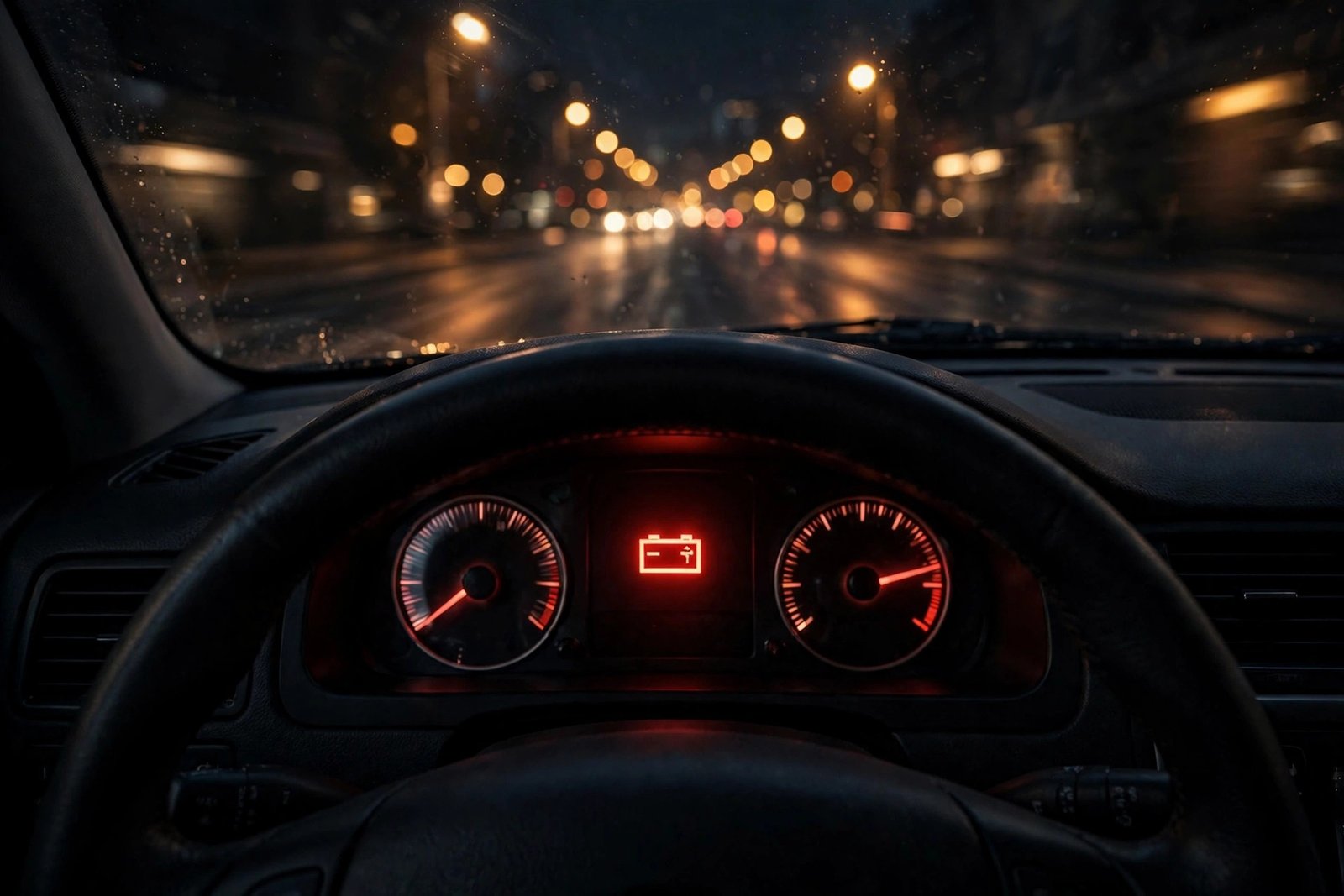
That little battery icon glowing on your dash is not telling you the battery is dead — it’s telling you the charging system has stopped working. Your car is now running on battery power alone, and that battery is draining. This guide is your roadside plan: what to do in the next few minutes, how long you can keep driving, and how to tell whether the alternator, belt, or battery is the culprit.
In this guide, you’ll learn:
- What the battery light actually means (and the #1 misconception)
- Your immediate action plan — what to shut off, where to head
- How long you can keep driving before the car stalls
- The most likely causes, in order of likelihood
- Checks you can do safely once parked
- Typical repair cost ranges (verified 2026-10-14)
Safety first: This is a get-to-safety situation, not a roadside repair. Never open the hood or touch the belt with the engine running. If you smell burning rubber or the engine starts overheating, pull over immediately — a broken belt can also drive the water pump and power steering.
The Misconception: It’s Not (Usually) the Battery
The battery light monitors the charging system — alternator, belt, wiring, voltage regulator — not the battery itself. When it comes on while driving, it means the alternator is no longer charging the battery properly. Your car keeps running, but only on whatever charge is left in the battery. Once that drains, the engine stalls — potentially in traffic, at night, or in bad weather.
Normal: The light comes on briefly when you start the car, then goes off. That’s the self-check.
Not normal: The light comes on and stays on while driving, or flickers. You are on borrowed time.
Your Immediate Action Plan (Do This Now)
- Turn off everything electrical you don’t need: AC, heated seats, infotainment screen, phone chargers, rear defroster. Every amp you save buys you minutes.
- Head somewhere safe immediately: A parking lot, a gas station, the nearest exit — not your original destination 40 minutes away. You typically have about 30–60 minutes of driving before the battery runs out (Jalopnik; varies with battery condition and load).
- Watch for escalation: Dimming headlights, flickering dash, power steering getting heavy, or other warning lights joining in means the battery is nearly done — pull over now.
- Once parked, turn the engine off and do the checks below. Do not restart it repeatedly — each start burns precious remaining charge.
Read the Pattern: Steady vs. Flickering vs. Plus Symptoms
Steady light, everything else normal — Classic alternator failure. The car will run until the battery drains.
Light flickers, changes with engine speed or bumps — Intermittent charging: loose belt, weak alternator, or a poor connection.
Light + burning rubber smell or squealing — Belt problem (broken, slipping, or shredded). Stop immediately — the same belt often drives the water pump and power steering.
Light + dimming headlights and dying accessories — Battery draining fast; you’re in the last stretch. Get off the road now.
Light came on right after hitting a deep puddle — Water may have soaked the belt or alternator. If the light clears after drying, still get the charging system tested soon.
The Most Likely Causes, in Order
1. Failing alternator (most common)
Alternators wear out — diodes, brushes, and bearings all fail with age, heat, and water damage. When output drops, the battery light comes on and the battery starts draining. Typical alternator lifespan is 7–10 years, but heat and heavy electrical loads shorten it.
2. Broken, loose, or slipping serpentine belt
The belt spins the alternator. If it snaps, slips, or shreds, charging stops instantly — often with a squeal or burning-rubber smell first. Check your maintenance records: most belts are due around 60,000–100,000 miles.
3. Corroded or loose battery terminals
Heavy corrosion or a loose clamp adds resistance that can confuse the charging circuit and trigger the light even with a healthy alternator. A quick visual check costs nothing; see corroded battery terminals.
4. Failing battery
Less common as the cause of the light, but a dying battery can’t hold the charge the alternator gives it. If the battery is 4+ years old, it’s part of the story.
5. Wiring, grounds, or voltage regulator
Damaged charging-system wiring, a rusty ground, or a failed voltage regulator (usually built into the alternator) can all trigger the light. These need professional diagnosis.
Checks You Can Do Once Parked Safely
- Belt inspection (engine OFF, cool): Look at the serpentine belt — is it still there, intact, and tight? Missing or shredded = tow truck, not a restart.
- Terminal check: Heavy white/green corrosion or a loose clamp? Clean and tighten.
- Voltage test (multimeter owners): With the engine running, a healthy charging system reads roughly 13.5–14.5 volts at the battery terminals. Below ~13V with the engine running = the alternator isn’t charging.
- Restart test: If the belt is intact and terminals are clean, restart once and watch the light. Still on = drive straight to a shop (short distance only) or call for a tow.
When to Stop Immediately and Call a Tow
- Burning rubber smell or visible belt damage — don’t restart.
- Engine temperature climbing — a broken belt may have stopped the water pump too.
- Multiple warning lights, heavy steering, or the engine stumbling — the battery is nearly dead.
- It’s nighttime or you’re in an unsafe spot — don’t gamble the remaining charge on a long drive.
Typical Cost Ranges
(Observed 2026-10-14; ranges vary widely by vehicle, region, and shop labor rates.)
- Alternator replacement: roughly $400–$800 professionally; $200–$500 DIY (themotorguy.com, 2026)
- Serpentine belt replacement: roughly $80–$150 professionally; $15–$40 DIY (themotorguy.com, 2026)
- Battery replacement: roughly $100–$250 (CostWhale 2026: national average ~$175, range $75–$300)
- Terminal cleaning: free (DIY)
- The point of acting fast: a $400 alternator job is cheap compared to a tow plus a dead battery plus a ruined evening.
FAQ
How long can I drive with the battery light on?
Roughly 30–60 minutes depending on battery condition and electrical load — but treat it as “get somewhere safe now,” not a countdown you can rely on.
Does the battery light mean I need a new battery?
Usually not by itself. It means the charging system isn’t charging. Replacing the battery without fixing the alternator or belt just kills the new battery too.
Can I just keep jump-starting it?
No — a jump start doesn’t fix a charging failure. The car will die again as soon as the borrowed charge runs out, possibly somewhere worse.
Why did the light come on right after a car wash or heavy rain?
Water on the belt can cause temporary slipping. If the light clears once things dry, still get the charging system tested — wet belts slip again.