
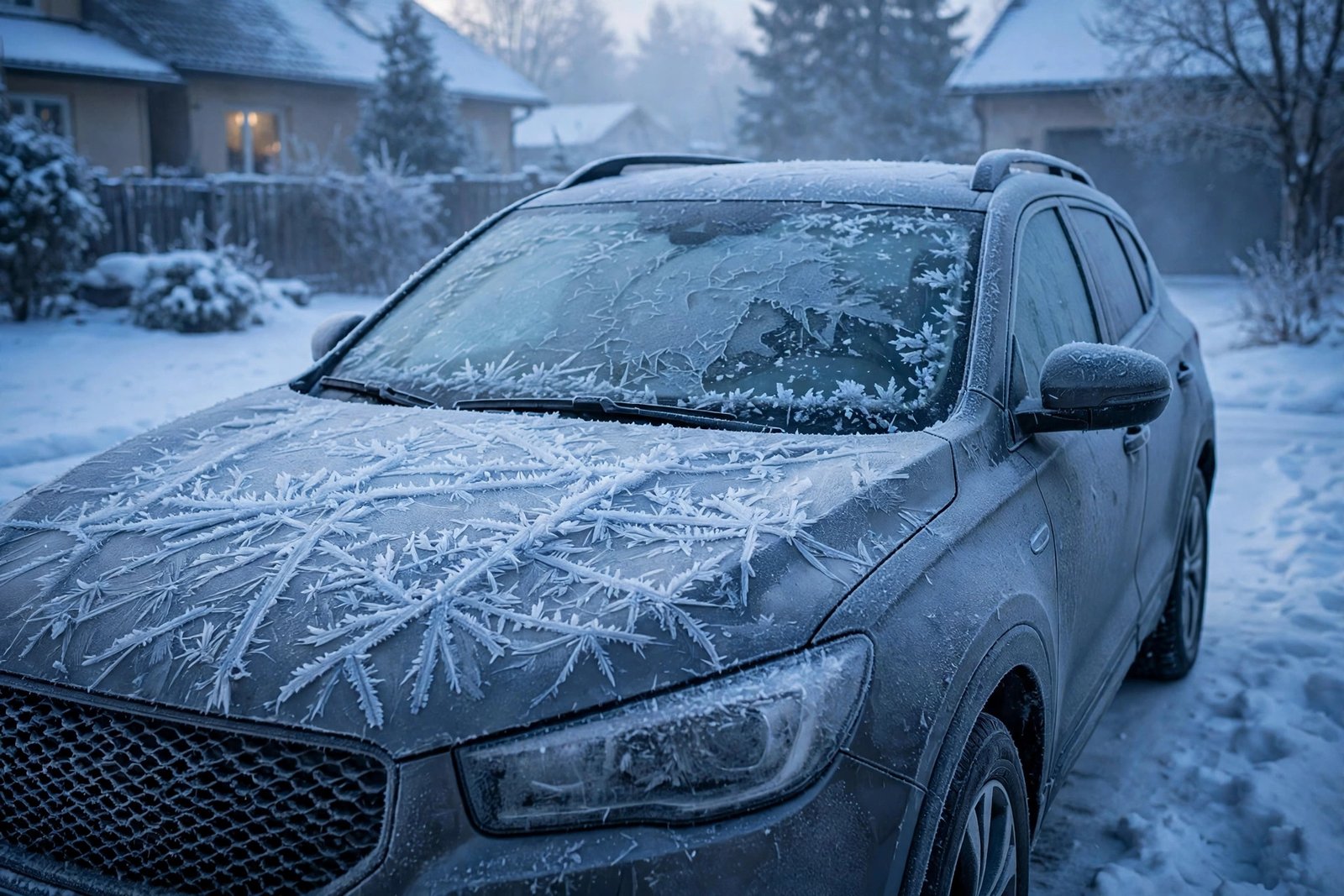
Cold is the battery’s worst enemy. It slows the chemical reaction inside the battery, thickens the engine oil the starter has to push through, and exposes every weak connection in the starting circuit. A battery that tested fine in October can give up entirely on a 15°F morning. This guide diagnoses your cold no-start by what the car actually does when you turn the key.
In this guide, you’ll learn:
- What each cold-start symptom points to (silence, clicks, slow crank, crank-no-fire)
- Why cold kills batteries — and the voltage numbers that matter
- Safe cold-start checks you can do yourself
- How to get it started right now
- How to prevent this next winter
- Typical repair cost ranges (verified 2026-10-14)
Safety first: Never crank for more than ~10 seconds at a time — let the starter cool a minute between tries, or you’ll burn it out on top of the battery problem. If you smell burning plastic or see smoke, stop and call for a tow.
Diagnose It by What You Hear
Silence — nothing happens at all — The battery is fully dead or a main connection has failed. Cold finished off a battery that was already marginal. See no sound, no lights.
Rapid clicking — The battery has some charge but not enough cranking amps for cold conditions. Check terminals first, then jump-start or charge. See clicking but won’t start.
Slow, labored cranking (ruh-ruh-ruh) — Weak battery plus thick cold oil. The starter is getting power but struggling. Jump-start or charge; then test the battery — it’s telling you it’s near the end.
Cranks at normal speed but won’t fire — The battery and starter are fine; cold isn’t your problem. Suspect fuel delivery (frozen fuel line, gelled diesel), spark, or a sensor. Prime the fuel pump (key to ON, wait 3 seconds, off, repeat 3–4 times) and retry.
Starts, then dies immediately — Flooding from repeated cranking, or a temperature sensor confusing the cold-start fuel mix. See starts then dies.
Why Cold Kills Batteries
A fully charged battery reads 12.6 volts at rest. Below about 12.2 volts it’s discharged — and in freezing temperatures, a discharged battery loses cranking power fast because the chemical reaction slows down. Meanwhile, thickened engine oil makes the engine harder to turn, demanding more current from a battery delivering less. That double hit is why cars die on the coldest morning of the year, not the mild ones.
Don’t be fooled by the dash lights: they can glow with as little as ~10 volts, while the starter needs hundreds of amps. Lights on ≠ battery good.
The Most Likely Causes, in Order
1. Weak or discharged battery (the #1 cold no-start cause)
Cold exposes a battery that was already declining. Batteries typically last 3–5 years; a 4-year-old battery that “was fine yesterday” is the classic winter-morning failure. Get a proper load test — most auto parts stores do it free.
2. Corroded or loose terminals
Corrosion adds resistance, and cold makes every bit of resistance worse. White/green crusty buildup or a clamp you can wiggle by hand = clean and tighten (ignition OFF, negative off first, negative on last). See corroded battery terminals.
3. Thickened or wrong-viscosity engine oil
Old or too-thick oil turns to syrup in the cold, and the starter can’t spin the engine fast enough. Use the winter-grade oil your owner’s manual specifies (often a lower “W” number, like 5W-30). If you’re overdue for an oil change, cold weather will find out.
4. Worn spark plugs / failed glow plugs (diesel)
Gas engines with worn plugs struggle to fire a cold fuel mix. Diesels depend on glow plugs to heat the combustion chamber — wait for the coil-shaped glow-plug light to go OUT before cranking, and cycle it twice in extreme cold.
5. Fuel delivery problems in the cold
Gasoline fuel lines can ice up from condensation (keep the tank at least half full to reduce it); diesel fuel can gel in extreme cold (winter-blend fuel or anti-gel additive helps).
6. Worn starter motor
A starter that was marginal in summer may not survive winter’s extra load. Slow cranking that doesn’t improve with a known-good battery points here.
How to Get It Started Right Now
- Turn off everything: Headlights, heater fan, defroster, seat heaters — give the starter every available amp.
- Wait 30 seconds with the key in ON (not START) on very cold mornings — let the fuel pump prime and electronics wake up.
- Crank in short bursts: 10 seconds max, then rest a full minute. Long cranking just heats the starter and drains the battery further.
- Jump-start properly: Connect correctly (see the safe sequence), let the donor car run a few minutes first, then try. If it starts, drive 20–30 minutes to recharge — don’t just idle in the driveway.
- Diesel: Cycle the glow plugs twice before cranking.
Prevent It Next Winter
- Test the battery before the first freeze — free at most auto parts stores. Replace a marginal battery in fall, not January.
- Keep the tank at least half full — reduces condensation that ices fuel lines.
- Use winter-grade oil per your owner’s manual.
- Park in a garage when possible; even an unheated garage is several degrees warmer.
- A battery maintainer (trickle charger) keeps a parked car topped up through cold snaps. See winter battery maintenance.
Typical Cost Ranges
(Verified 2026-10-14; ranges vary widely by vehicle, region, and shop labor rates.)
- Battery replacement: roughly $100–$250; AGM/start-stop batteries roughly $150–$300 (CostWhale 2026: national average ~$175, range $75–$300)
- Terminal cleaning: free (DIY)
- Oil change (winter grade): varies by vehicle; a standard synthetic change is the baseline
- Glow plugs (diesel): professional replacement varies widely — get a quote before authorizing
- The point of fall maintenance: a free battery test in October beats a tow truck in January.
FAQ
How cold is too cold for a car battery?
There’s no single number — a healthy, fully charged battery starts fine well below 0°F. A weak or half-discharged one can fail at 30°F. Age and charge level matter more than the thermometer.
Should I let the car idle to warm up?
Modern cars need only ~30 seconds of idle, then gentle driving warms everything faster and more evenly. Long idling wastes fuel and doesn’t charge a weak battery well — driving does.
Can cold permanently ruin a battery?
A fully discharged battery can freeze, and a frozen battery is usually destroyed (and can crack its case). Keep it charged and this doesn’t happen.
My car started fine yesterday at the same temperature. What changed?
Batteries fail on a curve, not a cliff — yesterday was its last good day. Cold just picks the morning.