
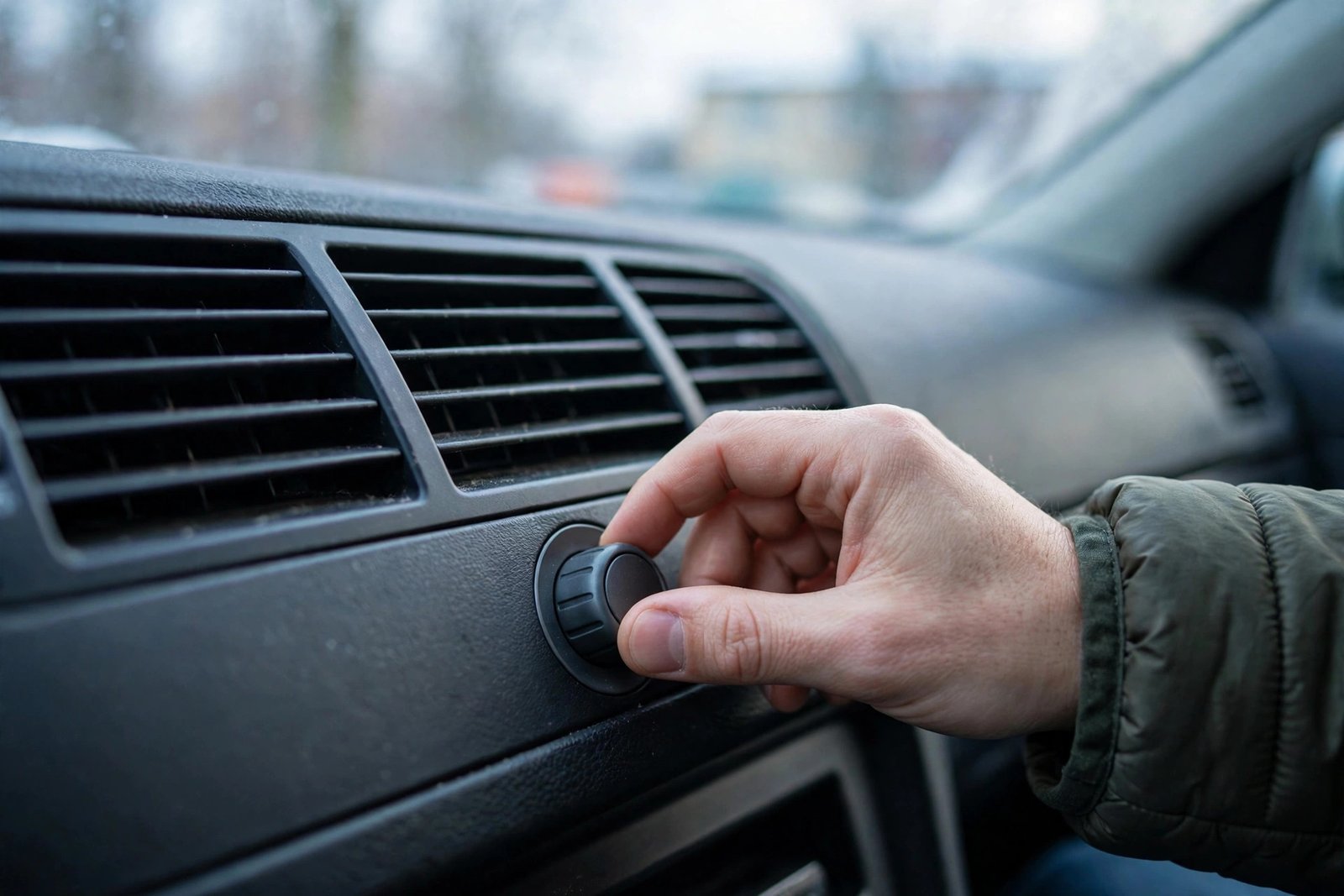
Your heater is on full blast but the vents are pushing cold air — even after driving for a while. Before assuming an expensive repair, understand this: your car’s heater is just a heat exchanger. Hot engine coolant flows through a small radiator under your dash (the heater core), and the blower fan pushes cabin air across it. Anything that reduces hot coolant flow, engine temperature, or airflow into the cabin produces the same symptom — cold air. This guide ranks the causes by likelihood and tells you what you can check safely.
In this guide, you’ll learn:
- The most common causes, in order of likelihood
- How to tell a coolant problem from an airflow problem in 60 seconds
- Safe checks you can do in the driveway
- When to stop and call a mechanic
Safety first: Check coolant only when the engine is completely cold — never open a hot radiator or pressurized reservoir cap. If the temperature gauge is climbing into the red, pull over and shut off the engine; low coolant affects the engine long before it affects your comfort.
First, Answer This: Is It Cold Air, or No Heat at Idle Only?
| Pattern | Points to |
|---|---|
| Cold air at all speeds, engine gauge normal | Blend door / airflow routing problem |
| Cold air at idle, warm when driving | Low coolant or weak circulation (no heat at idle but heat while driving) |
| Gauge reads low or takes forever to warm up | Thermostat stuck open |
| Foggy windows + sweet smell in cabin | Leaking heater core |
This split alone eliminates half the suspects. Cold-but-strong airflow with a normal temperature gauge usually means the cabin never receives the heat that’s available. Cold air with a low-reading gauge means the heat was never made in the first place.
The Most Likely Causes, in Order
1. Low coolant level (most common)
The heater core often sits high in the cooling system. When coolant runs low, it’s the first thing to lose flow — the engine gauge may still read normal while the heater blows cold. Top up only with the correct coolant for your vehicle (check the owner’s manual — colors aren’t standardized). Low coolant is a symptom, not a fix: the level drops because something leaks or evaporates it. If it drops again, the leak needs finding.
2. Thermostat stuck open
The thermostat should stay closed until the engine reaches operating temperature (roughly 195–220°F / 90–105°C on most vehicles). Stuck open, coolant circulates through the radiator from a cold start and the engine never fully warms up. Clues: gauge parks below normal, warm-up takes much longer than usual, heat improves slightly after long drives.
3. Air trapped in the cooling system
Air pockets after a coolant change or repair can block flow to the heater core. Symptoms: heat that comes and goes, gurgling behind the dash, or heat that improves after parking on an incline. Bleeding the system properly (per the service manual) restores circulation.
4. Clogged heater core
Years of corrosion and sediment can restrict the core’s narrow passages. The classic test: with the engine at operating temperature and heat on max, feel both heater hoses at the firewall. Both should be hot. A hot inlet and cool outlet means the core is restricted — flushing sometimes helps; replacement is a labor-intensive job because the dash usually comes out.
5. Blend door or actuator failure
If coolant flow is fine, the problem may be air routing: a blend door that can’t swing to the “heat” position, or a failed actuator. Clues: clicking or tapping from behind the dash when you change temperature, temperature controls that make no difference, or one side hot and the other cold (dual-zone systems). Gauge reads normal.
6. Blower motor issues
If there’s little or no airflow at all, the problem isn’t heat — it’s the blower motor, resistor, or fuse. See AC blower fan not working for the no-airflow diagnosis, and heater only works on high if only the highest speed works.
Safe Checks You Can Do Yourself
- Coolant level (engine cold only): Check the reservoir between MIN and MAX. Below MIN = top up and start looking for a leak.
- Watch the gauge: Takes much longer than usual to reach normal, or never gets there? Suspect a stuck-open thermostat.
- Heater hose test: Both heater hoses hot = coolant flow is fine, look at the blend door. One hot, one cold = restricted heater core.
- Listen at the dash: Clicking when you change temperature = blend-door actuator.
- Smell and fog test: Sweet smell in the cabin + greasy film on the windshield = leaking heater core — get it to a shop.
When to See a Mechanic
- Sweet smell in the cabin or coolant fog on the windshield (heater core leak)
- Coolant level keeps dropping (pressure test needed to find the leak)
- Temperature gauge runs low and never reaches normal (thermostat replacement)
- Heat only works on one side or the clicking behind the dash persists (blend door)
FAQ
Is it safe to drive with the heater blowing cold?
For your comfort, it’s an inconvenience. For the car, it depends: if the cause is low coolant, you’re risking engine overheating — don’t drive far without checking the level. If it’s a blend door, it’s harmless.
Can I just top up the coolant and ignore it?
Once, maybe — but coolant doesn’t vanish on its own. A level that drops again means a leak that needs finding before it strands you.
Why does the heater work a little at idle but get cold on the highway?
That’s usually a stuck-open thermostat: at speed, extra airflow through the radiator over-cools the coolant. See car takes a long time to warm up.
How much does a heater core replacement cost?
It’s labor-intensive (dash removal on many cars) — get a written quote from a shop rather than relying on general figures. Simple fixes like coolant or a thermostat are far cheaper.
Sources
- Fifth Gear Automotive — “Why Is My Car Heater Blowing Cold Air?” (low coolant, heater core, thermostat, water leak causes; FAQ on heater core signs) — https://fifthgear.biz/fifthgear-blog/my-heater-is-blowing-cold/
- Andrew’s Car Centre — “Why Is My Car Heater Blowing Cold Air? What to Check Next” (low coolant, stuck-open thermostat, restricted flow, actuator; UK angle) — https://www.andrewscarcentre.com/news/why-is-my-car-heater-blowing-cold-air-what-to-check-next/170045
- AutoZone — “Car Heater Blowing Cold Air” (heater core hose test, blend-door actuator reset, when to seek professional help) — https://www.autozone.com/diy/climate-control/car-heater-blowing-cold-air
- Nationwide — “Why Is My Car Heater Blowing Cold Air?” (low coolant, thermostat diagnosis; thermostat ~$8 part) — http://blog.nationwide.com/vehicle/vehicle-maintenance/car-heater-blowing-cold-air/
- WhoCanFixMyCar — “Why Is My Car Heater Blowing Cold Air?” (low coolant, air pockets, blocked core, faulty thermostat, cabin filter, controls) — https://www.whocanfixmycar.com/advice/why-is-my-car-heater-blowing-cold-air