
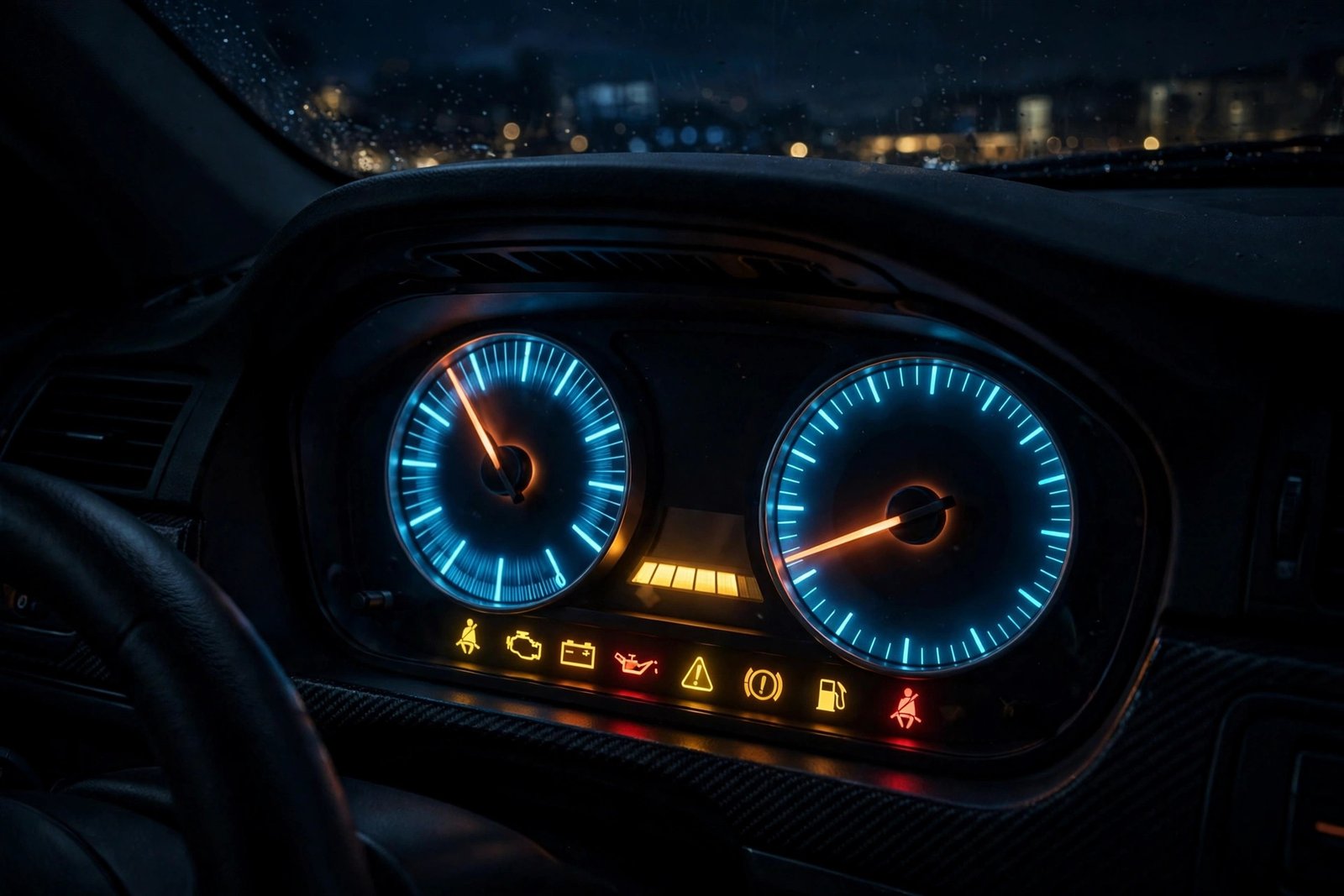
You turn the key, the dash lights flicker, flash, or dim — and the engine may or may not catch. That flicker is not random: it’s a direct visual readout of what’s happening to your car’s voltage at the exact moment the starter demands hundreds of amps. This guide is about flicker when you crank — if your lights flicker while driving, that’s a different problem (see battery light while driving).
In this guide, you’ll learn:
- Why dash lights flicker at the moment of cranking (the voltage-collapse mechanism)
- What each flicker pattern tells you
- The most likely causes, in order of likelihood
- Simple checks that confirm the culprit
- When to stop and call a mechanic
- Typical repair cost ranges (verified 2026-10-14)
Safety first: Ignition OFF for all terminal inspections. Limit cranking to ~10 seconds per attempt with a minute of rest between tries. If you smell burning plastic or see smoke, stop and call for a tow.
Why the Flicker Happens
When you turn the key to START, the starter motor tries to pull hundreds of amps from the battery. If the battery is weak or a connection is poor, system voltage plummets for that instant — below what the dashboard, computers, and lights need to operate. They flash, dim, or cut out, then recover when you release the key. The flicker is the voltage collapse made visible.
A healthy system barely dips. The deeper the flicker, the bigger the problem on the battery/connection side.
Read the Pattern
Flicker + rapid clicking, engine doesn’t turn — The classic weak-battery/poor-connection combo. Voltage collapses, the starter solenoid chatters, the dash strobes. Suspect: battery or terminals first.
Flicker, then the engine cranks and starts normally — The battery is marginal but still getting the job done — for now. This is an early warning. Test the battery this week, not next month.
Flicker + one solid click, then nothing — A connection is collapsing under load, or the starter is drawing excessive current. See single click, no start.
Dash doesn’t flicker — it just goes completely dark and stays dark — That’s not flicker; that’s a total circuit break. See no sound, no lights.
Flicker continues after the engine is running — The problem isn’t the starting moment anymore; the charging system is unstable. See battery light while driving.
The Most Likely Causes, in Order
1. Weak or discharged battery (most common)
The #1 cause of crank-time flicker. The battery can’t sustain voltage under the starter’s load. Batteries typically last 3–5 years — and a battery that “was fine last week” is the usual story. A proper load test (free at most auto parts stores) is the definitive check; resting voltage alone can mislead.
2. Corroded or loose battery terminals
White/green crusty buildup or a clamp you can wiggle by hand acts like a bottleneck exactly when maximum current needs to flow. Ignition OFF: disconnect negative first, clean posts and clamps with a wire brush, reconnect snugly (negative last). See corroded battery terminals.
3. Bad ground connection
The negative cable’s bolt to the chassis or engine block is the return path for all that current. Rust, looseness, or fraying here produces flicker plus a grab-bag of electrical quirks. The contact point should be tight, clean, metal-to-metal.
4. Starter drawing excessive current
A worn starter can pull abnormal current, dragging voltage down even with a decent battery. Clue: flicker that persists after the battery and connections test good — or flicker that gets worse as the engine gets hot.
5. Failing alternator (when flicker continues while running)
If the flicker doesn’t stop once the engine catches, the alternator may be delivering unstable voltage. Check for the battery warning light and test charging voltage (13.5–14.5V running is healthy).
6. Worn ignition switch
Flicker plus accessories cutting in and out as you turn the key — rather than only at the crank moment — points to the switch losing contact internally.
Quick Checks You Can Do Yourself
- Battery voltage: Multimeter on the terminals, engine off. ~12.6V is healthy; under ~12.2V is discharged. (Remember: voltage at rest doesn’t prove cranking strength — follow up with a load test.)
- Terminal inspection: Ignition OFF. Crust, looseness, or a clamp that moves by hand = clean and tighten.
- Headlight test: Headlights on, crank, watch them. Heavy dimming in sync with the dash flicker confirms a battery/connection problem rather than the starter.
- Ground check: Follow the negative cable to its chassis/engine bolt. Rust or looseness = clean and tighten.
- Load test: Free at most auto parts stores — the only test that measures what the battery does under real cranking load.
When to Stop and Call a Mechanic
- The battery tests good but the flicker persists — the starter or wiring needs professional testing.
- Flicker continues while the engine runs, especially with the battery light on — charging-system diagnosis.
- Burning smell, smoke, or hot wiring — stop immediately, tow it.
- The flicker is getting worse week by week — don’t wait for the morning it becomes a no-start.
Typical Cost Ranges
(Verified 2026-10-14; ranges vary widely by vehicle, region, and shop labor rates.)
- Terminal cleaning: free (DIY)
- Battery replacement: roughly $100–$250; AGM/start-stop batteries roughly $150–$300 (CostWhale 2026: national average ~$175, range $75–$300)
- Starter replacement: roughly $300–$900+ (Car Talk best estimate: $600–$900 common, $900–$1,400 luxury)
- The point of reading the pattern: flicker-with-clicking is almost always the cheap side (battery/connections) — confirm before spending starter money.
FAQ
Is a flickering dash dangerous?
The flicker itself isn’t dangerous — it’s a symptom. But it means your starting system is marginal, and marginal becomes stranded, usually at the worst moment.
Why does my radio reset when the dash flickers?
The voltage dip is deep enough to cut power to the radio’s memory — same reason the dash flashes. It’s another sign of how far the voltage is collapsing.
Can flickering damage the car’s electronics?
Repeated deep voltage dips aren’t good for sensitive modules. It’s one more reason to fix the underlying battery/connection problem rather than living with it.
The flicker started after I replaced the battery. What gives?
Check the installation first: loose terminals are the #1 post-swap issue. See new battery but won’t start.