Electronic Stability Programme: How It Keeps You Safe
Updated Nov 21, 2026

In This Guide
- The Quick Answer: ESP Keeps Your Car Pointed Where You Steer It
- What Electronic Stability Programme Is
- ESP vs ESC vs VSC: One System, Many Names
- How Electronic Stability Programme Works
- ESP, ABS, and Traction Control: How They Work Together
- When ESP Steps In
- What the ESP Light Means
- Can You Turn ESP Off?
- Is ESP Required by Law, and How Many Lives Does It Save?
- What ESP Cannot Do
- ESP Problems and What to Do
- Frequently Asked Questions
The Quick Answer: ESP Keeps Your Car Pointed Where You Steer It
Electronic Stability Programme, shortened to ESP, is the system that stops your car from sliding sideways when a turn, a sudden swerve, or a slick patch of road starts to push it off course. It watches where you are steering and compares that with where the car is actually going, many times per second. The moment the two stop matching, it brakes one wheel on its own and can cut engine power until the car is back on your intended path.
You have probably felt it work without knowing what it was. You turn sharply to miss something, or you hit a wet patch mid-corner, and for a split second the car seems to correct itself. A light with a skidding car symbol may blink on the dash. That blink is ESP doing its job. It is not a driving aid you switch on. It runs in the background on every trip, and it only steps in when the car starts to lose grip.
ESP and ESC mean the same thing. ESP is the name Bosch gave the system when it developed it with Mercedes-Benz, and ESC, short for Electronic Stability Control, is the generic industry term. Carmakers use their own labels too, which is why the same feature shows up as VSC on a Toyota, DSC on a BMW, and StabiliTrak on a Chevrolet. Under every name, the job is identical.
In this guide, you’ll learn:
- What Electronic Stability Programme is, in plain terms
- Why ESP, ESC, VSC, and DSC are the same system under different names
- How ESP senses a skid and corrects it
- How ESP works with ABS and traction control
- The situations where ESP steps in
- What the ESP light on your dash means
- When, if ever, you should turn ESP off
- Whether ESP is required by law, and how many lives it saves
- What ESP cannot do, and what to do when it faults
What Electronic Stability Programme Is
ESP is an active safety system. That word, active, matters. A seat belt protects you after a crash starts. ESP works to stop the crash from happening at all. It prevents the kind of loss of control that leads to a car spinning off the road or rolling over: the rear sliding out in a fast turn, the front plowing straight ahead when you steer into a corner, or the car fishtailing after a sudden lane change.
The system grew out of anti-lock brakes. In the late 1980s and early 1990s, Mercedes-Benz and Bosch worked together on a system that could do more than stop wheels from locking. They wanted a system that could steer the car by braking. The result was ESP, first fitted to the Mercedes-Benz S 600 Coupe in 1995. Toyota launched its own version, Vehicle Stability Control, the same year on the Crown Majesta in Japan. Within a decade, the technology spread from luxury cars to nearly every new car sold.
Today ESP is standard equipment, not an option. Federal Motor Vehicle Safety Standard 126 has required it on every new passenger car, SUV, pickup, and van under 10,000 pounds sold in the United States since the 2012 model year. Canada made it mandatory for 2011, and the European Union followed in 2014. If your car is a 2012 model or newer, it has ESP, whatever the badge on the dash calls it.
ESP vs ESC vs VSC: One System, Many Names
The alphabet soup around this system confuses a lot of drivers, so here is the simple version: ESP is a brand name, ESC is the generic name, and everything else is a carmaker’s label for the same core technology. Bosch trademarked ESP, short for Elektronisches Stabilitatsprogramm, which is German for Electronic Stability Programme. Because Bosch owns that name, other carmakers use their own terms. The Society of Automotive Engineers asks manufacturers to use ESC as the common term, but the brand names have stuck.
| Name on the car | What it stands for | Carmakers that use it |
|---|---|---|
| ESP | Electronic Stability Programme | Mercedes-Benz, Volkswagen, Audi, Chrysler, Dodge, Jeep, Hyundai, Kia |
| ESC | Electronic Stability Control | Honda, Hyundai, Kia, Chrysler (generic term used across the industry) |
| VSC | Vehicle Stability Control | Toyota, Lexus, Daihatsu, Suzuki |
| DSC | Dynamic Stability Control | BMW, Jaguar, Mazda, Land Rover |
| VSA | Vehicle Stability Assist | Honda, Acura |
| StabiliTrak | GM brand name | Chevrolet, GMC, Cadillac, Buick |
| AdvanceTrac | Ford brand name | Ford, Lincoln |
| PSM | Porsche Stability Management | Porsche |
| DSTC | Dynamic Stability and Traction Control | Volvo |
| VDC | Vehicle Dynamic Control | Subaru, Infiniti, Alfa Romeo |
When you shop for a used car, treat these names as equal. A Toyota with VSC and a Volkswagen with ESP have the same kind of protection. What matters is that the system is fitted and working, not which label the brochure uses.
How Electronic Stability Programme Works
ESP is a comparison machine. It constantly asks one question: is the car going where the driver is steering it? Four kinds of sensors feed it the answer.
The steering angle sensor reports exactly where you have pointed the front wheels. That is the driver’s intent. Wheel speed sensors at all four corners report how fast each wheel is turning. A yaw rate sensor measures how fast the car is rotating around its vertical axis, in other words whether the car is spinning. A lateral acceleration sensor measures how hard the car is being pushed sideways.
A control unit reads these sensors many times per second. In normal driving, the numbers agree: you steer left, the car turns left, and nothing happens. When they disagree, the car is starting to skid, and ESP acts in milliseconds, far faster than any driver could.
There are two kinds of skid, and ESP fixes each one differently.
Oversteer is when the rear of the car slides outward and the car rotates more than you steered for. This is the start of a spin. ESP brakes the outer front wheel. That single brake pulls the nose back around and stops the rotation.
Understeer is when the front tires lose grip and the car plows straight ahead even though you are turning the wheel. ESP brakes the inner rear wheel. That brake acts like a pivot point and helps pull the nose back into the corner.
In either case, ESP can also reduce engine power if braking alone is not enough. It does all of this through the same hydraulic hardware as your anti-lock brakes, which is why ESP is built on top of ABS. A car cannot have ESP without ABS, and every car with ESP also has traction control.
One thing ESP does not do is improve how your car corners. It does not add grip. It only uses the grip your tires already have, and it can only work within the limits of physics. On bald tires or sheet ice, there may not be enough grip for any system to use.
ESP, ABS, and Traction Control: How They Work Together
These three systems share sensors and brake hardware, but each one solves a different problem. Mixing them up is common, so here is how they divide the work.
ABS, the anti-lock braking system, stops your wheels from locking when you brake hard. A locked wheel slides, and a sliding wheel cannot steer. ABS pumps the brakes many times per second so the tires keep rolling and you keep steering control. If your ABS warning light stays on, the anti-lock function is off, although your regular brakes still work.
Traction control stops your wheels from spinning when you accelerate. It watches for a drive wheel turning faster than the others, which means it has lost grip, and it brakes that wheel or cuts engine power until it hooks up again. You feel it most when you pull away on snow, gravel, or a wet road.
ESP manages sideways motion. It does not care whether you are speeding up or slowing down. It cares whether the car’s actual path matches the path your steering asks for, and it steps in when the two split apart.
Think of it as a chain. ABS keeps you steering while you brake. Traction control keeps you moving while you accelerate. ESP keeps the car pointed the right way in between, through the corner itself. When the traction control light flashes on a slippery road, it is usually traction control working. When the skidding-car symbol flashes in a hard turn, that is ESP.
When ESP Steps In
ESP is quiet almost all the time. It only wakes up when the car is near the edge of its grip. These are the moments it is most likely to act.
A sharp swerve to avoid something. You yank the wheel left to miss debris, then right to get back in your lane. That fast double steering input is exactly the move that starts a spin, and ESP brakes individual wheels to keep the car stable through both turns.
A wet or icy corner. Rain, snow, or a patch of black ice cuts tire grip in the middle of a turn. The car starts to slide wide or the rear starts to step out. ESP catches the slide early, while it is still small.
A sudden lane change at highway speed. A fast lane change loads the suspension from one side to the other. On a slick road, that weight shift can start the car rotating. ESP steadies it before the driver even feels the problem.
A blowout or a strong crosswind gust. Either one can push the car off its line without warning. ESP treats the unexpected yaw the same way it treats a skid and brakes to correct it.
In each case, you may feel a brief pulsing in the brake pedal or hear a grinding sound from the ABS pump. That is normal. The flashing skidding-car symbol on the dash means the system is actively working, and the right response is to ease off the gas and steer smoothly where you want to go, then let the system finish the correction.
What the ESP Light Means
The ESP warning light shows a car with wavy skid marks behind it. On some cars it says ESP, ESC, or VSC instead. Its behavior tells you what is happening, and the difference matters.
A light that flashes briefly while you drive means ESP is working right now. It is correcting a skid. That is good news, not a fault. Ease off the gas, steer smoothly, and let it work.
A light that comes on for a few seconds at startup, then goes out, is a self-test. That is normal on every car with the system.
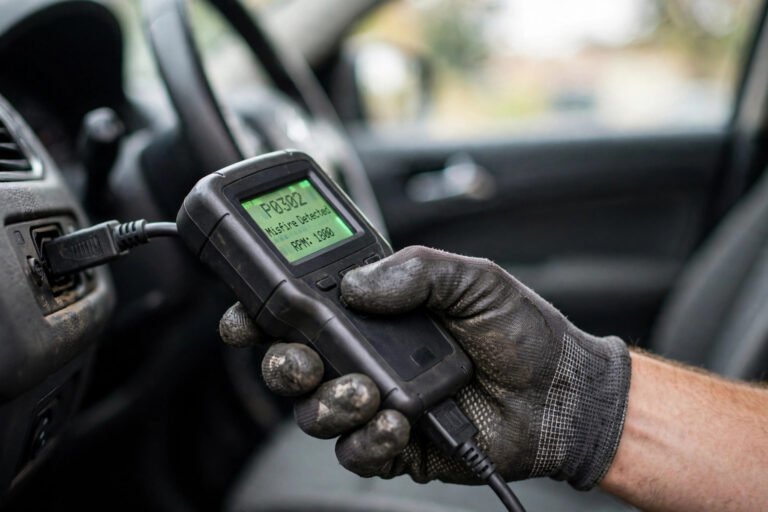
A light that stays on solid while you drive means the system is off or has a fault. You may have pressed the ESP OFF button by accident, or a sensor has failed. The most common real fault is a wheel speed sensor, which ESP shares with ABS and traction control, so those lights often come on together. A solid light means the protection is gone, so drive conservatively, especially in rain or snow, and get it diagnosed soon. This is a diagnosis job for a shop with an ABS-capable scanner, because the fault could sit in a sensor, its wiring, or the control unit, and guessing at it wastes money.
If the light comes on right after a wheel alignment or a battery change, the steering angle sensor may need recalibration. A shop can do that in minutes with a scan tool. It is not a do-it-yourself reset on most cars.
Can You Turn ESP Off?
Most cars have an ESP OFF button, usually near the shifter or on the dash, and there are a few narrow cases where switching it off helps.
Stuck in deep snow, mud, or sand. ESP cuts engine power when the wheels spin, and that is the opposite of what you need when you are trying to rock a stuck car free. Turning it off lets the wheels spin and dig for grip. Turn it back on the moment you are moving again.
Driving on a racetrack. Some drivers switch it off for track days. That is a controlled environment, not public roads.
Fitting snow chains or using a compact spare. Some owner’s manuals advise switching it off in these cases, because the mismatched wheels confuse the sensors.
For normal driving, leave it on. The system also protects you in the crash you never see coming, and on many cars it turns itself back on above a certain speed even if you switched it off. Federal rules also say a shop cannot permanently disable it. Only the owner can switch it off, and only for that drive.
Is ESP Required by Law, and How Many Lives Does It Save?
In the United States, yes. Federal Motor Vehicle Safety Standard 126, known as FMVSS 126, requires ESP on all new passenger vehicles with a gross vehicle weight rating of 10,000 pounds or less. The rule phased in over four model years: 55 percent of 2009 models, 75 percent of 2010 models, 95 percent of 2011 models, and every 2012 model and later. The phase-in was complete by September 2011, which is why every 2012 and newer car you see has the system.
The payoff is large. When it wrote the rule, the National Highway Traffic Safety Administration estimated that ESP would prevent 5,300 to 9,600 deaths a year once every car on the road had it. Earlier studies by NHTSA and the Insurance Institute for Highway Safety found that about one-third of fatal crashes could be prevented by the technology. The biggest gains are in single-vehicle crashes, the kind where a car runs off the road or rolls over, which is exactly the kind of crash ESP is built to stop.
Europe made the system mandatory on all new cars in 2014, and Canada in 2011. The global standard, Global Technical Regulation No. 8, is based on the American FMVSS 126 rule.
What ESP Cannot Do
ESP is one of the most effective safety systems ever fitted to a car, but it has hard limits, and knowing them keeps you safer than trusting the system blindly.
It cannot create grip. ESP works with the grip your tires have. Bald tires, worn tires, or the wrong tires for the season leave it nothing to work with. Tires are still the most important safety part on the car.
It cannot beat physics. Enter a corner far too fast and no amount of individual-wheel braking will hold the car on the road. ESP raises the limit of what the car can handle, but the limit is still there.
It cannot see the road ahead. ESP reacts to a skid that has already started. It does not know about the ice patch, the standing water, or the stopped traffic around the bend. Only the driver can slow down for those.
It does not replace safe driving. The system is a safety net, not a permission slip. The drivers who benefit most from ESP are the ones who never feel it work, because they drive within the car’s limits and it stays quiet.
ESP Problems and What to Do
ESP faults are rare, but when they happen, the diagnosis belongs to a shop. The system shares sensors with ABS and traction control, so a fault often lights up two or three dashboard warning lights at once, and the cause could be a wheel speed sensor, a steering angle sensor, damaged wiring, low brake fluid, or a control unit fault. Only a scan tool that can read ABS codes will point at the right one.
That said, there are a few checks any driver can make before booking the appointment. Make sure you have not bumped the ESP OFF button. Check that all four tires match in size and have roughly equal pressure, because a badly mismatched tire can confuse the wheel speed readings. And if the light appeared after recent work, such as an alignment, a battery swap, or a wheel bearing replacement, tell the shop, because the steering angle sensor may just need recalibration.
Never ignore a solid ESP light paired with a brake warning. That combination can mean a brake problem, and brakes are not a wait-and-see item. Get the car to a shop, and drive gently on the way there.
Frequently Asked Questions
Is ESP the same as ESC?
Yes. ESP, short for Electronic Stability Programme, is the Bosch brand name for the system. ESC, short for Electronic Stability Control, is the generic industry term. They describe the same technology, and carmakers also sell it as VSC, DSC, VSA, StabiliTrak, and AdvanceTrac.
Does my car have ESP?
If it is a 2012 model or newer and sold in the United States, yes. Federal rule FMVSS 126 has required it on all new passenger vehicles under 10,000 pounds since the 2012 model year. Many 2009 to 2011 models have it too, because the rule phased in over those years. Look for a button marked ESP OFF, ESC OFF, or a skidding-car symbol on the dash.
What does it mean when the ESP light flashes?
It means the system is actively correcting a skid right now. That is normal and good. Ease off the gas, keep steering smoothly where you want to go, and let it finish. A flashing light is not a fault.
What does it mean when the ESP light stays on?
It means the system is off or has a fault. Check whether you pressed the ESP OFF button by accident. If the button is not the cause, a sensor or wiring fault is likely, most often a wheel speed sensor. The car is still drivable, but the stability protection is gone, so drive carefully and get it diagnosed soon.
Should I turn ESP off in snow?
Only if you are stuck and need wheel spin to get moving again. Turn it back on as soon as the car is free. For normal driving in snow, ESP on is safer, because it catches the slides that snow causes.
Can ESP be repaired, and what does it cost?
Yes, but the cost depends entirely on the fault. A wheel speed sensor is one of the cheaper fixes, while a control unit fault costs far more. Because the cause is hard to pin down without a scan tool, a proper diagnosis comes first. A shop with an ABS-capable scanner can read the fault code and quote the repair from there.
Does ESP affect fuel economy?
No, not in any way you would notice. The system sits idle almost all the time and only brakes for fractions of a second when a skid starts. It has no measurable effect on day-to-day fuel use.

lily John
The Fixtorial team writes hands-on car troubleshooting guides for everyday drivers — symptom first, honest costs, and fixes you can verify yourself.