
Check Engine Light: 3 Reset Methods That Work
Updated Nov 21, 2026

In This Guide
- The Quick Answer: Fix the Cause First, Then Reset the Light
- What Resetting the Check Engine Light Actually Does
- Before You Reset Anything: Read the Code First
- Method 1: Reset With an OBD-II Scanner (Recommended)
- Method 2: Fix It and Let the Car Clear the Light Itself (Safest Proof)
- Method 3: Disconnect the Battery (Least Reliable)
- What a Reset Cannot Erase: Permanent Codes
- When Not to Reset the Light
- What a Check Engine Light Diagnosis Costs in 2026
- If the Light Comes Back After a Reset
- The Bottom Line
- FAQ
The Quick Answer: Fix the Cause First, Then Reset the Light
A check engine light resets in three ways: clear the codes with an OBD-II scanner, fix the cause and let the car switch the light off itself after about three clean trips, or disconnect the battery. The scanner is the best method because it reads the code before it erases it. Letting the car clear the light on its own is the safest proof the repair worked. Disconnecting the battery is the least reliable option and may not clear the codes at all.
Here is the part most drivers miss: resetting the light fixes nothing. It erases the stored trouble code, the freeze frame snapshot of engine conditions when the fault happened, and the readiness record of the car’s self-tests. The fault itself stays until it is repaired. If the cause is still there, the light usually comes back within one to three drive cycles, a few days of normal driving.
Never reset a flashing check engine light. A flashing light means the engine is misfiring badly enough to damage the catalytic converter. Pull over, switch the engine off, and have the car towed to a shop. This guide covers the three reset methods, what each one erases, the times you should not reset at all, and what it costs to have the light diagnosed properly in 2026.
In this guide, you’ll learn:
- What resetting a check engine light actually does, and what it cannot do
- How to reset the light with an OBD-II scanner, step by step
- How the car clears the light itself after a repair
- How to reset the light by disconnecting the battery, and why it often fails
- Why some codes cannot be erased by any reset method
- The 4 times you should not reset the light
- What a check engine light diagnosis costs in 2026
- What to do if the light comes back after a reset
What Resetting the Check Engine Light Actually Does
Your car’s computer watches dozens of sensors and runs self-tests on the engine, the emissions system, and the transmission. When a test fails, the computer stores a diagnostic trouble code, saves a freeze frame of engine speed, load, temperature, and fuel trim at that moment, and switches the check engine light on. Resetting the light sends a clear command that erases the stored codes and the freeze frame, and it sets every readiness monitor back to not ready.
Readiness monitors are the car’s record of which self-tests have finished since the last reset. An emissions test reads them. If the monitors are not ready, the station cannot confirm the car is running clean, so it sends the car away. That is why clearing codes right before an emissions test backfires: the light goes out, but the car fails as not ready instead.
A reset also erases the information a mechanic needs. The freeze frame tells a technician what the engine was doing when the fault happened, and the stored code points to the system that failed. Clear both before a shop visit and the technician has to start from scratch, which can add diagnostic time you pay for. Always read and write down the codes before clearing them.
Before You Reset Anything: Read the Code First
Every reset method below starts the same way: find out why the light is on. A free code read at most auto parts stores takes about five to fifteen minutes. The store plugs a scan tool into the diagnostic port under the dashboard and prints the stored codes with a list of possible causes. That printout names a code, not a confirmed diagnosis, but it tells you whether you are looking at a loose gas cap, a misfire, or an emissions fault.
A steady light with a car that drives normally is not an emergency, but get it checked soon. If the check engine light is on but the car runs fine, the cause is often a minor emissions fault, and the code read tells you which one. A flashing light, a light paired with rough running, a loss of power, or a strong fuel smell is different. Do not reset those. Get the car to a shop, and have it towed if the light is flashing. If another warning light is on at the same time, check what the dashboard warning lights mean before you decide what to do next.
The diagnostic port, called the OBD-II port, is standard on every car sold in the United States since 1996. It is a 16-pin connector, almost always under the dashboard on the driver’s side, usually within about 18 inches of the steering column. You do not need tools to find it. Kneel by the driver’s door and look under the dash, just above the pedals.
Method 1: Reset With an OBD-II Scanner (Recommended)
This is the cleanest way to reset a check engine light because the scanner reads the code before it erases it. A basic handheld scanner costs under $30 online or at an auto parts store, and AutoZone lists Innova scan tools from $45.99 up to several hundred dollars for models with live data and more features. A phone adapter with an app works the same way for a basic clear.
Work with the ignition on and the engine off. Most cars refuse the clear command while the engine is running, and the engine-off position is the safe one for this job.
- Find the OBD-II port. Look under the driver’s side dashboard for the 16-pin connector.
- Plug in the scanner. Push it in firmly until it seats. The scanner powers up from the port.
- Turn the ignition to ON, engine off. The dashboard lights come on. Do not start the engine.
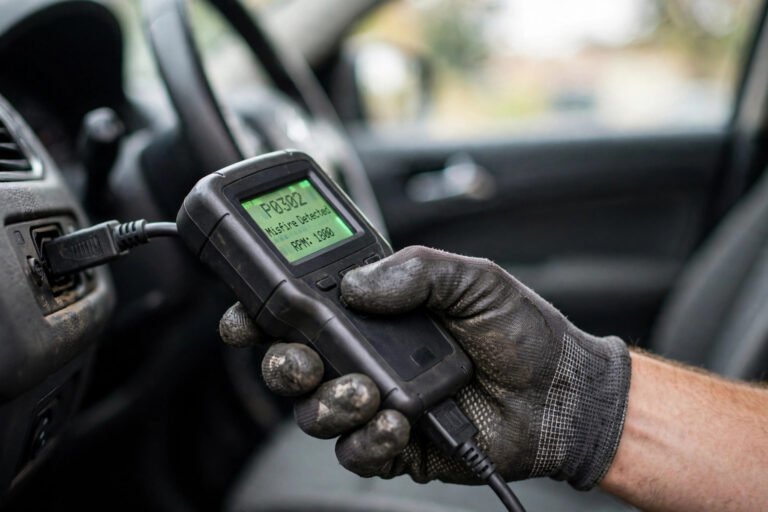
- Read the codes. Select Read Codes or Scan for DTCs and wait for the list. Write down every code, including pending codes, and photograph the freeze frame screen if your scanner shows one. This record is your diagnosis. Once you clear, it is gone.
- Understand the code. Search the code plus your car’s year, make, and model, for example “P0455 Ford F-150.” The search tells you the common causes. A P0455 or P0457 often points to a loose or faulty gas cap. A P0301 points to a misfire on cylinder 1. Knowing the code keeps a small problem from turning into a guess.
- Fix the cause first. Tighten the gas cap until it clicks, replace the part that failed, or finish the repair the code calls for. Clear the codes only after the cause is fixed. Clearing first and fixing later just hides the light while the fault keeps running.
- Clear the codes. Select Clear Codes or Erase Codes and confirm. The check engine light should go out at once.
- Read again, then drive. Run a second read to see what stayed, including any permanent code the scanner could not erase. Then take the car for a normal drive. If the repair was right, the light stays off. If the fault is still there, the light usually returns within one or two drive cycles.
A scanner reset is fast and controlled, and it leaves you with a record of what the car reported. That record is what a shop asks for if the light comes back.
Method 2: Fix It and Let the Car Clear the Light Itself (Safest Proof)
This method takes the longest, usually three to seven days of normal driving, but it is the most natural reset and the best proof the repair actually worked. The Ohio EPA advises not clearing the codes when possible: if the repair was correct, the light turns off on its own as the car completes its drive cycles, and that also tells you the car is ready for an emissions test.
A drive cycle is a set of driving conditions the car needs to rerun its self-tests. A typical cycle starts cold, with the engine below about 120 degrees, then includes at least 20 minutes of driving with a mix of city and highway speeds, and ends with a full engine cool down. The exact pattern differs by make and model, so treat those figures as a pattern, not a rule for your car.
Under the California OBD-II rules that nearly every car sold in the United States is built to meet, the light switches off after three consecutive driving cycles in which the responsible monitor runs and the fault does not appear. The stored code is erased only after the fault stays away for at least 40 engine warm-up cycles. That slow erase is deliberate: it keeps a history of the fault on record long after the light goes out.
This method has one clear advantage over the other two. It does not reset the readiness monitors, so the car stays ready for an emissions test. If the light does not go off after a week of normal driving, the problem was probably not fully fixed, and that is useful information, not a failure. Get the codes read again instead of clearing them by hand.
The loose gas cap is the classic example the EPA itself gives. If the check engine light came on after getting gas, tighten the cap until it clicks, then drive normally for a few days. The light should clear on its own once the evaporative system test passes three times in a row.
Method 3: Disconnect the Battery (Least Reliable)
Disconnecting the battery resets the car’s computer, which can clear stored codes, but this method is the least reliable of the three and the easiest to regret. It may or may not erase the codes, depending on the car, and it wipes settings you will have to redo.
Work with the ignition off and the key out. Wear gloves and eye protection, and keep metal tools away from the positive terminal. Never let a wrench bridge the two terminals.
- Turn everything off. Ignition off, key out, lights and accessories off.
- Disconnect the negative terminal first. Use a wrench, usually 10 mm, on the negative cable, marked with a minus sign and often a black cover. Loosen the clamp and lift the cable clear of the terminal. Tuck it aside so it cannot spring back onto the post.
- Wait at least 15 minutes. The computer holds a small charge that keeps its memory alive for a while. Fifteen minutes is the commonly given wait, and some cars need longer.
- Reconnect the negative terminal. Push the clamp back on, tighten it snug, and check that it does not wiggle.
- Start the car and check the light. If the light is off, drive normally and watch for it to return. If it comes back within a few days, the fault is still there.
Expect side effects. Disconnecting the battery can erase radio presets, clock settings, power window auto up and down, and the learned idle settings on some cars. The car may idle rough for a few minutes while it relearns. On some models, the battery disconnect does not clear the codes at all, and the light stays on. That is why this method sits last: it costs you settings and gives you the least control.
Never disconnect the battery as a way to pass an emissions test. Where it does erase the codes, it also resets the readiness monitors to not ready, and the station will reject the car until the monitors run again.
What a Reset Cannot Erase: Permanent Codes
On model year 2010 to 2012 and newer cars, some codes are stored as permanent codes in non-volatile memory. A scan tool cannot erase them, and neither can a battery disconnect. The only way a permanent code clears is for the car’s own monitor to run and pass, which proves the fault is actually gone. That design exists to stop a cleared light from hiding a real emissions fault.
If your scanner clears the codes but one code stays, or the light returns after a single short drive, a permanent code or an unfixed fault is the likely reason. Read the codes again and note which one stayed. That code is the one to chase, and a shop diagnosis is the next step if the cause is not obvious.
When Not to Reset the Light
Resetting the light is the wrong move in four common situations. Each one turns a reset from a harmless step into a costly delay.
1. The light is flashing
A flashing check engine light means an active misfire that can overheat and destroy the catalytic converter within minutes. Do not reset anything. Pull over, switch the engine off, and have the car towed. Driving on, even gently and for a short distance, risks a repair bill in the thousands. A shop within a couple of miles is the only exception, and only at low speed.
2. Right before an emissions test
Clearing codes resets every readiness monitor to not ready. The test station rejects the car as not ready, and vehicles from model year 2001 onward are allowed only one not-ready monitor. If the fault is still there, the light comes back during the driving needed to set the monitors anyway, so the reset buys nothing and costs you a failed visit. Fix the cause, drive normally until the monitors run, and then test.
3. Before a shop visit
A mechanic needs the stored code and the freeze frame to diagnose the fault quickly. Clear them and the technician has to wait for the fault to return or run tests from scratch. That adds diagnostic time, and diagnostic time is what you pay for. Write the codes down, leave the light on, and hand the shop the code list when you arrive.
4. Before selling the car
Clearing the light to hide a fault from a buyer is dishonest, and it does not work for long. The buyer, or their mechanic, can read the permanent codes and the not-ready monitors with a basic scan tool, and the light comes back within a few days of normal driving. Disclose the fault and the code, or fix it before the sale.
What a Check Engine Light Diagnosis Costs in 2026
A free code read and a paid diagnosis are two different products, and knowing the difference saves money. A parts-store scan is free at many chains, takes five to fifteen minutes, and gives you the stored codes plus a list of possible causes. It does not prove which part failed.
A shop diagnostic is the paid step. RepairPal’s national estimator puts check engine light diagnosis and testing at $125 to $183 in labor, updated September 3, 2026. An earlier RepairPal range from January 2026 put the same work at $122 to $233, so the current band is the one to use. The fee covers a technician’s time with the scan tool plus the hands-on tests the code calls for, and whether it is credited toward the repair depends on the shop. Ask before you approve the work.
The repair behind the light is the bigger number. CarMD’s 2026 Vehicle Health Index, published April 22, 2026, put the average check engine light repair at a record $554 in 2025, up 33 percent from the prior year, across more than 39 million vehicles. That average is why a paid diagnosis is usually the cheaper half of the bill: an hour of testing beats replacing parts on a guess.
| Option | What you get | Typical cost in 2026 |
|---|---|---|
| Parts-store code scan | Stored codes and a possible-causes printout | $0 at many chains |
| Basic OBD-II scanner | Read and clear codes at home | Under $30 to $45.99 and up |
| Shop diagnostic visit | Scan, live data, pinpoint tests, written cause | $125 to $183 in labor (RepairPal) |
| Average check engine repair | The repair behind the light | $554 (CarMD 2026 Vehicle Health Index) |
These are reference estimates, not quotes for your car or ZIP code. Taxes, fees, and related repairs are not included. A quote well above the RepairPal band deserves a second opinion, and a free scan that names a code is never a substitute for the testing that confirms the failed part.
If the Light Comes Back After a Reset
A light that returns within one to three drive cycles means the fault is still there. Read the codes again and compare them with the ones you wrote down before the reset. The same code points to an unfinished repair or a misdiagnosis. A different code points to a second fault, or to a repair that disturbed a nearby part.
Common reasons a light returns include a repair that treated the symptom instead of the cause, a new part that was faulty out of the box, a vacuum hose knocked loose during the repair, or a code that needs the full drive cycle to set. None of these means the reset failed. The reset did its job, and the car is telling you the fault is real.
Do not keep clearing the light and driving on. Each reset erases the freeze frame a technician needs, and a fault that keeps returning is a fault that is getting worse. Book a diagnostic visit, bring the code list, and let the shop run the pinpoint tests. If the light is flashing, or the car runs rough, loses power, or smells strongly of fuel, stop driving and have it towed.
The Bottom Line
Reset the light only after you know the code and the cause is fixed. An OBD-II scanner is the best tool for the job because it reads before it erases. Letting the car clear the light itself after a repair is the safest proof the fix worked, and it keeps the car ready for an emissions test. Disconnecting the battery is a last resort that may not work and will cost you settings. Never reset a flashing light, never clear codes before an emissions test or a shop visit, and never use a reset to hide a fault from a buyer. A reset turns the light off. Only a repair turns the problem off.
FAQ
How do I reset my check engine light without a scanner?
Fix the cause, then drive normally for three to seven days. The car switches the light off itself after about three clean drive cycles, and the stored code is erased after at least 40 warm-up cycles without the fault. Disconnecting the negative battery terminal for at least 15 minutes can also work, but it may not clear the codes on some cars, and it erases radio presets and other settings.
How long does it take for the check engine light to reset itself?
Usually three to seven days of normal driving. The light goes out after three consecutive driving cycles in which the self-test runs and finds no fault. A drive cycle typically starts cold, includes at least 20 minutes of mixed city and highway driving, and ends with a full cool down. If the light is still on after a week, the fault was probably not fully fixed.
Will disconnecting the battery reset the check engine light?
Sometimes, but not reliably. Disconnect the negative terminal with the ignition off, wait at least 15 minutes, then reconnect it. On some cars the codes stay, and on all cars the reset also wipes readiness monitors and settings such as radio presets and power window memory. A scanner is the more reliable method.
Can I reset the check engine light before an emissions test?
You can, but it will fail the test. Clearing codes sets every readiness monitor to not ready, and the station rejects the car as not ready. Vehicles from model year 2001 onward are allowed only one not-ready monitor. Fix the cause, drive until the monitors run, and then take the test.
Why does my check engine light come back after I reset it?
Because the fault is still there. A reset erases the code and the light, not the problem. If the cause was not repaired, the computer detects it again during the next drive cycle and switches the light back on, usually within one to three drive cycles. Read the codes again and compare them with the ones you recorded before the reset.
Is it safe to drive with the check engine light on after a reset?
If the light was steady, the car drives normally, and the code pointed to a minor fault such as a loose gas cap, short trips are usually fine while you watch for its return. Stop driving and arrange a tow if the light flashes, the engine runs rough, power drops, or you smell fuel. Those signs mean the fault is serious, and a reset cannot make it safe.
What is the cheapest way to read a check engine code?
A free code scan at an auto parts store. Most chains read the stored codes and print a possible-causes list at no charge, and the visit takes about five to fifteen minutes. A basic handheld scanner costs under $30 if you want to read and clear codes at home. Neither option replaces a paid shop diagnosis, which RepairPal puts at $125 to $183 in labor for check engine light diagnosis and testing.

lily John
The Fixtorial team writes hands-on car troubleshooting guides for everyday drivers — symptom first, honest costs, and fixes you can verify yourself.


One Comment