
Car Idles High? 7 Causes and How to Diagnose Each One
Updated Nov 22, 2026
In This Guide
- The Quick Answer: Check Three Things Before Anything Else
- Pattern Match: What Each Idle Behaviour Usually Means
- What a Normal Idle Looks Like
- 1. Vacuum Leak: Why Your Car Idles High
- 2. Idle Air Control Valve Stuck Open or Clogged With Carbon
- 3. Dirty Throttle Body — Carbon Holding the Plate Open
- 4. Faulty Engine Coolant Temperature Sensor — the Computer Thinks It’s Still Cold
- 5. Faulty Throttle Position Sensor — the Computer Thinks You’re Pressing the Gas
- 6. PCV Valve Stuck Open — a Vacuum Leak From Inside the Engine
- 7. EVAP Purge Valve Stuck Open — Fuel Vapour Flooding the Idle
- The 5-Minute Diagnostic Order
- What a Shop Does That You Can’t
- What High Idle Repairs Typically Cost
- When to Stop Driving and Call for a Tow
- Keeping the Idle Healthy
- Frequently Asked Questions
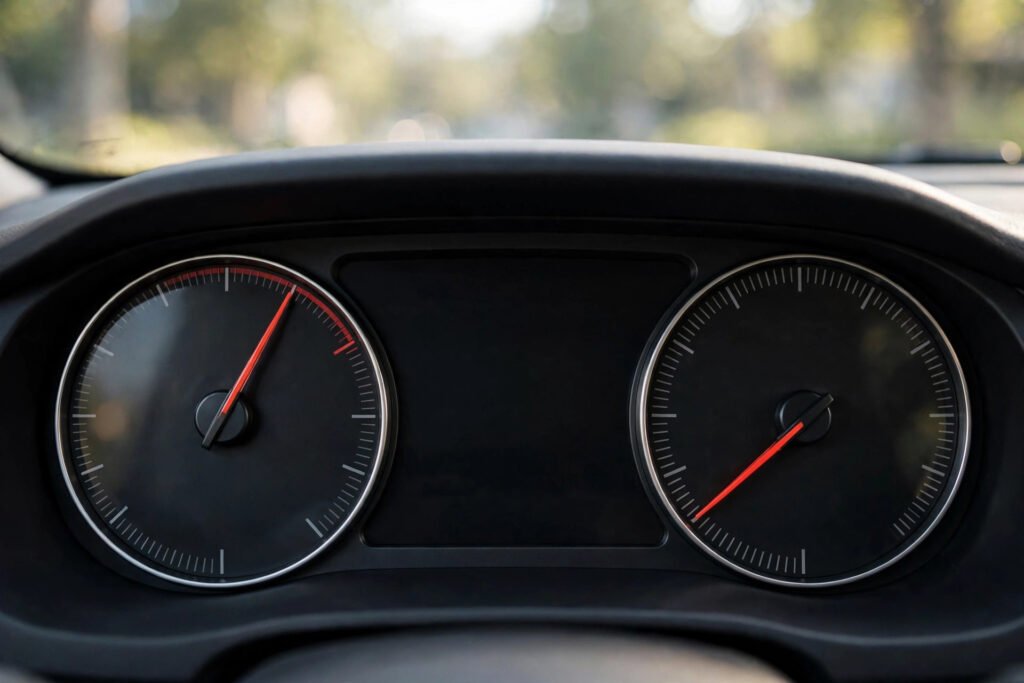
When your car idles high, you pull up to a red light, foot off the gas, and the engine is still roaring like you are holding the accelerator down. The tachometer sits at 1,500 RPM — or higher — and it stays there. The car creeps forward against the brake, it clunks hard when you shift into Drive, and every stop feels like you are fighting the engine instead of parking it.
A high idle on a cold start is normal: the engine deliberately revs higher for a minute or two to warm up, then settles down. A high idle on a fully warmed-up engine is not normal. It means extra air — or wrong information — is reaching the engine, and the computer is feeding it fuel to match. The good news is that high idle follows patterns, and the pattern usually points straight at the cause. A car that idles high only when cold has a different problem from one that idles high all the time, and one that surges up and down has a different problem again.
Safety first: a car that idles too high is harder to stop and can lunge forward when you shift into gear — keep a firm foot on the brake at every stop, leave extra following distance, and do not drive it if the idle surges unpredictably or the car lunges on its own. If the engine races the moment you start it, or the car creeps forward hard against the brakes, switch it off and call for a tow rather than driving it to a shop. Transmission engagement, braking, and steering problems are diagnosis-only here: once a car is lunging or surging, it belongs on a tow truck, not a road test. Never reach into a running engine bay to inspect hoses or linkages — a spinning fan and hot parts can injure in a second, so do the visual checks below with the engine off, and leave anything involving fuel or moving parts to a shop.
The Quick Answer: Check Three Things Before Anything Else
If the idle is high right now, run these three checks first — they separate “normal cold-start behaviour” from a real fault in about two minutes:
- Warm or cold? A high idle on a cold start that drops to normal within a couple of minutes as the engine warms up is the designed fast-idle warm-up, not a fault. A high idle that stays high after the temperature gauge reaches its normal middle position is a fault.
- Read the number. Watch the tachometer with the engine warm, in Park, foot off the gas. A warm engine that still sits above roughly 1,000 RPM is idling high; readings of 1,200 to 1,500 RPM or more on a warm engine point to a constant, uncontrolled flow of air into the engine.
- Is the check engine light on? A lit check engine light plus a high idle often means the computer has already spotted the problem — idle-control codes P0505, P0506, and P0507 point directly at the idle system. Even a cheap scan tool, or a free code read at an auto parts store, can turn a guessing game into a named suspect.
In this guide, you’ll learn:
- What a normal idle looks like — and when a high one is actually a problem
- The 7 most common causes, with the exact check for each
- How to tell a vacuum leak from a stuck idle valve from a bad sensor
- What you can safely check yourself, and what belongs in a shop
- What idle repairs typically cost, and when to stop driving and call for a tow
Pattern Match: What Each Idle Behaviour Usually Means
| What you notice | Most likely explanation | First check |
|---|---|---|
| High idle on a cold start, drops to normal as it warms | Normal fast-idle warm-up — not a fault | Wait for the temperature gauge to reach normal |
| High idle all the time, even fully warm | Vacuum leak, stuck idle valve, or dirty throttle body | Hiss test and throttle body (causes 1–3) |
| Idle surges up and down on its own | Idle valve sticking, vacuum leak, or sensor giving bad data | Scan for codes; check for hissing (causes 1, 2, 4–5) |
| High idle plus a check engine light | Idle system codes P0505/P0506/P0507, or a sensor fault | Read the code first (cause 4–5) |
| High idle only with the AC or heater on | Idle valve not compensating for the extra load | Idle valve function (cause 2) |
| Idle high and the temperature gauge reads low or never rises | Coolant temperature sensor telling the computer the engine is still cold | Gauge behaviour + ECT sensor (cause 4) |
| Idle jumped right after a battery was disconnected or replaced | Idle relearn lost — the computer forgot its learned idle position | Drive cycle / relearn, then recheck |
| Car lunges or clunks hard shifting into gear | Idle too high for the transmission to engage smoothly | Stop driving if it lunges — tow, don’t force it |
What a Normal Idle Looks Like
An engine at idle is doing the minimum work needed to keep itself running with your foot off the gas: turning the alternator, the water pump, and the power steering pump, and holding steady against the load of the transmission in Drive. On a fully warmed-up engine, most cars settle at a calm, steady speed — and a warm engine that still sits above roughly 1,000 RPM is idling high. EngineerFix’s high-idle guides put a genuinely faulty warm idle at 1,200 to 1,500 RPM or more, with the needle holding there instead of dropping.
Cold is different, and this is where most false alarms come from. On a cold start the computer deliberately raises the idle — the “fast idle” — to warm the engine and the catalytic converter faster, and to keep a cold engine from stalling. That is supposed to happen, and it is supposed to end: as the coolant temperature climbs toward normal, the idle should step down to its warm speed within a couple of minutes. If it never steps down, or if it steps down and then climbs again, the warm-up system is being fooled — usually by one of the causes below — and the computer is holding the fast idle because it believes the engine is still cold.
The idle is controlled by air, not by the accelerator. With your foot off the gas the throttle plate is closed, and the engine breathes through a small bypass passage — either a dedicated idle air control valve or, on modern drive-by-wire cars, a precisely cracked-open electronic throttle plate. The computer meters that bypass air to hold the target idle speed. Anything that lets in extra air the computer did not order, or any sensor that lies about temperature or throttle position, breaks that control — and the idle climbs.
1. Vacuum Leak: Why Your Car Idles High
This is the most common mechanical cause of a high idle, and the first one to suspect when the idle is high on a warm engine.
A vacuum leak is any place where air gets into the intake manifold after the mass airflow sensor — so the computer never measures it. Cracked or disconnected rubber vacuum hoses are the usual entry point: years of heat and vibration make them brittle, and a split hose can leak a surprising amount of air. Larger leaks open up at gaskets — the intake manifold gasket, or the throttle body mounting gasket — and at the PCV system, where a stuck valve or a ruptured hose creates a large bypass straight into the manifold. A less obvious but serious one is a leak in the brake booster diaphragm, which draws air from the intake manifold whenever the brake pedal is released. The result is the same in every case: unmetered air enters, the oxygen sensors report a lean mixture, and the computer adds fuel to correct it — which raises the engine speed.
The check: with the engine off and cool, look and listen. Pop the hood and inspect the small rubber vacuum hoses for cracks, splits, or loose connections, especially where they meet the intake manifold and the brake booster. With the engine running at idle, listen closely for a hissing or whistling sound from the engine bay — a vacuum leak often announces itself that way. If you can hear the hiss, you can often find the leak by moving your ear along the hoses (hands clear of the fan and belts). A leak big enough to raise the idle is usually big enough to hear.
The fix: a cracked hose is a cheap part and a quick replacement, and it is one of the few high-idle fixes that is genuinely simple. Gasket leaks and brake booster leaks are shop work — they need the intake taken apart or the booster tested, and a brake booster fault also touches the braking system, which is diagnosis-only territory. If the hiss is there but you cannot find the source, a shop can run a smoke test: harmless smoke is pumped into the intake, and it pours out of the leak. It is the fastest way to find a leak that hides behind the engine.
2. Idle Air Control Valve Stuck Open or Clogged With Carbon
On cars that have one, the idle air control (IAC) valve is the part whose entire job is holding the idle steady — and it is the primary suspect when the idle is high and steady rather than surging.
The IAC valve is an electrically operated plunger or stepper motor that opens a bypass passage around the closed throttle plate, letting a small, precisely measured amount of air into the manifold. The computer adjusts it constantly to counteract load changes — switching the air conditioning on, shifting into gear, turning the steering — so the idle stays put. Over time, carbon and oil vapour from the intake air build up inside the valve’s passage and on its pintle. When the deposits stop the valve from seating fully, it sticks partly open and feeds a continuous excess of air into the manifold that the computer cannot correct — a fixed high idle. The same valve failing the other way causes stalling and rough idle, which is why a bad IAC valve can show up as either symptom depending on where it sticks.
The check: the pattern is the clue. A high idle that is steady rather than surging, that gets worse — or appears — when you switch the air conditioning on or shift into gear, and that came on gradually over months, fits a sticking IAC valve. A scan tool helps here: idle-control codes P0505, P0506, or P0507 point directly at the idle system, and a technician can command the valve and watch whether it responds. YourMechanic’s IAC guide notes that carbon buildup in the intake manifold is the usual reason these valves go bad, and that an air induction service every few years helps keep the deposits from returning.
The fix: cleaning the valve and its passage with a dedicated throttle body cleaner sometimes frees a valve that is merely dirty — but removal and cleaning is a hands-on job, and on some cars the valve is buried. Replacement is the common cure when cleaning does not hold. Cost guidance is below, but the short version is that this is usually a modest repair, not a major one — and it is worth confirming the diagnosis with a scan before replacing the part, because a vacuum leak produces the same symptom for a different reason.
3. Dirty Throttle Body — Carbon Holding the Plate Open
Even on cars without a separate IAC valve, the throttle body can cause the same fault, because on modern drive-by-wire cars the electronic throttle plate itself does the idle valve’s job.
The throttle plate should seal tightly against the bore of the throttle body when your foot is off the gas. Carbon deposits and grime build up around the edge of the plate over years of driving, and even a thin ring of baked-on carbon can stop the plate from closing completely. That tiny gap acts exactly like a small vacuum leak: extra air slips past the closed plate, the computer adds fuel, and the idle rises. The same fouling can affect the idle valve’s passage on cars that have one, which is why throttle body cleaning is one of the first repair steps EngineerFix names for a high idle, alongside cleaning the mass airflow sensor.
The check: this one is hard to confirm from the driver’s seat, which is why it usually gets found by elimination — vacuum leak ruled out, IAC valve tested, and the idle still high. A shop can inspect the throttle bore directly. One indirect clue: a high idle that appeared gradually and got slowly worse over months, with no sudden event and no hissing leak, fits carbon buildup better than a hose that split overnight.
The fix: cleaning the throttle body bore and plate edge with a specialised cleaner, and cleaning the mass airflow sensor while you are there, is the standard repair. A word of caution that matters: on drive-by-wire cars, do not force the throttle plate open by hand — the plate is moved by an electric motor, and forcing it can damage the mechanism or confuse the computer’s learned positions. Throttle body service on an electronic throttle is best left to a shop that can perform the idle relearn afterwards, because the computer needs to re-learn where “closed” is once the carbon is gone. On older cable-throttle cars the same caution applies in reverse: check that the throttle cable or linkage is not binding or misadjusted and holding the plate slightly ajar — even a small amount of tension prevents the plate from returning to its fully closed resting position.
4. Faulty Engine Coolant Temperature Sensor — the Computer Thinks It’s Still Cold
If the idle is high and the temperature gauge reads low, or takes far longer than usual to reach normal, the coolant temperature sensor is the most likely liar in the system.
The engine coolant temperature (ECT) sensor tells the computer how warm the engine is, and the computer uses that reading to decide the idle speed. A cold engine gets a fast idle; a warm engine gets a normal one. If the sensor fails and reports a permanently cold temperature, the computer runs the cold-start fast idle forever — even with the engine fully warmed up. EngineerFix names the ECT sensor as the most common sensor failure behind a high idle, and the logic is straightforward: the computer is not malfunctioning, it is faithfully following bad data.
The check: watch the temperature gauge. If it sits low, climbs very slowly, or never reaches its normal middle position while the idle stays high, the sensor is a strong suspect — but note the thermostat can produce similar gauge behaviour, so this is a “suspect,” not a verdict. A scan tool settles it: a technician can read the live coolant temperature the computer is seeing and compare it with the actual engine temperature. A reading stuck near cold on a hot engine is conclusive.
The fix: sensor replacement is a routine shop job, and the part itself is usually inexpensive — the cost is mostly diagnostic time and access, which varies by car. Do not confuse this with a thermostat stuck open, which also leaves the engine running cool: the thermostat is a different part with different symptoms, and a shop will separate the two with the live temperature reading before replacing anything.
5. Faulty Throttle Position Sensor — the Computer Thinks You’re Pressing the Gas
The throttle position sensor (TPS) reports the exact angle of the throttle plate to the computer. If it fails or drifts out of calibration and reports a small throttle opening when the plate is actually closed, the computer switches to its off-idle fuel and timing maps — and the idle climbs, because as far as the computer knows, you are pressing the accelerator.
The check: a TPS fault usually leaves fingerprints beyond the idle. Look for a high idle combined with hesitation when you press the gas, a surge when you lift off, or a check engine light with a throttle-related code. A scan tool can read the live throttle position: with your foot off the gas it should read zero or near zero, and it should rise smoothly as you press the pedal. A reading that sits a few percent open at rest, or jumps erratically, is the tell.
The fix: this is a scan-tool diagnosis and a sensor replacement — not a cleaning job. TPS testing and replacement belong in a shop, because the sensor’s calibration matters and a wrong reading after replacement causes the same problem you started with. If your car is drive-by-wire, the throttle position sensing is built into the throttle body assembly itself, which can make the repair a throttle body replacement rather than a standalone sensor — ask for the diagnosis before approving the part.
6. PCV Valve Stuck Open — a Vacuum Leak From Inside the Engine
The positive crankcase ventilation (PCV) system is easy to overlook, and it is a common high-idle culprit precisely because it connects straight into the intake manifold.
The PCV valve meters blow-by gases from the crankcase back into the intake to be burned. When the valve sticks open, or its rubber hose cracks, it becomes a large vacuum leak that bypasses the throttle body entirely — the same unmetered-air problem as cause 1, but from a part most drivers have never heard of. EngineerFix lists the PCV system among the first places to look for a vacuum leak, and a stuck-open valve can raise the idle on its own.
The check: the PCV valve is usually a small, inexpensive part plugged into a valve cover with a hose running to the intake. With the engine off, pull the hose and check it for cracks and a loose fit; the valve itself should rattle faintly when shaken — a valve that does not rattle at all is often stuck. Oil residue around the valve or a whistling sound from that area at idle are supporting clues.
The fix: a PCV valve is one of the cheapest parts on this list and is often owner-replaceable in minutes on cars where it is accessible. If it is buried under an intake cover or manifold, let a shop do it — the part is cheap either way, and the labour depends on access. Replace the hose with it if the hose is brittle, because a new valve on a cracked hose still leaks.
7. EVAP Purge Valve Stuck Open — Fuel Vapour Flooding the Idle
The last common cause lives in the evaporative emissions system, and it is worth knowing because it often arrives with a fuel smell as a bonus clue.
The EVAP purge valve is supposed to open only at the right moment to draw fuel vapour from the charcoal canister into the engine. If it sticks open, it feeds a constant stream of fuel vapour — and the air that carries it — into the intake at idle, when the engine needs almost no fuel at all. The extra vapour leans and enriches the mixture unpredictably, and the computer compensates by raising the idle. The same stuck-open valve is a common cause of rough idle and hard starting after refuelling, so a high idle that started shortly after a fill-up, or one that comes with a faint fuel smell near the car, fits this cause.
The check: the fill-up connection is the giveaway — hard starting or a high, uneven idle right after refuelling points at the purge valve. A scan tool can command the valve closed and watch whether the idle settles. Do not confuse this with a fuel leak: a strong fuel smell, visible wetness, or a puddle under the car is a stop-and-tow situation, not a purge valve diagnosis — fuel leaks are a fire risk, and the car should not be driven.
The fix: purge valve replacement is a shop job on most cars, because the valve’s location and the evaporative system’s testing need proper equipment. It is usually a modest repair, but it must be confirmed by testing rather than guessed at, because its symptoms overlap with vacuum leaks and idle valve faults.
The 5-Minute Diagnostic Order
Work through these in order, and stop at the first one that explains your symptom — most high-idle faults are found in the first three steps:
- Warm or cold? Let the engine reach normal temperature. If the idle drops to normal, there is no fault — that was the cold-start fast idle.
- Read the codes. A check engine light, or a free code read, can name the system immediately — P0505, P0506, and P0507 point at idle control; throttle and temperature codes point at causes 4 and 5.
- Listen for the hiss. Engine running, hood up, ears moving along the vacuum hoses and the brake booster connection. A hiss is a vacuum leak until proven otherwise (cause 1), including the PCV hose (cause 6).
- Watch the gauge and the load. Temperature gauge stuck low points at the coolant sensor (cause 4). Idle that jumps when the AC switches on points at the idle valve (cause 2).
- Think about what changed. Idle went high right after a battery disconnect? Suspect a lost idle relearn. Right after a fill-up? Suspect the purge valve (cause 7). Gradually over months? Suspect carbon — throttle body or idle valve (causes 2–3).
What a Shop Does That You Can’t
If the driveway checks find nothing, a shop has three tools that settle a high idle quickly. A smoke test pumps harmless smoke into the intake and shows exactly where a vacuum leak is — no guessing, no replacing hoses one at a time. Live data on a professional scan tool shows the coolant temperature, throttle position, and idle valve command the computer is actually seeing, which exposes a lying sensor in seconds. And the scan tool can command the idle valve and the purge valve open and closed while watching the idle respond, which separates a stuck valve from a leak. That is why the diagnostic fee is money well spent on this fault: the parts are mostly cheap, but replacing the wrong cheap part three times costs more than one proper diagnosis.
What High Idle Repairs Typically Cost
Costs vary widely by vehicle, region, and labour rates, so treat these as planning ranges, not quotes for your car. Get a local quote once the fault is identified:
| Repair | Typical range |
|---|---|
| Vacuum hose replacement | Usually the cheapest fix on this list; often a single hose and a few minutes of labour |
| PCV valve replacement | Inexpensive part; labour depends on access |
| Throttle body cleaning (with idle relearn) | Usually a modest service charge |
| Idle air control valve replacement | $120 to $500 (eOBDcode), parts $45 to $400+ and labour around $70; YourMechanic’s example for a Chevrolet Suburban 2500 averages $160 ($65 parts, $95 labour) |
| Coolant temperature sensor replacement | Usually an inexpensive part; labour varies by access |
| Throttle position sensor / purge valve replacement | Moderate; throttle body assembly replacement on drive-by-wire cars costs more than a standalone sensor |
A vacuum leak found by a smoke test is often a hose that costs less than the diagnostic time — which is exactly why the smoke test pays for itself. And an idle valve replaced on a guess, when the real fault was a cracked hose, is the most common wasted money on this list.
When to Stop Driving and Call for a Tow
Some high-idle checks are safe driveway work: watching the gauge, listening for a hiss with the engine running (hands clear), reading codes, and inspecting hoses with the engine off and cool. Stop driving and call for help if you hit any of these: the car lunges forward against the brakes or surges unpredictably, the idle races the moment you start the engine, shifting into Drive or Reverse slams the transmission, the brakes feel weak because the engine is fighting them, or you smell fuel or see a leak. A car that cannot be held still at a stop is a crash risk, not a “drive it to the shop” situation — have it towed. The same applies to any repair that requires working around a running engine’s belts and fan, fuel system work, or transmission diagnosis: those belong to a professional.
Keeping the Idle Healthy
A high idle is usually a wear-and-age fault, not a maintenance failure, but a few habits keep the causes at bay: replace cracked or brittle vacuum hoses when you spot them rather than waiting for them to split, keep up with air filter and induction cleaning so carbon builds up more slowly in the throttle body and idle valve, and do not ignore a check engine light — an idle code caught early is a sensor or a hose, while the same fault ignored for months can foul the throttle body and the idle valve together. If the battery is disconnected for any work, expect the idle to behave oddly for a short while afterwards: the computer has to re-learn its idle position, and a few normal drive cycles usually settle it. If it does not settle, the relearn may need a scan tool, or there is a real fault underneath. If the engine is also shaking at idle rather than just revving high, our guide on why a car vibrates at idle in Drive covers the vibration side, and if the idle problem comes with a warning light, our guide on the check engine light on but the car runs fine explains what that combination usually means. A car that stalls instead of idling high has the opposite version of the same fault — see our guide on why a car stalls while driving — and if the temperature gauge is behaving strangely alongside the idle, our guide on a car overheats in traffic or at idle covers the cooling side of the same sensor system.
Frequently Asked Questions
Is a high idle bad for the engine?
In the short term it is mostly a drivability and safety problem rather than an engine-destroying one — but it wastes fuel, wears the brakes (because you are braking against the engine), slams the transmission every time you shift into gear, and can overheat the transmission fluid in stop-and-go traffic. Fix it promptly rather than driving around it.
Can I drive with a high idle?
Only if the idle is mildly high, steady, and the car holds still at stops with normal brake effort. If it lunges, surges, or needs hard braking to stay stopped, do not drive it — tow it. The risk is a car that moves when you do not expect it to.
Why is my idle high only when the engine is cold?
That is the designed fast idle: the computer raises the revs to warm the engine and catalytic converter. It should drop to normal within a couple of minutes as the temperature gauge reaches its normal position. If it never drops, the computer still thinks the engine is cold — suspect the coolant temperature sensor (cause 4).
Why does the idle go up when I turn the AC on?
A small rise is normal: the AC compressor adds load, and the idle valve opens slightly to compensate. A large jump, or an idle that stays high after the AC is switched off, means the idle valve is not compensating properly (cause 2).
Will a high idle fail an emissions test?
It can. A vacuum leak or a sensor fault that raises the idle also upsets the air-fuel mixture, which can push emissions out of limits and trigger the check engine light — and a lit check engine light alone fails the test in many states. Fix the idle fault before the test.
Does a high idle waste gas?
Yes. An engine spinning faster at every stop is burning more fuel while going nowhere, and the effect adds up in city driving. It will not bankrupt you in a week, but it is one more reason not to leave the fault for months.

lily John
The Fixtorial team writes hands-on car troubleshooting guides for everyday drivers — symptom first, honest costs, and fixes you can verify yourself.


One Comment