
Transmission Shifts Hard? 8 Causes and the Fluid Test First
Updated Nov 22, 2026

In This Guide
- Quick Symptom Match
- How Smooth Shifting Is Supposed to Work
- 1. Low Transmission Fluid — The Most Common Cause
- 2. Old, Burnt, or Wrong Transmission Fluid
- 3. Clogged Transmission Filter
- 4. Failing Shift Solenoid or Pressure Control Solenoid
- 5. Transmission Control Module Fault or Lost Adaptive Learning
- 6. Worn Valve Body
- 7. Worn Clutches, Bands, or Internal Damage
- 8. Engine or Sensor Problems Mimicking a Transmission Fault
- Quick Checks You Can Do Yourself
- Transmission Shifts Hard: When to See a Mechanic
- Cost Guidance
- FAQ
Transmission shifts hard? A healthy automatic transmission changes gear so smoothly you barely notice it. So when yours starts banging into gear, jerking the car forward on upshifts, or clunking loudly on downshifts, something has changed — and it is worth finding out what before the problem gets more expensive.
The short answer is that low, old, or burnt transmission fluid is behind most cases of hard shifting. Transmission fluid is the hydraulic medium that makes every gear change happen, and when its level drops or its condition degrades, the pressure that engages each gear arrives late and then all at once — which is exactly what a hard shift feels like. That is not the only possibility, though: a sticking shift solenoid, a confused control module, a worn valve body, or internal wear can all produce the same jolt, and each one points to a very different repair bill.
In this guide, you’ll learn:
- What hard shifting feels like and how it differs from slipping
- The 8 causes of hard shifts, matched to the symptom you notice
- The fluid colour and smell test that identifies the most common cause in minutes
- Simple checks you can do in the driveway before paying for diagnosis
- When a fluid service will fix it and when the transmission needs a specialist
- Honest 2026 repair costs for each likely repair
Safety first: a transmission that shifts hard is a transmission under stress. If the hard shifts come with slipping, a flashing check-engine light, a burning smell, a puddle of red fluid under the car, or a transmission temperature warning, stop driving and have the car towed — continuing to drive can turn a solenoid or fluid repair into a full rebuild. Transmission fluid is also hot enough to burn: only check it exactly as your owner’s manual describes, and never open a transmission that is still hot. This guide helps you diagnose; internal transmission work belongs with a certified transmission specialist, not a driveway repair.
Quick Symptom Match
| What you notice | Most likely cause | What to check first |
|---|---|---|
| Hard shifts that started gradually and get worse as the car warms up | Low or degraded transmission fluid | Fluid level and condition (colour and smell) |
| Harsh shifts plus a red puddle under the car | Transmission fluid leak | Look under the car and check the fluid level |
| Hard shifts in only one or two gears, often with a check-engine light | Failing shift solenoid | Scan for transmission codes (P0750–P0770 range) |
| Hard shifts that began right after a battery replacement or fluid service | Control module lost its adaptive learning | Ask a shop about a TCM relearn or software update |
| Harsh engagement into Drive or Reverse with a loud clunk | Worn valve body or low fluid pressure | Fluid condition first, then a pressure and code scan |
| Hard shifts plus slipping, flaring RPM, or burnt-smelling fluid | Worn clutches or internal damage | Stop driving; needs a specialist diagnosis |
| Jerking on shifts plus a rough-running engine or misfire | Engine or sensor problem confusing the shift timing | Scan for engine codes, not just transmission codes |
| Hard shifts only on the first few minutes of a cold morning | Cold, thick fluid (plus normal cold-shift firmness) | Whether it disappears once the car is fully warm |
How Smooth Shifting Is Supposed to Work
In an automatic transmission, gear changes are made by hydraulic pressure. The transmission pump pressurises the fluid, the control module decides when to shift, and shift solenoids — small electro-hydraulic valves — open and close to route that pressurised fluid to the right clutch packs and bands. Each clutch pack engages gradually, slipping just enough to hand over smoothly from one gear to the next.
That choreography depends on two things: the right amount of clean fluid at the right pressure, and precise electronic control of when and how hard each clutch applies. Anything that disrupts the pressure, the fluid quality, or the timing turns a smooth handover into a slam. That is why the same symptom — a hard shift — can come from a $300 fluid service or a $4,000 rebuild, and why matching the exact pattern matters before any money is spent.
1. Low Transmission Fluid — The Most Common Cause
Low fluid is the first suspect because it is both the most common cause and the cheapest to fix. When the level drops — usually because of a slow leak at a cooler line, pan gasket, or axle seal — the pump cannot maintain steady hydraulic pressure. Pressure builds too slowly, the clutch pack engages late, and then locks up suddenly when the pressure finally arrives. The result is a delay followed by a bang.
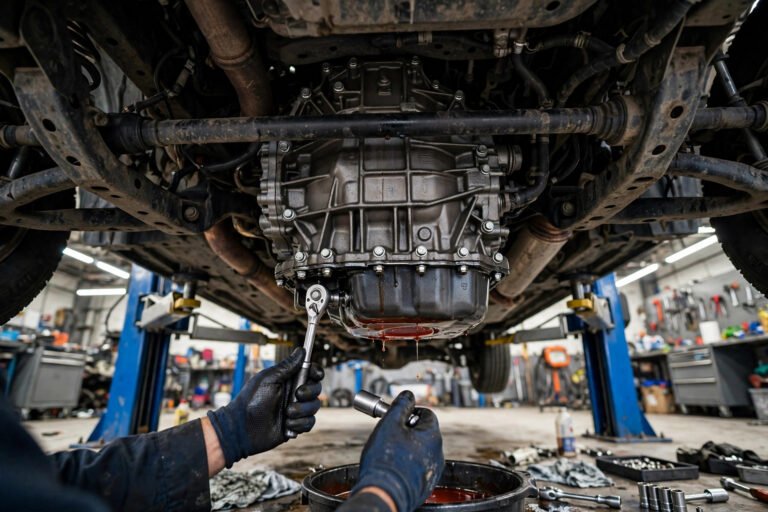
The giveaway: the hard shifts started gradually and get worse the longer you drive, or they appeared alongside a reddish puddle under the car. Low fluid also commonly causes delayed engagement into Drive or Reverse. If your car has a dipstick, check the level with the engine running and warmed up, on level ground, exactly as the owner’s manual describes — many modern cars have sealed transmissions with no dipstick, in which case only a shop can check the level. A transmission fluid leak needs to be found and fixed first, because topping up a leaking transmission is only a temporary patch.
2. Old, Burnt, or Wrong Transmission Fluid
Fluid does not just get low — it wears out. Heat and use break down the fluid’s friction modifiers, and friction material and metal particles contaminate it over time. Burnt fluid cannot hold consistent pressure or lubricate properly, so clutch packs grab unevenly and shifts turn harsh. The wrong fluid type causes the same problem even at the correct level: modern transmissions are built for very specific fluids, and a generic ATF with the wrong additive package changes how the friction materials engage.
The giveaway: wipe the dipstick on a clean white paper towel. Healthy fluid is translucent red or pink and smells faintly sweet. Fluid that is dark brown or black, or smells burnt, is worn out and needs changing. If the fluid was recently changed and the hard shifts started right after, the wrong fluid type is a real suspect — check that the service used the exact specification your owner’s manual calls for.
3. Clogged Transmission Filter
Inside the transmission pan sits a filter that catches friction material and debris before they reach the valve body and solenoids. As that filter clogs, it restricts flow to the pump, pressure drops, and shifts become delayed and harsh — the same pattern as low fluid, but with a full fluid level. This is why a filter change is part of a proper transmission service, not an optional extra.
The giveaway: hard shifts that developed slowly over many miles with no leak and a correct fluid level, especially on a car that has never had a transmission service. If the fluid is also dark, the filter is very likely part of the story. A fluid and filter service is the fix here — but if the pan contains heavy metallic debris when it is opened, that points to internal wear rather than a simple service, and the shop should say so before reassembling.
4. Failing Shift Solenoid or Pressure Control Solenoid
Shift solenoids are the electrically operated valves that direct pressurised fluid to each gear’s clutch pack, and the pressure control solenoid regulates how hard that fluid pushes. When a solenoid sticks, responds slowly, or fails electrically — often from debris in the fluid or from simple wear — the pressure arrives at the wrong moment or at the wrong strength, and the gear engages with a jolt instead of a smooth handover.
The giveaway: hard shifts that affect only certain gears — for example, a slam on the 1–2 upshift but smooth shifting everywhere else — often with a check-engine light. A scan tool will usually find a code in the P0750–P0770 solenoid range, or a generic P0700 transmission control code. Solenoids can often be replaced individually or as a pack without removing the transmission, which makes this one of the better outcomes — but the diagnosis must come first, because a solenoid code can also be set by low fluid or wiring damage, and a car that won’t go into gear at all can share the same root causes.
5. Transmission Control Module Fault or Lost Adaptive Learning
Modern transmissions learn. The transmission control module (TCM) constantly adjusts shift pressure and timing to compensate for wear, temperature, and your driving style — this is called adaptive learning. When the battery is disconnected, the module is reset, or new fluid is fitted, that learned data can be lost, and the transmission reverts to default settings that can feel harsh until it relearns. A failing TCM, a software fault, or a bad speed sensor feeding it wrong data will also produce hard shifts, because the module is commanding shifts at the wrong RPM or road speed.
The giveaway: the hard shifts began right after battery work, a jump start, or a transmission service — that points to lost adaptive learning, and a shop relearn procedure with a scan tool often restores smooth shifting without any parts. If the harshness is constant and a scan shows TCM or speed-sensor codes (such as P0715 or P0720), the module or sensor needs diagnosis. Software updates from the manufacturer also exist for some models with known harsh-shift complaints — a dealer or specialist can check whether one applies to your car.
6. Worn Valve Body
The valve body is the transmission’s hydraulic control centre: a maze of passages and spool valves that route fluid exactly where the solenoids command it. Over time, wear and debris let valves stick or leak pressure internally, so the pressure that reaches a clutch pack is wrong even when the fluid level, filter, and solenoids are fine. A sticking valve can also make a shift harsh in one direction and soft in another.
The giveaway: hard shifts that persist after a fluid and filter service and after the solenoids test good, often with harsh engagement into Drive or Reverse and a clunk you can feel through the floor. Valve body problems are diagnosed with pressure testing and live scan data, not guesswork — this is specialist territory, and a valve body replacement is a mid-range repair, well below the cost of a rebuild but not a job to attempt without the right equipment.
7. Worn Clutches, Bands, or Internal Damage
Inside the transmission, clutch packs and bands are wear items. With high mileage, neglected fluid, or years of towing and hard use, their friction material thins out and they can no longer engage smoothly. At this stage hard shifting usually comes with other symptoms: slipping, RPM flaring between gears, delayed engagement, burnt fluid, and sometimes metallic debris in the pan. This is the cause every other cause is trying to rule out.
The giveaway: burnt-smelling black fluid, slipping as well as hard shifts, or hard shifts in every gear. If the transmission has also dropped into limp mode — stuck in one gear with limited speed — the control module is protecting a damaged transmission, and driving on is likely to make the damage worse. A rebuild or a remanufactured unit is the usual fix here. Get a second opinion before authorising a rebuild: a reputable transmission specialist will show you the pan debris and the pressure-test results rather than quoting a rebuild off a test drive alone.
8. Engine or Sensor Problems Mimicking a Transmission Fault
Not every hard shift starts in the transmission. The TCM times shifts using engine data, so a faulty throttle position sensor, a failing mass airflow sensor, or an engine misfire can make the transmission shift at the wrong moment — and a misfire under load can feel exactly like a transmission jolt. Worn engine or transmission mounts are another mimic: the transmission itself shifts fine, but the worn mount lets the whole drivetrain rock and thump, which the driver feels as a clunk on every gear change.
The giveaway: the jerking happens even when the car is not shifting — a misfire stumbles at steady speed too — or there is a separate engine symptom such as rough idle, hesitation, or a flashing check-engine light. For mounts, the test is simple: with the brakes firmly applied and a helper watching, shift between Drive and Reverse — if the engine rocks visibly, a mount is worn. On manual transmissions, hard shifting has its own causes — a clutch that does not fully disengage, worn synchronizers, or low gear oil — covered in our guide to grinding gears when shifting.
Quick Checks You Can Do Yourself
- Check the fluid colour and smell: on cars with a dipstick, pull it with the engine warm and running, and wipe the fluid on a white paper towel. Red or pink is healthy; brown is tired; black and burnt-smelling means service is overdue.
- Check the fluid level: only where your car has a dipstick and only by the owner’s manual procedure — wrong procedure gives a wrong reading. Sealed transmissions need a shop lift and a scan tool.
- Look for leaks: check under the car for red or reddish-brown fluid, especially near the front centre. A fresh leak explains a sudden onset.
- Note the exact pattern: which gears, hot or cold, upshift or downshift, Drive engagement or while driving. A single-gear problem points at a solenoid; every gear points at fluid or pressure; cold-only points at fluid condition.
- Scan for codes: a basic OBD-II scanner reads engine codes, and many now read transmission codes too. P0700, P0730, P0750–P0770, and P0740 are the common ones here — write them down before clearing anything.
- Watch the engine, not just the gearbox: if the engine also idles rough, hesitates, or misfires, the transmission may be reacting to an engine fault rather than causing one.
- Try the mount test: brakes on, helper watching the engine, shift between Drive and Reverse. Excessive rocking means a worn mount is adding the clunk.
Transmission Shifts Hard: When to See a Mechanic
Get a shop involved if the fluid is black or burnt-smelling, if a scan shows transmission codes, if the hard shifts started suddenly, or if the fluid service does not fix it. Solenoid, valve body, and control-module diagnosis all need a scan tool that can read transmission data — a generic code reader is not enough. A transmission specialist, rather than a general shop, is the right call once fluid and basic checks are ruled out, because pressure testing and valve body work are their daily work.
Stop driving and arrange a tow if the transmission is also slipping, if the check-engine light is flashing, if you smell burning fluid, if there is a large fluid leak, or if the transmission has dropped into limp mode. Driving on in that state can destroy clutch packs in miles, turning a repairable fault into a rebuild. If the shifts are only mildly firm and there are no warning lights, smells, or leaks, a short drive to the shop is reasonable — but do not keep driving it for weeks hoping it improves, because hard shifts do not fix themselves.
Cost Guidance
The spread on this repair is wide because the same symptom can mean a fluid service or a rebuild. These are 2026 US planning ranges from RepairPal estimates and specialist price guides — your exact quote depends on the vehicle, the transmission type, and local labour rates, and all figures exclude taxes and fees.
| Repair | Typical 2026 cost | When it applies |
|---|---|---|
| Transmission fluid change (drain and fill) | $294–$356 | Fluid low, old, or burnt; the first step in most cases |
| Transmission fluid and filter service | $621–$785 | Filter clogged or fluid badly degraded |
| Shift solenoid (single) | $150–$500 | One gear shifts hard; solenoid code stored |
| Shift solenoid pack | $450–$900 | Multiple solenoids or pack design |
| Valve body replacement | $850–$1,900 | Harsh shifts persist after fluid and solenoid checks |
| Diagnostic fee | $100–$200 | Scan and pressure testing (often credited toward the repair) |
| Local transmission rebuild | $2,800–$5,200 | Worn clutches or internal damage |
| Remanufactured transmission, installed | $3,800–$6,500 | Rebuild not practical or not warranted |
| Complete transmission replacement | $6,238–$6,764 | RepairPal estimate; new or factory unit at a dealer |
The fluid-change figures are RepairPal’s September 2026 national estimates, and the solenoid figures come from a November 2026 price guide citing RepairPal data. The lesson in the table is to start cheap and prove the cause: a fluid and filter service that fixes the problem costs a fraction of a solenoid pack, and a solenoid pack costs a fraction of a rebuild. Always get the diagnosis in writing before authorising internal work, and ask whether the quote includes the fluid, the filter, and any relearn procedure the transmission needs afterwards.
FAQ
Can I drive with a transmission that shifts hard?
For short, gentle trips to a shop, usually yes — if the shifts are only mildly firm and there are no warning lights, smells, slipping, or leaks. Stop driving and tow it if the transmission slips, the check-engine light flashes, you smell burning fluid, or the car drops into limp mode.
Will a fluid change fix hard shifting?
Often, yes — if low, old, or burnt fluid is the cause and the clutch packs are not already worn out. A fluid service will not fix worn clutches, a failed solenoid, or a bad valve body, which is why the fluid check comes first: it is the cheapest possible fix and the right diagnostic starting point.
Is hard shifting the same as slipping?
No. Hard shifting is a harsh, jolting engagement; slipping is the engine revving up without the car accelerating, as if the gear is not holding. They have overlapping causes — low or burnt fluid can cause both — but slipping is the more serious symptom and usually points further toward internal wear.
Why does my transmission only shift hard when it is cold?
Cold transmission fluid is thicker, so pressure builds differently until the fluid reaches operating temperature. Some firmness in the first few minutes on a cold morning is common, especially in winter. If the harshness disappears once the car is fully warm, check the fluid condition — but if it stays harsh when warm, or gets worse with heat, have it diagnosed.
Why does it only slam from 1st to 2nd gear?
A single-gear harsh shift usually points to the solenoid, valve, or clutch pack for that specific gear change — the 1–2 shift is the most commonly reported one. Get the codes read: a solenoid code for that gear narrows it down fast, and it is often a far cheaper repair than a general rebuild.
How much does diagnosis cost?
A transmission diagnostic scan and inspection typically runs $100–$200 at an independent shop, and many shops credit it toward the repair if you proceed with them. That fee is money well spent: guessing at a solenoid, a valve body, or a rebuild without data is how small transmission problems become large bills.
My manual transmission shifts hard — is it the same problem?
Not quite. Manual hard shifting usually comes from a clutch that does not fully disengage, worn synchronizers, or low or wrong gear oil — not from the hydraulic and solenoid causes in this guide. See our guide to grinding gears when shifting for the manual side.

lily John
The Fixtorial team writes hands-on car troubleshooting guides for everyday drivers — symptom first, honest costs, and fixes you can verify yourself.

2 Comments