
Car Grinding Gears When Shifting: 7 Causes to Check Now
Updated Nov 22, 2026

In This Guide
- What Grinding Gears Actually Means
- Read the Symptom First
- 1. Clutch Drag — The Clutch Is Not Fully Disengaging
- 2. Worn Synchronizers (Synchros)
- 3. Low, Dirty, or Wrong Transmission Fluid (Gear Oil)
- 4. Worn or Bent Shift Linkage, Cables, or Shift Fork
- 5. Damaged Gear Teeth or Internal Wear
- 6. Grinding Only Into Reverse
- 7. Grinding in an Automatic Transmission
- Car Grinding Gears When Shifting: Checks You Can Do in Order
- When to Stop Driving and Book a Shop
- What a Repair Usually Involves
- Frequently Asked Questions
Car Grinding Gears When Shifting starts with that harsh metallic crunch when you change gear, one of the most alarming sounds a car can make, and it is also one of the most informative. Grinding gears means two metal parts are meeting while they are still moving at different speeds, instead of meshing smoothly. The good news is that the pattern of the grind usually points straight at the cause: whether it happens in one gear or all of them, only when cold, only into reverse, or only when you rush a shift each narrows the suspects fast.
This guide focuses on manual transmissions, where grinding is most common, with a short section at the end for automatics, which grind for different reasons. Internal transmission work is shop work — opening a gearbox is not a driveway job — but the checks in this guide will help you tell a simple fix (a floor mat under the clutch pedal, low gear oil) from a failing synchronizer or clutch that needs professional repair, and they will help you stop doing further damage in the meantime.
Safety note — read this first: Do not force the shifter when it grinds. Forcing a gear home grinds metal off the gear teeth and synchronizer rings, and the metal debris then circulates in the gear oil and wears everything else faster. If a gear will not engage cleanly, back off, re-press the clutch fully, and try again gently. If grinding is constant, loud, or accompanied by the car popping out of gear or refusing to engage at all, drive only as far as a shop and no further. A transmission that cannot hold a gear reliably is not safe to rely on in traffic, and continuing to drive on it turns a repair of one part into a rebuild of many.
In this guide, you’ll learn:
- What grinding gears actually is, in plain terms
- How to read your symptom — one gear, all gears, reverse only, cold only — and what each pattern means
- The 7 most common causes, from clutch drag to worn synchronizers
- The safe checks you can do in your driveway, in order, simplest first
- When to stop driving and book a transmission shop
- What a repair usually involves, and how to avoid paying for the wrong one
What Grinding Gears Actually Means
In a manual transmission, changing gear means connecting the engine’s spinning input shaft to a different gear on the output shaft, which is turning at road speed. For the teeth to mesh quietly, both sides must be spinning at the same speed at the moment they meet. That matching job belongs to small friction rings called synchronizers, or synchros — one per forward gear — which briefly grab the gear and bring it up to (or down to) the shaft’s speed before the teeth engage.
Grinding happens when that speed-matching fails. The teeth clash instead of meshing, and you hear and feel the crunch through the shifter. Anything that stops the synchros from doing their job — a clutch that does not fully disconnect the engine, gear oil that is low, dirty, or the wrong type, or synchros that are simply worn out — produces the same sound, which is why diagnosis starts with the pattern, not the noise alone.
Read the Symptom First
Your grinding pattern narrows the cause faster than any other step. Match yours before you start replacing parts.
| What you notice | What it most likely means |
|---|---|
| Grinding in one gear only, usually 2nd or 3rd | The synchronizer for that gear is worn |
| Grinding in every gear, including reverse | The clutch is not fully disengaging (clutch drag) |
| Grinding only into reverse | Reverse is unsynchronized on most manuals, so any clutch drag or a still-spinning input shaft shows up here first |
| Grinding only when the car is cold, easing as it warms up | Gear oil is thick, low, or the wrong viscosity, or synchros are early-stage worn |
| Grinding only on fast or rushed shifts, fine when you shift slowly | Early synchro wear, or clutch not fully pressed before the shift |
| Grinding plus a gear that pops out on its own | Worn synchro, shift fork, or gear teeth — internal wear, shop diagnosis |
| Grinding plus difficulty getting into gear at all | Clutch drag, linkage fault, or internal damage — see the related guide on a car that won’t go into gear |
| Grinding that started right after a clutch, fluid, or linkage job | Wrong fluid type, air in the clutch hydraulics, or a misadjusted linkage from that job |
The single most useful test is the one-gear versus all-gears question. One gear points inside the gearbox at that gear’s synchro. All gears point outside the gearbox at the clutch, the linkage, or the fluid — which are cheaper to fix and should always be ruled out first.
1. Clutch Drag — The Clutch Is Not Fully Disengaging
This is the first suspect when grinding affects every gear, and it is the cause most often mistaken for a ruined transmission. Clutch drag means that even with the pedal pressed all the way down, the clutch disc is still partly touching the flywheel, so the transmission’s input shaft keeps spinning. When you try to select a gear, you are asking stationary teeth to mesh with a spinning shaft — and they grind.
Common causes of clutch drag include air in the hydraulic clutch system, a failing clutch master or slave cylinder, a stretched or misadjusted clutch cable on cable-operated cars, a warped or bent clutch disc, or a dragging pilot bearing. Sometimes the cause is embarrassingly simple: a thick floor mat bunched under the pedal that stops it travelling fully, or a driver habit of not pressing the pedal all the way to the floor before shifting.
The giveaway: grinding in all gears, difficulty engaging first gear or reverse from a standstill, and a car that creeps forward slightly at a stop with the clutch fully pressed. If the clutch pedal feels spongy, sinks, or has changed its bite point recently, the hydraulics are a prime suspect. Clutch hydraulic bleeding and adjustment are shop jobs on most cars, but checking the floor mat and confirming you are pressing the pedal fully costs nothing and should always come first.
2. Worn Synchronizers (Synchros)
Worn synchros are the classic cause of grinding, and the most common cause when the grind is limited to one gear. Each synchro is a friction ring that matches the speed of its gear to the shaft before engagement. Over years of shifts — especially rushed shifts, shifts made without fully pressing the clutch, and aggressive downshifts — the friction surface wears thin and can no longer equalize the speeds. The teeth then clash, and you hear it.
Second and third gear synchros tend to wear first because those gears are used most often and involve the largest speed changes between ratios. Early-stage synchro wear grinds only occasionally, often only on fast shifts or when cold. Late-stage wear grinds every time you select that gear, no matter how gently you shift, and the gear may start resisting engagement or popping out.
The giveaway: grinding confined to one gear, worse on quick shifts, sometimes eased by shifting slowly or double-clutching (pressing the clutch twice, with a pause in neutral, so the shaft speed falls before you select the gear). If double-clutching makes the grind disappear, that strongly suggests synchro wear rather than a clutch problem — but it is a diagnostic clue, not a permanent fix. Replacing synchros means removing and opening the transmission, which is transmission-shop work, and the cost depends on how many synchros need replacing and what else is worn once the box is open.
3. Low, Dirty, or Wrong Transmission Fluid (Gear Oil)
Manual transmissions run on gear oil, and synchros depend on it. The oil lubricates the gears, cools the friction surfaces, and — critically — gives the synchro rings the exact friction characteristics they need to grab and match speeds. When the oil level drops through a leak, when the oil degrades with age and heat, or when the wrong viscosity or specification is fitted, the synchros slip or bind instead of synchronizing, and shifts grind.
Low fluid often announces itself alongside other symptoms: a transmission fluid leak under the car, harder shifting across all gears, or a whining noise from the gearbox. Contaminated fluid — dark, burnt-smelling, or carrying metal particles — is worse, because it signals wear already happening inside. And the wrong fluid is a real trap: some gearboxes specify a particular GL rating or viscosity, and a well-meaning fluid change with the wrong specification can make shifting worse within days.
The giveaway: grinding across several gears that appeared gradually, grinding worse when cold (thick, degraded oil flows slowly), or grinding that started soon after a fluid change. Check the level and condition using the method in the guide on how to check transmission fluid — noting that many manuals have no dipstick and are checked via a fill plug, which is a shop job if access is awkward. Use only the fluid specification in your owner’s manual, and if the drained fluid contains visible metal debris, do not just refill and drive on — the debris means internal wear that needs a shop’s assessment.
4. Worn or Bent Shift Linkage, Cables, or Shift Fork
The shifter in your hand does not move the gears directly. It moves them through linkage rods or cables (external) and shift forks (internal) that slide the synchro sleeves into place. If a linkage bushing wears out, a cable stretches, a rod bends, or a fork wears or bends, the sleeve may not travel fully into engagement. The gear then sits half-engaged, teeth clash, and you get grinding plus a vague, sloppy, or imprecise shifter feel.
The giveaway: the shifter feels loose, vague, or notchy; the grind is worse in particular shifter positions; or the gear lever does not sit where it used to in the gate. External linkage wear — bushings and cables — is usually the cheapest internal-adjacent repair on this list and should be inspected before anyone opens the gearbox. A bent or worn shift fork, by contrast, lives inside the transmission and is a shop repair, often found together with synchro wear on a car that has been shifted hard for years.
5. Damaged Gear Teeth or Internal Wear
Sometimes the gears themselves are the problem. Teeth can chip, round off, or wear down after years of grinding shifts, low fluid, or heavy-load abuse, and once the tooth profile is damaged the gear can never mesh cleanly again. This is also the end-stage of the other causes on this list: every grind removes a little more metal, so a worn synchro ignored for months eventually damages the gear it was supposed to protect.
The giveaway: grinding that is constant in one gear no matter how carefully you shift, metal debris in the gear oil, a gear that pops out under load, or grinding accompanied by a constant whine or rumble from the gearbox even when you are not shifting. There is no driveway fix for damaged gears. A shop will need to open the transmission to assess whether one gear set can be replaced or whether a rebuild or replacement transmission is the honest answer — and a shop that quotes either without inspecting the oil and the box is guessing.
6. Grinding Only Into Reverse
Reverse deserves its own section because it behaves differently. On most manual transmissions, reverse has no synchronizer at all — manufacturers omit it because drivers are expected to be fully stopped before selecting reverse, so there is nothing to synchronize. That makes reverse the most sensitive gear in the box: if the input shaft is still spinning even slightly when you select reverse, the straight-cut reverse teeth clash loudly.
A brief crunch into reverse after a hurried shift, with the car not quite stopped, is often driver technique rather than a fault. The test is simple: come to a complete stop, press the clutch fully, wait a second or two for the input shaft to stop spinning, and then select reverse. Many drivers also find that selecting a forward gear briefly before reverse quiets the clash, because it helps stop the shaft. If reverse still grinds every time after a full stop and a full clutch press, the cause is usually clutch drag or worn reverse gear teeth from repeated clashing — both need a shop, and the longer reverse is forced, the worse the tooth damage gets.
7. Grinding in an Automatic Transmission
Automatics grind far less often than manuals, and when they do, the causes are different — there are no synchros to wear and no clutch pedal to misjudge. In an automatic, grinding during shifts or when selecting drive or reverse most often points to low or contaminated automatic transmission fluid (ATF), which starves the hydraulic system that engages clutch packs and bands; to a failing torque converter; or to worn planetary gear teeth or bearings inside the gearbox.
The giveaway: grinding or harsh engagement combined with delayed engagement, slipping, or shuddering on acceleration — the classic automatic-transmission distress signals. Check the ATF level and condition if your car has a dipstick (healthy ATF is translucent red; dark, burnt-smelling fluid is a warning), and note that many modern automatics are sealed units with no dipstick, which makes even the check a shop job. Do not add random ATF or a “stop-slip” additive on a guess: the wrong ATF specification can damage an automatic quickly, and additives do not repair worn gears. An automatic that grinds needs a transmission specialist, not a fluid top-up and hope.
Car Grinding Gears When Shifting: Checks You Can Do in Order
Work through these simplest-first, with the car parked on level ground, the parking brake on, and the engine off unless a step says otherwise:
- Check the floor mat and your pedal technique. Remove any mat bunched under the clutch pedal, press the pedal fully to the floor, and shift slowly and deliberately. If the grind disappears, you have found it.
- Come to a complete stop before reverse. Press the clutch, wait two seconds, then select reverse. If reverse is quiet now, the earlier grind was a still-spinning shaft, not a fault.
- Map the pattern. Note which gears grind, whether it is worse cold or hot, and whether slow shifting or double-clutching helps. That pattern is the most valuable thing you can hand a shop.
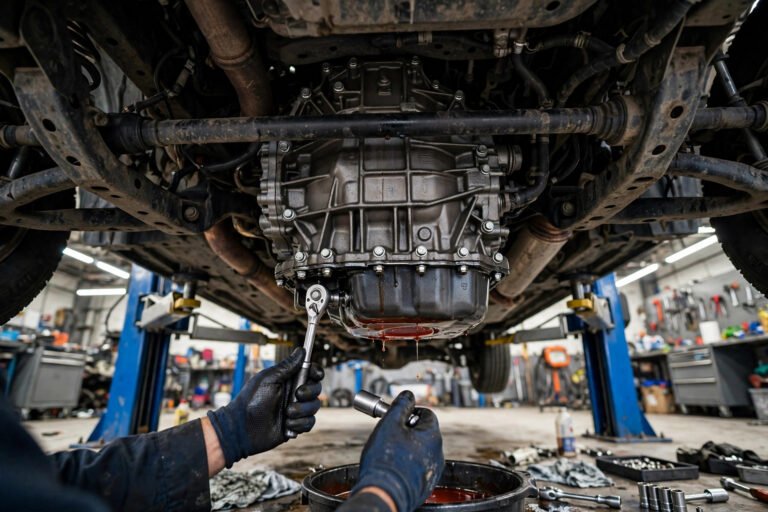
- Check the transmission fluid. Level, colour, and smell, using the correct method for your car — and look underneath for a leak. Dark fluid or visible metal particles mean shop assessment, not just a refill.
- Feel the shifter. Vague, sloppy, or misaligned travel points at linkage or cable wear — an external inspection a shop can do cheaply.
- Try the engine-off test. With the engine off, the gears should select smoothly (the input shaft is not spinning). If a gear still grinds or refuses with the engine off, the fault is mechanical — linkage, fork, or internal — not clutch drag.
- Scan for codes. A basic OBD-II scanner will not diagnose synchro wear, but on cars with electronic transmission controls it can reveal sensor or solenoid faults that mimic mechanical grinding.
When to Stop Driving and Book a Shop
Stop driving beyond getting to a shop if any of these apply: grinding in every gear that does not improve with a full clutch press; a gear that pops out on its own; a gear that will not engage at all; grinding accompanied by a burning smell, fluid leaking under the car, or a constant whine from the gearbox; or metal debris in the transmission fluid. Also book a shop promptly — even if the car still drives — when grinding is confined to one gear and getting worse week by week, because that is synchro wear progressing toward gear damage. Note the related symptom carefully: a car that dies when put in gear is a different fault (engine load or idle control, not gear clash), so do not confuse the two when describing symptoms to a mechanic.
What a Repair Usually Involves
Costs vary too much by model, by whether the fix is external or internal, and by local labour rates to quote a single number — but the shape of the job is predictable, and knowing it protects you from paying for the wrong repair. External fixes (clutch hydraulic bleeding or cylinder replacement, linkage bushings or cables, a fluid change with the correct specification) are the cheapest and should always be ruled out first. Clutch replacement is a mid-size job: the transmission must come out to reach the clutch, so labour dominates. Synchro or gear replacement is the biggest job: the transmission must come out and be opened, and a reputable shop will inspect everything inside once it is open rather than replacing one synchro blind. That is also why a rebuild-versus-replacement conversation only makes sense after inspection — a shop quoting a rebuild without opening the box, or a replacement without checking the clutch and fluid first, is skipping the diagnosis that saves you money. Get the diagnosis right first: the most expensive mistake with grinding gears is replacing a transmission when the real fault was a floor mat, a clutch hydraulic fault, or the wrong gear oil.
Frequently Asked Questions
Can I still drive with grinding gears? Yes, briefly, if it only happens occasionally — but every grind removes metal, so persistent grinding gets more expensive the longer it is driven on. Get it diagnosed promptly.
Why does my car only grind into 2nd gear? Because second gear’s synchronizer is usually the hardest-working in the box — it handles the largest speed change from first gear and is used on almost every drive. Grinding confined to one gear almost always means that gear’s synchro is worn.
Why does my car grind only when it is cold? Cold gear oil is thicker and flows more slowly, so worn or marginal synchros struggle most before the box warms up. Grinding that disappears once warm still means wear or degraded fluid — it is an early warning, not a clean bill of health.
Can low transmission fluid cause grinding? Yes. Low, dirty, or wrong-specification gear oil stops synchros from matching speeds cleanly, which produces grinding across several gears. Check the level and condition first, use only the specification in your owner’s manual, and have the fluid inspected for metal debris before assuming a refill has fixed the underlying wear.
Does double-clutching fix grinding? It can mask synchro wear on a downshift by manually matching shaft speeds, which is why it works as a diagnostic clue. It does not repair a worn synchro, and relying on it long-term still leaves the damaged parts wearing. Use it to confirm the diagnosis, then get the repair booked.
My automatic grinds when I shift into drive. Is that the same problem? No. Automatics have no synchros or clutch pedal, so grinding there usually means low or contaminated ATF, a torque-converter fault, or internal gear wear. Do not apply manual-transmission fixes to an automatic — get a transmission specialist to diagnose it.

lily John
The Fixtorial team writes hands-on car troubleshooting guides for everyday drivers — symptom first, honest costs, and fixes you can verify yourself.

One Comment