
Transmission Fluid Leak Under Car: 6 Causes & Repairs
Updated Nov 22, 2026

In This Guide
- Is It Actually Transmission Fluid Leak Under Car? (The Puddle ID Test)
- Quick Cause Match
- Cause 1: Transmission Pan Gasket (Most Common)
- Cause 2: Worn Axle or Output Shaft Seals
- Cause 3: Damaged Transmission Cooler Lines
- Cause 4: Cracked or Punctured Transmission Pan
- Cause 5: Loose Pan Bolts or Drain Plug
- Cause 6: Front Pump / Input Shaft Seal (Most Expensive)
- Free Checks Before You Pay for a Diagnosis
- Mechanic Handoff: What to Say
- 2026 Repair Cost Ranges
- FAQ
If you have a transmission fluid leak under car, a reddish puddle where you parked is one of the most alarming things a car can show you — and unlike engine oil, transmission fluid is something the car cannot afford to lose. Transmission fluid is the transmission’s lifeblood: it lubricates, cools, and provides the hydraulic pressure that engages the gears. There is no “topping it off every month” strategy here. A confirmed leak is a repair that needs scheduling within days, not weeks, because the cost compounds aggressively once the fluid drops below the minimum mark.
In this guide, you’ll learn:
- How to confirm the puddle is actually transmission fluid (not oil or coolant)
- The 6 most common leak sources, from the cheap pan gasket to the expensive front-pump seal
- Real 2026 repair cost ranges for each source, from published repair data
- The 3 free checks to do before you pay for a diagnosis
- When it’s safe to drive to the shop — and when it’s a tow call
Safety first: RepairPal’s guidance on this is clear — a small leak or seepage can be driven to the repair facility, but a car with a moderate-to-large leak should NOT be driven. If the fluid loss is severe, you may notice the engine revving when you’re not accelerating (transmission slipping), a transmission warning light, or the car dropping into a protective “limp mode” that locks it in one high gear. If any of that happens while you’re driving, pull over somewhere safe, stop the car, and call a tow. Driving on starving fluid overheats the transmission and can friction-weld internal clutches together — turning a $150 gasket job into a four-figure rebuild.
Is It Actually Transmission Fluid Leak Under Car? (The Puddle ID Test)
Before anything else, make sure the red puddle is what you think it is. Slide clean cardboard or a light-colored rag under the wet area:
| Fluid | Color | Consistency | Where it lands |
|---|---|---|---|
| Fresh transmission fluid (ATF) | Translucent red (some are green) | Thinner than engine oil, slightly sweet smell | Front or middle of the car |
| Aged transmission fluid | Dark red to brown, burnt smell | Still thinner than oil | Front or middle |
| Engine oil | Amber to dark brown/black | Thick, pungent smell | Middle to front |
| Coolant | Green, red, orange, or clear | Watery, sweet smell | Front of the car |
| Power steering fluid | Clear, brown, green, or red | Similar thinness to ATF | Front |
The two giveaways for ATF: it usually pools toward the front or middle of the vehicle (where the transmission sits), and fresh fluid is unmistakably red. If your car’s dipstick-accessible transmission, check your transmission fluid with the engine running, in Park, after the car has warmed up — a low reading plus a red puddle confirms the diagnosis.
Quick Cause Match
| What you notice | Likely cause | What to check first |
|---|---|---|
| Wetness or drips around the transmission pan’s edges | Pan gasket failure (most common) | Look at the pan’s perimeter from underneath |
| Red drip near the front wheels on a front-wheel-drive car | Axle seal leak | Check inside the front wheel wells for wetness |
| Red fluid coating the underside, dripping from multiple points | Cooler line crack or corrosion | Follow the metal/rubber lines running along the underside |
| Drip appears after hitting road debris; pan looks dented | Cracked or punctured pan | Inspect the pan’s surface for cracks or dents |
| Small seep around the pan bolts after a recent service | Loose pan bolts / drain plug | Look for fresh seepage at the bolt line |
| Leak concentrated where the transmission meets the engine | Front pump / input shaft seal | Position of the drip: right behind the engine bell housing |
Cause 1: Transmission Pan Gasket (Most Common)
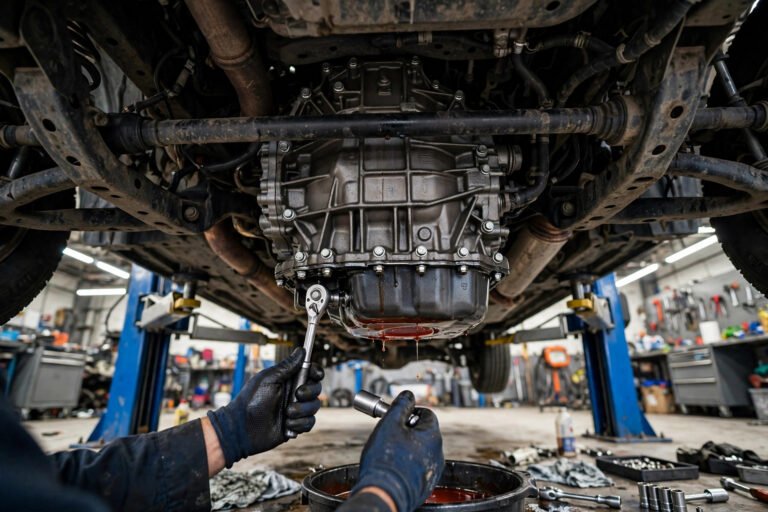
The transmission pan is bolted to the bottom of the transmission and holds several quarts of fluid. A rubber or cork gasket seals the gap between the pan and the housing. RepairPal names this the most common source of a transmission leak, and with good reason: constant heat cycles cause the gasket to harden, crack, and shrink over time. The leak usually starts as minor seepage around the pan’s edges and worsens as the gasket continues to deteriorate.
This is also one of the more encouraging repairs: it’s an external part, no transmission removal required, and the job typically takes a professional two to three hours including a fluid refill and mating-surface inspection.
Cause 2: Worn Axle or Output Shaft Seals
Wherever a spinning shaft enters the transmission case, a seal keeps the fluid in. On front-wheel-drive cars those are the axle seals at the front wheels; on rear-wheel-drive models it’s the output shaft seal at the back of the transmission. Like the pan gasket, these seals harden and shrink with age and heat cycles, then start weeping fluid around the shaft. A drip that appears just inside a front wheel well on a FWD car points here. These seals are usually accessible without pulling the transmission, which keeps labor in the middle of the range.
Cause 3: Damaged Transmission Cooler Lines
Transmission cooler lines carry hot fluid from the transmission to the cooler (usually built into the radiator) and back. They run exposed along the underside of the car, where metal lines corrode — especially with road salt — and rubber sections go brittle with age. Because these lines carry pressurized fluid, even a small crack can spray fluid across a wide area, so you may see it coating the underside of the car or dripping from multiple points rather than one clean drip. A pinhole leak in a corroded line is a common find on older vehicles in salt-belt states.
Cause 4: Cracked or Punctured Transmission Pan
The pan itself is generally thick metal, but it sits low and exposed. A hard hit on road debris can crack or puncture it — and unlike a gasket that fails gradually, this one usually starts dripping suddenly right after an impact. If a red puddle appears the morning after you heard something strike the underside, inspect the pan visually for dents or cracks. Some pans have a drain plug, and an over-tightened or cross-threaded plug can leak from that spot too.
Cause 5: Loose Pan Bolts or Drain Plug
Not every transmission leak needs new parts. Pan bolts can back off slightly over time, or a drain plug may not have been fully torqued during a service. The result is a slow seep along the pan’s bolt line — fluid weeping from between the pan and the housing rather than from a single point. This is worth ruling out before authorizing parts, because re-torquing to specification sometimes resolves a minor seep (though never over-tighten: crushed gaskets leak worse than loose bolts).
Cause 6: Front Pump / Input Shaft Seal (Most Expensive)
The input shaft seal sits where the transmission connects to the engine’s torque converter, inside the bell housing area. When it fails, the leak concentrates at the seam between the engine and transmission — right behind the engine block. The problem isn’t the seal itself (it’s a cheap part); it’s the access. Replacing it requires removing the transmission entirely, which runs six to eight hours of labor at most shops. That’s why this is the repair with the widest cost spread: same failed seal, dramatically different labor than the pan gasket.
Free Checks Before You Pay for a Diagnosis
- The cardboard test. Park over clean cardboard or newspaper overnight. The position of the drip (front, middle, or rear of the car) narrows the suspect list enormously — and a shop will ask you exactly this question.
- Fluid level and color. If your car has a transmission dipstick, check it with the engine running, in Park, fully warmed up. Low fluid + red drip = confirmed. Dark brown fluid with a burnt smell also tells you the remaining fluid has been overheating, which matters for the repair estimate.
- The three-day drip diary. Note whether the drip is one or two drops (seepage) or a spreading puddle, and whether it worsens. Small seepage that stays stable is a “schedule soon” problem; a growing puddle is a “schedule now” problem. A shop can quote more accurately when you can describe this.
Mechanic Handoff: What to Say
Tell the shop: where the drip lands (front/middle/rear), what color it is, whether the fluid level is low, and whether you’ve noticed any slipping, delayed engagement, or a warning light. Expect the inspection to include a dye test or a thorough underside inspection to pinpoint the source — because the same drip location can come from two different seals, an accurate diagnosis saves you from paying for the wrong repair.
2026 Repair Cost Ranges
These are shop averages from published repair-data sources (EngineerFix, AutoTrends, CarCareTotal). Independent shops typically run 20–30% below dealership rates on the same repair, so get two quotes on the bigger jobs:
| Leak source | Typical shop cost | Notes |
|---|---|---|
| Pan gasket replacement | $100–$410 | Often includes fluid + filter service; 2–3 hours labor |
| Cooler line repair/replacement | $100–$500 | Metal lines cost more than rubber sections |
| Axle/output shaft seals | $150–$600 | No transmission removal needed |
| Front pump/input shaft seal | $200–$900+ | Requires full transmission removal (6–8 hrs labor) |
| Pan replacement (cracked pan) | $200–$1,500 | Labor varies widely by vehicle |
The number that should motivate speed: if a leak has already caused internal damage from running low — glazed clutch packs, overheated components — repair costs can reach $1,000–$2,000 or more. The cheapest transmission leak repair is always the one done early.
FAQ
Can I drive with a transmission fluid leak?
RepairPal’s rule of thumb: small leaks or seepage can be driven to the repair facility. A moderate-to-large leak should not be driven — you can’t tell how much fluid you’re losing while in motion, and the transmission can fail from lack of lubrication. Watch for slipping (engine revving without the car accelerating), delayed engagement, or a warning light — any of those means stop and call a tow.
How do I know the leak is from the transmission and not engine oil or coolant?
Color and location. Transmission fluid is typically red (some green), thinner than engine oil, and lands toward the front or middle of the car. Engine oil is amber-to-black and thicker; coolant is watery and green, red, orange, or clear. The cardboard test makes this easy to see at a glance.
Will a stop-leak additive fix my transmission leak?
Seal-conditioner additives are marketed for very minor seepage, but they don’t repair a hardened gasket, a torn seal, a cracked line, or a punctured pan — the failed part still needs replacement. At best they’re a short-term bridge to a real repair, never the fix itself.
How fast can a transmission fail from a leak?
It depends entirely on the leak size. A slow seep with the fluid level kept up can go days or weeks, but a serious leak can drop the level below the minimum mark quickly — and once it does, overheating damages internal components fast. That’s why the drip diary matters: a growing puddle is a “this week, not next month” repair.
Does a transmission leak trigger a warning light?
Sometimes — you may see a transmission warning light, and some modern cars drop into a protective limp mode (locked in one high gear) when the control unit detects pressure loss. But don’t wait for a light: many leaks develop silently until damage is done.
Can a leak make my car act like the transmission is dying?
Yes. Low fluid causes slipping, delayed or harsh shifts, and hesitation — the same symptoms as a failing transmission. If you’ve noticed the car won’t go into gear or stalls or dies when put in gear, check the fluid level before assuming the worst: sometimes the transmission is fine and it’s simply starved of fluid.

lily John
The Fixtorial team writes hands-on car troubleshooting guides for everyday drivers — symptom first, honest costs, and fixes you can verify yourself.

5 Comments