
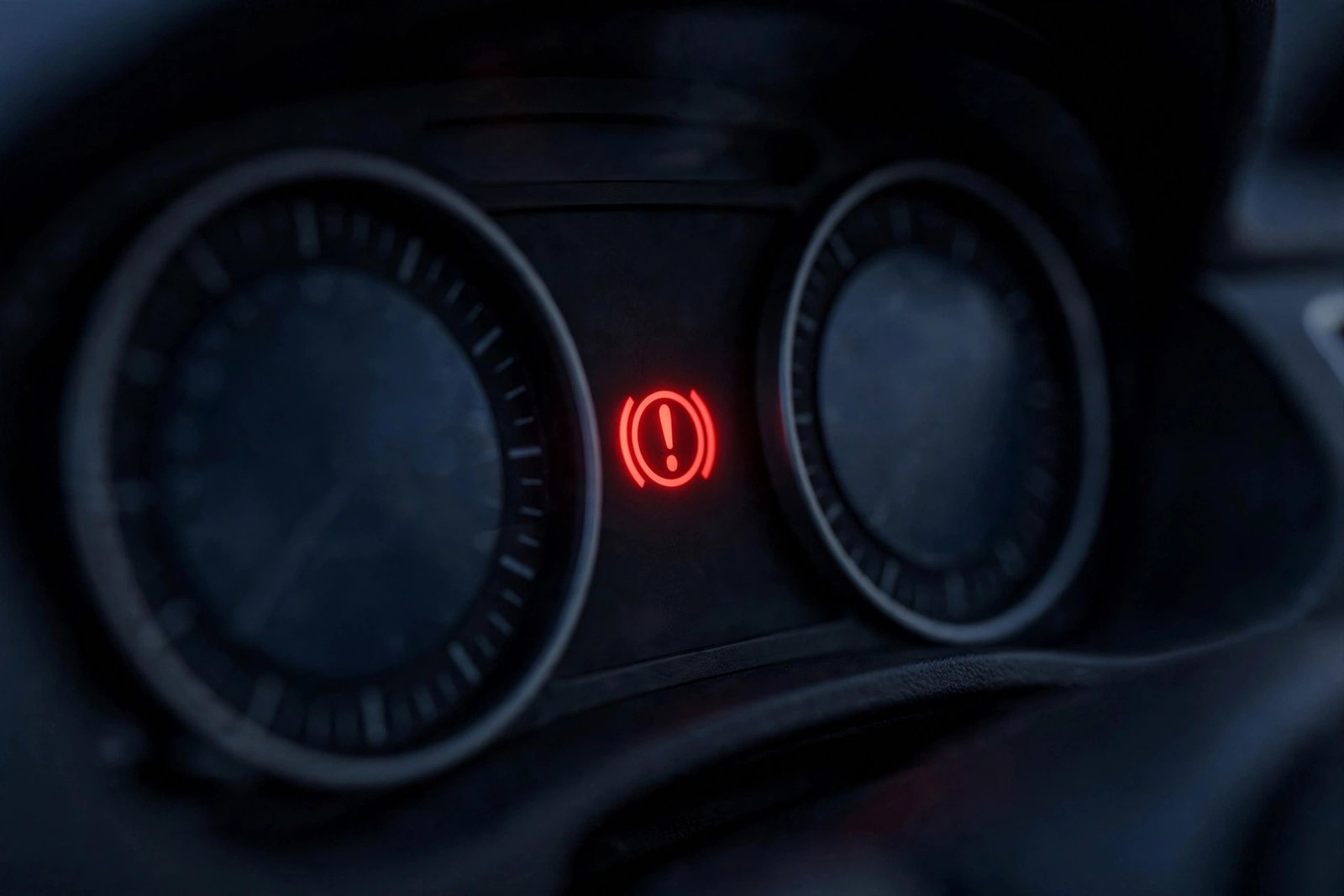
The red brake warning light is one of the few dashboard warnings you should never ignore. It’s a multi-purpose alarm: depending on the car, that same light (often a circle with an exclamation mark, or the word “BRAKE”) can mean anything from “you forgot the parking brake” to “the hydraulic system is losing pressure.” Your job as a driver is to sort the trivial from the critical in about thirty seconds — this guide shows you how.
Safety first: A red brake warning light is a stop-and-check signal, not a finish-your-errands signal. Do the 30-second checks below. If the pedal feels soft, sinks, or the stopping distance has changed, do not keep driving — arrange a tow to a certified mechanic.
In this guide, you’ll learn:
- The 30-second triage: what to check the moment the light comes on
- What each version of the light (BRAKE, (!), (P), ABS) actually monitors
- The most common triggers, in order of likelihood
- When it’s safe to drive to a shop — and when to call a tow
- What to tell your mechanic
The 30-Second Triage
- Check the parking brake. Release it fully. The #1 cause of this light is simply the parking brake still engaged — even partially. If the light goes out, you’re done.
- Look at the pedal and stopping feel. If the pedal feels normal and stops are normal, the light is likely a minor issue (sensor, pad wear). If the pedal is soft, sinks, or stopping takes longer, treat it as urgent.
- Check brake fluid — parked, safely. Under the hood, find the translucent brake-fluid reservoir and check the level against the MIN/MAX marks (don’t open the cap unless you need to top up, and only with the correct fluid type from your owner’s manual).
If the light stays on after the parking brake is fully released, or fluid is low, the car needs a certified mechanic — promptly.
What the Different Lights Monitor
- Red “BRAKE” or (!) in a circle — the main brake warning: low brake fluid, hydraulic pressure imbalance (Federal Motor Vehicle Safety Standard FMVSS 105 requires a pressure-differential warning), or the parking brake.
- (P) in a circle — parking-brake status. If it’s on while the brake is released, the switch or the system behind it needs checking.
- ABS light (amber) — the anti-lock system specifically. When it’s lit alone, standard brakes usually still work but ABS is disabled; stopping distances in hard/emergency braking can be longer. ABS warning light
- Red and flashing, or red BRAKE + ABS together — highest urgency. Minimize driving and get the car inspected immediately.
Your owner’s manual is the final authority on your car’s exact light set — this guide covers what they commonly mean.
The Most Common Triggers, in Order
1. Parking brake engaged (most common)
A switch on the parking-brake lever or pedal completes a circuit and lights the dash as a reminder. Sometimes the brake is only partially engaged or the switch sticks, so the light stays on after release. Rule this out first, every time.
2. Low brake fluid
The reservoir has a float sensor that trips the light when fluid drops below a threshold. Critical point: brake fluid is a sealed system — it doesn’t evaporate. Low fluid means pads have worn significantly (caliper pistons extend farther and draw more fluid) or there’s a leak. Both need a certified mechanic to investigate; topping up treats the symptom, not the cause. low brake fluid symptoms
3. Worn brake pads (on cars with wear sensors)
Many vehicles carry electronic pad-wear sensors that trigger the dashboard light when pads reach roughly 2–3 mm. Mechanical wear indicators just squeal; electronic ones light the dash. Either way, it means replacement time is approaching.
4. Faulty sensor or switch
Level sensors, parking-brake switches, and wiring age. A light that flickers over bumps or comes and goes with no other symptom is often electrical — but “probably a sensor” is a diagnosis a mechanic makes after ruling out the serious causes, never before.
5. ABS fault or hydraulic pressure problem (least common, most serious)
A pressure-differential switch detects imbalance between the dual hydraulic circuits — the signature of a serious leak. An ABS module fault usually pairs the ABS light with other warnings. These are certified-mechanic territory immediately.
When It’s Urgent — Stop and Tow If
- The pedal feels soft, spongy, or sinks toward the floor.
- Stopping distance is noticeably longer than normal.
- The red BRAKE light and the ABS light are both on.
- You see fluid leaking near the wheels or under the car.
- The light came on suddenly along with a change in braking feel.
Low fluid with normal pedal feel still needs a prompt shop visit — you’re driving on the warning the system gave you, and hydraulic faults don’t heal.
What to Tell Your Mechanic
“I have the red brake warning light on” is the opener; the closer is: whether the parking brake was engaged, what the fluid level showed, how the pedal feels compared to normal, when the light appeared (sudden vs. gradual), and any sounds, pulls, or smells. Those five facts let a shop go straight to the hydraulic circuit or the sensor instead of guessing.
FAQ
Can I keep driving with the brake warning light on?
If it was the parking brake, yes — once released. If the light stays on for any other reason, limit driving and see a mechanic promptly. If pedal feel has changed at all, don’t drive — tow it.
Will topping up brake fluid turn the light off?
Often yes — the float sensor just needs the level back above the threshold. But low fluid is a symptom (wear or leak), and in a sealed system it shouldn’t drop. Topping up without finding the cause is borrowing trouble.
My light flickers over bumps — what does that mean?
A level hovering near the sensor threshold (fluid slightly low) or a loose sensor/switch connection. The fluid interpretation is the safer assumption — have the level and the system checked.
Is the ABS light the same as the brake warning light?
No. The amber ABS light means the anti-lock system is disabled; your base brakes usually still work. The red brake warning light is the higher-priority alarm — it covers fluid, hydraulics, and the parking brake.