
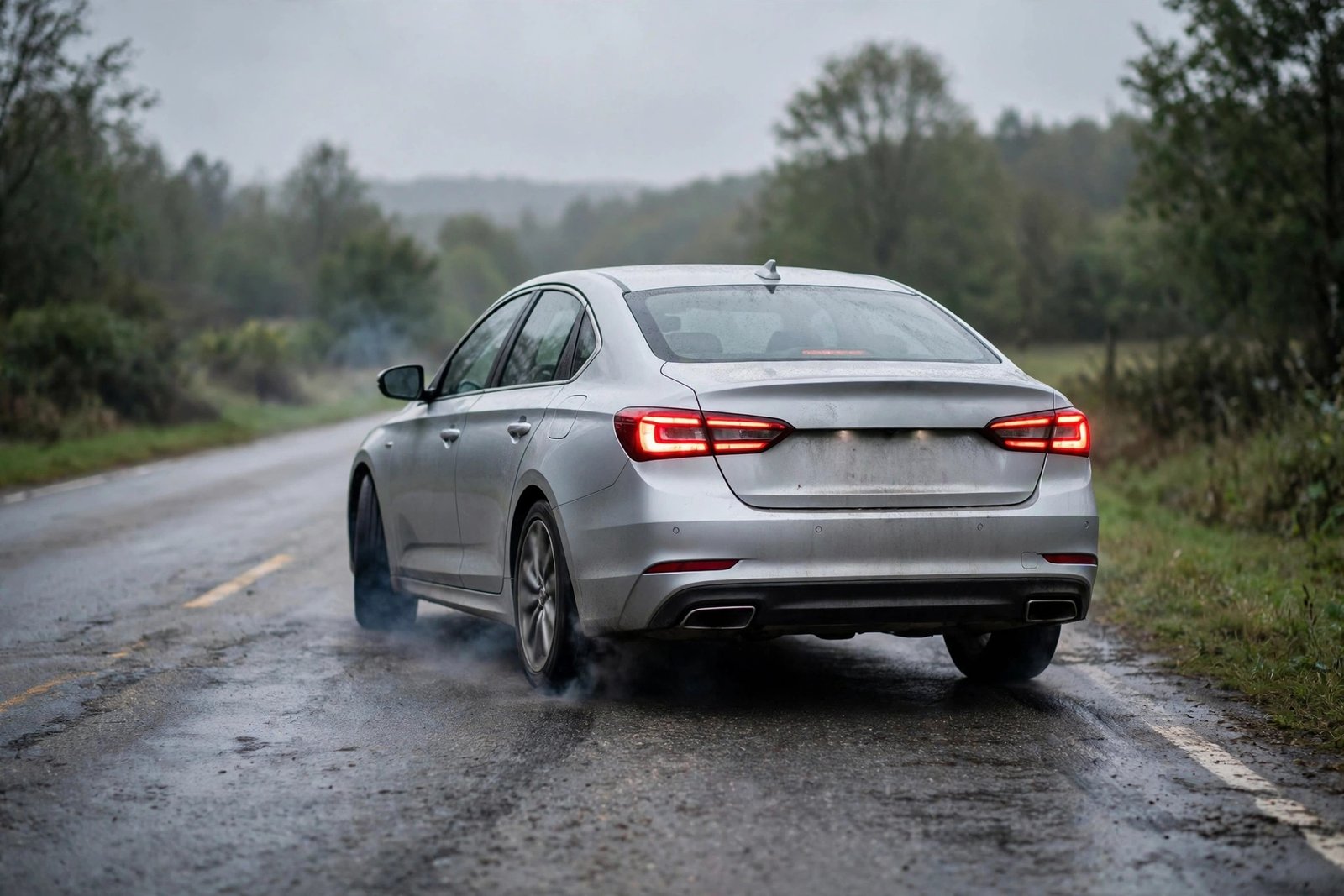
If your car drives straight and only veers left or right when you press the brake pedal, the problem is almost certainly in the braking system — not the wheel alignment. One side of the car is generating more (or less) stopping force than the other, so the car rotates toward the harder-working side. The harder you brake, the harder it pulls — which is exactly why this symptom deserves attention before it becomes a sharp veer in an emergency stop.
This guide walks the symptom, in order of likelihood, and tells you what to report to a certified mechanic. Diagnosis only — brake repair is safety-critical shop work.
Safety first: A mild pull in normal braking becomes a dangerous veer under hard emergency braking, because the imbalance scales with braking force. Avoid highway speeds, leave extra following distance, and don’t wait — get the car inspected promptly. If the pull is sudden or violent, minimize driving.
In this guide, you’ll learn:
- The one-question test that separates brakes from alignment
- The most common causes, in order of likelihood
- A safe hands-off heat check that identifies the dragging corner
- Non-brake causes that mimic the symptom
- What to tell your mechanic so the diagnosis is fast
The One-Question Test: Brakes or Alignment?
It tracks straight hands-off, then pulls only when you brake — braking imbalance. That’s this article.
It drifts to one side while cruising, hands off, whether or not you brake — wheel alignment or tire issue. Still see a mechanic, but it’s a different diagnosis (alignment, tire pressure, suspension).
It pulls when braking AND the steering wheel shudders — often a braking imbalance with a warped rotor or stuck caliper on one side. Note both symptoms together.
This distinction matters: if the pull only happens under braking, an alignment won’t fix it.
The Most Likely Causes, in Order
1. Sticking caliper (most common)
The caliper is the hydraulic clamp that squeezes the pads against the rotor. It slides on guide pins that must move freely. When pins corrode or the piston sticks, the caliper can fail two ways — and each pulls differently:
- Stuck open (dragging): the pad never fully releases. That corner runs hot, wears its pads fast, and grabs sooner than the other side — the car pulls toward the stuck side, every time you brake, often with a burning smell from that wheel.
- Stuck closed (not applying): that wheel contributes little braking force — the car pulls away from it, toward the working side.
What to look for (without touching): after a normal drive, hold the back of your hand a few inches from each front wheel. A dragging brake runs noticeably hotter on the affected corner. Do not touch hot brakes — hover only.
2. Collapsed or restricted brake hose
A deteriorated inner lining of a flexible brake hose can act like a one-way valve: it lets fluid pressure in when you press the pedal but traps it after you release — keeping that brake partially applied. The sinister part: the hose often looks perfectly normal from the outside. Diagnosis requires a mechanic to test the hydraulic circuit at that wheel.
3. Contaminated brake pads
Oil or grease — from a torn CV boot, a weeping seal, or spilled fluid — reaching a pad’s friction surface lowers its grip. The other side bites harder and the car pulls toward the clean side. Contaminated pads can’t be cleaned and reused; the fix includes addressing whatever put the contamination there.
4. Uneven pad wear
Pads that are far thinner on one side of the axle indicate a mechanical problem (often the sticking caliper above) rather than normal wear. Uneven wear between left and right is always a symptom of something else — never “just” worn pads.
5. Non-brake mimics: tires and suspension
- Uneven tire pressure between the front pair shifts grip side to side; it’s the cheapest check there is.
- Worn suspension components (control arm bushings, tie rods) let a wheel shift position under braking load.
- Road crown — roads slope for drainage, so a slight drift on crowned roads is normal. This one follows the road, not the pedal.
Simple Observations You Can Make Safely
Observation only — no wrenches, no touching hot parts.
- Run the one-question test: hands off, straight-line cruise — does it drift? Then brake gently, then firmly (in a safe, empty area). Note exactly when the pull appears.
- Check tire pressure: look up the correct pressures in the owner’s manual or door-jamb sticker and check all four with a gauge, cold. Uneven front pressure is a free fix that mimics this exact symptom.
- Hover-check wheel heat: after a normal drive, hover the back of your hand a few inches from each wheel. One wheel noticeably hotter than the rest points to a dragging brake on that corner. Never touch brake components.
- Note the smell and the wear: a burning smell from one corner, or one wheel with visibly dustier/darker buildup, strengthens the stuck-caliper case. Report it; don’t investigate further.
- Capture the history: sudden or gradual? After rain, sitting, or recent brake work? Any warning lights? Mechanics solve “pull” cases faster with this timeline.
When to See a Mechanic Promptly
- Any pull that only happens when braking — it gets worse with braking force, so emergency stops are the risk.
- Heat, burning smell, or visible smoke from one wheel.
- Pull plus grinding, pulsing pedal, or a warning light.
- A violent or sudden change in behavior — minimize driving.
What to Tell Your Mechanic
“Pulls left/right only when braking” is the key sentence — it tells them to skip the alignment rack and test the hydraulic circuit. Add: which direction, whether it’s every stop or intermittent, which corner felt hotter (if you checked safely), tire pressures, and when it started. Shops can verify a dragging caliper quickly once they know which corner to test.
FAQ
Is it the brakes or the alignment?
If the car only pulls when you press the brake pedal, it’s the brakes. Alignment pulls are present while cruising, hands off, with or without braking.
Why does the pull get worse when I brake hard?
The imbalance is proportional to braking force. A small asymmetry under gentle braking becomes a hard veer under hard braking — one reason not to ignore a “mild” pull.
Can low tire pressure cause this?
Yes — uneven pressure between the front tires changes grip side to side and mimics a brake pull. It’s the first thing to rule out, because it’s free to check.
My car pulls toward the side that smells hot — what does that mean?
Heat plus pull toward the same corner strongly suggests a dragging/sticking caliper on that side. Get it inspected promptly — a dragging brake overheats and can lengthen stopping distances.