
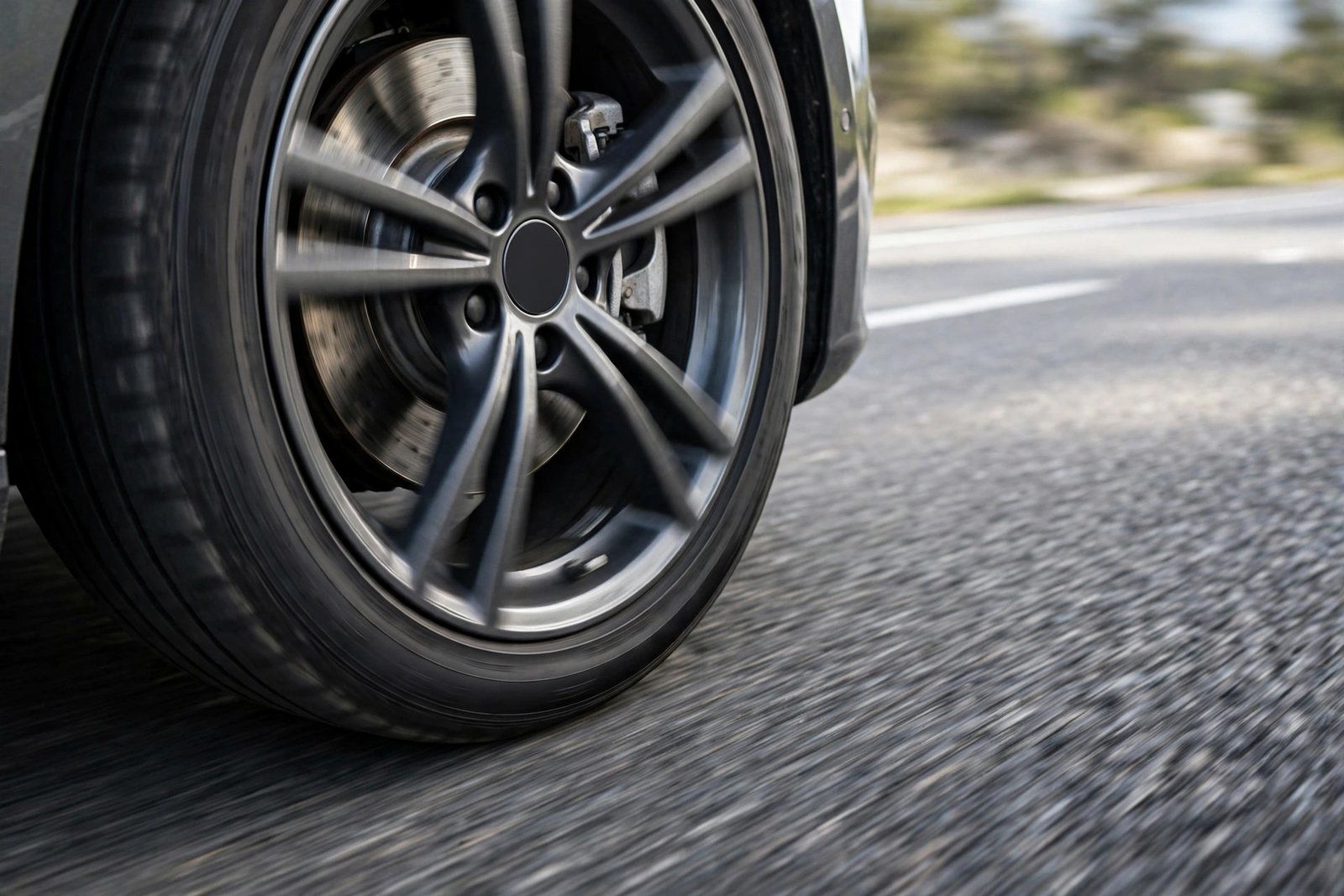
A low hum that starts as faint road noise and grows louder the faster you go is one of the most-misdiagnosed sounds in a car. Many drivers chase it for months — new tires, alignments — when three simple road tests would have pointed at the wheel bearing in an afternoon.
In this guide, you’ll learn:
- The three road tests that separate a wheel bearing from tire noise
- The most common causes, in order of likelihood
- How to tell which wheel is the culprit
- When a hum becomes a “stop driving” problem
Safety first: A failing wheel bearing is a rotating-part failure — in the late stages it can seize or, in extreme cases, let the wheel separate. Do the road tests below at normal traffic speeds on a safe, open road. If the hum has become a loud grind, skip the tests and drive straight to a shop.
The Key Question: Does the Hum Follow Road Speed or Engine Speed?
This single question eliminates half the suspects:
- Follows road speed (gets louder/higher-pitched as the car goes faster, regardless of gear or RPM) → wheel bearing, tires, or drivetrain. Keep reading.
- Follows engine speed (changes when you rev in Park, or changes with gear at the same road speed) → belt, pulley, or engine accessory. See the belt/whine guides in the Noises & Vibrations hub.
The Three Road Tests
Do these on a quiet stretch of road, radio off.
Test 1: The neutral-coast test (bearing vs engine/drivetrain)
At a speed where the hum is clear (say 50–60 mph), shift to Neutral and let the engine idle while you coast. If the hum persists unchanged, the engine and transmission are ruled out — the sound is coming from something that spins with the wheels: bearing or tires.
Test 2: The weave test (find the bad bearing)
Gently weave left and right within your lane at speed. Turning loads the outside wheels — so if the hum gets louder when you steer left, the right-side bearing is the suspect (it’s carrying more weight), and vice versa. A hum that changes pitch or volume through turns is the classic wheel-bearing signature. Tire noise, by contrast, stays roughly constant through turns.
Test 3: The road-surface test (bearing vs tire)
Drive the same speed over different surfaces — smooth new asphalt vs coarse concrete. Tire noise changes dramatically with the surface; bearing noise doesn’t. If the hum is identical on glass-smooth asphalt and rough concrete, it’s the bearing.
The Most Likely Causes, in Order
1. Worn wheel bearing (most common)
Bearings let the wheels spin freely under the car’s full weight. When the grease seal fails, lubricant escapes, grit enters, and the rolling elements pit — producing a low hum that rises with speed, progresses to a growl, and finally a grind. The weave test is the giveaway: noise changes with cornering load.
2. Uneven tire wear — cupping or feathering
Cupped tires (alternating high/low spots around the tread) produce a rhythmic hum easily mistaken for a bearing. Feathered edges (saw-tooth tread blocks) slap the pavement. Tire noise changes with road surface (Test 3) and often changes character after a tire rotation — a hum that moves after rotating tires is a tire problem, not a bearing.
3. Failing differential or drivetrain component
A hum that changes when you apply or release the throttle — present under load, gone when coasting in Neutral — points at the differential or transfer case rather than a bearing. Bearings hum regardless of load.
4. Bent wheel or internal tire damage
A bent rim or a separating tire belt creates a speed-dependent thump/hum with a once-per-revolution rhythm. Check for visible wobble, bulges, or uneven wear.
Simple Checks You Can Do Yourself
- Hands on the tire: Run your palm around the tread of each tire (engine off, car parked). Cupping feels like scalloped dips; feathering feels sharp one way and smooth the other. Uneven wear = tire noise suspect.
- The spin test (only if you’re comfortable and the car is safely supported): With the suspect wheel off the ground, spin it by hand and listen for grinding or roughness. Rock the wheel top-to-bottom — noticeable play suggests a worn bearing. Use proper jack stands; never rely on the jack alone.
- Tire pressure: Under-inflated tires hum more and wear unevenly. Check pressures against the door-jamb sticker, not the tire sidewall.
- Mileage context: Bearings commonly fail after high mileage or after pothole/curb impacts and water exposure. A hum that started right after you hit a pothole is a strong clue.
When to See a Mechanic — Soon vs Now
Soon (this week): A mild hum that passes the weave test. Bearings wear progressively; catching it at the hum stage is a routine repair.
Now (drive straight there, avoid highways): The hum has become a growl or grind; you feel vibration in the steering wheel or seat; the wheel has play. A severely worn bearing can overheat, seize, or damage the hub — and in extreme neglect cases the wheel can separate.
Ask the shop to check: Request they distinguish bearing vs tire before replacing anything — a road-force balance and a stethoscope check on a lift take minutes and prevent a wrong-guess bearing replacement.
FAQ
Can I drive with a humming wheel bearing?
A mild hum: yes, to a shop, but don’t ignore it for months — the window between “I hear something” and serious failure can be shorter than drivers expect. A grind: minimize driving.
Why does the noise get louder when I turn one way?
Turning shifts the car’s weight onto the outside wheels, loading those bearings harder. A damaged bearing gets louder under load — which is also how you identify which side is bad.
New tires didn’t fix the hum — now what?
That’s actually diagnostic information: it points away from tires and toward the bearing. Tell the shop the tires are new so they don’t re-chase that path.
Is it the front or rear bearing?
Front-bearing noise often comes through the steering wheel and changes with steering input; rear-bearing noise is more of a cabin drone. The weave test plus a shop’s lift check pin it down.
Sources
- motoringchronicle.com — “What a Grinding or Humming Noise From Your Car’s Wheels Actually Means for Your Safety” (speed-dependent hum = bearing; turn test; seizure risk) — https://motoringchronicle.com/what-a-grinding-or-humming-noise-from-your-cars-wheels-actually-means-for-your-safety/
- engineerfix.com — “Why Is My Car Making a Humming Noise When Driving?” (cornering load test; bearing vs tire distinction) — https://engineerfix.com/why-does-my-car-make-a-humming-noise-when-driving/
- engineerfix.com — “Why Does My Car Make a Humming Noise When Accelerating?” (coast-in-neutral test; cupping/feathering) — https://engineerfix.com/why-does-my-car-make-a-humming-noise-when-accelerating/
- webuyanycarusa.com — “Car Noises and What They Mean: 9 Sounds Not to Ignore” (bearing hum vs cupped tires; urgency framing) — https://www.webuyanycarusa.com/blog/car-noises-what-they-mean
- yourmotorcare.com — “Humming Noise Getting Louder: Causes Guide” (rotational-frequency explanation of speed-dependent hum) — https://yourmotorcare.com/humming-noise-getting-louder-with-speed/