
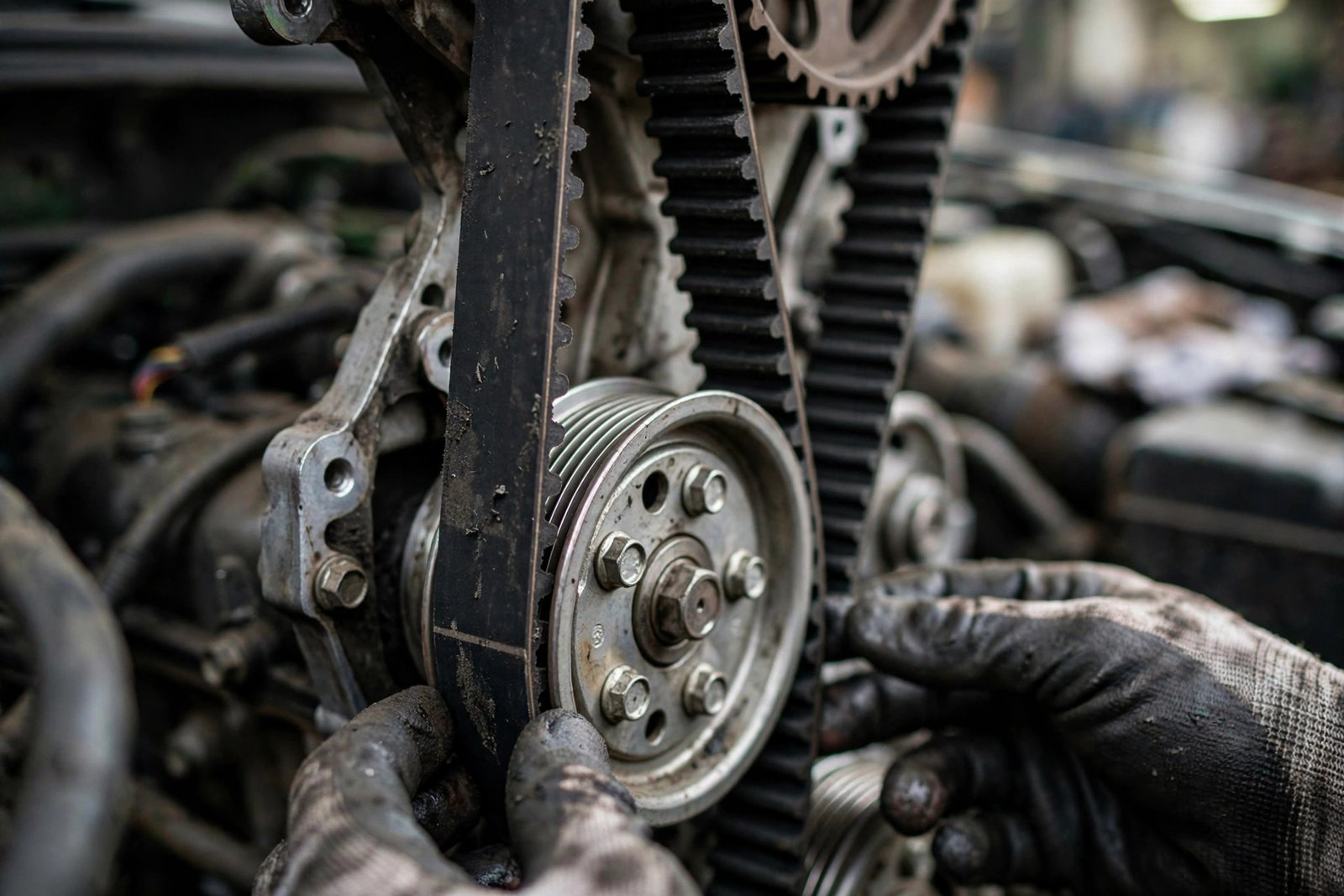
The timing belt or chain is the one part that can turn a maintenance item into an engine replacement. It synchronizes the crankshaft and camshaft — keeping valves and pistons moving in precise choreography. When that choreography fails, the consequences range from a tow truck to a destroyed engine. Here's how to know which system your car has, what wearing-out looks like, and when to act.
Scope note: timing component replacement is professional work — it requires precise alignment, special tools, and on interference engines a single mistake bends valves. This article is diagnosis and decision-making; the wrenching belongs to a certified mechanic.
Step 1: Which One Does Your Car Have?
This is the question to answer first, because everything else follows from it:
- Check your owner's manual — it lists the timing system and the replacement interval if it's a belt.
- Call a dealer parts department with your VIN — they can tell you in 30 seconds.
- Rough pattern (not a rule): many Honda, Toyota (older models), VW/Audi, and Hyundai/Kia engines use belts; most modern American V8s, BMWs, and newer designs use chains. But there are countless exceptions — verify for your specific engine.
Belt vs Chain: The Honest Comparison
| Timing Belt | Timing Chain | |
|---|---|---|
| Material | Reinforced rubber with teeth | Metal, like a heavy bicycle chain |
| Replacement | Scheduled — typically every 60,000–100,000 miles (check manual; time limit often ~6 years regardless of miles) | Usually "lifetime" — replaced only when worn/failing |
| Replacement cost | Generally $500–$900 (economy/mid-size); $1,000+ luxury — varies widely by engine and labor access | Generally $1,000–$3,000+ — more labor-intensive |
| Failure mode | Often sudden, with little warning | Usually gradual — gives symptoms first |
| Noise | Quiet | Slightly more mechanical noise, worse when worn |
(Cost ranges: typical US shop estimates reported by automotive guides, verified 2026-10-14; your engine's labor access dominates the final number.)
Why It Matters: Interference Engines
In most modern engines (called interference designs), the valves and pistons share the same space at different times — the timing system is what keeps them from colliding. If a belt snaps or jumps timing in an interference engine, pistons hit valves: bent valves, damaged pistons, possibly a destroyed cylinder head. That's a multi-thousand-dollar repair — or a totaled engine on an older car.
Non-interference engines just stop running — annoying, but no internal collision. Your manual or a mechanic can tell you which yours is. This is why belt replacement intervals are not suggestions.
Symptoms of a Worn Timing BELT
Belts often fail with minimal warning — that's what makes the interval sacred. Warning signs when they appear:
- Ticking or slapping noise from the front of the engine
- Engine misfires or rough running (belt may have jumped a tooth)
- Difficulty starting or sudden stalling
- Visible cracks, fraying, glazing, or missing teeth (if the cover allows inspection)
- Oil leaking from the front of the engine near the timing cover (can degrade the belt)
The real rule for belts: replace on schedule, not on symptoms. Waiting for symptoms is gambling with an interference engine.
Symptoms of a Worn Timing CHAIN
Chains stretch gradually and usually announce themselves:
- Rattling on cold startup that fades as oil pressure builds (the classic sign — worn chain/tensioner)
- Persistent rattle or maraca-like noise at idle
- Check engine light with cam/crank correlation codes (P0016/P0017 range)
- Rough idle, loss of power
- Metal shavings in the oil (advanced wear)
Chains and oil: the chain lives inside the engine, bathed in engine oil. Neglected oil changes are the #1 chain killer — dirty oil wears chains, guides, and tensioners prematurely. Your oil-change habits directly determine your chain's life.
The Used-Car-Buyer Angle
If you're buying a used car with a timing belt: verify the belt service history. No records? Budget for immediate replacement — a seller's "it was probably done" isn't worth an engine. For chain engines: listen for cold-start rattle on the test drive and check the oil-change history.
When to Act (Urgency Guide)
- Belt at/over interval (miles OR years): book replacement now — this is preventive, not optional
- Cold-start rattle (chain): inspect soon — it's wearing, not failed yet
- Belt snapped / engine died suddenly with no restart: tow it — do not keep cranking (cranking an interference engine with a snapped belt just causes more valve damage)
Common Mistakes
- "Lifetime" belt thinking. Belts have time limits too — rubber ages. A 7-year-old belt with 50,000 miles is still due on many schedules.
- Replacing the belt but not the tensioner, idlers, and water pump. They're all in the same area, all wear items — doing the belt alone and paying the same labor again a year later is the classic false economy. (Mechanics routinely recommend the full kit.)
- Ignoring oil changes on a chain engine. The chain's life is your oil-change discipline.
- Assuming "chain = never worry." Modern smaller chains and tensioners do wear — listen for the cold-start rattle.
FAQ
Can I tell belt vs chain by listening?
Not reliably. Chains are slightly noisier in general, but a healthy chain vs a belt isn't distinguishable by ear. Check the manual.
Does a timing belt give warning before snapping?
Usually very little — that's the danger. Ticking, misfires, or visible wear sometimes appear, but many belts fail suddenly. The interval is the warning system.
Why is chain replacement so expensive?
Labor: the chain is inside the engine, often behind multiple covers, sometimes requiring engine mount removal or partial engine-out access. The part is cheap; the hours aren't.
My mechanic says replace the water pump with the belt — upsell?
Usually legitimate. On many engines the water pump is driven by the timing belt and sits behind the same covers — replacing it during the belt job costs the part only, versus full labor later.
Sources
- RetroCarsMag — "Timing Belt vs Timing Chain: What's the Difference?" (symptom lists for both; belt $400–$2,000+ by vehicle class; chain $1,000–$4,500+; oil-change habits and chain life) — https://retrocarsmag.com/timing-belt-vs-timing-chain-whats-the-difference/
- TorqBull — "Timing Belt vs Timing Chain Differences" (belt 60,000–100,000 mi; chain life-of-engine with maintenance; sudden vs gradual failure; cold-start chain rattle; used-car-buyer angle) — https://torqbull.com/timing-belt-vs-timing-chain-whats-the-difference/
- FordFast — "Timing Belt Replacement Interval" (60,000–100,000 mi guide; warning signs; average $500–$900; water pump/tensioner/idler recommendation) — https://fordfast.com/timing-belt-replacement-interval-what-you-need-to-know/
- Central Vermont Auto Mart — "Timing Belt or Timing Chain?" (pros/cons; belt 60k–100k, modern belts 100k–120k+; chain rattle/metal shavings/CEL symptoms; oil habits critical for chains) — https://www.centralvermontautomart.com/discover-more/service/timing-belt-vs-timing-chain-central-vermont.htm
- DailyDriven.ro — "Engine Timing: Belt vs Chain, Wear Symptoms, Replacement" (belt visual/auditory symptoms; chain cold-start rattle; interference-engine consequences) — https://dailydriven.ro/en/engine-timing-belt-vs-chain-wear-symptoms-replacement-1594903
how often to change engine oil