
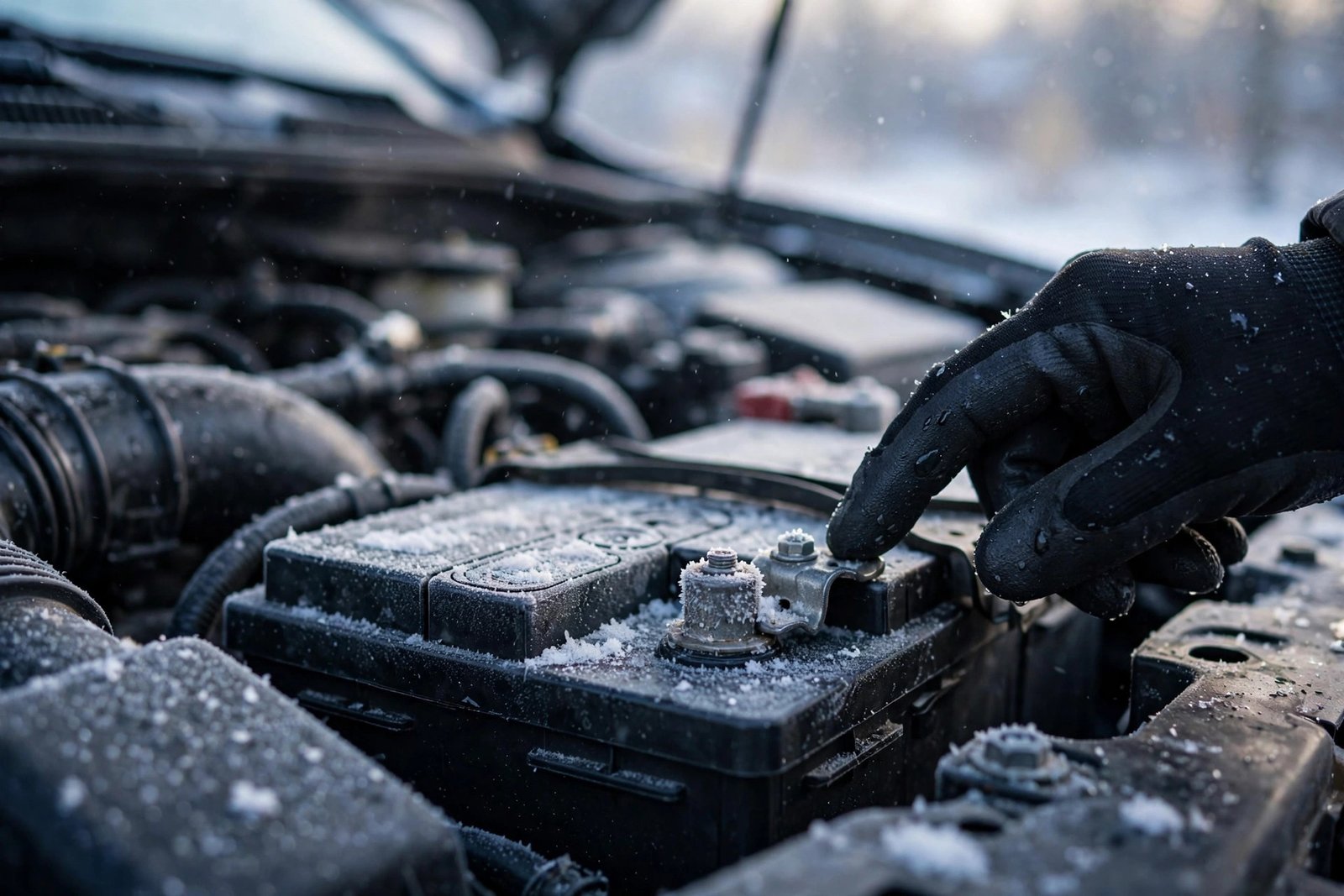
Cold is a battery's worst enemy. Chemical reactions inside the battery slow down as temperature drops — a battery can lose a large share of its starting power below freezing (the Battery Council International has cited losses up to ~60% in freezing temperatures) — while the engine simultaneously needs more power to crank through thickened oil. That's the double hit that strands people on the first truly cold morning. A 30-minute pre-winter routine prevents most of it.
Step 1: How Old Is Your Battery?
Find the date sticker on the battery case (month/year). Most car batteries last 3–5 years.
- Under 3 years: likely fine — continue with the checks below.
- 3–4 years: get it tested before winter (most auto parts stores do this free).
- 5+ years: you're on borrowed time in cold weather. Proactive replacement beats a tow truck in January.
Step 2: Check the Voltage (12.6V Rule)
With the engine off and the car sitting for a few hours, a healthy fully-charged battery reads ~12.6V at the terminals (multimeter, $15 tool). Roughly 12.4V = ~75% charged; 12.0V = ~25% — that's a battery that won't survive a cold snap. Below 12.4V resting, charge it or have it tested.
Step 3: Clean the Terminals
White, green, or blue crusty buildup on the terminals adds resistance — and in winter, when every amp counts, resistance is what turns a slow crank into a no-start.
- Ignition OFF. Disconnect the negative cable first, then positive.
- Scrub posts and clamps with a wire brush (baking soda + water paste for heavy corrosion).
- Reconnect positive first, then negative, snug but not gorilla-tight.
- A dab of dielectric grease or a corrosion-inhibitor spray on the terminals slows regrowth.
Step 4: Check the CCA Rating
Cold Cranking Amps (CCA) = how much current the battery can deliver at 0°F. It's printed on the battery label. Make sure your battery meets or exceeds your car's specified CCA — a battery sized for Florida summers will struggle in Minnesota Januaries. When replacing, buy for your climate, not just your car.
Step 5: Fix the Short-Trip Habit
This is the silent winter battery killer: short 5-minute trips don't give the alternator enough time to recharge what starting took out. Each cold start is a withdrawal; only sustained driving repays it. In winter:
- Combine errands into one longer drive when you can
- Take a 20–30 minute highway drive weekly if your routine is all short hops
- If the car sits for days/weeks, a battery maintainer (trickle charger) keeps it topped up — cheap insurance for stored or rarely-driven cars
Step 6: Reduce the Load, Park Smart
- Before starting on a frigid morning: turn off headlights, heater/blower, heated seats, and rear defroster — give the battery every available amp for cranking. Turn accessories back on after the engine's running.
- Park in a garage when possible — even an unheated garage moderates the cold significantly.
- Battery blankets/warmers (plug-in wraps) help in extreme-cold regions — follow the product's and your manual's instructions.
- Unplug phone chargers and dashcams when parked — small parasitic drains add up over cold days.
The "Why" in 30 Seconds
Heat actually does the long-term damage (summer heat accelerates internal corrosion), but cold exposes the weakness — a battery marginal in October fails in January because available power drops while cranking demand rises. That's why pre-winter testing matters: you're finding October's marginal battery before January does.
When to Replace vs Maintain
Maintain (clean, charge, test): battery under ~4 years old, passes a load test, holds 12.6V resting.
Replace: 5+ years old, fails a load test, slow cranking even when charged, swollen/cracked case, or needs jump starts with no obvious cause (lights left on, etc.).
FAQ
Will idling the car warm up the battery?
Idling recharges slowly and doesn't warm the battery meaningfully. Driving is far more effective — the alternator works harder under load.
Does cold weather damage the battery permanently?
Cold itself mainly reduces available power temporarily. But a discharged battery can freeze (the electrolyte is mostly water when discharged), and a frozen battery can crack — that's permanent. Keeping it charged is the protection.
Should I disconnect the battery if storing the car for winter?
A battery maintainer is better — it keeps the battery healthy without losing the car's computer settings. If you must disconnect, negative terminal first.
My car has start-stop — anything different?
Start-stop cars use AGM or EFB batteries, which cost more. Replace with the same type — a conventional flooded battery won't survive start-stop cycling. The winter checklist still applies.
Sources
- Batteries Plus — "Test your car battery before winter hits!" (terminal cleaning; 15–20 min drives to recharge; battery blanket; AGM for severe winters; free battery testing) — https://www.batteriesplus.com/blog/power/winter-car-battery-test
- AutoNation Mobile Service — "Can a Car Battery Die from Cold + How to Protect It" (annual pre-winter test; correct CCA for climate; reduce electrical load before starting; longer drives) — https://www.autonationmobileservice.com/i/blog/car-battery-die-from-cold/
- Firestone Complete Auto Care — "Why Your Car Battery Dies in Winter" (CCA rating for climate; park indoors; limit electrical usage before starting; battery blanket) — https://www.firestonecompleteautocare.com/blog/batteries/why-car-batteries-die-in-winter/
- PoweringAutos — "Can Cold Weather Discharge Your Car Battery?" (BCI 2021: up to 60% starting-power loss below freezing; test/clean/replace; maintainer for stored cars) — https://poweringautos.com/can-cold-weather-discharged-car-battery/
- Commercial Carrier Journal / Interstate Batteries — "Cold weather battery tips" (cold thickens oil → harder cranking; test starting/charging system; keep connections tight) — https://www.ccjdigital.com/trucks/vocational/article/15046186/cold-weather-battery-tips
car won't start in cold weather