
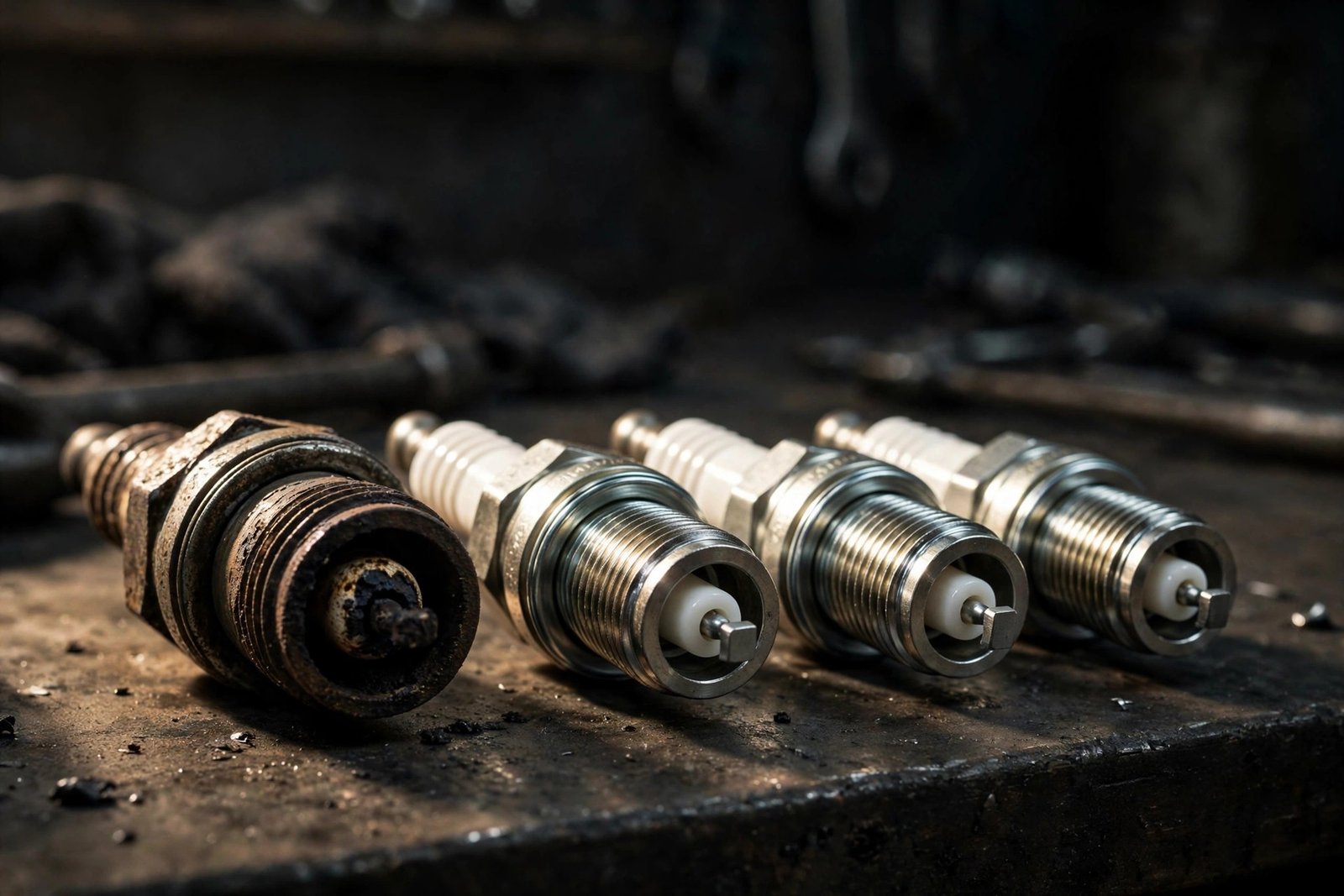
Spark plugs are small, cheap, and easy to ignore — until they start misfiring and turn a cheap part into an expensive catalytic converter repair. The tricky part: they wear gradually, so the symptoms creep up and you get used to them. This guide covers the symptom list, the honest replacement intervals (they vary hugely by plug type), and the one warning sign that means stop driving.
Symptoms of Worn Spark Plugs
- Engine misfires / stumbling — hesitation or jerking under acceleration; the check engine light may come on with misfire codes (P0300–P0308)
- Rough idle — shaking or uneven idle, often worse when cold
- Hard starting — extended cranking, especially cold or damp mornings
- Sluggish acceleration — flat, hesitant response when you press the pedal
- Worse fuel economy — fewer miles per tank than usual
- Engine vibration felt through the seat or steering wheel
- Fuel smell or popping from the exhaust — raw fuel odor means unburned fuel is reaching the exhaust
The flashing-light rule: a flashing check engine light means an active misfire is dumping unburned fuel into the catalytic converter, which can overheat and destroy it. Stop driving and get it checked now. A steady light = book service soon; a flashing light = stop.
Replacement Intervals — By Plug Material (This Is the Key)
There is no single spark plug interval. It depends on what your car came with:
| Plug type | Typical interval | Notes |
|---|---|---|
| Copper / nickel | ~20,000–30,000 miles | Older cars, cheapest plugs, shortest life |
| Platinum | ~50,000–60,000 miles | Common in many 2000s–2010s cars |
| Iridium | ~60,000–100,000 miles | Most modern cars; longest life |
Your owner's manual is the authority — it specifies both the interval and the plug type for your engine. Always replace with the type the manufacturer specifies; "upgrading" to a different plug design the engine wasn't calibrated for is rarely beneficial.
Factors that shorten plug life: frequent short trips, stop-and-go traffic, oil contamination (worn valve seals), and poor fuel quality (carbon deposits).
Plug Problem or Coil Problem?
Worn plugs and failing ignition coils cause nearly identical symptoms (misfire, rough idle, flashing CEL). The practical split:
- All cylinders aging together, high mileage, gradual onset → plugs are the prime suspect. Replace the full set (never mix old and new plugs).
- Sudden misfire on one cylinder, especially after the plugs were recently done → suspect the coil on that cylinder.
- A scan tool settles it: a P030X code identifies the cylinder; moving the coil to another cylinder and seeing if the code follows is the classic coil test. If you're not comfortable with this, a shop diagnoses it in minutes.
What Worn Plugs Cost You If Ignored
This is the part that justifies the article: neglected plugs don't just run rough.
- Catalytic converter damage — unburned fuel overheats the catalyst; converter replacement is one of the priciest exhaust repairs
- Ignition coil overload — worn plugs with eroded gaps force coils to work harder, shortening coil life
- Fuel waste and emissions — incomplete combustion across thousands of miles
- Hard-start wear — extended cranking strains the starter and battery
The parts themselves are cheap (typically a few dollars to ~$20 per plug); professional replacement commonly runs in the low hundreds including labor, varying by engine (some V6/V8 plugs are buried under intake components). Catch it at the symptom stage and it's one of the cheapest fixes on the car.
What Worn Plugs Cost You If Ignored
This is the part that justifies the article: neglected plugs don't just run rough.
- Catalytic converter damage — unburned fuel overheats the catalyst; converter replacement is one of the priciest exhaust repairs
- Ignition coil overload — worn plugs with eroded gaps force coils to work harder, shortening coil life
- Fuel waste and emissions — incomplete combustion across thousands of miles
- Hard-start wear — extended cranking strains the starter and battery
The parts themselves are cheap (typically a few dollars to ~$20 per plug); professional replacement commonly runs in the low hundreds including labor, varying by engine (some V6/V8 plugs are buried under intake components). Catch it at the symptom stage and it's one of the cheapest fixes on the car.
Common Mistakes
- Replacing plugs one at a time as they fail. They wear as a set — replace them all.
- Wrong gap or wrong plug type. Even pre-gapped plugs can shift in shipping; verify the gap against your manual's spec.
- Over-tightening. Stripped threads in an aluminum cylinder head turn a cheap job into an expensive one. Use a torque wrench to the manual's spec.
- Ignoring a flashing check engine light and "driving it to the shop next week." Active misfires kill catalytic converters.
- Assuming new plugs fix every misfire. Coils, injectors, vacuum leaks, and compression issues misfire too — if new plugs don't fix it, diagnose further.
When to See a Mechanic
- Flashing check engine light (stop driving; tow if it's severe)
- Misfire persists after plug replacement (coil/injector/compression diagnosis needed)
- Oil-fouled plugs (points to valve seals or piston rings — an engine issue, not a plug issue)
- Plugs are inaccessible without major disassembly (some transverse V6s) — labor cost may favor a shop
FAQ
Can bad spark plugs cause a car not to start?
Yes, especially on 3- or 4-cylinder engines where one dead cylinder is a large fraction of total power. On a V8, one bad plug usually means rough running rather than a no-start.
How long can I drive on worn spark plugs?
Mild wear: weeks to months, with gradually worsening MPG and performance. Active misfiring (flashing CEL): not at all — you're risking the catalytic converter with every mile.
Do I need to replace ignition coils with the plugs?
Not automatically. Coils are replaced on failure, not on schedule. But if a coil fails, it's often sensible to do plugs at the same time if they're due.
Are expensive iridium plugs worth it?
If your manual specifies them, yes — use them. If your car came with copper plugs, "upgrading" to iridium without a manufacturer recommendation doesn't buy you anything.
Sources
- The Motor Guy — "8 Symptoms of Bad Spark Plugs (And Replacement Cost)" (symptom→urgency table; plug-vs-coil disambiguation; flashing CEL = stop driving, catalyst damage) — https://themotorguy.com/symptoms-of-bad-spark-plugs/
- AutoZone — "Bad Spark Plug Symptoms – How to Check Spark Plugs" (symptom list; intervals 30,000–100,000 miles by vehicle/plug; parts ~$4–$20 each) — https://www.autozone.com/diy/spark-plugs/how-to-tell-if-your-spark-plugs-are-going-bad
- The Motor Guy — "8 Symptoms of Bad Spark Plugs (And Replacement Cost)" (symptom→urgency table; plug-vs-coil disambiguation; flashing CEL = stop driving, catalyst damage) — https://themotorguy.com/symptoms-of-bad-spark-plugs/
- Fleetio — "How to Inspect and Replace Spark Plugs" (30,000–100,000 miles by type: copper/platinum/iridium; torque and gap mistakes; DIY $20–$100, pro $100–$250) — https://WWW.FLEETIO.COM/resources/how-to/spark-plugs
- Nissan Parts — "How to Tell If a Spark Plug Is Bad" (electrode wear; slow acceleration, poor economy, misfire symptoms; ~100,000-mile iridium interval example) — http://parts.nissanusa.com/blog/how-to-tell-spark-plug-is-bad
- JD Power — "How Long Do Spark Plugs Last?" (material-based life: nickel ~30k, platinum ~50k, iridium ~75k; failure signs; driving-style effects) — https://www.jdpower.com/cars/shopping-guides/how-long-do-spark-plugs-last?make=&model=
Sources
- The Motor Guy — "8 Symptoms of Bad Spark Plugs (And Replacement Cost)" (symptom→urgency table; plug-vs-coil disambiguation; flashing CEL = stop driving, catalyst damage) — https://themotorguy.com/symptoms-of-bad-spark-plugs/
- AutoZone — "Bad Spark Plug Symptoms – How to Check Spark Plugs" (symptom list; intervals 30,000–100,000 miles by vehicle/plug; parts ~$4–$20 each) — https://www.autozone.com/diy/spark-plugs/how-to-tell-if-your-spark-plugs-are-going-bad
- Fleetio — "How to Inspect and Replace Spark Plugs" (30,000–100,000 miles by type: copper/platinum/iridium; torque and gap mistakes; DIY $20–$100, pro $100–$250) — https://WWW.FLEETIO.COM/resources/how-to/spark-plugs
- Nissan Parts — "How to Tell If a Spark Plug Is Bad" (electrode wear; slow acceleration, poor economy, misfire symptoms; ~100,000-mile iridium interval example) — https://WWW.FLEETIO.COM/resources/how-to/spark-plugs
- JD Power — "How Long Do Spark Plugs Last?" (material-based life: nickel ~30k, platinum ~50k, iridium ~75k; failure signs; driving-style effects) — https://www.jdpower.com/cars/shopping-guides/how-long-do-spark-plugs-last?make=&model=