
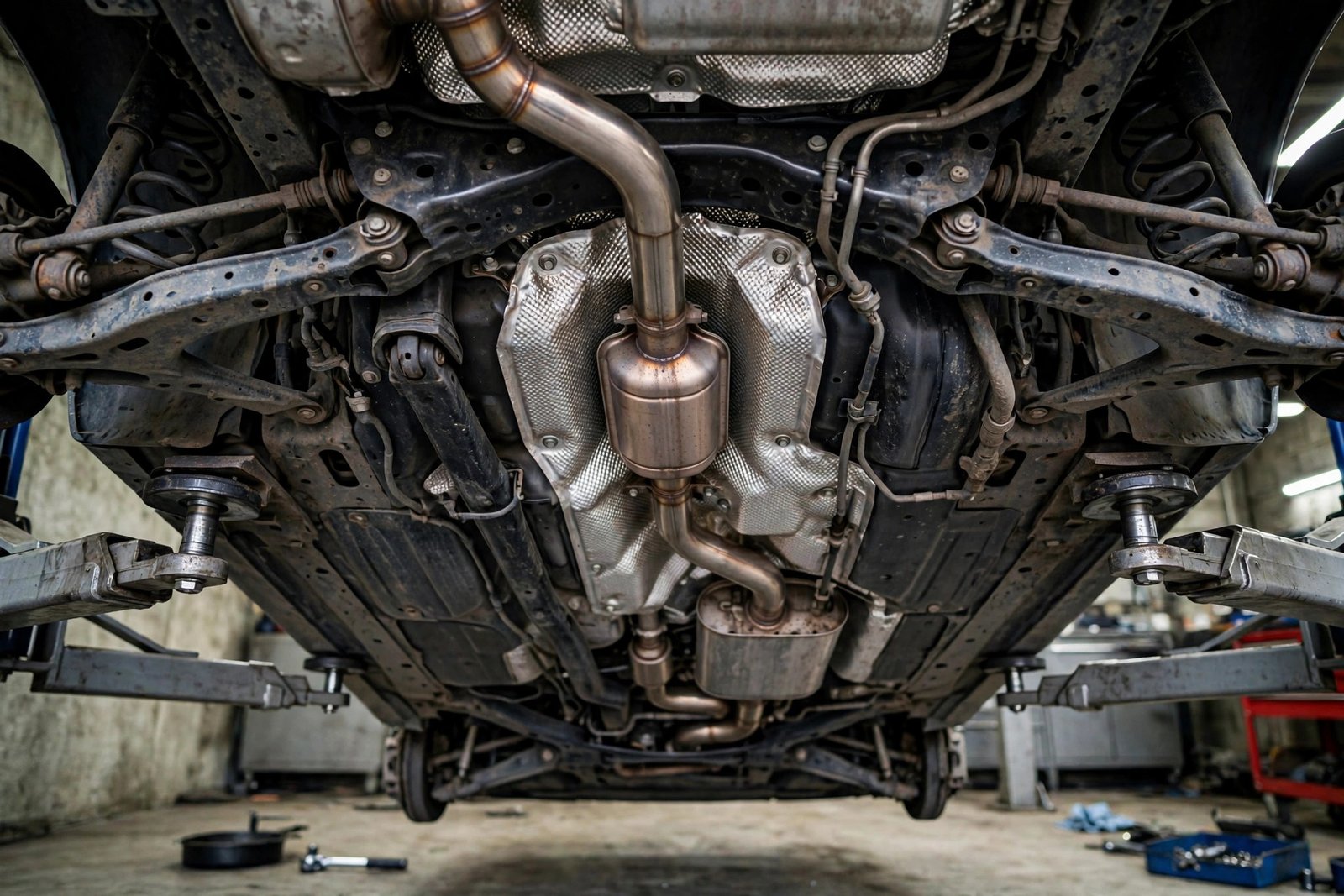
You’re sitting at a red light and there’s a metallic rattle coming from underneath the car. It stops — or changes — when you drive off. That “only at idle” detail is actually the biggest clue: at idle the engine vibrates at low frequency with gentle exhaust pulses, and anything loose underneath resonates with it.
In this guide, you’ll learn:
- The three rattle “textures” and what each one means
- The most common causes, in order of likelihood
- Simple checks you can do without crawling under the car
- Which rattles are urgent and which can wait for your next shop visit
Safety first: Exhaust parts stay dangerously hot long after shutdown. Never touch the exhaust, catalytic converter, or heat shields until the car has been parked for hours. Never crawl under a car supported only by a jack — use proper jack stands or have a shop lift it.
The Three Rattle Textures
Close your eyes at the next red light and pick which one matches:
- Thin, tinny buzzing — like a soda can full of screws, or sheet metal vibrating. → Exhaust heat shield or loose clamp. The most common and least urgent.
- Rocks in a metal can — a deeper, chunkier rattle, like marbles shaken in a tin. → Catalytic converter internals breaking apart. Needs a shop visit.
- Heavy clunk or thud that comes and goes — something swinging and hitting. → Broken exhaust hanger letting the pipe knock the chassis, or a worn engine/transmission mount.
If the rattle only appears when you accelerate rather than at idle, see rattling noise when accelerating — different forces, different suspects.
The Most Likely Causes, in Order
1. Loose exhaust heat shield (most common)
Thin metal shields protect the cabin floor, fuel lines, and wiring from exhaust heat. Their small bolts and spot welds rust or shake loose, letting the shield buzz against the pipe at idle frequencies. Annoying, rarely urgent — but a shield that detaches fully can drag on the road (see metallic scraping noise under the car).
2. Failing catalytic converter (the “rocks in a can” rattle)
The converter’s ceramic honeycomb can crack from impacts, misfires, or age. The loose pieces tumble inside the metal shell — most audible at idle when exhaust pulses are gentle, and often louder after a drive when everything is hot. A failing converter can eventually restrict exhaust flow and trigger a check engine light.
3. Broken or degraded exhaust hangers
Thick rubber hangers suspend the exhaust beneath the car. When they crack or snap, the pipe swings and knocks against the chassis or suspension — a heavier clunk/rattle at idle that may quiet once the pipe settles at speed.
4. Worn engine or transmission mounts
Mounts isolate engine vibration from the chassis. When the rubber cracks, the engine moves excessively and can contact the firewall or subframe — a heavy, low-frequency rattle, often worse in Drive than in Park (see car vibrates at idle in Drive).
5. Loose belt tensioner or idler pulley
A stretched serpentine belt lets the tensioner arm oscillate (“tensioner flap”) — a chattering rattle from the front of the engine at idle. A failing AC compressor clutch can also rattle with the AC off and go quiet the moment the AC engages.
6. Muffler with broken internal baffles
Rusted baffles inside the muffler vibrate and produce a dull, hollow rattle that depends on engine speed.
Simple Checks You Can Do Yourself
- The AC toggle test: Turn the AC on and off at idle. A rattle that vanishes the instant the AC engages points at the AC compressor clutch.
- The tap test (engine OFF and stone cold): Crawl beside — not under — the car and tap the exhaust heat shields and the catalytic converter shell gently with your knuckles or a rubber mallet. A loose shield will buzz; a failing converter will reproduce the “rocks in a can” sound.
- The rev test: In Park, blip the throttle gently. A rattle that changes pitch smoothly with RPM is engine-bay (belt/pulley); one that comes and goes at certain RPM “resonance points” is exhaust hardware.
- The Park-vs-Drive test: Shift between Park and Drive (foot firmly on the brake). A rattle that appears or worsens in Drive points at engine/transmission mounts under load.
- Look, don’t touch: Shine a flashlight under the car for a visibly hanging shield, a sagging exhaust section, or a dangling plastic undertray.
When to See a Mechanic — Soon vs Now
Soon (next shop visit): Thin heat-shield buzz with no other symptoms. Mention it at your next service — it’s usually a quick re-secure.
This week: “Rocks in a can” rattle (catalytic converter), or a heavy clunk from a swinging exhaust. A converter shedding internals can clog and strand you; a swinging exhaust can damage wiring or fuel lines.
Now: Rattle + check engine light + loss of power (possible converter blockage); rattle + burning smell; anything visibly dragging under the car — pull over and check before driving on.
FAQ
Why does the rattle stop when I start driving?
At idle the engine’s low-frequency vibration hits the resonant frequency of the loose part. At higher RPM the vibration frequency changes and the part stops resonating — the looseness is still there, just quiet.
Can a heat shield rattle damage anything?
Usually it’s just noise. The risk is if the shield detaches fully and drags, or if it’s the converter rattling — that’s a part that affects emissions and can block exhaust flow.
Is it the engine or the exhaust?
Quick rule: engine-bay rattles (belt, tensioner, lifters) are heard best with the hood open and change smoothly with RPM; underbody rattles (shields, converter, hangers) are heard best from beside the car and come and go at specific RPMs.
My rattle only happens with the AC on — is that this article?
Partially — a rattle that appears with the AC on can be the compressor clutch or the extra load shaking a loose mount or shield. The AC toggle test above is your first move.
Sources
- engineerfix.com — “What Causes a Rattling Noise When Idle?” (heat shield, catalytic converter internals, hangers, tensioner) — https://engineerfix.com/what-causes-a-rattling-noise-when-idle/
- engineerfix.com — “Why Does My Car Make a Rattling Noise When Stopped in Drive?” (heat shield resonance; engine mounts under load) — https://engineerfix.com/why-does-my-car-make-a-rattling-noise-when-stopped-in-drive/
- mechanicbase.com — “Car Rattles When Idling?” (converter, heat shield, motor mounts, tensioner) — https://mechanicbase.com/troubleshooting/car-rattles-when-idling/
- jdpower.com — “Why Is My Car Making a Rattling Noise When at Idle?” (lifters, piston slap, AC compressor rattle test) — https://www.jdpower.com/cars/shopping-guides/why-is-my-car-making-a-rattling-noise-when-at-idle
- webuyanycarusa.com — “Car Noises and What They Mean: 9 Sounds Not to Ignore” (underbody rattle = exhaust: shield, hanger, converter, muffler baffle) — https://www.webuyanycarusa.com/blog/car-noises-what-they-mean