
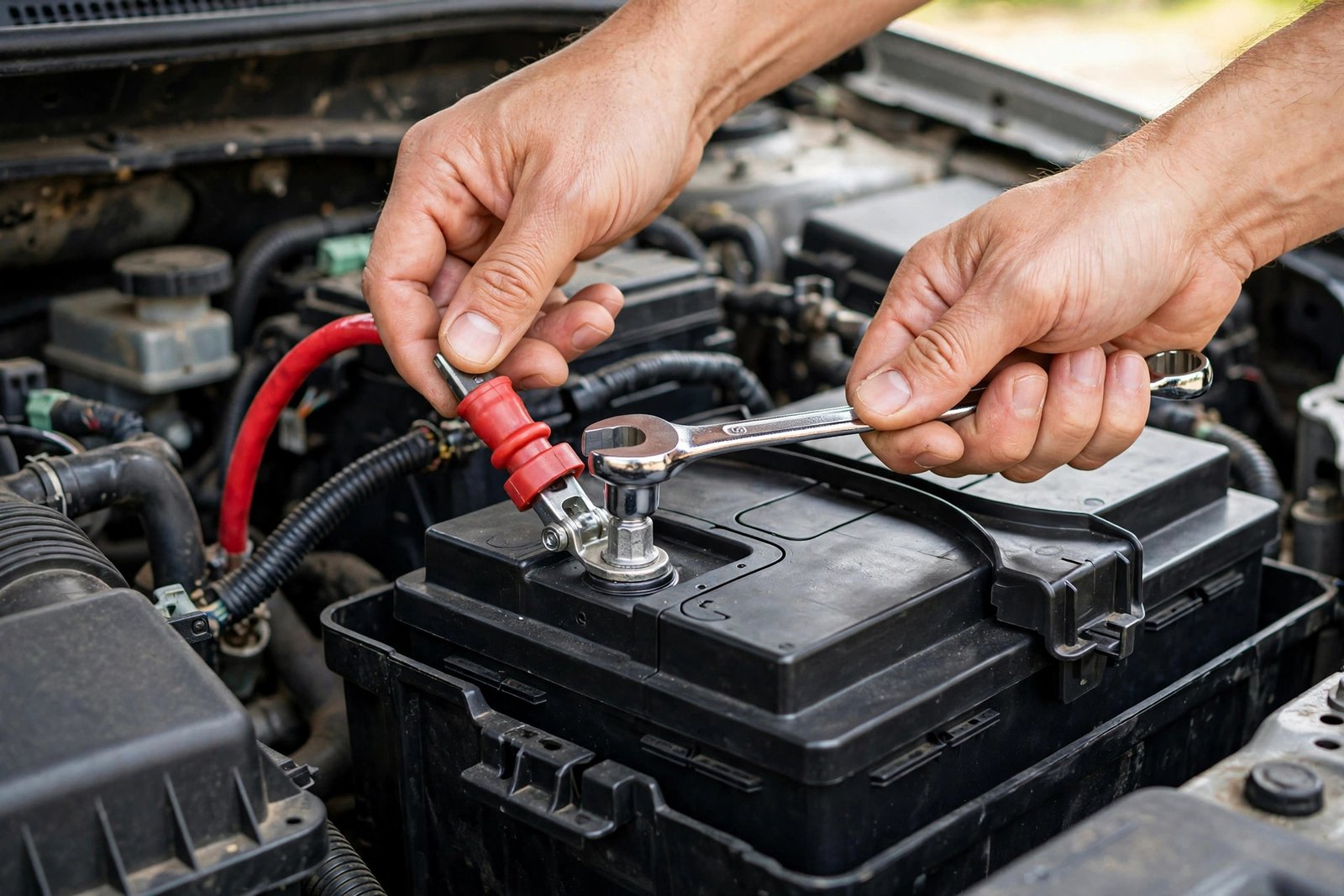
You just paid for a new battery — and the car still won’t start. Frustrating, but here’s the useful part: the battery is the one thing you know is good. That narrows everything. Work backward from the swap itself: most of the time, the problem is the installation — and when it isn’t, the swap just revealed what was really wrong all along.
In this guide, you’ll learn:
- Why “the battery is new” is actually a diagnostic advantage
- The post-swap symptom branches (dead dash vs. click vs. crank-no-fire)
- The installation checks, in order
- How to tell when the battery was never the problem
- When to stop and call a mechanic
- Typical repair cost ranges (verified 2026-10-14)
Safety first — read this before anything else: If you suspect the cables were connected reversed (positive to negative), do NOT keep trying to start the car. Reversed polarity can fry the ECU and electronics in seconds. Check polarity visually right now: red cable to the + terminal, black cable to the − terminal.
Branch by What Happens Now
Dash is completely dead — nothing lights up — Power isn’t leaving the new battery at all. Suspects: terminals not actually connected/tight, reversed cables, or a main fuse blown during the swap.
Dash lights up, but you get a click or nothing when cranking — Power reaches the car but not the starter. Suspects: loose terminals (the #1 post-swap issue), the ground cable knocked loose during the swap, or the starter was the real problem all along.
It started once after the swap, then died again — The new battery worked, then got drained. The battery was never the problem — the alternator isn’t charging. See battery or alternator.
Cranks fine but won’t fire — Also never a battery problem. The original no-start was fuel, spark, or immobilizer. See cranks but won’t start.
Security/key light flashing — The immobilizer lost sync during the disconnect. Try the spare key; some cars need a reset procedure (owner’s manual) or dealer-level reprogramming.
The Installation Checks, in Order
1. Terminal tightness — the #1 post-swap issue
New battery, old clamps. Ignition OFF: try to twist each clamp by hand. If either moves, that’s your no-start — the starter needs hundreds of amps and a loose clamp can’t deliver them. Clean any invisible corrosion film off the new posts and clamps with a wire brush, then tighten snugly. See corroded battery terminals.
2. Polarity — check it visually, now
Red (+) cable to the positive terminal, black (−) to negative. If they’re reversed, stop immediately and correct it — then have the car checked, because reversed polarity can blow the main fuse or damage electronics even if it “seems fine.”
3. The ground cable
The main negative cable bolts to the chassis or engine block — it’s easy to knock loose or forget during a swap. Trace it and confirm both ends are tight and clean.
4. Main fuses
The power surge of reconnecting a battery can blow the main fuse (often 60–120A, near the battery). Check your manual’s diagram; a visibly broken element = replace. If the new fuse blows instantly, there’s a short — stop and call a mechanic.
5. Is the “new” battery actually good?
Yes, new batteries can be bad — defective from the factory, or discharged from months on the shelf. Most auto parts stores will load-test it free, even if you bought it elsewhere. A new battery should read ~12.6V at rest.
6. Correct battery for the car?
Wrong group size (doesn’t fit the tray/clamps properly), wrong terminal layout, or too-low cold-cranking amps for your climate can all cause problems. Match the owner’s manual specification — especially for start-stop cars, which need AGM batteries.
When the Battery Was Never the Problem
If the installation checks out, the swap just exposed the real culprit:
- It clicks or won’t crank on a verified-good new battery → the starter or its circuit was the problem all along. See single click.
- It ran briefly, then died → the alternator wasn’t charging the old battery and is now draining the new one. Test charging voltage (13.5–14.5V running). See battery light while driving.
- It dies overnight → a parasitic drain killed the old battery and will kill this one too. See battery keeps dying.
- It cranks but never fires → fuel, spark, or immobilizer — the battery was a red herring from the start.
When to Stop and Call a Mechanic
- You found reversed cables — have the electronics and main fuse checked even if the car seems okay.
- A replaced main fuse blows again immediately — there’s a short; don’t keep replacing it.
- The security system won’t recognize any key after the disconnect — immobilizer reset needs professional tools.
- Installation is perfect and it still won’t crank — starter or wiring diagnosis needs professional equipment.
Typical Cost Ranges
(Verified 2026-10-14; ranges vary widely by vehicle, region, and shop labor rates.)
- Re-seating and cleaning terminals: free (DIY)
- Battery replacement (if the “new” one is defective — warranty usually covers it): roughly $100–$250 (CostWhale 2026: national average ~$175, range $75–$300)
- Terminal replacement: inexpensive parts — readersdigest.ca notes the whole DIY terminal-replacement job runs under $20 including new terminals
- Starter replacement (if the starter was the real problem): roughly $300–$900+ (Car Talk best estimate: $600–$900 common, $900–$1,400 luxury)
- Alternator replacement (if the alternator was the real problem): roughly $400–$800 professionally (themotorguy.com, 2026)
- The point of working backward: check the free installation stuff before paying to diagnose what the swap revealed.
FAQ
Can a brand-new battery be bad?
Yes. Factory defects happen, and batteries lose charge sitting on shelves for months. A free load test settles it in minutes — and defects are usually covered under warranty.
Do I need to “register” or reset anything after a battery swap?
Some vehicles (notably certain European models) require a battery registration or reset procedure so the charging system charges correctly; others just need radio presets and the clock redone. Check your owner’s manual for your car.
Why is my radio asking for a code now?
Many factory radios have anti-theft codes that trigger on power loss. The code is often in your owner’s manual packet or obtainable from a dealer with your VIN.
The car started fine for a week after the new battery, then died. What now?
That’s the alternator-not-charging pattern (or a parasitic drain). The new battery just bought you a week. Test the charging system before the new battery is ruined too.